


Crofter
-
Posts
3484 -
Joined
-
Last visited
-
Days Won
11
Everything posted by Crofter
-
From memory, the actual nacelle and generating bit was only about £12k, but the pole, founds, cabling, inverter etc brought the total up to £32k. You could do some of that work yourself I suppose but I was looking at FiT so everything had to be done by an MCS contractor. That was five years ago, and I think FiT is now so low that a non accredited approach might make more sense.
-
Most turbine manufacturers suggest a mean wind speed of 5m/s as the cutoff point for viability. It's not overly expensive to rig up a data logger- something we looked into quite seriously. A 5kw turbine would have cost about £30k to install, but that was most of our build budget so we decided to do the new house instead.
-
Yes that is very interesting. The obvious downside is that it must be quite sensitive to wind direction.
-
Great stuff. It was a funny old day today- snow in the morning, then perfect sunshine without a cloud in the sky from midday onwards. Just watch those frosts if you're pouring concrete! Are you going volumetric or readymix?
-
A what now?
-
Yes, an interesting concept, a bit more realistic than the 'tiny house' movement IMHO. The scale and materials are very similar to my own project. I'm personally a bit torn on the issue of what size new houses should be. As a society in general we expect/demand everything to be bigger and better- whether it's a phone, a fridge, a car, or a house. And I think this is part of the reason why new houses are out of the reach of too many people. We demand an en suite bedroom for every person in the house, plus a guest room, a play room, an integral garage, a utility room, etc etc.No wonder houses are so expensive! On the other hand, the size of a house is only one part of the total cost- land and services being a huge part- and if you are going to all the trouble of building, it's a bit shortsighted to cut the size right down if that leads to a house that is of only niche interest and limited market value.
-
Thanks, some food for thought there. Due to the way I detailed it (badly, in hindsight) I can't really fit any more than a 5mm soffit board in place. It will however be fully/continuously supported along each edge so I doubt even ply would sag over the 250mm span. Main concern is that I think ply would deteriorate quite quickly. From what I've gleaned via Google, uPVC is probably not an option as it seems to be 10mm thick boards. It's not really a priority but if I don't fit something soon the starlings are going to start nesting in the eaves and making a right racket...
-
Split backing is well worth it. I used Siga on my TF build, 12/48mm split. In one little bit I used tape without a split, because I'd run out of the Siga, and it was a right PITA.
-
I'd originally planned to just use some leftover latch cladding for my fascia, and some 5mm ply for the soffit. The fascias were done months ago and the soffit partially done. I'm not all that happy with how it looks though, and I think it's letting the rest of the build down a bit. I'm wondering about fixing something like aluminium over the fascia, and using the same material for the soffit. This would be color matched to my alu clad windows and steel roof. I think uPVC might also be an option, but I'm not sure about thickness of the material, and color availability. Is steel an option? Looks good on the roof... Cost is going to be the main concern here, as I haven't budgeted for this. It's a small house so I only need a total of 20m. The fascia depth is 200mm and the soffit is about 250mm, from memory. Before I go to the trouble of getting lots of quotes, it would be good to hear from people who have also considered these options.
-
Ideally the visible silicone bead is pretty much for aesthetics and to make cleaning easier- the tray/wall junction should be sealed properly before the tiles go on. I took advice from a Welsh bloke and used a tanking kit with a rubber tape, plus some CT1. The white silicone simply hides this.
-
MVHR: More extracts than supplies?
Crofter replied to Crofter's topic in Mechanical Ventilation with Heat Recovery (MVHR)
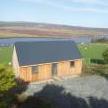
So, today has largely been spent clearing all the junk out of my loft space in preparation for MVHR install. I'm amazed at the amount of stuff that I had squirreled away up there, in a house that isn't even inhabited yet. Mostly packaging and various offcuts kept just in case. Anyway, it's decision time for my MVHR install. As noted in my posts above, I will have an extract near the kitchen and one above the shower. Another will go in the loft space. One supply will go in the living room. I can relatively easily add a second supply in the bedroom, but it would be directly above the head end of the bed. As MJNewton says: Is this a legitimate concern? The bedroom ceiling is vaulted so the supply terminal would be nearly 12ft above floor level. Finally, is there merit in having a trickle supply in the loft space, to match the extract? -
Part 24 - Finishing all those little things
Crofter commented on Stones's blog entry in An Orkney Build (in ICF)
Looking great! It's funny how you can live with the little jobs not finished but only when you finally get round to them do you realise what a difference it makes. -
I had the loan of a Hitachi gas nailer for my frame, only gripe with it was the usual problem of it not liking cold weather. I later bought a cheap 2nd hand Clarke coil nailer and a compressor, this did all my sheathing, sarking, and cladding. £50 well spent. Picked up a DeWalt framing nailer which has been fine. I don't find the airline to be much bother, but I do have a small site and can just put the compressor in the middle of the house. Someone on here bought a Silverline framing nailer for under £100 brand new, and seemed pretty happy with it.
-
I used corrugated steel, 0.7mm with plastisol coating. Very pleased with it, and I get much more rain noise from my 3G windows than from the roof. I was going to get the anti condensation flocking but my local BM couldn't supply that. I have a good roofing membrane underneath so I don't think it's a problem.
-
We're in the same ballpark, then. I tend to have to pay a bit extra for materials due to my location. Lovely little house, by the way!
-
Caley Sheet Metal in Inverness would be worth a call, obviously I'd speak to our local BMs (Jewson and Rembrand) too. Haulage from Inverness via Skye Express but you'd need some way of offloading at your end. If you want to save a few quid, a long trailer and a squad to lift it off at your end? That's how I did quite a bit of my timber.
-
These sheds/tiny houses etc are making my project look very expensive! C.£40k for 43m2 useable, this is the entire project cost except for land itself, so includes services, access, related permits, foundations, and internal fitout (inc a full kitchen with dishwasher, induction hob etc, and MVHR). Insulation to about double BRegs minimum, triple glazed aluclad windows. I had to spend a big chunk of my budget on the sewage treatment system- about £7k- dictated by ground conditions.
-
Yes it'll have Wi-Fi beamed across from my own house. As to 3/4G... hahaha there's a reason I don't own a mobile phone
-
I'm Makita throughout, apart from my corded multitool from Lidl. I've never been in a Waitrose...
-
Ah but hold on to your receipt, they will come good on the 3yr warranty
-
I've got a small all electric house with just a UVC and an electric towel rail. It's a holiday let and I like the idea of being able to boost and otherwise control the heater and hot water remotely. Just wondering if anybody has experience of a WiFi enabled controller? I see that Timeguard do one: https://www.tlc-direct.co.uk/Products/SMFSTWIFI.html?source=adwords&ad_position=1o4&ad_id=45425533757&placement=&kw=&network=g&matchtype=&ad_type=pla&product_id=SMFSTWIFI&product_partition_id=311803904081&test=finalurl_v2&gclid=CjwKCAiAt8TUBRAKEiwAOI9pAIEXcdO25zbR7rUgzyudik8wC3oygkwYreNaHBTQEYKUTk4TR_PCBBoCI-gQAvD_BwE
-
Congratulations on getting thus far. Give me a shout if you're looking for any contacts or advice
-
Yup, from a certain spot in the park you can see it quite easily (also from the pub car park). The front wall is only partially clad in larch at the moment but it's fairly distinctive compared to all the white houses.
-
MVHR: More extracts than supplies?
Crofter replied to Crofter's topic in Mechanical Ventilation with Heat Recovery (MVHR)
A bin extract would be neat, not possible for me though. Reminds me of Jeremy's cistern extract idea, which is pretty clever. -
Foundation Cost and requirements - is BC being too picky
Crofter replied to hmpmarketing's topic in Foundations
My 'portable building' sits on eight concrete piers, each about 450mm square and of heights varying between 150-900mm due to the slope of the site. These piers are themselves cast atop individual concrete bases measuring around 800mm square and of whatever depth was needed to reach firm soil (minimum 500mm from memory). The building itself is a big monolithic box that should, in theory, be capable of transport by crane or low loader, just as a container would be. BC have shown zero interest in my project, and I have had no contact with them other than my initial query to check if my proposal would be exempt.


