Iceverge
-
Posts
4384 -
Joined
-
Last visited
-
Days Won
31
Everything posted by Iceverge
-
@nod What's taking the weight of the door? Is it resting on the outer leaf?
-
Top marks for the demo. Everyone's house should be knocked down and rebuild IMO.
-
 How much of this regulation is based on data rather than hunches? Our kids just fine a suitable box/chair to climb up on what ever height they fancy. Having higher window sills make zero difference in our case other than increase the fall risk back into the room when they invariably find their way up on the sill.
 -
Good Closed cell foam to top up the cavity. It'll do a cracker job of improving your airtightness too. Blow in another 300mm of cellulose. It'll help with airtighess much more than mineral wool, you'll get better coverage around roof timbers etc and it involves none of the human suffering. Consider good quality uPVC. Better performance and less cost. Think about ventilation. Depending on access a central MVHR would be ideal but dMVHR/DCV/MEV/PIV would all work.
-
Stop any chance of the EPS floating if the concrete was too watery and to protect the perimeter strip and DPM during screening. Also if you use PIR isn't there a risk of the aluminium foil reacting with the cement and making bubbles in the concreting? Thought it was best practice but more than happy to be corrected. Less components is always better than more! We didn't use one by the way.
-
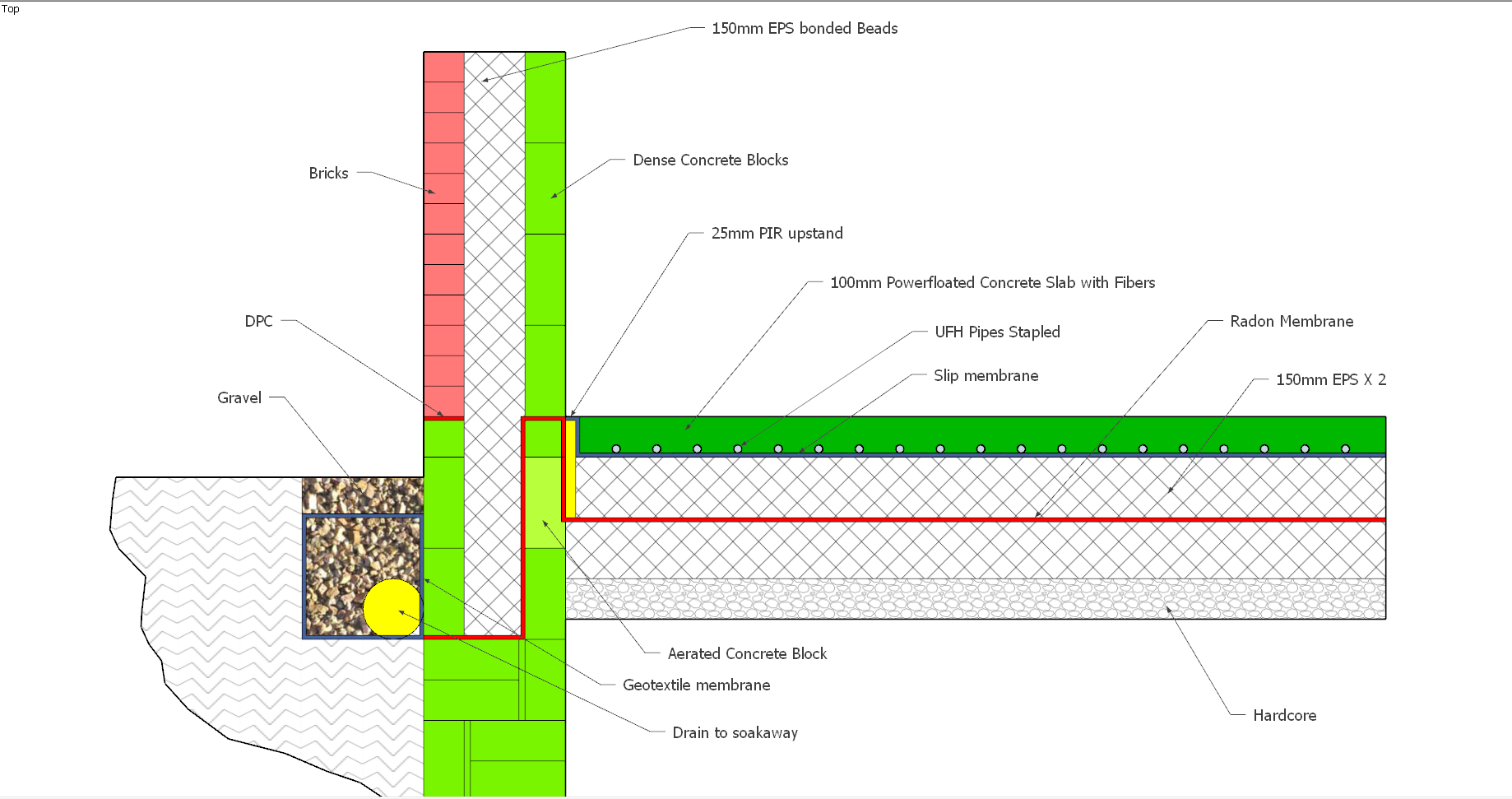
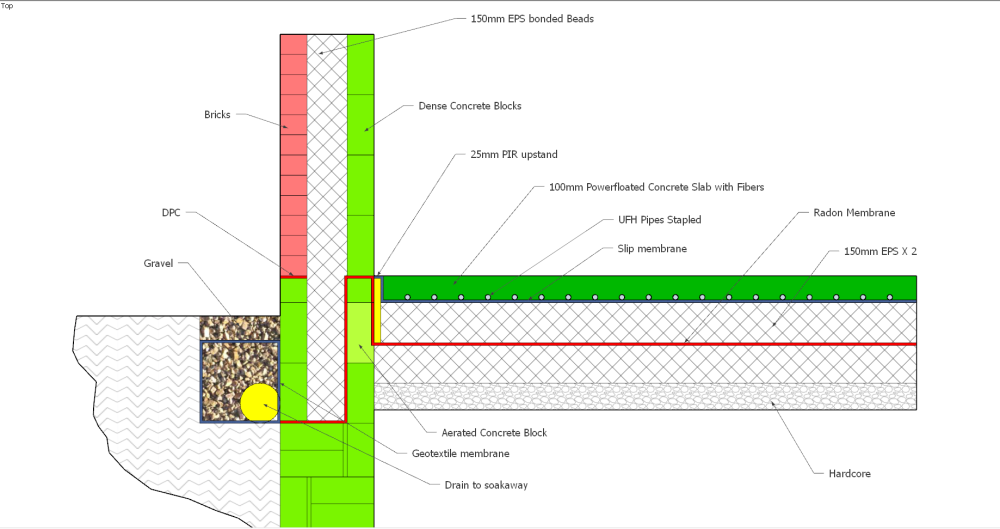
Points to note 1. I've moved the Radon membrane between the two layers of EPS and forgone the Sand binding as the EPS will protect the membrane. You could then use 150mm X 2 of Floor insulation then which will give you a U value of about 0.11. 2. I've put a French Drain at the perimeter which is always a good idea to keep the bottom of the walls dry and prevent splashing. 3. The cavity insulation extends well below the floor insulation. This will ensure any mortor droppings don't fill the cavity and create a thermal bridge here. 4. The PIR upstand is "pinned" in place by the floor insulation. Otherwise it comes loose during the floor pour. 5. Let the slip membrane extends well beyond the internal leaf during the pour and trim it back later. It'll protect the Radon membrane and the PIR upstand during screeding. 6. I've included the block sizes to allow for normal cavity tie spacings.
-
Strange detail that. Not to fear, plenty of expertise here. Are you planning on UFH? A simpler detail for the floor might be. 1. Finished floor. 2. 100mm powerfloated concrete slab with UFH stapled to insulation. 3. Slip membrane. 4. Insulation ( as much as you can fit) EPS is cheaper and better than PIR in my opinion but thicker. 5. Radon Membrane. It's just a slightly thicker sheet of plastic with all tapes welded/taped so does the job of the DPM. 6. Sand binding. 7. Hardcore. You'll have a significant thermal bridge at the wall floor junction there. You need an aerated concrete block in line with the insulation and to take the cavity insulation down to the plane of the floor insulation. 150mm full fill EPS beds would be my choice as it can be used to insulate below ground level and is harder to muck up and will give a U-Value of 0.21W/m2K. I might do a drawing....
-
Friction fit rockwool sagging between rafters
Iceverge replied to daunker's topic in Heat Insulation
TBH I thinks it looks fine. . I would do PIR boards. Tape joints and foam to wall. 3*1 strapping for service cavity. First fix wiring. Plasterboard Skim. -
Friction fit rockwool sagging between rafters
Iceverge replied to daunker's topic in Heat Insulation
I would put 20*70mm strapping along the line of the joists to create a service cavity.with 120mm + screws through into the joists. You'll have something nice to fix your ceiling to then too. A mate recently used T&G pine floorboards for their ceiling. It looks good but lots of care is needed to ensure it is tidy. -
Any downsides to removing purlins and using ridge beam?
Iceverge replied to Digmixfill's topic in Roofing, Tiling & Slating
Why stop at 125mm. 220mm with blown cellulose in between is where it's at. A/T membrane and 47mm counterbattened and insulated service cavity. -
https://475.supply/blogs/foam-fails/foam-fails-reason-5-excessive-shrinkage https://www.rdh.com/wp-content/uploads/2017/06/Long-term-Polysio-Movement-and-Thermal-Performance-Study.pdf Alas it does. "Dumb" insulation with K value of no less than 0.032W/mK is a better bet long term. Cheaper too.
-
New member - stuck for what to do next to warm the house
Iceverge replied to Sparrowhawk's topic in Introduce Yourself
Give her a 6mm masonry bit a boroscope and a notebook first! EPS beads are almost idiot proof. How wide is your cavity? Is it a brick or render finish? -
A vapour barrier stops (tries to stop) the movement of vapour through a structure. Hard to achieve 100% tightness and can cause trouble by trapping moisture in the wall if done badly. This is especially a risk where you have two impermeable layers. EG a sheet of polythene and a layer of PIR. You can get variable VCLs (Vapour control layer) like Intello Plus but they're dear. An airtightness layer stops the movement of air though a structure. As air carries most of the vapour the task is often given over to the VCL. However it can be a sheet of OSB, woodfiber, clay plaster etc which are all more vapour open. @bmj1 No need for vapour barrier (Vs VCL) Get a really good airtightness layer and let the rest of the structure as breathable (vapour open) as possible.
-
That thickness of PIR will be fine. A quick play with Ubakus.com makes me think about 50mm of PIR is good. What is the purpose of the 10mm high emissivity gap? It sounds like a recipe for thermal looping in the real world unless you can completely seal the gap. ( impossible in reality)
-
Assuming the insulated plasterboard isn't too thick it should be fine. Airtighess is your thing here. Drafts are how almost all moisture gets carried into a structure causing interstitial condensation, not diffusion. The airtighess layer can be anywhere, think of it like blocking a pipe, it matters not whether at the beginning of the end so long as its done properly. In in this case a parge coat inside the blocks would work. It'll need to be taped/sealed to the windows and floors and all penetrations to be effective though. If you can't guarantee this you're better off limiting the thickness of the insulated PB to about 20mm of PIR to ensure the dewpoint of the insulation doesn't move too far inboard in the wall. In other words if you have drafts blowing through the wall and a hefty chunk of internal insulation there's a risk that damp air will condense on the inner block wall as it'll be too cold. Have you committed to insulated plasterboard? A MF stud internally might be an easier detail.
-
No, a parge coat behind the plaster would be needed for airtightness though.
-
Mitigating Risk With Upfront Payments To Timber Frame Companies?
Iceverge replied to thefoxesmaltings's topic in Timber Frame
The market seems to judge what they do as fair. As @Nickfromwales says they have plenty of work. Ultimately this is one of the things that made us choose the builder we did, trustworthiness. Taking a chance with such a large sum of money needs to be risk appraised and the benefits ultimately couldn't outweighs the risk of going with a builder with more passive experience but whom we were less sure about giving our money to. Who knows what would have happened in hindsight. Cellulose fill stick build and police the airtightness yourself with a DIY blowerdoor test. It'll be more than fine and cost less to boot I reckon. -
Mitigating Risk With Upfront Payments To Timber Frame Companies?
Iceverge replied to thefoxesmaltings's topic in Timber Frame
The way the house building industry is funded is rubbish. I think this is due to the time for invested money to be returned in a useable product. Hence what we all do is buy one brick, one plank and one nail at a time, pay people at short intervals and watch our houses slowly go up. Everyone's exposure is small, you buy a brick and some mortar, pay a mason and your investment is secured quickly. The disadvantage is you negate the advantages society leant two hundred years ago in the industrial revolution with the efficiencies and quality improvements of mass production. Anything build in a factory like trusses, kitchens and windows are all bespoke to fit in with aforementioned bricks. Hence they have only one customer for the product made. The manufacturer is really exposed. If one person doesn't pay they're left with £££££ of product they can't sell. They respond to this by gambling on the creditworthiness of the client every time they make a sale, often going bust in the process or else demanding large amount of cash upfront like MBC and shifting the risk to the client. As they are the top end of the market and have clientele who can afford to self insure, who can blame them. If MBC were building a standard house type X that could really be erected in any one of 100 clients sites in a blink of an eye their risk would be much smaller. However if they prebuild a bespoke slab and kit for @Furnace and they don't get paid they are goosed. Until we all agree to live in extremely standardised houses we will have to live with the risks of building brick by brick or else exposing ourselves to the creditworthiness of manafactuers and they will need to do the same for us. -
Dirt clogging the preliminary filter in the diesel tank would be my stock answer for various farm machines I have. Particularly a problem for excavators as they regularly get filled with drums. Often it will run dry and conk out, you put some more diesel in and the greater "head" pushes it down the pipe again only to do the same thing when the fuel level gets lower. If you can take the fuel pipe off the diesel filter and attach a bicycle pump you can often blow the filter clean with a few whooshes of air back into the tank and your machine will work for weeks or months again just fine. Long term the tank needs cleaning of course.
-
Wool between joists is better than PIR in my opinion anyway. It can move to accommodate shrinkage etc and you'll avoided thermal bypass long term
-
That's a U value of about 0.15. Absolutely sufficient. 95mm is a beefy service cavity, is this 95x44 mm timbers on their sides to creat this?
-
Ace well done.
- 39 replies
-
- 1
-

-
- the windy roost
- icf
- (and 2 more)
-
Mitigating Risk With Upfront Payments To Timber Frame Companies?
Iceverge replied to thefoxesmaltings's topic in Timber Frame
I get that for sure but I-Beams come at a significant premium over rough cut lumber and not normally available "off the shelf" unlike rough cut lumber. Likewise assuming it is the same system as @IanR you speak of the woodfiber board externally is a special order items at most builders merchants. Any pics to help to visualise this please? Insulating the internal reveals is good for outward opening windows but not really practical with Tilt and Turns like ours. Is this not avoidable by inserting it in a conduit or using a thicker guage of wire? (Schoolboy mode here!) More questions to follow.... -
You could probably bank more of the heat in a time of use tarrif considering it's a concrete first floor. That and run the ASHP at a lower flow temp due to the larger emitter area thus boosting your COP. I don't think you need it. A few UFH mats under the tiles would suffice but if you do choose to do it, it's not all negative.
-
No need for any central heating in passivhaus. We get by on a single plug in rad downstairs. The only good reason I can think of for UFH upstairs is cooling.