Iceverge
-
Posts
4487 -
Joined
-
Last visited
-
Days Won
32
Everything posted by Iceverge
-
You can play with this calculator. I find it tremendous fun, but then again that's just me. https://www.ubakus.com/en/r-value-calculator/? I knocked up @Russell griffiths and @ProDave roofs. Have a look at the Heat Protection page. Its shows much greater heat swings with the lower density insulation of PIR that with denser woodfiber. I'd be interested to know is this a problem in reality? Both have similar U values so should preform well in winter. prodave_roof.pdf Russel_G_roof.pdf
-
Have you plans to convert the garage to living space at any stage? Your architect will probably do a good job regarding the building regs but it sounds like you need a better person to draw up construction details. Unless they can concisely explain EWI window details etc thank them for their time and get someone else. Ideally someone with passivhaus/low energy experience. If they can't explain it in simple terms they don't understand it. Design wise I'd alter a few things. 1. Move the utility to the garage side and make it bigger. 2. I'd bin the chimney in the extension. If you're desperate for a stove use one of the existing fireplaces. 3. Don't bother with knocking through the back wall of the sitting room. A lot of work and expense for little gain. Keep the hopes up.
-
Welcome Mark, As mentioned time spent at the design phase is invaluable and I feel your pain in trying to find the right professionals. To oft it seems the case "I've always done it this way" or else you are expected to fund someone's ego trip. Nonetheless with research and care an amateur can achieve a very good quality build as many on here can testify. External insulation is an excellent way of cutting thermal bridges and and I think you're on the right track. The passive house magazine have a guide on it and other topics that I found useful. https://passivehouseplus.ie/magazine/guides/the-ph-guide-to-external-insulation How far down the road of the design process are you? Jonathan
-
 I've had quick scan of your manual. Turn on the enthalpy/exchanger bypass and crank the MVHR to its top setting. With the heating on also you should see results in a day or two.
 -
Can you remove the enthalpy module? I had a similar issue with humidity, in fact one particularly cold morning I was worried we might have a leaking window there was so much condensation after running down the frames. IIRC indoor RH was about 90% and temp 14deg. I put the MVHR from 40% to boost for a couple of days and it made a big difference. The house is now at 16deg at 75% humidity buy feels bone dry. Opening the windows periodically and allowing a complete airchange and closing them again will help as the outside air even at 90%RH once warmed up can absorb much more moisture than the already warmer but saturated air inside. It may not be enough though and you might have to resort to a dehumidifier.
-
+1 no voids. I drilled trial holes in a awkward spots afterwards to check. Also the DPC we used to close the cavity was bulging up everywhere. They may not be 100% bonded thought so any cores should be done prior to pumping.
-
Roughly yes but prices may vary UK to ROI
-
€100/m³ installed including VAT. Beware there may be structural issues with a wider cavity and extra costs with wider footings and wall ties.
-
As documented before cheap radiator fan inserted into a sheet of OSB covering a window will more than exceed any blower door fan pressure. Use the back of your hand for the big holes and a candle inserted in a length of electrical conduit to nail any small leaks. A diligent sweep of the house will get you above or beyond passive levels. For awkward spaces airtight sealant and/or airtight paint will remedy most things. I'd be surprised if the OSB is causing the issues assuming the cellulose is dense packed behind it. Also don't loose too much heart. Your reading could mean totally different things for different shapes and sizes of houses and the natural sheltering externally has a very large impact also.

-
Closing cavity at the top for blown beads
Iceverge replied to MortarThePoint's topic in Heat Insulation
As a workaround adding extra insulation below the roof joists or a fillet piece internally might work if aiming for low thermal bridging at the eaves. -
Closing cavity at the top for blown beads
Iceverge replied to MortarThePoint's topic in Heat Insulation
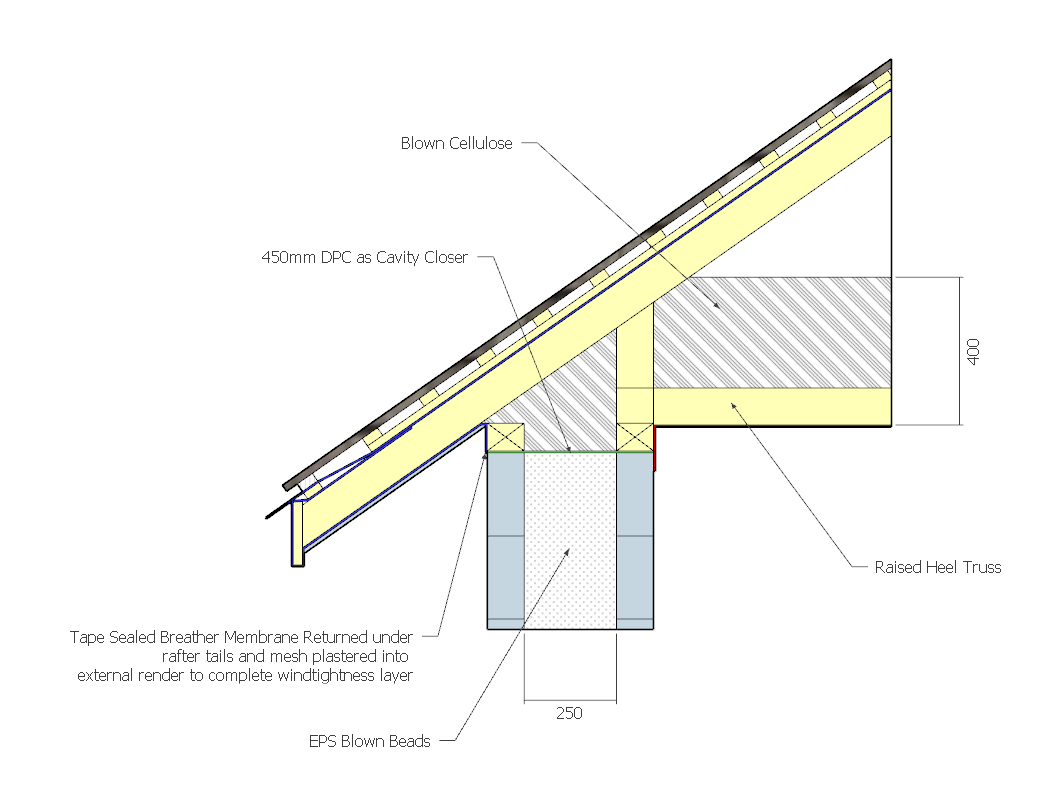
This is what we did.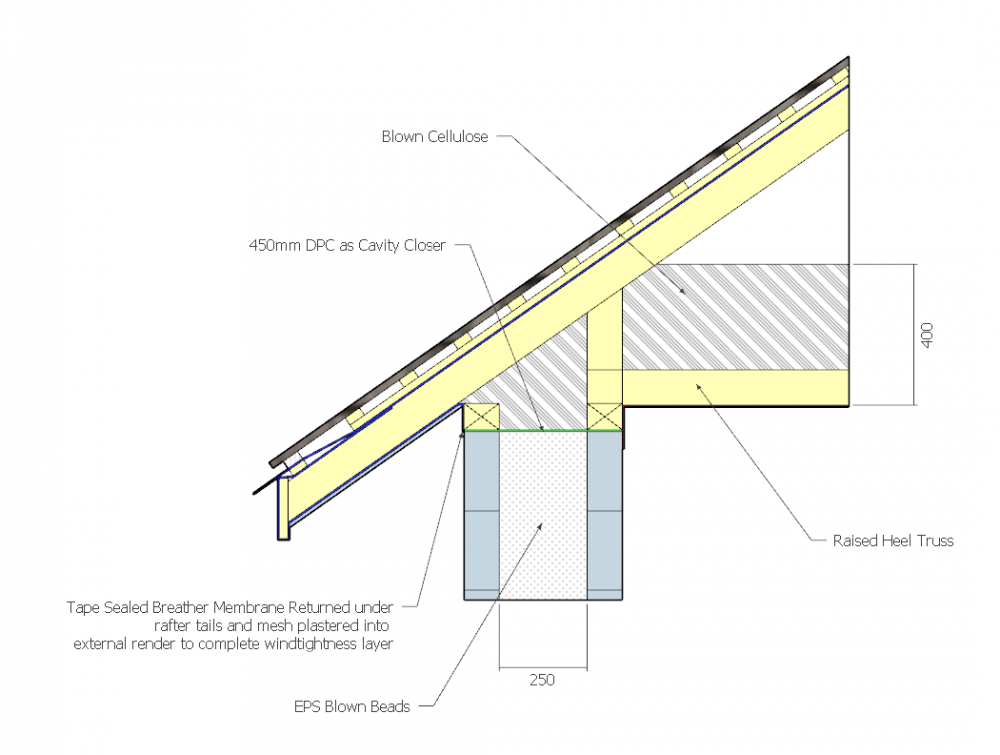
-
If you have knowledge of the building process or can access the knowledge easily and importantly you have the time and ability to be on site often I'd self manage it. Nobody cares more than you about your house or money. Beware though it's not a matter of just pressing go, handing over plans to trades and walking away. Its takes time and attention and if you can find a good builder or project manager they're worth paying. I was drawn towards ICF in the beginning but settled on cavity walls in the end. I think if we were to start again we'd go timber frame.
-
Do you have plans to show us?
-
@Mr PunterPunter yup. 13.5%
-
@LSB there's a first time buyers/builders grant. Vat is 13.5% for anybody to supply and fit. 21% for supply only.
-
Alas not in Ireland.
-
Brick filling a partition stud wall
Iceverge replied to SimonD's topic in Bricklaying, Blockwork & Mortar
If they're not putting any lateral pressure on the stud I can't see the problem. I imagine that if you leave gaps you willing not improve the sound attenuation much. I have heard of filling studs with a tamped hemp/earth mix to reduce sound transmission. -
Is Zehnder worth it?
Iceverge replied to BartW's topic in Mechanical Ventilation with Heat Recovery (MVHR)
Have a look at the passivehaus database. https://database.passivehouse.com/en/components/list/ventilation_small it gives a like for like comparison of units with regards to heat recovery and importantly unit noise. No surprise the better units are more coins. -
training Backhoe loader/180 Excavator Training.
Iceverge replied to BogBeast's topic in Tools & Equipment
I had them dug until they were completely root free. The main issue was the over exuberance of a fledgling digger owner determined to get the better of a 3t Norwegian spruce butt with a very willing but ultimately undersized digger. -
training Backhoe loader/180 Excavator Training.
Iceverge replied to BogBeast's topic in Tools & Equipment
Go for it! Find a wide open space and crack on. You can't really do any serious harm as long as bystanders are far far away. I've had a 7.5t excavator ( sumitomo s160) and now a backhoe (Massey 860). For outright digging the tracked machine will probably do a job 3 times as fast as a backhoe and never get stuck. A shower and a slightly muddy field might scupper a backhoe especially a 2wd one. For big tree stumps I failed and broke a good couple of heavy duty chains with my tracked machine trying every trick to dislodge them. Don't underestimate how awkward and heavy they can be. If it was my money I'd probably hire a 13t+ (bigger the better) tracked machine and an operator to do the major excavations and site clearance. The speed with which it will happen will shock you and in terms of paying people to work for you, digger drivers are some of best value. Then by all means get your own digger for small jobs and poking around. Its worth looking for an extendable dipper for that extra reach both digging and lifting. 4wd is a must for wet ground. I'd prioritise reliability over price. Nothing more frustrating wasting a couple of good building days covered in oil, skinning your Knuckles fixing a wreck. -
Mistake, advice needed . Insulation in cavity stops at DPC.
Iceverge replied to connick159's topic in Brick & Block
Local contractor in Ireland affiliated to Energystore Belfast. Don't think they cover Britain. -
Mistake, advice needed . Insulation in cavity stops at DPC.
Iceverge replied to connick159's topic in Brick & Block
+1 We intentionally build and insulated the cavity for 500mm below dpc with bonded bead to mitigate bridging. -
A mini split is our back up plan if our passive House needs any heating at all ( none currently installed). I did a little bit of reading and although most sales people will happily tell you any unit will work well one salesman warned me against buying a unit focused on cooling as it will ice up in cool damp weather when providing heating. A unit also sold in Scandinavia with a focus on heating would be a safer bet. More expensive unfortunately but some great COP numbers. https://www.orionairsales.co.uk/mitsubishi-electric-air-conditioning-msz-fh35ve-wall-mounted-35kw12000btu-inverter-heat-pump-a-240v50hz-1458-p.asp https://www.orionairsales.co.uk/panasonic-air-conditioning-wall-mounted-inverter-heat-charge-cs-ve9nke-25kw--9000-btu-a-240v50hz-3426-p.asp#:~:text=The Panasonic Heat-charge has,prevent cool air during defrost.
-
Loft hatch and ladders for timber frame passive house
Iceverge replied to kaye's topic in Lofts, Dormers & Loft Conversions
I used an airtight hatch but it is only 550*550 so no space for a ladder. It was ok but it did leak a little on my diy depressurisation airtightness test. Some extra sealant fixed it but it does not have the robust seals of a door or window. I like tony’s idea. I toyed with the idea of using a standard hatch and a pvc window as the other side of the airlock, perhaps a chunk of foam in the void for insulation. It would be a more robust option I feel. -
I've just bought Kerradeco panels, About €40 per m2. Will let you know what they're like when they arrive in a few weeks althought the sample looked much nicer than the hollowcore PVC ones.