Iceverge
-
Posts
4381 -
Joined
-
Last visited
-
Days Won
31
Everything posted by Iceverge
-
+1 to @ProDaves suggestion. it might be worth tieing the garage floor into the rising walls with some poured concrete and rebar. Alternatively forget about filling and just do a concrete suspended floor with precast planks. £2k ish should see you most of the way there
-

Passing flue through wall / roof
Iceverge replied to markocosic's topic in Stoves, Fires & Fireplaces
Looks fine to me. -
Confused by Triple Glazing Justification
Iceverge replied to MortarThePoint's topic in Windows & Glazing
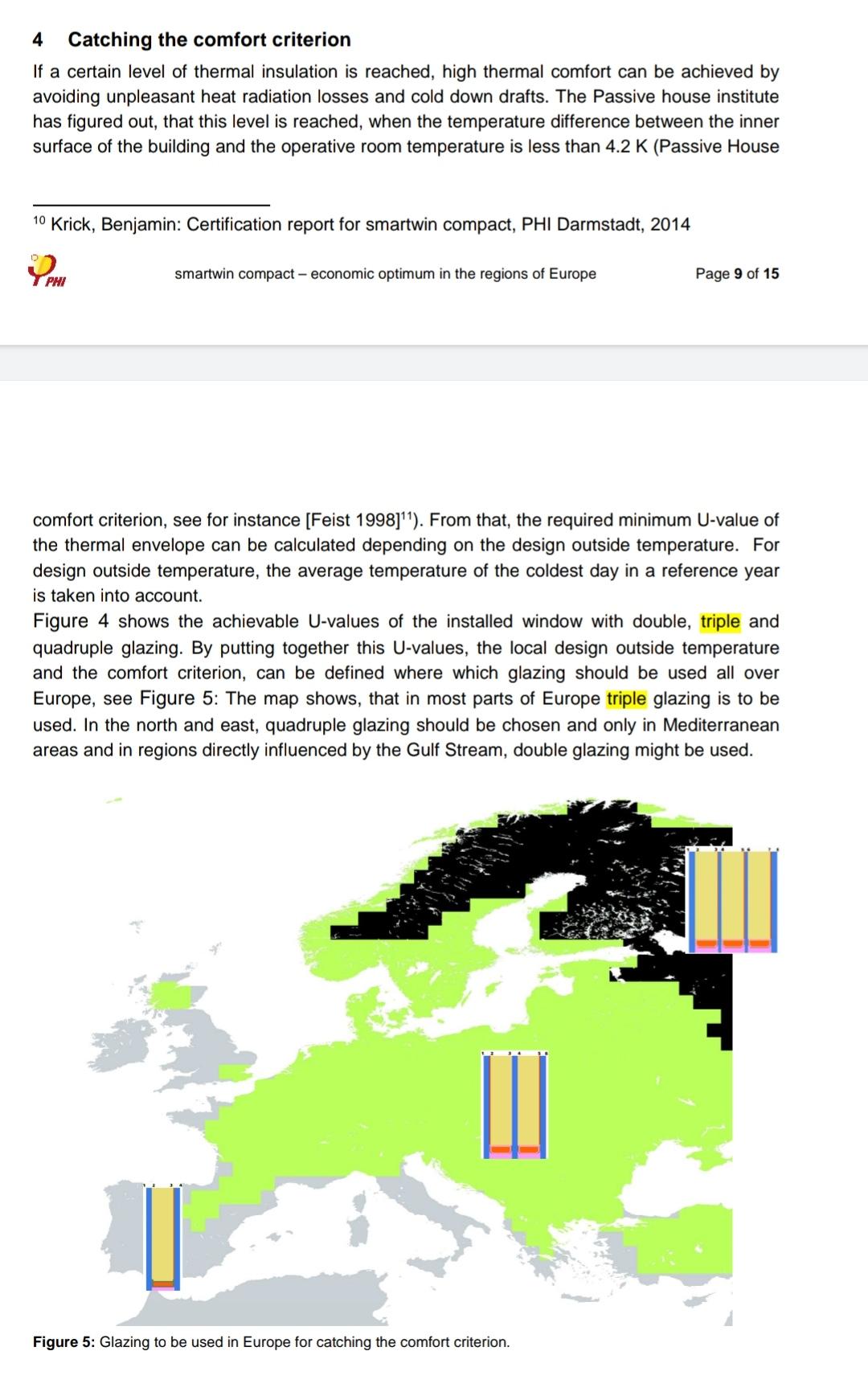
An important part of glazing is thermal comfort. Someone in the passive house movement (cult!?) figured 4 deg was the maximum difference between adjoining surfaces in a house for maintaining a scientifically calculated level of comfort. The attached image I found in a Smartwin doc suggests that for almost all of the UK double glazing is sufficient to achieve this. However, I challenge you to source a suitably high quality double glazing supplier that the price uplift to triple glazing isn't marginal.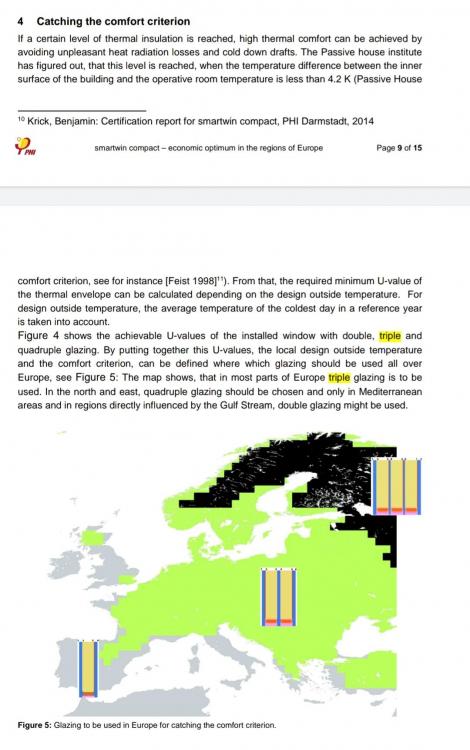
-
Sounds fine. If it was me I'd tape the kit externally first making sure your windows and all penetrations are sealed to the SIPS. Then make a DIY blowerdoor fan. Depressurise the House and check for leaks coming into the building and rectify. This will assure your windtight layer. Then apply the external membrane, no need to tape. The membrane will be over the tape protecting them from any leaks that come through your cladding/rainscreen. Then apply the internal PIR. Tape all joints and tape the PIR to all penetrations and repeat your DIY blowerdoor depressurisation. This will assure your airtight/VCL layer. Doing this method will protect your structure from moisture and ensure that the wall performs to its designed parameters.
-
Use 200MM Graphite EPS. Worked out less than 1/2 the price of 150mm PIR for us.
-
More than enough.
- 27 replies
-
- 1
-

-
- outbuilding
- garden office
- (and 4 more)
-
Caution using multiple airtightness/VCL layers. It's not a reliable way of getting a good blowerdoor score as you'll lightly get the result that corresponds to your best layer only and the others will be redundant. In doing it you will increase your chance of trapping moisture in the wall with all the associated ramifications. Your cost of materials and labour will increase too. You need a good air tightness layer somewhere in the structure of the wall. Normally in this neck of the woods that's placed towards the interior of the majority of the insulation. That means that you need a windtightness layer to the exterior of the insulation if it is of a permeable type to avoid wind blowing through it. Less of a issue with SIPS EPS etc. What is your wall buildup?
-
Confused by Triple Glazing Justification
Iceverge replied to MortarThePoint's topic in Windows & Glazing
As usual it depends. The less energy your house takes to heat the more of a difference it will make. Going to double glazing would increase our annual heat demand by 30%. On a poorly built house this would represent a far lower % difference. The numbers can only tell so much. A cheap double or triple glazed window will leak air, catch when opening, and fall off the hinges in a few years. Whimsically there needs to be a point at which you draw the line at where the inner accountant gets to rule all. Otherwise you'd be mental to install windows turning on the light is far more economical! -
UVC on cheap electricity for water. Fan heater for heat. Spend your time and effort on airtightness insulation and mechanical ventilation. Your heat demand will be so low then heating may not be needed.
- 27 replies
-
- 1
-
-
- outbuilding
- garden office
- (and 4 more)
-
MVHR is Largely Bogus
Iceverge replied to DavidHughes's topic in Mechanical Ventilation with Heat Recovery (MVHR)
Does she run indoctrination courses ? might send the mrs........... -
How much noise do you expect to have to deal with? That cavity wall may not perform as well as you think (although it will be very good) and will require chasing etc to get your wires in. I would lean towards a metal wall system. Have a play with the below. https://www.british-gypsum.com/white-book-system-selector/partitions
-
I think it was a coil in tank thermal store. These need to be kept very hot to produce usable amounts of DHW with consequent high losses. Not really suitable for low energy houses. Shame really as I like the simplicity.
-
Shower, hot water options
Iceverge replied to ash_scotland88's topic in Bathrooms, Ensuites & Wetrooms
good point. If you want to store a given amount of energy a larger tank will loose less heat per kWh stored than a small one. You could also add a second tank if space or floor loadings are an issue. I reckon our 300l cylinder @70deg does 4 x 15 minute showers with no reheat. System boiler, 300l min UVC Thermostatix mixer showers. Maybe allow wiring for a single electric shower if you need it for peace of mind. -
Glad to hear it. @Gone West was one of the original blogs I drew much knowledge from over the past 6 years of this process.
-
Much better option. Not cheap though. I think Peter Stark ( if i remember correctly) used it without any membrane and had passivhaus airtightness. Either I can't use the search correctly or he's disappeared? His blog was very useful. If I had a choice for timberframe I'd use blown in cellulose everytime. It's got a great decrement delay, C02 negative, vastly improves airtightness, is non toxic, leaves little mess to clear up and is cheaper than PIR. If you have good installers It gets into all the nooks and crevices that board and batt insulation can't.
-
like @Cpd said I would caution putting PIR in a stud wall. it’s a tricky slow job to get right ( which means it almost never is). Add to that the shrinking of timber and board insulation and you’ll have a wall full of gaps and a cold house. Save your builder some heartache and your pocket some cash and use a good quality insulation batt. Doing much to boost U values beyond building regs isn’t near as useful as getting really good airtighness, MVHR and triple glazing. Worrying about the third decimal place in U values (although it is a pastime of mine!) won’t get you a warm house. Good detailing will.
-
I’d keep the MVHR out of the attic If I could. Easier to get a good airtight envelope, avoid possible noise issues, no difficulties accessing for servicing, no summer overheating issues with the MVHR drawing in very hot air from just above the slates if you have roof terminals. If you only use PIR between the rafters your insulated space in the roof will get bonkers hot in the summer. It has a low decrement delay meaning heat will soak through very fast from the sun heated slates. A natural insulation like woodfiber will help with this but is not cheap. What we did was blow 400mm cellulose at ceiling level in our attic. Not the cheapest but less than PIR and, if you have the space, better in every way.
-
We managed to take all services apart from wastes from the downstairs utility to an upstairs hot press through a 600 x 150 opening in the Slab.this required a bit of planning but it worked fine. The electric cables and MVHR all went straight up to a service void of 88mm under the roof trusses and eventually dropped vertically into the sockets and outlets. I drilled 2x150mm holes for the wastes through the slab after with an SDS and a chisel (i love suffering). My time would have been better spend pinpointing the opes to the supplier and letting them do it initially. PS our supplier limited us to 300mm from a 1200 slab so the opening had to be across 2 slabs.
-
Tilt and turn opening sashes can be larger than casements AFAIK. I wouldn’t disregard those up and over windows that @ProDave describes. Only yesterday i had to remove a mountain of kids and Mrs detritus off the window sill so i could open our living room window. (tilt and turn) Had i an outward opening window i could simply have thrown it all out into the garden. Maybe i’ll have to fit some of those pigeon spikes ?
-
You could increase the diameter of the duct to compensate for the increased flow resistance. If there's space the price will be negligible.
-
you can add more than one if needed. your peak heating load is what you’re after. there’s a good spreadsheet here somewhere if you search for it.
-
Without know the various areas of your windows walls and doors it's impossible to say. A 160m2 bungalow has a far greater surface area than a 2.5 story cube. Either that or forego the ASHP at build stage. Install a wills heater and monitor it for a year. You'll know exactly then.
-
I hope you demanded a discount! 3.25% less board you've been landed with ?
-
You save half your "cup miles" as 90% of the crockery etc only have 2 locations. In use or in a dishwasher. The extra journey to and from the cupboard is gone. The big unload that nobody likes doing is now just about 10% of contents because everything else has been taken out when it was used. Unexplained benefits: The pile of unwashed stuff in the sink seems to have disappeared. When we run the dishwasher now it's always nearly completely full, I don't know why. There is presumably a saving only doing full loads. You have a backup in case of failure. Nobody want's to have the victorian horror of hand washing a cheese scoop or a strawberry fork.
-
So Far so good. Ours is 400mm wide which I hope will help and the nearest trees are about 20m away. It looks nice and allows more direct sunlight deeper into the room. I think you have the wrong idea.The window sills are wider if anything. Acoustically it's excellent. Much like a hotel or similar. Dimentionally totally stable too. Super fast to install. Less than an afternoon. You can have solid walls upstairs pretty much where you like too. It's a very thick buildup. In our case. 10mm carpet, 10mm underlay, 75mm reinforced concrete screed 150mm precast concrete floor, 110mm service void in suspended metal ceiling and 12.5mm plasterboard and 3mm skim. I had to insist the fitters kept the service void as tight as possible. Had I not it would have likely ended up nearer to 150mm if not 200mm. A posi joist floor for the equivalent span might be 100mm thinner. Its very tricky to detail well for airtightness. I've discussed elsewhere on here previously. It requires a much heavier structure on the ground floor in places. In our case 215mm inner leaf and RSJ's over the load bearing openings. It's a total PITA to route wastewater pipes if you didn't put them in first day. Cost wise there's very little difference between posi joists. I think about €30/m2 from memory. If you build a very well detailed and insulated airtight with MVHR house the heating debate becomes a bit mute. You could put in direct electric heating, radiators, duct heating, a logburner, air to air, UFH, ASHP, gas boiler, oil boiler, GSHP, mini nuclear reactor etc etc etc and the heat will distribute pretty evenly around your house and you'll have a super comfortable home with no cold spots. No cold floors and no drafts. Just do whatever is cheapest and/or greenest IMHO. We've a small electric heater on cheap night rate electricity in the hallway and the whole house is very comfortable. I hum and ha about whether we should have included UFH pipes "just in case" but as soon as you go down that route you're throwing away all the effort of building a passive house.