


Jeremy Harris
-
Posts
26430 -
Joined
-
Last visited
-
Days Won
360
Everything posted by Jeremy Harris
-

How Often Does Your Building Inspector Visit?
Jeremy Harris replied to Triassic's topic in Building Regulations
Same here for our LABC in Salisbury. 'Phone call first thing in the morning and they were always here the same day. I think we should have had four or five inspections in total, with nothing being looked at between the visit when the insulation was being blown in and the completion inspection. -
Someone (think it may have been @SteamyTea) did an experiment with samples of EPS to see whether it absorbed water or not. This was years ago, either on Ebuild or possibly on the GBF. Samples were left submerged in a bin full of water for a long time, then weighed to see how much water they had absorbed, and the result was close to sod all. In the case of EPS laid on top of a drainage layer, there's never going to be any hydrostatic pressure to push water even slightly into the EPS, so it's very hard to see how any water could be absorbed. The stuff is naturally moderately hydrophobic anyway, so there won't be any capillary effect to "suck" moisture up into it. The only case where I can see there being very slight thermal performance degradation happening is for the case where the stuff is used around a basement, where there may well be hydrostatic pressure pushing a tiny amount of moisture into the EPS.
-
EPS has a long track record of being used in wet ground without any problems. Before being used for passive slab insulation it was used for lots of basement builds in Germany and Austria, for around 50 years now, with no problems from moisture ingress. I believe they've even used EPS raft foundations to build railway lines across deep bogs, too.
-
You need to look at the best way to do this efficiently, whilst protecting all the cables/circuits, and that means looking at the maximum demand from each CU, allowing for diversity. I'd be inclined to have a small master CU, fed from the meter tails, with DP MCBs feeding the cables that supply each of the CUs on each floor, garage etc. That way the cable supplying each of the distribution CUs can be sized for the demand. I'd also opt to fit all-RCBO CUs everywhere else, with just a single DP isolator in each CU. The way this would work is that the 25mm² meter tails are OK coming in to the main CU with just the company fuse for protection (assuming they are less than 3m away from the meter). The cable to each distribution CU would be protected by a suitably rated DP MCB (I'd opt for DP ones to allow isolation of each distribution CU using the main CU MCBs). Each individual circuit from the distribution CUs would have the mandatory over-current and residual current protection by the RCBOs. One slight issue with this configuration is the need to allow good access to every CU, something that could eat up a bit of space.
-
Heating and Cooling
Jeremy Harris replied to SlivenClod's topic in Energy Efficient & Sustainable Design Concepts
As I type this, at nearly 6pm, our house has had the cooling on for around 3 hours, due to bright sunshine this afternoon (the cooling is managing to hold the room temperature down to around 23.5°C, we tend to prefer the room temperature to be around 22°C). We don't have a massive amount of glass, but it's more than enough to allow the house to get uncomfortably warm without active cooling. Our heating hasn't been on at all for the past couple of weeks or so, either. It's largely a problem in spring and autumn for us, when the low sun angle allows the sun to penetrate more deeply into the house, but it's still a PITA to deal with. I dearly wish I'd been able to fit external blinds or shutters, and may well try to see how receptive the local planners would be to me adding them now (they weren't happy with the idea of shutter originally). -
Cost of installing 3 phase vs moving existing mains head?
Jeremy Harris replied to joth's topic in Electrics - Other
It depends almost entirely on how far away the 3 phase supply is, plus whether it has enough capacity. Sometimes you're lucky and there is a 3 phase cable nearby, other times you're unlucky and the nearest 3 phase cable maybe a couple of hundred metres away. There aren't necessarily 3 phase supplies running down every road; here, for example, we have lots of single, or 2 phase, runs strung along the lanes in the village, with only a handful of 3 phase cables. -
I think this runs into which bit of legislation takes precedence. We had two planning conditions that were, in effect, mutually exclusive. I had a planning requirement (that I believe originated from highways) stating that the drive gradient shouldn't exceed 1:15, and a condition imposed by the Environment Agency stating that the garage and car parking area had to be a minimum of 1.5m above the 1:100 year flood risk level. As the latter was level with the bottom of the drive, it meant the drive had to slope up 1.5m in the space of around 12m, just to fit in the plot, which gave a gradient of around 1:8. I explained this to the planning officer who told me that the EA requirement took precedence over the highways requirement, and that the drive gradient condition would be removed. My guess is that there may be similar rules that apply as to whether appearance trumps part of the normal hierarchy used to ensure safety.
-
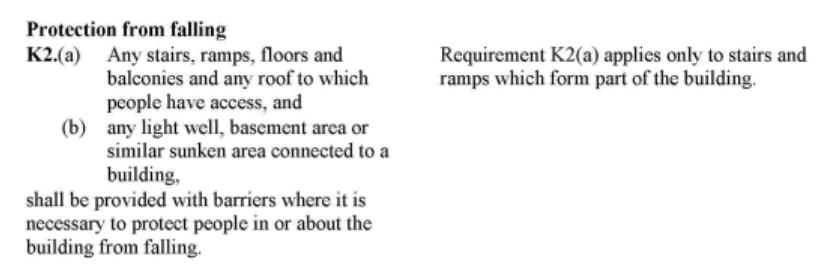
The general rule that's been used for decades is that if infrequent maintenance access is only by a temporary ladder or scaffolding, then no fixed provision for fall prevention/fall arrest is required. That's been the standard interpretation of the prevention from falling part of the building regulations (not Part K, which is only guidance as to compliance, and is not the regulations) for years. If there is a fixed ladder or staircase, or some other form of fixed roof access, then measures are normally required, ideally prevention, but if that isn't practical, then fall arrest provision. FWIW, the building regulations legal requirements are all here: https://www.legislation.gov.uk/uksi/2010/2214/schedule/1/made This is the law, whereas the Approved Documents (like Part K etc) are only guidance as to methods that may be used as one way (they may well be other ways not in the Approved Documents) to demonstrate that the requirements in the regulations have been complied with. The bit I quoted earlier came from the regulations, so is the legal requirement, not guidance. This is a cut and paste of the whole part of the law which I quoted from earlier:
-
Part K2 has nothing about requiring fall protection from any elevated area to which there isn't access (my highlight): Protection from falling K2. (a) Any stairs, ramps, floors and balconies and any roof to which people have access
-
I'm guessing that this is a commercial condition that's just been blindly copied on to a domestic building regs approval. The general rule is that if access equipment is needed to get up on to a roof, then there's no requirement for a balustrade or permanently installed fall prevention/arrest systems for dwellings. They are only needed if the roof can be accessed without using ladders, scaffolding etc. If the roof can be accessed without access equipment then it will almost certainly be cheaper (and better) to provide a balustrade of some sort, perhaps glass if you want to retain the look of a roof with no railings around it. I think it would be a good idea to go back to building control and ask them which part of the building regulations requires fall prevention/fall arrest from a domestic dwelling roof.
-
Carbon neutral = zero carbon, and may be an EPC of A100, but it's really making sure that the emissions part, the Environmental Impact Rating (EIR), gives a zero value for CO2 emissions. Taking our build as an example, we ended up with an EPC of A107, and and EIR of A107, with CO2 emissions of -0.9 tonnes per year, so we're carbon negative, in effect.
-
That Roofers Been Signed Off Sick
Jeremy Harris replied to Triassic's topic in General Self Build & DIY Discussion
I have the utmost sympathy for him. I had a bout of vestibular neuronitis around 30 odd years ago and it was, without any shadow of doubt, the very worst few weeks of my life. The slightest movement would make me sick, and even trying to lie down, and stay as still as possible, was little relief, as everything carried on moving around me. If you can imagine that feeling you get when so completely pissed that nothing will stay still, but without any of the anaesthetic effects of alcohol then that's pretty much it, 24/7, for weeks on end. It took around 6 weeks to sort itself out, and even relatively simple things, like going to the bathroom, became activities that took hours, with frequent stops to try and control the vertigo and nausea. I can still remember pretty much every moment of that time, it was that dreadful. -
Ownership / Copyright of Planning Design and Drawings
Jeremy Harris replied to davidc's topic in Surveyors & Architects
As long as you've been assigned the right to use the design and drawings to build your house, then it's fine for that house. Problems arise when a right to use a copyright design hasn't been assigned, for example when someone gets something drawn up by an architect (or anyone else) and then decides not to continue to use the services of that architect, but to go elsewhere. In that case, the copyright holder has to consent to the use of their design, drawings, etc and may want a fee to allow this. if the design and planning work has been paid for in full, then I would guess that there's already an assignment to use the design and drawings, but it would be worth checking to be sure. Copyright is, I believe, implicit, and doesn't need to be specifically stated on any document (although often it is) in order to apply. In this case, even if you are assigned a right to use copyright material, it would usually remain the intellectual property of the author. -
No, the Polar unit is not an air-to-water heat pump. It is a direct unit, with refrigerant gas flowing through the tank coil, rather than water. This increases the available temperature over a normal air-to-water heat pump a fair bit, for the reasons explained in that video. The Mitsubishi Ecodan is a standard air-to-water heat pump, that circulates heated water through a tank coil, or UFH, so a different operating principle.
-
The Ecodan range from Mitsubishi have nothing to do with MVHR, they are simply air-to-water heat pumps.
-
I originally fitted downlighters with MR16 LEDs, then changed them for very low profile LED panel lights. These barely get warm, and only project about 6mm behind a skimmed plasterboard ceiling (they project about 21mm up from the rear face of the front flange). I'd say that there would be no need at all to protect a VCL some 50mm above these, given that they only every get around 10 to 20 °C above room temperature.
-
What is the mA rating of your constant current LED downlighters?
Jeremy Harris replied to joth's topic in Lighting
I've found that the current rating for the constant current ones tends to be 300 mA, with the voltage then changing for the higher power ones. We have several 3 W nominal lights that run at 300 mA ~10 VDC and some 6 W nominal ones that run at 300 mA, ~20 VDC, both are the low profile round panel light type, that seem to give a very even light spread. I had problems with RFI from some of the constant current supplies, so ended up throwing them out and using a different arrangement that, thankfully, doesn't create loads of RFI -
There's the Magic Box, although I'm not sure that it's still available, plus all the variants on the Portuguese/Spanish flat plate collector direct ASHPs. They all work OK, and tend to be able to provide a higher water temperature than an indirect air-to-water system, but there are other options for getting really hot water from a heat pump, too. Daikin make a hybrid ASHP with a small gas boiler that works well, for example. The gas consumption is pretty low, as the bulk of the heating is done by the ASHP pre-heater, with the gas heater only giving a lift to the warmed water to get it up to around 55 to 60°C. This means they can run on LPG reasonably cheaply.
-
Looks to be just a direct ASHP to me, with the refrigerant circulating around the tank coil. Bit of a pig to install, as it will need silver soldered pipe joints to the coils and also need to be installed by someone with an F gas ticket, as the primary will have to be pressure and leak tested, put under vacuum and then gassed up. There are lots of other systems around that use a direct refrigerant coil in the tank, but most of the common ones use air from the house to supply the heat pump, and they aren't always that easy to fit to a well-sealed house with MVHR (can be done, but they tend to imbalance the MVHR when running). Most of the units I've seen are Chinese, where they seem to be very popular, judging by the number of them for sale on Alibaba. The Mitsubishi Ecodan is an air to water heat pump, not a direct unit like this.
-
Masonry leaf with new timber self build
Jeremy Harris replied to davidc's topic in New House & Self Build Design
There's no masonry in our build at all, it's timber frame with a timber cladding. No problem with a self-build mortgage from Ecology, they didn't question it. No problem with insurance, either, the premium's the same as if it were block and brick. -
You can probably get two runs of MDPE in a 100mm duct OK, as minimal insulation is needed, as the ground under the slab won't ever drop below zero around here (it'll sit at around 8°C). If your mains supply is coming in from an external meter cabinet, then it needs to be 25mm² SWA, which is pretty hefty. I ran mine in a 100mm duct, just to make cable handling a bit easier. You could probably run another couple of runs of cable in the same duct OK if it's 100mm. BT require that their cables are run in their own grey Duct 56, which they should free issue on request. It's a rigid duct system, so you need to request a hockey stick to bring it up through the slab. You cannot put data/telecomms cables in the same duct as mains cable. 100mm duct should be OK for running a couple of pipes for an ASHP, and ideally you'd also run a cable duct for this as well, perhaps. Sealing is pretty easy, just screw up a ball of chicken wire to fit tightly inside, thread a bit of hefty fence wire through it and secure it well. Push the ball down into the duct, with the bit of fence wire poking out, then fill with expanding foam. The chicken wire stops rodents chewing into the foam and the bit of fence wire allows the plug to be pulled out at some future date. Do this both ends of any spare open ducts.
- 16 replies
-
- 1
-

-
- services
- penetrations
- (and 1 more)
-
FWIW, the FBW system didn't have control of autothrottle for the low pass, as the gear was down and throttle control was manual. The crew throttled up too late, not appreciating that the relatively large turbofans took a few seconds to spool up from the low power setting for their descent to TO power. I can't recall whether they pushed the TOGA button or not, but even if they had it seems to have been too late to allow the engines to spool up in time. Edited to add: Just checked, the crew selected TOGA, but it was too late, and the pilot flying then accidentally cancelled the TOGA switch by pulling the power back to flight idle and then pushing the power levers fully forward again, as he apparently didn't believe that the engines were spooling up (they were, until he pulled the power off...). It's not clear if he engaged TOGA again when he reapplied full power, but I suspect he may have done, as IIRC the TOGA switch on an Airbus is detent operated at the forward end of the power lever range of movement.
-
The accident was the Air France Flight 296 one at Mulhouse, involving an Airbus A320. The cause was pilot error, rather than a defect in the FBW system, notably the failure of the crew to spool up the engines to TO power sufficiently early, following a very low pass with the gear down (the low pass was illegally low, below the height of nearby obstacles). The crew disputed the cause, and claimed (wrongly) that the engines failed to respond, when in reality they were responding exactly as designed, the crew just hadn't taken into account the time taken for them to spin up to TO power. Had the crew started to apply power earlier they wouldn't have found themselves on the back of the drag curve and would have been able to climb OK. If you look at video of the accident you can see the aeroplane doing all it could to help the crew, including going to maximum pitch attitude in an attempt to climb as soon as the engines spooled up enough. Part of the problem was that the crew erroneously believed that the FBW system would get them out of any trouble. It allows the pilot flying to pull back hard on the side stick with no risk of stalling the aeroplane, which is what they did. Sadly, this put the aeroplane into an irrecoverable position, where with insufficient power to climb the aircraft, plus the high drag (from being pitched to maximum nose up) their problems were exacerbated and caused the virtually zero climb rate just before the aeroplane impacted the trees. If the crew had applied maximum TO power a few seconds earlier the aeroplane would have got them out of trouble OK. Following this accident there was a lot of controversy about the authority of FBW systems, largely driven by crews who failed to fully appreciate what they could and could not do. The flight crew of AF296 were convicted of involuntary manslaughter.
-
It should be OK to build ICF walls on to a passive slab with a ring beam. That would remove the floor/wall thermal bridge, and should be pretty straightforward to design.
-
FWIW, I've just checked, and my uPVC garage door and frame is anthracite, and cost £320 inc VAT. It's nice and substantial, and has now been in for nearly 5 years, with no sign of any degradation.
