Jeremy Harris
-
Posts
26430 -
Joined
-
Last visited
-
Days Won
360
Everything posted by Jeremy Harris
-
 My experience is that the heat loss from a tank will be a great deal higher than the specification, if the tank is kept hot most of the time. The standing loss test method uses a cyclic measurement where the tank is assumed to be cold some of the time, I believe. I measured the heat loss on our double spray foam insulated 210 litre thermal store and it was specified to be around 1.5 kWh per day, but in reality it was over 3 kWh/day at 65°C. I added an additional layer of 50mm thick PIR foam all around it, as a foamed in place octagonal jacket, with all the joints foamed and taped, and managed to get the heat loss down to a bit over 2 kWh/day. Our Sunamp is a lot better, it loses around 0.7 kWh/day.
 -
I doubt that doing this would make any significant difference, TBH, as MVHR only moves a small volume of air, and air is a pretty lousy way to move heat, as it has a low specific heat capacity. MVHR will typically change the air about once every two hours or so, so not really much. The specific heat capacity of air is around 1210 J/m³.K, so if the plant room volume was, say, 10m³, and it was 10°C warmer than you wanted it to be, then the MVHR would typically move about 60 kJ of heat out of the room each hour, or around 0.017 kWh.
-
Definitely looks like an internal door, and internal door furniture too, judging by the corrosion on the screws holding the handle on. I fitted a cheap, half double glazed, uPVC door and frame to the side of my garage, and am very pleased with it. No maintenance needed and it's secure enough, being intended for use as a house external door. IIRC it cost about £300, and came pre-hung in a frame, so was a doddle to install.
-
The real issue here is whether or not the FAA continue to stand by the principle of "grandfathering", as that's the root cause of the issues with the 737 MAX range. The basic 737 airframe is now well over 50 years old, and because of the way the FAA airworthiness certification rules work, Boeing were not required to certify the MAX range wholly against the standards that apply today, so we have a "new" aircraft that's certified in large part to mid-1960s standards, long before the advent of fly-by-wire*** (FBW) in commercial aircraft. This is key, because the changes made to the 737 MAX range really needed the flight envelope protection measures that FBW provides, as by moving the new, larger, engines forward they created a potential handling problem with the effect of thrust on attitude, so needed to provide enhanced stall protection. They were allowed to do this using a single sensor FBW stall protection system, which they euphemistically called MCAS (manoeuvring characteristics augmentation system), something that would be prohibited under normal FBW certification requirements, which usually need at least double redundancy. Most FBW systems use three separate sensor systems, where practical, for flight safety critical tasks, with a "majority vote" scheme to try and remove the impact of a single sensor failure. Because the 737 was really a 1966 aeroplane, Boeing chose to just fit MCAS without being fully transparent as to how much flight control authority it had. As we seem to have discovered, rather tragically, MCAS has a great deal of flight control authority, as it turns out that it moves the whole horizontal stabiliser in order to try and prevent the wings reaching the critical angle of attack, and this is an extremely powerful control, more powerful than the manual trim wheels in the cockpit at speeds over ~300kts, and these manual trim wheels are really the only way the crew had to try and trim the aircraft nose down, especially as MCAS seems to have falsely triggered at the same time as the stick shaker operated. The latter would have contributed to the high cockpit workload, I'm sure, as I know from personal experience that trying to fly an aeroplane with the stick shaker on raises a heck of a sweat in itself, especially in an aircraft type that cannot recover from a deep stall. ***With the exception of Concorde, which was, at the time, pretty much a one-off FBW aircraft and the first to enter commercial operation. The first mass production commercial FBW aircraft was the Airbus A320, more than 20 years after the non-FBW Boeing 737 started mass production.
-
Spans - Precast Flooring or intermediate support
Jeremy Harris replied to Moggaman's topic in RSJs, Lintels & Steelwork
One thing to remember with block and beam is that the dead load is pretty high, due to its inherently high mass. A lighter floor build up may well end up being stiffer, just because the total load (dead and live loads) may well be a fair bit lower, so the overall deflection will be lower for a given area moment of inertia of any support beams/joists. -
I doubt that you'll find a battery system cost effective, TBH. I'm fitting one, but I'd be the first to admit that the cost benefit is at best a bit marginal, but for us, the benefit of having a backup power supply during power cuts makes it worth fitting. I'd get someone to look over your SAP calcs and check to see how much you need in terms of renewables to get to A100. We're A107 with just 6.25 kWp, in an MBC house that's all electric, so getting to zero carbon (effectively A100) shouldn't be that difficult.
-
MVHR - sucking in polluted air
Jeremy Harris replied to Moggaman's topic in Mechanical Ventilation with Heat Recovery (MVHR)
We live in pig central here in Wiltshire, the county probably has more pigs than people... -
Why do these firms think it's OK to just blame their subbies, as if that resolves them of any responsibility for the quality of their product? Imagine the outcry if Boeing tried to claim that they weren't responsible for their aircraft crashing due to a design defect, by blaming their subcontractors and refusing to accept that Boeing were at fault.
-
Sounds a bit awry to me, too. We have 6.25 kWp of PV and our house is "carbon negative", even though it's all-electric, as we generate more electricity per year than we consume, and we don't have battery storage (yet).
-
Yes it was, but the points awarded for the performance elements were supposed to have been checked by BC for compliance with the CfSH criteria, so there was a crossover between planning and building control, in effect (planning stipulated it, but building control were required to verify performance-related aspects).
-
MVHR - sucking in polluted air
Jeremy Harris replied to Moggaman's topic in Mechanical Ventilation with Heat Recovery (MVHR)
The worst smells, IMHO, are pig muck, closely followed by chicken manure. Both of those are enough to make me retch, even though my mother ran a pig farm for years, so I should have got used to it. -
He just accepted the data given to him via email. I offered to send the specs of the house from the contract, together with the air test chit and some photos, but in the event he had lodged the certificate before I sent them to him.
-
There's always two stages. You need a design SAP assessment as a part of the building regs approval, but that doesn't need to be done by a registered assessor (I did ours and it was accepted without question). For completion you have to have an as-built assessment, and that has to be by a registered assessor. In our case I also did the as-built SAP and just emailed it to an assessor in Manchester who took my word on everything and lodged the as-built EPC. He didn't ever look at the house or anything associated with it, just the SAP worksheet that I emailed him. As it happens I was honest about the details of the house, but it wouldn't have made any difference if I'd just made up the data. I just randomly picked an assessor and found that all I needed to do was email him the data, which tends to suggest that the SAP process isn't really a very thorough check of the as-built performance of a house. From what I can gather, actually visiting a build to check on the as-built specification is a relatively uncommon practice, so it would seem that it might well be relatively easy to just play the system in order to get a better EPC.
-
It comes down to the way that NHBC advertise and the fact that lenders may insist on there being a warranty, which leads to an expectation that the house has a ten year warranty from NHBC. The reality is that it has an 8 year warranty from NHBC, plus a 2 year guarantee (that only covers construction defects) provided by the builder (not necessarily the developer). I strongly suspect that it's only those who have ever tried to claim on a house warranty that will uncover the way that responsibility is split, with them having to deal with the builder initially, and then with NHBC once the initial period after completion is over. Part of our problem was that NHBC initially refused to accept the completion date for the house. It had been a show house on a small development of 6 houses and so was the first house completed. We bought it as a "new" house, but in reality it was nearly two years old, and we didn't discover the leaks until some time after we moved in. The defect in the roof flashing was known by the builder, as we found evidence of silicone sealant that had been applied around the flashing when we had it replaced, plus there were old watermarks down the chimney breast in the loft. Our first hurdle was convincing NHBC that we should be dealing with them, as they claimed to have "lost" the completion paperwork. This was the first of many delaying tactics that they used, and which continued even after we got our lawyer involved in chasing them.
-
The regulations that apply are those in force on the date that you submit for building regs approval, and cannot be changed if the rules subsequently change, unless by agreement. As an example, we were originally required to meet Code for Sustainable Homes Level 4, but that was scrapped just before we started the build, so I applied to have the CfSh requirement lifted (only because I didn't want to build the stipulated bike shed) and this was agreed.
-
My experience of watching two new build estates being constructed over the past three or four years suggests that the build quality is inherently pretty poor. I've seen several houses with missing or very badly fitted cavity wall insulation, absence of cavity closers around openings, dormers built with no roof insulation and pretty poor internal blockwork. This is just stuff that's been easily visible from the road by the estate, and it seemed that the builders really couldn't care less who saw the poor work, as no attempt was made to hide what they were doing. I discussed it two years ago with our then MP, who strongly defended the right of builders to self-regulate and not be subject to independent inspections. We've since seen, from Grenfell, the consequences of a regime that allows self-regulation and poor inspection practice, plus product approval that bordered on being fraudulent. I think we can reasonably assume that there is an endemic quality problem with the UK building sector. My own view is that we've had a problem developing ever since the building inspection procedure was opened up to a competitive market, as it seems inevitable that there would be a loss of independence, and that inspection companies that found faults in new builds probably wouldn't win contracts from that developer in future.
-
We spent well over a year trying to get NHBC to cough up for a leaking roof before we gave up and just had the flashing fixed ourselves, and if our experience is typical then it suggests that there is a long delay in settling claims, so what NHBC might be reporting now could well be defects that in reality date back two or three years or more.
-
I believe this may be partly down to the time when the NHBC warranty becomes effective. My experience with them was that they don't cover the first year (might be two years) after completion, and expect the builder to cover any claims made in that period. Their warranty only becomes effective after the initial guarantee period from the builder expires, and is intended to cover unforeseen defects in the property.
-
https://www.bbc.co.uk/news/business-47826166 This line caused me to raise my eyebrows: The implication is that having 93% of customers reporting snags with their new home was OK, but that 99% isn't. What the heck do these people do in terms of pre-completion inspections and de-snagging? It would seem that the answer to that is sod all, which then rather begs the question as to what hidden defects there may be, if they can't even be bothered to do visual inspections.
-
MVHR - sucking in polluted air
Jeremy Harris replied to Moggaman's topic in Mechanical Ventilation with Heat Recovery (MVHR)
Not a practical joker, then, @ProDave? I remember the "cling film over the loo" trick from uni days, where at least one young lady of our acquaintance ended up with a soggy bottom when peeing into a loo that had had the cling film treatment... -
U value is probably less important than decrement delay for roof insulation where there are rooms in the roof. PIR has a really short decrement delay, so the inside of it will tend to track the outside temperature with only a short delay, perhaps an hour or so.
-
MVHR - sucking in polluted air
Jeremy Harris replied to Moggaman's topic in Mechanical Ventilation with Heat Recovery (MVHR)
It's really hard to be sure, but if the MVHR intake filter is an F7 (the finer pollen filter) then that should filter down to about 1µ, so will remove the majority of the smoke particulates. I suspect that the smell is from trace amounts of volatiles, that most probably aren't particularly harmful, especially in a situation where they are only present for a short period of time. I would guess that these could be reduced using an activated carbon filter, but an activated carbon filter is likely to need more frequent replacement than a normal intake filter. -
Gravenhill Solar Gain Factor 0.5-0.7 in Design Code
Jeremy Harris replied to Ferdinand's topic in Boffin's Corner
That is indeed a contradictory rule, and one that will probably lead to some houses overheating, unless additional measures are taken to reduce the solar gain in some way, I suspect. I dearly wish that I'd opted to fit glazing with a lower g value, as that would have probably removed the need to retrofit (expensive) reflective film. -
MVHR - sucking in polluted air
Jeremy Harris replied to Moggaman's topic in Mechanical Ventilation with Heat Recovery (MVHR)
In the past couple of years we've had maybe three or four occasions when we've had to turn the MVHR off for a couple of hours because of smoke outside, but if we didn't have MVHR then those were days when we'd have had to go around closing windows and vents to keep the smoke out anyway. At least with MVHR just flicking the switch to turn it off fixes the problem until the smoke clears outside. -
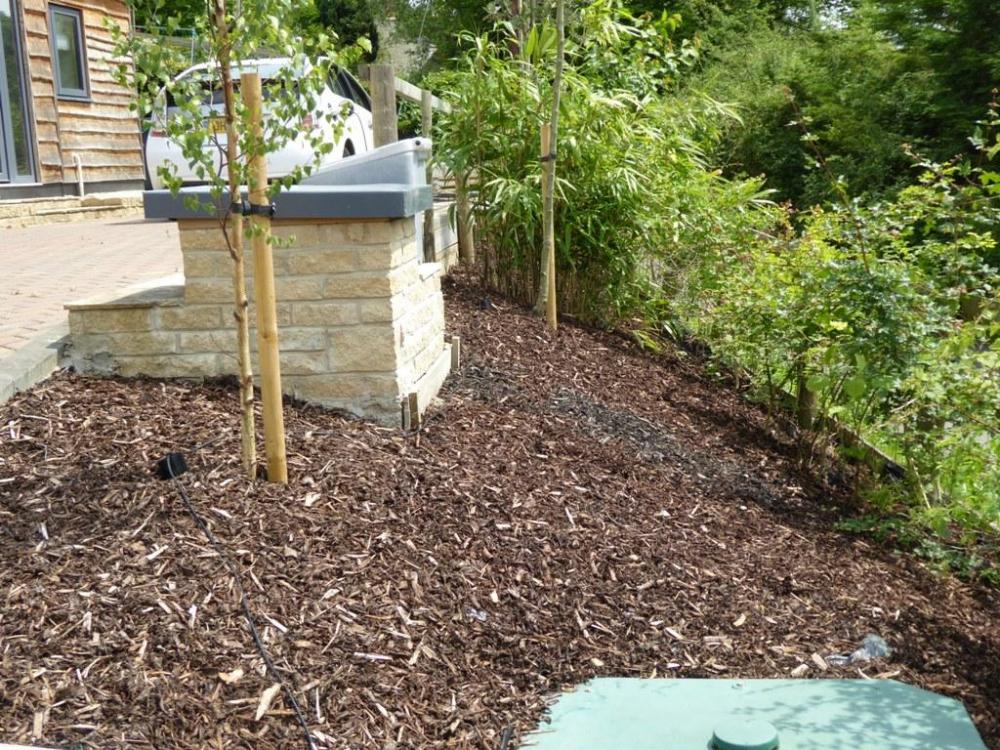
Our clump of bamboo has grown from a single shoot that sprung up out of nowhere about 4 years ago. It's being very well behaved, and just seems to be forming a solid clump, that's getting bigger but shows no sign at all of spreading outwards. I've absolutely no idea what variety it is, but it's not ideal for screening as it doesn't seem to grow very high. it's in the centre of this photo, taken last summer, if anyone's interested, or wants to identify the variety.