Jeremy Harris
-
Posts
26430 -
Joined
-
Last visited
-
Days Won
360
Everything posted by Jeremy Harris
-

Septic Tank v Sewage Treatment Plant
Jeremy Harris replied to canalsiderenovation's topic in Waste & Sewerage
As a word of warning, we had no idea where the septic tank was on the farm, as someone had concreted over the cover when the yard was resurfaced. The septic tank was discovered when the top collapsed one night, luckily when no one, and no livestock, was in the yard. That was a brick built affair, with lots of missing bricks that had fallen out over the years (they were all lying in the bottom). The top was just some rusted out angle iron, with a couple of sheets of rusted out corrugated iron on top, then some pretty rubbish concrete on top of that. It's a miracle that it hadn't collapsed before, as cars, tractors etc had been driving over it for years. -
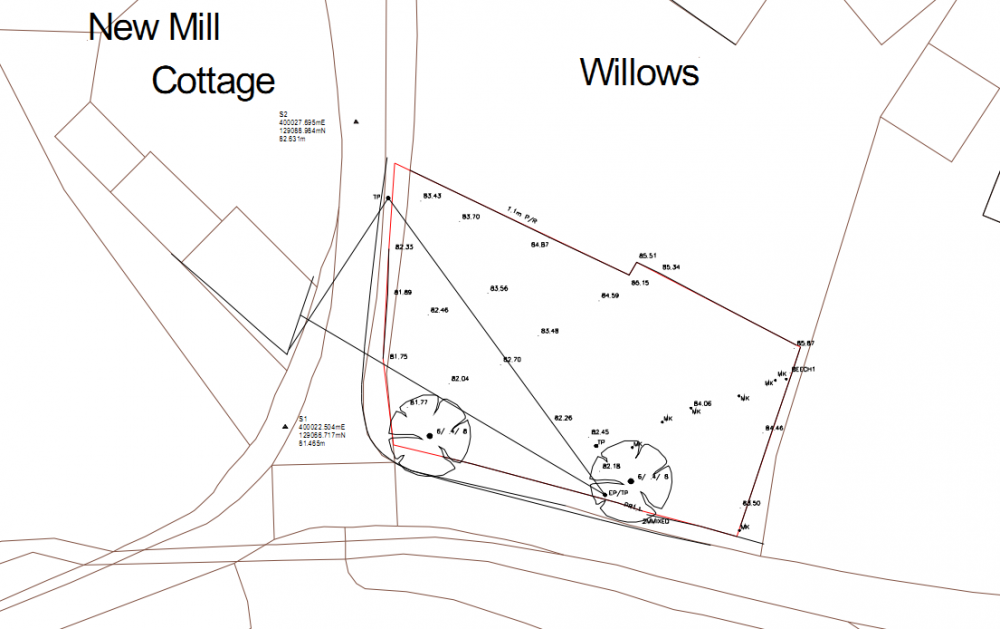
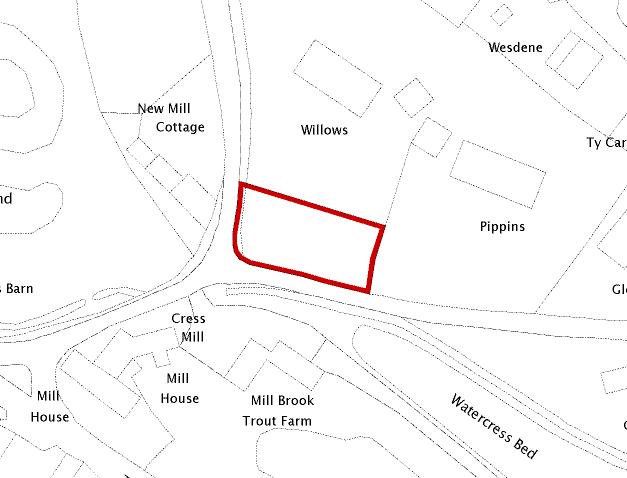
To be fair to our solicitor, she did ask me specifically to check the boundaries on the ground were as shown on the title plan, although she didn't specifically mention that she'd spotted that one was way out (not sure how anyone could miss it, as she had both the title plan and the vendors topo plan in the file). This is the pre-amendment title plan she had: and this is the topo survey she had, showing the on-the-ground boundaries:
-
Hugh Piggot is a person with a lot of practical experience of living a "hair shirt" off-grid life, and some of his stuff is well worth a read. He relies a lot on wind generation, simply because it's pretty windy up at Scoraig, but he does have some PV generation as well. Looking at his blog, this post gives a rough outline of the kit he's using: http://scoraigwind.co.uk/2015/11/my-electricity-supply-here/ Hugh uses a tiny PV array about the same size as the one you're thinking of, but gets most of his energy from wind generation, with just a back up generator. He has about 38 kWh of battery capacity, which probably gives a realistic usable capacity of maybe 20 kWh or so, as he uses Rolls lead acid cells. A friend of mine went up to Scoraig for one of the courses Hugh runs, and reckoned their setup was very good, but you have to be prepared for there being virtually no creature comforts there. The whole community is really about getting back to basics, and seems to work pretty well, well enough that the community at Scoraig has been there a long time now, which is itself quite remarkable, as it's not accessible by road at all, although if you're pretty fit you can walk there, along a fairly rough path that's around 10 miles long, IIRC.
-
Salus Auto Balancing Actuator - any knowledgeable expert?
Jeremy Harris replied to readiescards's topic in Underfloor Heating
My experience with the Salus actuator is that it seems to always try to maintain a 4°C temperature differential between flow and return when the flow is below 30°C, and a 7°C temperature differential if the flow is above 30°C (never tried this, as our flow doesn't get this high). I've never seen ours actually shut off at all, but you can hear it motoring for a minute or two after switch on, as it adjusts to get the valve opening matched to the temperature differential. I have noticed that it initially opens too far (as you'd expect) then starts to close down as things warm up. I think I'd be inclined to put a couple of thermometer probes right at the clip-on temperature sensors for the valve, to see what the temperature differential is, and what the sensed flow temperature is, as the actuator sees it. I've a collection of cheap thermometers from eBay, that have remote probes, and which are useful for this kind of monitoring task. -
Grand Designs at Graven Hill starts tonight on Channel 4
Jeremy Harris replied to ProDave's topic in Property TV Programmes
I drove around the estate in Swindon he designed, The Triangle, a year or so ago, just to see what it looked like in reality, now that it's had time to be lived in. It's not a grand design, IMHO, and the ventilation "wind chimneys" just seem to look a bit odd (and apparently don't work very well). Here's what it looked like last year, (from Google Earth):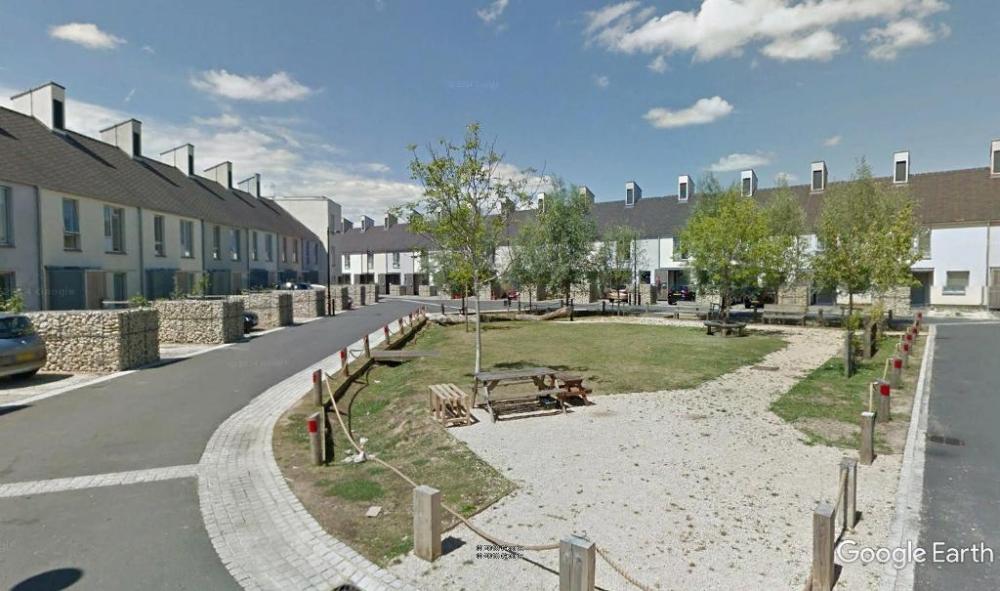
-
The only way to be reasonably confident that this isn't a major problem would be to get a competent surveyor to look at it. One concern I'd have is that if there is an obvious defect like this, in a 5 year old house, what other defects might there be that aren't so visible? I'm not a fan of paying for advice usually, but this looks to be a case where, if it were me, I'd get a professional opinion.
-
Me too. The cost of the battery system and generator alone will exceed £7k, plus both will only have a life of about 10 years before they need replacing. In addition, the generator will need to run almost 24/7 in order to keep just the baseload going, as the very small battery system isn't going to sustain it overnight. To put this into context, our house is about as low energy as you can practically get for a two bedroom, two person, house. We have 25 PV panels and there's no way that, even with a 9.6 kWh battery system (which is what I'm about to install) we can be off-grid. We might manage to be off grid for a few days here and there, but without a generator we'd not be able to sustain being off-grid for very long, even in mid-summer.
-
Septic Tank v Sewage Treatment Plant
Jeremy Harris replied to canalsiderenovation's topic in Waste & Sewerage
An alternative to a leach field (a treatment plant can't discharge to a soakaway usually) may be to look at installing a drainage mound. This is essentially a mound of permeable stuff like sand, with the discharge being pumped into it. It takes up less space than a leach field and will work where the permeability of the sub-soil is too poor for a leach field to work. -
I don't see why not. The thin inner insulation layer does next to sod all in terms of real-world performance, and is really just there as a form for the concrete. There's a very small risk that the cistern may end up slightly cooler, but frankly that's going to be trivial when compared to the effect of fill water at around 8°C coming into the cistern.
-
It could be ground smooth easily enough, not cheap though.
-
LABC aren't to blame for build defects that aren't building regs related, which may be part of the problem you've been having in seeking redress. In the first case your case is against the builder, not LABC, for selling a house with unacceptable defects; the house seems to not have been of "merchantable quality", and that's a requirement in law, I believe.
-
If it were me then I'd start getting serious on social media, the TV shows that name and shame crap builders, any media story about crap builders (Taylor Wimpey seem the flavour of the week, makes a change from Persimmon, who are usually the crap builders that get the most flak). The house will have had a 2 year warranty from the builder, plus another 8 years after than from NHBC, that covers construction defects. This is, without any doubt, a collection of really bad construction defects. To fight this will need getting an expert opinion, then pursuing the builder, or NHBC, for redress. NHBC are a PITA in my personal experience, but if you persist you may well win. It really comes down to how much stamina you have, as these bastards rely on being able to delay things, and be so obstructive, that people give up.
-
Good grief, I didn't realise this was a new build. That's just bloody appalling work by a developer, and way below the expected standard of workmanship. I thought, looking at the photos, that this was a bodged DIY job you were looking to put right. Words fail me, as bad as mass housebuilders are, I'd not have thought they could do crap like this. Given that the house had a warranty, it was definitely not sold as seen, as there's an obligation on the builder to put right defects for the first two years post completion, anyway.
-
Doesn't look great to me. If I had to guess I'd say they left it too long before floating it, so it was getting a bit too firm and has picked up a bit on the float. Ours was a lot smoother than that, with no marks at all to show that it had been power floated.
-
As far as building regs are concerned I very much doubt this was notifiable work, so it's really a matter of looking for the best fix in terms of protecting your property from further degradation and making the decking area safe, usable and durable. The normal guidance is for the ground level all around the house to be at least 150mm below the DPC, but this isn't mandatory, AFAIK, and there are lots of houses that have a higher ground level than this, without problems. The significant point for your house is that it looks as if it may have a suspended ground floor, judging from the position of the airbricks. With a suspended floor you would be well advised to stick to at least the 150mm below DPC rule, and ensure that all the air bricks are clear of obstructions. It looks like a fair bit of the decking will have to come up, with the area of ply boarding that was under the artificial grass, and which looks to have rotted out, being replaced by something more suitable. For this area I'd be inclined to look at lowering the level of the artificial grass and laying it on a new sub-base, not MOT1, as that won't drain very freely, but perhaps MOT3 with a whacked layer of coarse grit blinding. If this was laid so that the surface of the artificial grass was around 150mm below DPC I think it would solve that particular problem, and be long-lasting and maintenance free. The rest of the decking presents a few challenges. Clearly there needs to be a strip of the underlying ground dug out around the house, to lower the ground level a bit, and ensure that there's good drainage, so that water can't sit close to the house. There's no problem with having the decking cantilevered over the dug out area, as long as the decking supports can deal with this OK. What you don't want is a gap between the decking and the wall of the house that's big enough to present a hazard, yet the dug out area around the house wall needs to be around 250mm wide to be effective, and needs to be able to drain freely, and not act like a big gutter. The decking itself should be OK overhanging a gap this wide, and can be cut so that it's around 20 to 30mm clear of the wall of the house. Where there are air bricks, I'd be inclined to ensure that there is a space above them in the decking, perhaps with some form of protection from someone getting their foot caught, so as to ensure that there's free air flow to them. All this work is the sort of stuff that a decent landscaping/garden service company, or small general carpenter/joiner, could do without too much difficulty. The biggest problem you are likely to have is finding someone who's reliable and will do a decent job. In general, those who advertise on sites like Check a Trade etc are often those who are looking for work, and as a general rule of thumb the best people never need to look for work, as they pick up enough jobs by word of mouth (doesn't make it any easier to find them, though).
-
Snap! I bought our four way manifolds cheaply from Screwfix, too. I've noticed that Screwfix no longer stock them, they only seem to stock the Speedfit ones, as I had a look earlier, when I first spotted this thread.
-
A price of £3k for FoD seems, if anything, pretty low to me. We're in a marginal FTTC area, so I asked about getting FTTP via FoD, and was told that the price would be around £9k, but that if we got together with other nearby properties they could reduce this a bit, as the cost of the main fibre run from the cabinet could be shared.
-
No, not for home charge points. They are usually always active, and are turned on by any car that's plugged in to them. Some can be restricted use, so that they need an RFID card to turn on, but in my experience these have always been domestic type charge points installed at hotels, where they wish to restrict use to hotel guests only (seems fair enough, especially as I've used charge points like this as a hotel guest a few times now). Public charge points, i.e. those installed by councils, supermarket owners and at service stations and cafes along our road network, have a plethora of operating methods, which is one of the major disincentives for electric car use, IMHO. Last time I looked in detail, there were over 30 different companies offering charging services, and all used a different way of charging users. Most use a subscription service, with a monthly charge for a card, plus a charge for electricity used. The monthly charge is typically around £8, so having a handful of these cards in your wallet is a pretty big monthly cost, before the cost of any electricity used is added. Some charge points have shifted to a 'phone app based model, but generally these are very flaky. They fail to work as often as not, so charging has to be initiated by a lengthy 'phone conversation with their help desk. The app based systems all require a direct debit authorisation to be set up in advance, so again you could have maybe a dozen or more of these set up, just to ensure you can access a charge point wherever you happen to be. The government have passed legislation that is aimed at allowing free access to any public charge point, with a common payment system (just like buying fuel at a filling station) but the charge point operators are really reluctant to adopt this. The main companies that seem to be shifting towards compliance with the government requirement are Instavolt and Shell, who are both offering charge points that accept normal contactless payment by debit or credit card, or Apple Pay, which uses the same RFID technology. This seems to be the way to go, as it makes paying for electricity much like buying fuel.
- 6 replies
-
- 1
-

-
- free car charger
- monitoring
- (and 1 more)
-
I've no doubt that some will sign up for it, in the erroneous belief that they need to continue to supply usage data to those who want it.
-
As long as you realise that 2.55 kWp of PV will only meet a tiny part of your energy needs, and that you will be relying on the generator for a great deal of the time, then that's fine. With only that small amount of PV, you can pretty much forget about getting any useful generation at all for maybe four or five months in winter. It's worth putting your PV array into PVGIS (http://re.jrc.ec.europa.eu/pvg_tools/en/tools.html ) and seeing what the output will be (PVGIS seems to be pretty accurate, as far as I can tell). I don't know where you are, but a quick run assuming that you're somewhere near Newtown (picked at random as being near the middle of Wales!) and your PV array faces south, with optimised elevation and azimuth, this is how much electricity you would generate: PVGIS-5_GridConnectedPV_52.513_-3.311_CM_crystSi_2.55kWp_14_37 (opt)deg_2 (opt)deg.pdf (ignore the fact that the file is titled grid connected, it doesn't mean anything useful in this context). Looking at this data, you would get around 4.5 kWh/day in October, around 2.7 kWh/day in November, around 2 kWh/day in December, around 2.3 kWh/day in January, and around 4.1 kWh/day in February. That's not a lot of energy at all. Our energy consumption is pretty low, given that our house is a passive house, designed to use very little energy and be less than zero CO2, but in winter we use around 15 kWh to 25 kWh per day, maybe ten times as much as your PV system will generate. A standard block and brick house built to just the (pretty dire) building regs minimum requirements could easily use double this, or more. If you're relying on power from the PV system then you're pretty much going to have to forget about using most electrical appliances for around 5 months of the year, as for lots of days in winter you're going to struggle to have enough generation to run the lights, let alone anything else. As an example, our background load (just the power that stuff in the house uses 24/7) is around 200 W, which is higher than I'd like, but is a consequence of having a sewage treatment plant (the necessary aeration system uses power), a borehole for water (the pump and disinfection unit use power) and things that are on a lot of the time, like the internet router, the circulation pump for the heating system and low power LED lights (all the lights in the house are low power LEDs). Our base load of ~200 W couldn't be met by the power generated from your very small PV system between the end of September and the beginning of March, let alone anything else, like a washing machine, TV, PC or whatever.
-
This is because OLEV was paying for the data collection, and they've decided to stop, as new OLEV subsidised charge points will need to be "smart" grid compliant, so that the energy companies can control when cars get charged (or not) so as to better manage peak demand. You could have disabled the Chargemaster at any time by just taking off the cover and removing the SIM card, it's what some people who have been concerned about the pretty lax data security with these things have been doing, and it doesn't have any impact on the function of the charge point at all. The only function of the data link was to transmit data about the usage of the charge point, to allow manufacturers and electricity providers to build up a database of usage statistics. There was never any control capability built in to the data linked charge point, so they can't be turned on or off remotely (unlike the new "smart" charge points, that are specifically designed to be able to be turned on and off remotely).
- 6 replies
-
- 1
-

-
- free car charger
- monitoring
- (and 1 more)
-
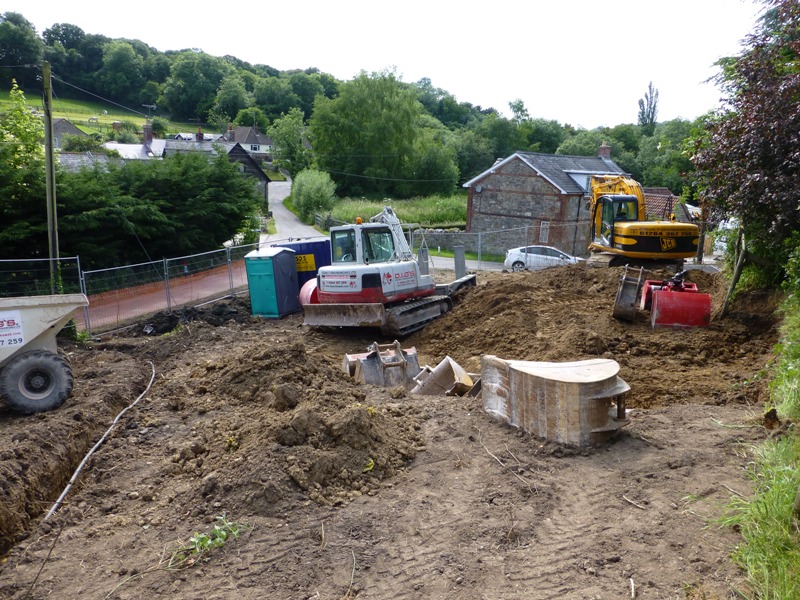
Well done for the game played so far! I think your assessment of the way they are playing this is spot on. They will try every trick they can to squeeze money from you, as they won't want to have to bear any additional cost if they can help it. I found that having a digger on site that dug up their unauthorised underground cable, which was only buried about a foot down, (with no warning tape, pretty scary and definitely not as it should have been laid) spurred them into action in the end. I dragged their cable clear of the area we needed to excavate and sent them a photo of the work in progress, telling them that they needed to get a move on before their cable got damaged. This is the offending cable that had no wayleave, at the lower left, just after we'd exposed it and before we dragged it to one side:
-
We have 6.25 kWp of installed PV, and I'm looking at installing battery storage. We're also "off grid" for water and sewage, but have grid electricity that we use as a big battery, in effect. Over the course of a year the PV generates a bit more than double the amount of energy we use (the house is all-electric, no bottled gas, oil, or other toxic fuel burning stuff). However, from around October to about March every year we don't generate anywhere near enough electricity from the PV to cover the house consumption, even though the house consumption is very low (it's a passive house, so needs very little heating). It wouldn't matter how big a battery system I installed, we could never hope to meet more than maybe 10% to 20% of our winter energy needs from the PV generation, so would need some other means of keeping the battery charged for around 4 or 5 months of the year. If we had a generator, then it would need to deliver around 15 kWh to 25 kWh per day, during the PV "dead season", so would be costly to run. Unfortunately, we can't install wind generation, but if we could I think we could possibly reduce the winter deficit. Paul Camelli (his blog has been mentioned in this thread before, it's well worth a read: https://lifeattheendoftheroad.wordpress.com/ ) has managed (after many years of off-grid experience and development) to create a system that doesn't need a generator now, with the combination of some PV generation, a fair bit of wind generation, and, perhaps most importantly, a small amount of always-on micro hydro generation. His micro hydro system only delivers a couple of hundred Watts, but that apparently really makes a big difference in terms of keeping his battery topped up, and has meant that he rarely, if ever, needs to fire up the generator. At the moment we use the grid as a seasonal battery to meet the winter requirement, by putting far more into the grid in summer than we use in winter. That's not ideal, but my next step is to install a battery system so that when we need to use grid power we can do so at the best time, overnight, when grid demand is low. I doubt the battery system will be cost-effective, in terms of being cheaper than buying electricity from the grid, as the capital cost alone would pay the electricity bill for many years to come. It will, however, reduce the net CO2 we use, and even though we're already CO2 negative, reducing our environmental impact further has to be a good thing to try and do (and is why I drive an electric car, charged for more than half the year with PV generated energy).
-
The snag is that hot washing (it needs to be over 60°C) uses a lot more energy. The best solution would seem to be to just fit a single tank fed from the spring and use that. The tank will act as a big buffer, so can fill up overnight when there's no water demand. Alternatively, you could do the necessary filtering and disinfection (you'll need to install a UV light disinfection system anyway) on the spring supply, then pump it into an accumulator to give you a treated store of pressurised clean water. I have a relative whose water supply comes from a slow spring, little more than a trickle, and they have an underground storage tank, with an overflow (much the same as a rainwater tank) with a small pump set that pulls from that and runs the water through a 5µ filter and UV disinfection unit to supply the house as required. That works well, as the spring doesn't have anywhere near enough flow to meet their instantaneous demand, but is more than enough to keep their tank topped up. Their tank can supply their water needs for several days, so they can cope with short periods when the flow from the spring is really low. The overflow from the tank runs to a large pond at the end of their garden, and the overflow from that runs down to a nearby stream. The pond is also their rainwater run off attenuation system, that stops surface water from running off quickly beyond their boundary (which is now a SuDS requirement).
-
My experience (on two plots with boundary errors) has been that the solicitor/conveyancer has had a get-out when it came to whether they should have spotted the errors (neither one did). On both occasions I was sent a copy of the plan showing the land to be conveyed and asked to confirm whether the plan was accurate or not. It was down to me to confirm whether or not it was, as neither time were obvious boundary errors (and in the first case an unlawfully repositioned public footpath) spotted by the solicitor/conveyancer.