Jeremy Harris
-
Posts
26430 -
Joined
-
Last visited
-
Days Won
360
Everything posted by Jeremy Harris
-
 Seems to be criminal, as the money was recovered using the Proceeds of Crime Act.
 -
There's a small development near us (four houses) that has a shared hammerhead turning area. From what I can gather it causes a lot of friction, as it ends up being used as overflow parking when anyone up there has guests, so forcing the others to reverse out down the shared drive.
-
The gradient is about 1:9 at the steep part, so over the often quoted maximum allowable for resin bonded gravel of 1:12. The drive is steep enough that lightly loaded rear wheel drive vans often can't get up the steep part in the dry, meaning I end up having to go and clean off the tyre skid marks where they have spun the wheels whilst trying. I'd guess this might be quite damaging to a resin bonded gravel surface.
-
GSHP likely to be better choice...
Jeremy Harris replied to Digmixfill's topic in Air Source Heat Pumps (ASHP)
I looked at this in detail, and the small Kensa unit was initially my preferred unit. However, the cost was astronomical compared with an ASHP, and would never have been recovered from the small saving through the life of the unit. The GSHP install, with me doing most of the work, was going to be around £8k, and would run with a true COP (allowing for pump losses, which often aren't mentioned) that would have been about 8% better overall than an ASHP. Our ASHP cost around £2k (installed). Our ASHP costs maybe £200 a year in electricity (I've not checked lately but suspect this is a big over-estimate), so if we had a GSHP we'd save maybe £16 a year. To recover the ~£6k premium for installing a GSHP, and ignoring the higher maintenance costs for a GSHP then it would take around 375 years to recover the additional cost just from the small energy saving. We've been consistently getting a COP of over 3.5 from our ASHP, often it runs at around a COP of 4, so there isn't much difference between it and a GSHP in practice. -
The PCM breaks down at around 125° C I believe, so an ST system pressurised to 1.3 bar above atmospheric would be enough to raise the boiling point to the critical temperature for the PCM. From what I've seen, it's not that hard to get ST systems to this sort of temperature when they stagnate.
-
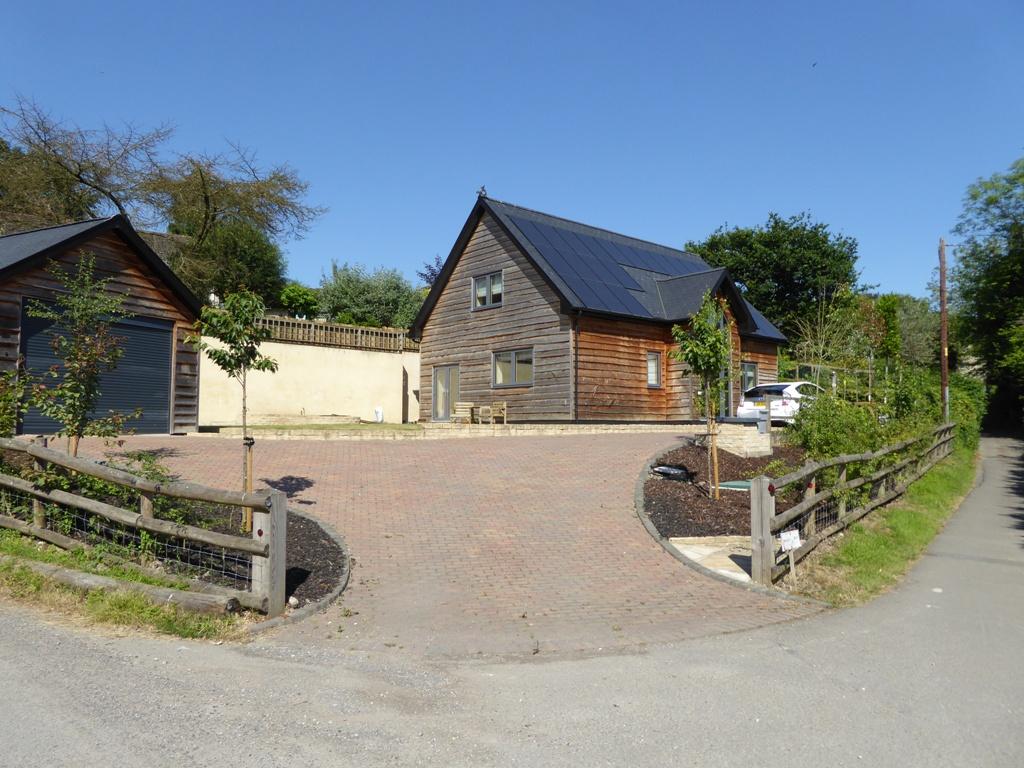
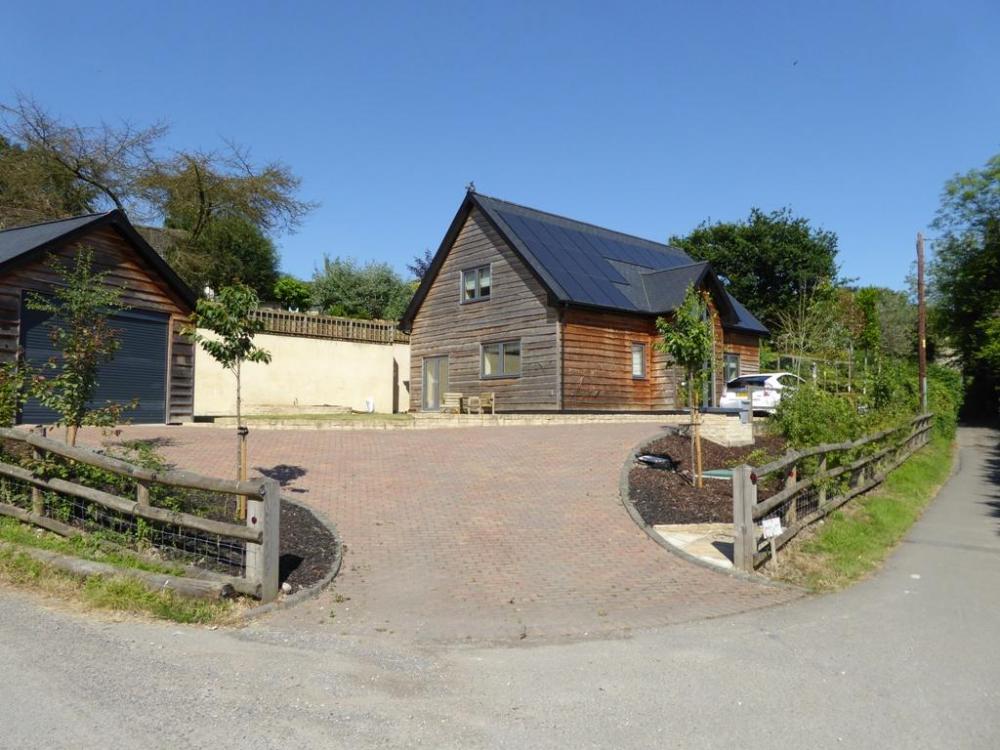
Here's a photo that shows our drive taken last summer (around 4 years after the pavers went down). It's quite a steep slope, hence the pavers, and we were advised that the slope was a bit too great for resin bound gravel. The pavers are Bradstone Infilta, Autumn, came from Simply Paving (who gave a better price delivered than any of our local BMs).
-
Worth remembering that any driveway will have to be SuDs compliant, so will need some form of drainage to prevent run off. It's slightly easier to do this with permeable surfaces than with impermeable ones, as a rule, as you don't need to build in linear or side drains. It might be worth looking at things like permeable resin bonded gravel, or if the drive is flat, gravel contained within a grid mat. FWIW, we have permeable pavers and they don't move at all. I park in the same spot all the time and over 4 years there's no indication that any car has ever parked there. Weeds are a pain, but not too hard to control, although I've found that I have had to resort to weedkiller a few times. Now it seems that moss is starting to dominate, and that doesn't look bad, and it seems to keep the weeds at bay.
-
Interesting, but it assumed that vehicle would be driven for between 21% and 38% of their maximum range every day, which is pretty unrealistic. For someone with a newer EV, like a Hyundai Kona or Kia eNiro, or even a Tesla or Jaguar iPace, that battery capacity usage equates to around 45 to 90 miles per day. I doubt that many people drive that far every day. My mileage is probably around 1/3 of that.
-
In general yes, it's pretty easy to plug a OBD connector in and then use some readily available software to look at the battery health in detail. Most EVs have some form of open source software available that can read data via the OBD port and give a health report. Some manufacturers include a battery health display in the car, Nissan I believe do this with the Leaf, but it's not as capable as using LeafSpy and a laptop.
-
It's my primary concern about the whole idea of V2G. It keeps getting promoted, but the impact of cycle life on a vehicle battery used as a domestic energy store is going to be pretty high. I typically charge my car about once every week or two, so over a year it might, possibly, get around 50 cycles (allowing for multiple charges on longer trips). Using it as a home storage battery, with PV and off-peak charging, would probably increase that to around 500 cycles a year or more. The requirements for vehicle and home storage batteries seem markedly different, in that cycle life isn't really at all significant for a vehicle battery, but having a high peak charge and discharge capability is. A home storage battery doesn't need a high charge or discharge capability, as it'll probably never charge or discharge at over a fraction of 1C, but it does need a useful cycle life that's at least 4000 cycles or so.
-
Might be worth having a read of the guidance on the Planning Portal: https://www.planningportal.co.uk/info/200130/common_projects/43/outbuildings In general, it's unlikely that consent would be refused for a single garden shed of modest size, and the process of getting approval should be fairly painless, although is likely to take some time. It depends on your local authority, but most householder applications should take between 8 and 12 weeks to be processed, if straightforward and uncontentious. If you are not in a Designated Area (Conservation Area, Green Belt, National Park, AONB etc) then you might wish to consider applying to have the condition on your planning consent removed. Sometimes PD rights will be revoked by condition at the request of the applicant, usually developers who want to preserve the appearance of a development until they have sold all the houses. In such cases it may be possible to get PD rights restored, so that anything that would normally fall within PD rights can be built without needing further consent.
-
Welcome. That clause looks to be a fairly standard revocation of Permitted Development rights condition, and is the sort of thing often included when granting planning consent to a dwelling that is in some form of restricted planning area (most often these revocations of PD will be standard for houses built within a Conservation Area, Green Belt, a National Park or sometimes an AONB). It means that if you wish to erect a shed then you need to get planning consent. This would be via a householder submission and would most probably be granted, as long as the shed was not too large or unsightly. The condition is there primarily to limit the proliferation of buildings etc in what may be considered to be a sensitive area, the intention being to prevent "over development" usually.
-
Hello from the North West - Alternative Self Builds ?
Jeremy Harris replied to Jonathan Aspden's topic in Introduce Yourself
Welcome. As @ProDave says, there are quite a few hear that have designed and built passive, or low energy homes, using a variety of construction methods. Our house is timber frame (twin stud) built on a passive slab, with blown cellulose insulation in the walls and roof and airtightness that's a bit better than the PassivHaus limit. -
First off, I'm not an expert, by any stretch of the imagination. Secondly, @Barney12's problems are well documented here, as are those experienced by @Eileen, so there are at least three members here who've experienced some problems/issues with their Sunamps. I think that @readiescards may also have had a unit replaced by Sunamp. I think we may have around half a dozen or so members that have the newer model Sunamps, so it would seem that perhaps 50% of them, maybe more, have experienced some problems.
-
I think repeatabilty is more important than the absolute value, as that probably gives a good indication of stability, so, with luck, the value will be consistent through the year. Although the blue book suggests 200Ω as the upper limit, I believe that one or two of the Part P approval bodies set a maximum acceptable limit of 100Ω, on the basis that this provides assurance that Ra won't increase above 200Ω through seasonal variation. I've still got an old 4 terminal tester, and although that's a tedious way to test an earth electrode, and I haven't used it in a long time. That does have the advantage that it's more likely to detect patchy ground conductivity issues, though.
-
FWIW, to test Ra, a multitester will usually use the same function as used for testing Ze, and that pulses a fairly high current (around 20 A) from line to the earth electrode CPC in order to measure the resistance. IIRC mine uses a pulse of current of about 40ms duration for this test. Testing the trip current and time of the RCD is a separate test, only done once the electrode has tested out OK (Ra lower than 200Ω, ideally lower than about 100Ω). A 30 mA RCD only needs an Ra of around 2,333Ω to trip, whilst staying within the maximum safe voltage of 70 V on the CPC from the electrode, which is way too high a resistance to be acceptable for an earth electrode. For this reason alone it's extremely unwise to rely on an RCD test as a way to guess that the earth electrode is installed correctly and has a low enough Ra.
-
As @ProDave says, without proper test gear, and the knowledge of how to use it, it's not something you can DIY. Apart from testing the installation, it must also be inspected to ensure that it physically complies with the regs, which means ensuring that the earth electrode is properly installed, that the CPC is of the correct gauge and properly terminated, that the terminal at the top of the electrode is protected by an appropriate housing, that the CPC is protected in conduit from that housing to the earth block, etc, etc. It's not a big job to do, the actual inspection and testing shouldn't take more than half an hour at most, if all has been installed as it should be.
-
This is something that I feel guilty about, if I'm honest, as I know full well that my enthusiasm for the Sunamp PV, based entirely on my experience of its excellent performance, has influenced others. To now find that the new product has been engineered in such a way that it fails to perform as well as the original Sunamp PV, at least when used as a way of storing heat derived from PV generation, is disappointing. It may well be that there is a genuine fix for the various problems in the pipeline, but right now I'm afraid that I don't have a great deal of confidence that this is the case. The primary reason for my doubt has to do with the way that we're being drip-fed information, and have been getting a mixed messages, from denial that there are any problems, through to rather unconvincing explanations as to how the unit can be monitored to see if it's likely to fail to charge before it gets depleted to the point where we run out of hot water. I understand that the need for some form of feedback to the user is now understood, which is a step in the right direction. Right now I feel that there need to be a concerted effort to rebuild confidence in the performance of the product, and having a means to let the user know the state of charge, and whether the unit is accepting charge or not, is vital, IMHO, when it comes to convincing users that the product is working well. The suppliers of PV diverters learned this early on, and it's no accident that the best-selling unit has a pretty informative user interface.
-
Right now I'd really like to talk with someone technical who actually understands their own product. All I've done is reverse engineer how I believe their controller works, based on observations of the way it behaves, yet it seems that I may know at least as much, possibly more, about the basics of the controller than the technical chap that's been tasked with talking me through things. It's frustrating as hell, as back when I first got the Sunamp PV I had several really sensible and useful conversations with a technical chap at Sunamp that really understood every detail of the way the control system worked.
-
I've chucked the ball back in their court for now, as if they want to know how their new controller is performing then I need to be able to tell when it's on or off, without lifting the lid and sticking a meter on the contactor...
-
Sounds very much like a duff stat. Should be a relatively easy fix, with luck.
-
I've been having some correspondence with Sunamp recently, as well as with other Sunamp customers who have had similar issues. The good news is that they are making changes to the controller firmware, that they believe will reduce or remove the failure to charge problem that we have for around 30% of the time. I believe that they have changed the charge acceptance threshold, but I don't know what they've changed it to, and TBH I doubt that it's a fixed value, given the challenges posed by trying to estimate state of charge from just three temperature sensors inside the heat battery (really a cell, IMHO, but they refer to it as a battery). Sunamp are certainly being helpful, and are sending me an updated controller, and have asked if I can assess it's performance. However, this is a Catch 22 request, as they've also said that I can't fit the status light to the new controller... The big problem this presents is that without the status light there is no way to tell whether or not the Sunamp is in the "accepting charge" state, which means that not only can I not compare it to the original controller's performance, but I have no way of knowing whether or not we are likely to run out of hot water the following day. I'm not that confident that they have really grasped the nature of charging a Sunamp from excess PV generation, either, as the suggested fix for having no indicator was to just time how long the Sunamp took to charge. Bit of a tall order when it's charging from variable power PV and you have no way of knowing when the thing is charged... My question about modifying the new controller to fit the absolutely essential status indicator has gone back to their technical people, but I have been given an interim reply that mentions it disrupting the way the controller senses the status of the heat battery, which is, frankly, BS, as the only sense mechanism is the chain of temperature sensors, and they are completely isolated from the heating element contactor (which is all that the indicator mod connects to). I'm really glad that Sunamp are looking at this issue, and have been working on a way to address it, but at the same time I've not got a lot of confidence that they actually know a lot about how either normal excess PV generation systems work, or how they interface with their product. This is completely at odds with the technical people involved in the Sunamp PV, who clearly had an in-depth understanding of what was needed to make best use of PV generation. I'm hopeful that things are looking up. though, and that I will be able to stop going into the services room every morning just to reset the Sunamp so we can be assured of getting hot water the following day.
-
Shower screen needed.
Jeremy Harris replied to TheMitchells's topic in Bathrooms, Ensuites & Wetrooms
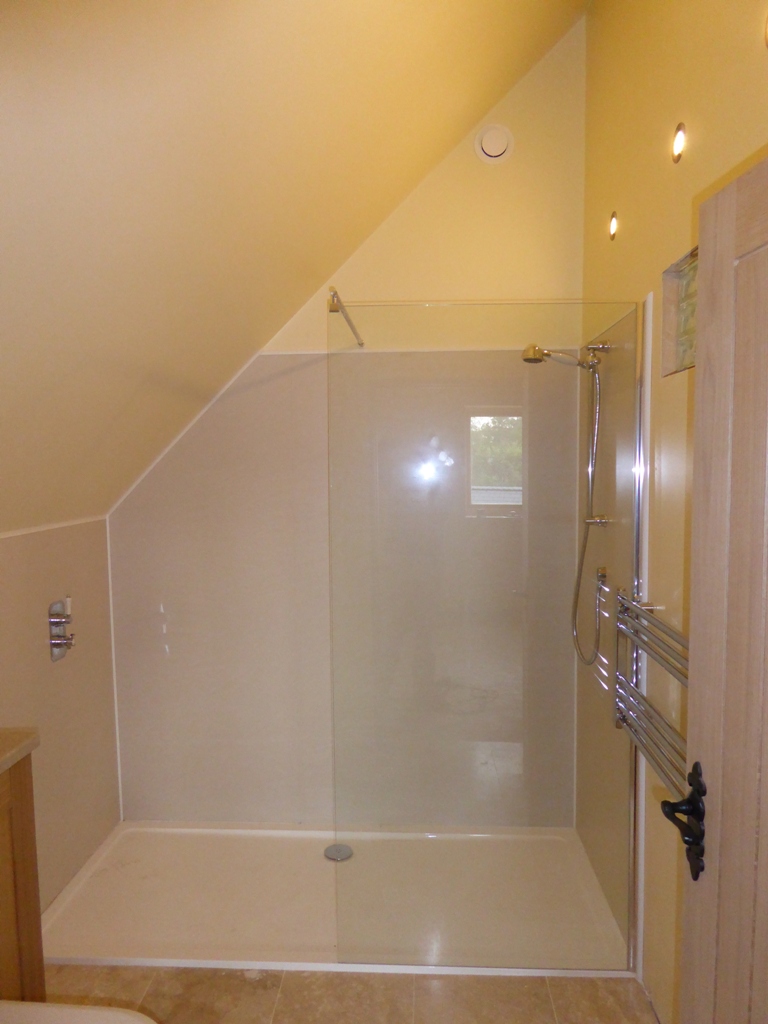
I bought ours from eBay! It's exactly like the one in your photo, @TheMitchells, with the same style fixings. I can't find the seller right now, but it's an 8mm coated glass panel 900mm wide, and came with all the fixings. The coated glass is worth having in my opinion, as it "self-cleans", which means no more scrubbing the glass to keep it looking shiny. This is ours, installed: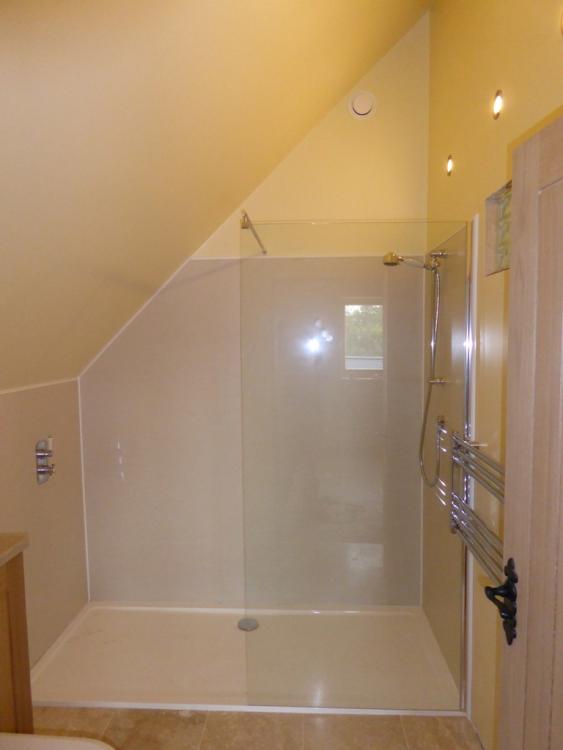
-
I bought our meter box from these people: https://www.meterboxesdirect.co.uk/ About £40 or so. The stainless steel IP65 wall box I've recently bought, which is going to house the new CU, only cost about £80.
- 33 replies
-
- 1
-

-
- electrical connection
- trenching quote
- (and 2 more)
-
The only thing they might (rightfully) quibble about is having stuff other than their meter in the meter box. Strictly speaking you're only supposed to fit stuff like an earth block, Henley and perhaps a fused isolator inside the meter cabinet, so my small consumer unit and additional cables are a bit naughty. I'm in the process of tidying my cabinet up, by adding a stainless enclosure where the caravan hook up point is, removing the small garage CU that's in the meter box and fitting a new CU inside the stainless box to feed all the external stuff. Rather usefully, I was chatting about doing this to the chap that changed our meter for an E7 one, and he "accidentally" left some unused fuse seals behind...
- 33 replies
-
- 2
-

-
-
- electrical connection
- trenching quote
- (and 2 more)