
Nickfromwales
-
Posts
31390 -
Joined
-
Last visited
-
Days Won
346
Everything posted by Nickfromwales
-
Pedantic ones will quote 1 in 5, but if you can visually demonstrate adjoining SVP's or that the you are not the end of line or at the crest of the sewerage network you should get an agreement that the SVP is not necessary. But; No, we cannot. An AAV allows air in ( hence the name "air admittance" valve ), so these categorically will not and do not provide any such means of venting per-se. AAv's are only a requisite where the invert from a discharging SVP to the 'manhole' aka IC is above 1300mm. Below that, there is not even a requirement for the AAV.
-

What cables to use within a HA cabinet?
Nickfromwales replied to Hilldes's topic in Networks, AV, Security & Automation
Solid core cable needs particular 'kid gloves' when stripping and terminating, and I'd choose tri-rated in a heart-beat vs solid for rack / cabinet wiring. Also, why the obsession with twisted pairs? All of the rack cabinets I've made in my time have been populated with tri-rated or screened cables suited to their individual applications. Screens will provide RF / EMF control so what are you specifically looking to combat? If I have ever wanted to set out numerous looms to 'look pretty' and twisted pairs have been my choice, I've simply pulled 10m of the chosen 2x cores of stranded ( xmm2 ) cables and then tied the ends off and put the other ends into the chuck of my cordless drill, pulled them taut, and then slowly spun them into a twisted pair. If the connectors are vice clamps vs screw down rotary type, the need for boot-laces becomes one of personal preference vs necessity. -
Are other PIR manufacturers to be exempt from this question?
-
Blauberg vs Boulder
Nickfromwales replied to Bosi's topic in Mechanical Ventilation with Heat Recovery (MVHR)
Brink are PH certified, and not enough money to convince me that a compromise on something which potentially can save me annually on my heating costs would be such a good idea..... Longevity needs to be considered here also, in equal importance, as these units will be running 24/7/365. "Buy cheap, buy twice" eg not so cheap then after-all -
PH standards for all new builds? You'll be lucky to find insulation in half of the new stock being sold to first time buyers, fortified by over-stretched council / back-handed private BCO's signing off these builds in non-scrutinised batches of 10+ at a time from a single dwelling inspection. A heat pump would cut any heating bill in half ( minimum ) if a dwelling had any discernible level of attention to a fabric-first approach, with robust BCO monitoring. Whilst new buyers still rave over a nice shower cubicle and a cloakroom WC, the demand of the typical new build ( mass-produced ) buyer still doesn't drive such focus 'elsewhere' I'm afraid.
-
Only if no one else in the dwelling opens a tap / flushes a loo, and no appliances are using cold mains at the same time Otherwise your huge electric shower will shut down and you;ll have to select its lowest setting and suffer a shower akin to me peeing faster-than. That rule applies to any and all electric instantaneous heaters, which are largely over marketing-hyped utterly useless bags of shit. I will concede that if new builds receive a mandatory 3ph electricity supply, the 3ph Steibel Eltron 27 electric instant is an absolutely fantastic bit of kit. I'm seriously impressed by it. Its 1ph little brother is however completely pitiful on a good day in the peak of summer, and a complete waste of money and wall space in the depths of winter where it needs to dig deep to uplift colder incoming water temps to the same level. You do have to consider the sanity of some folk writing here 14oC "right now" = 9pm on a November night. Less gin, more tonic, eh? Probably renting @SteamyTea's conservatory and banished from making physical contact with the room stat ?
-
Real world passive house heating demand figures?
Nickfromwales replied to Smallholder's topic in Boffin's Corner
Architects can be dangerous things...... What they should say to you is to do the sums and get on top of the M&E coordination as early on as possible. It is such a holistic equation, made up from so many relative ( but often overlooked ) facets, that such a statement seems to be popular in buying these professionals all the insurance they need to survive without undertaking such ( or sometimes ANY ) due diligence. One 'eco friendly' chap had actually designed a heated floor to be sat on cold strip foundations without any thermal break...... Taking advice from anyone other than qualified M&E's, or testimonials from folk who have built, and then moved into, and are now living in such a dwelling is pretty dangerous practice and often costly. Another failed to specify a heat pump for a dwelling that had a mandatory requirement for NZEB certification as part of the PP! "Double the demand" is huge in PH terms. My 2 cents would be to stop taking advice from the architect as their approach is worryingly non-robust in this particular respect. -
They seem spot on for a temporary / relocatable ‘hit’ of a little additional heat. Thermostatic too with timer by the looks of it. ?.
-
All the way to each outlet that you wish to have serviced by the HRC circuit . Not to every outlet afaic as I never really bother with baths / showers ( unless the shower is the far side of the building ) or any outlets in the immediate vicinity of the hot water device. Baths and showers typically get opened up immediately to 100% flow rate, so discharge the dead leg quick enough to not waste the heat / energy from running the HRC to such an infrequently used outlet. Bottom line…..just wait, as it’ll be 10 seconds or so max, typically, before premium temp DHW gets to that outlet so not life or death imho. Typically a basin with a 10mm feed, which runs for no longer than ~10m, will not attract the HRC. Reason being is that most HRC set-ups will have a recently used outlet or an HRC pump on for the daytime / periods of occupancy ( which will ‘pre-heat’ the larger bore pipework and the hot manifold, by design ) so the non-HRC outlets will therefore not have any discernible dead leg to shift, other than the tiny volume of cool / cold water in the 10mm delivery pipe. Works a charm.
-
I've just installed and commissioned a full house system for a client, with UVC in upstairs plant room, and I fitted 10mm runs to the downstairs en-suite and cloak WC plus upstairs master are all 10mm hot and cold runs where the water pressure is 'not excellent', and the flow is more than adequate ( given modern basin taps are restricted / air blended for low flow rates anyhoo ). I ran a HRC to the utility and kitchen ( 15mm flow and 10mm return ) for instant premium hot water to both of those outlets. I don't ever do the above series HRC as it just doesn't rid you of every drop of the dead legs, the whole point of installing one in the first place! Also, if you do a manifold / radial setup then you need individual HRC returns back to a third manifold so you can isolate every hot outlet individually ( hot and HRC both need to be shut off to isolate a HRC serviced hot outlet ). Also series HRC means several outlets can be pulling down one run of pipe, so the flow rates will suffer quite a bit too, especially with Buteline as the fittings have a lot of resistance. My preferred installation methods see just one fitting at the end of each continuous pipe run so flow rates are very very good indeed, even more so when preserving what flow you have where the cold mains is not as good as you'd have liked. Any multi-occupant dwelling would deffo benefit from a 200-300L cold mains accumulator too, which are cheap enough these days, which will stave off pressure drops when things like WC's are flushed or an appliance is filling whilst someone is showering. Makes a huge difference.
-
Don’t fill with water then, simples! Buy the pipes in the correct length coils from Wunda and they’ll come sealed and pre-pressurised to a good few bar. Cutting into it gets quite a notable rush of air and associated hissing noise. Either that or complete a regular installation with manifold rails and pressurise yourself / installer with air. A pressure gauge will show you that things haven’t gone tits-up during screeding
-
Only with an ASHP install.
-
You should be fine minus the AAV then Guessy-McGuess-Bob
-
Why the need for antifreeze? Are you winter prepping? Just dry test with air if you’re just needing to prove the pipes before install. If you’re just looking to treat the system at the point of commissioning then you just do that via the upper manifold vent / drain point with a 3/4” or 1/2” flexible hose and a funnel. Make sure the lower manifold air vent / drain are completely removed otherwise it’ll be ridiculously slow going.
-
As much use as a waterproof teabag. ?. Give me a measurement from the top of the muncher to the point the discharge pipe opens up at the PStn. Run there, gallop back ?
-
The research evidence on security alarms
Nickfromwales replied to Adsibob's topic in Networks, AV, Security & Automation
Problem is, they know where the key for the steering lock will be, on your car keys , so they get those by burglary anyhoo. Therefore only a deterrent to the opportunistic thief. Bollards are a good choice, as long as they’re not cheap bits of crap that they’ll know they can simply knock over with your car. Thieves can readily identify popular security products and gauge their resilience / robustness etc in the wink of an eye. Good ( well placed and very bright ) security lighting, and some basic disciplines re where keys are kept at night / choice of door locks / don’t have a letterbox in the house door etc are all little 5 and 10%’s of additional obstacles which may make the scrotes move on. -
Is there anything in the pipes atm?
-
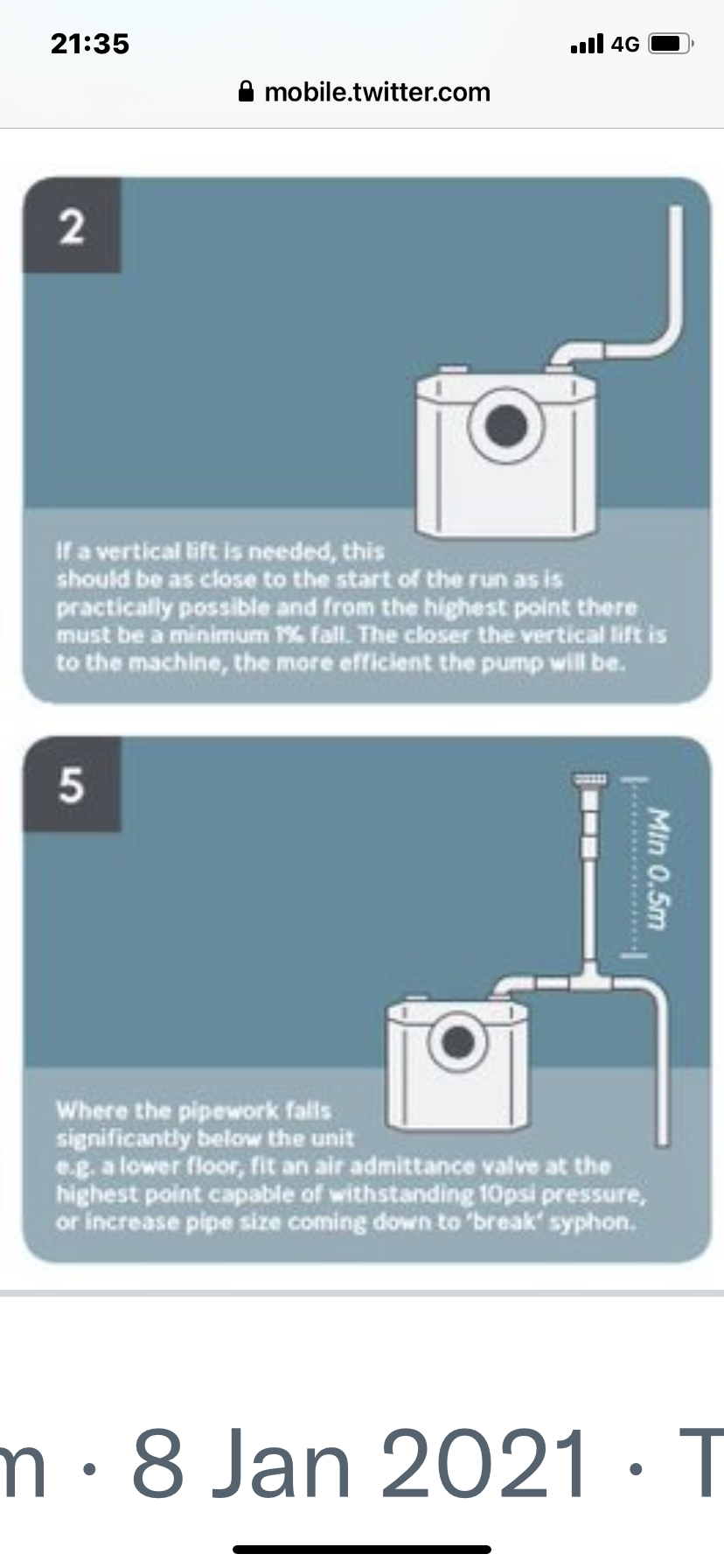
Like it says, if you can run a 32 or 40mm pipe from the point of invert it’ll allow a natural air break. How much of a drop from the muncher to the connection to the SVP?
-
-
If, my young crapprentice, you allow a fall on the discharge pipe, and you get it wrong, you’ll set up a perfect siphon tube. That’s where the contents of the pipe then suck the turd-scoffing device empty with loads of gurgling and slurping noises ( think of a fat kid on the dregs of his McDonald’s milkshake and you get the idea )…….
-
You’d be better off running it uphill to the point of termination as otherwise you have to put an air admittance valve on the pumped discharge line to stop siphoning.
-
It was a choice of; 1) read that 2) order another bottle of Shipyard hic…..
-
I’ve had Rubi cutters all the way from 400mm to 900mm and then a Sigma 900mm. Gave my Rubi one away to a mate starting out and I’ll be staying with Sigma. Outstanding bit of kit and far less effort to get a good cut. Literally couldn’t spot the difference between factory and cut edges.
-
MBC Frame - Windows - When to order ?
Nickfromwales replied to bob the builder 2's topic in Windows & Glazing
On my current clients build there were some delays, so we've pushed ahead getting the windows in before the full weight loading can commence. I've strategized this by asking that the fixings for the heads of the windows be left so that we can tighten / loosen these fixings retrospectively after 30 or so days after final loads have been applied. That will be sufficient time for the TF to 'relax' and the weight above to transfer down onto the ground floor window heads ( if any does at all i'll be surprised tbh ) where we can then adjust accordingly. -
This isn't an issue surrounding up / down stairs loo's this is whether or not your house is fulfilling its individual obligations to vent the communal sewerage system ( street network ) to vent the built up methane aka 'sewer gasses' to atmosphere. Your house is not doing this, but, with a neighbour either side doing so, I would almost instantly discount you having / suffering from any issues related to the excessive build up of said gasses. The smell you are suffering is, IMO, being caused by damp in the room. The only way sewer gasses would be able to get into the room spaces would be if the traps on the WC / bath / basin etc were being sucked dry by vacuum when the WC was flushed. As the WC is downstairs, I am confident that this can be ruled out.