
Nickfromwales
-
Posts
30353 -
Joined
-
Last visited
-
Days Won
297
Everything posted by Nickfromwales
-

Adapters for radiators tubing height
Nickfromwales replied to Bruno's topic in Central Heating (Radiators)
Can you post a pic of what you have please? -
Pump, and flow switch, and a relay between the two. Items which need to be bought, items which consume energy, and items which fail. Every time a component fails, your perceived saving goes into the pocket of the engineer........and you know he will be back again at some stage Plus you'll have the extra, significant, associated losses of the external 'gubbings' and the cost of running the secondary pump which needs to run flat out usually. Due to convection, the external stuff turns into a waste radiator when the tank is static ( after being charged and the stat satisfied ) removing the heat to its surroundings. I get the knee-jerk attraction of part charging via the upper 1/3, but the whole point of providing low cost energy via the ASHP is that you can harvest the max amount of energy in the shortest window, eg the Go! tariff charges the whole larger cylinder once a day at 5p/kWh + the multiplication of the SCoP ( so DHW at ~2.5p/kWh on a good day minimum expected ). With that said, I have zero love for the Mixergy tank, and waaaaaaay less love for the PHE solution and additional costs / losses. Absolutely no sale there AFAIC. Folk get lost in an seemingly 'miserly' pursuit of maximised costs savings, and it's just a waste of time, effort and money. If you have cheap electricity and an ASHP, or PV and and ASHP, then you would surely want to maximise the yield and stuff the UVC full to the gunnels at each opportunity. These only lose a degree and hour max, so in 24hrs ( and with an suitably sized UVC aka energy buffer of 300-400L ) the numbers are far better eg that would be the most 'bang for the buck'. Telford stainless cylinder = lifetime warranty too, zero maintenance!!! This solution sells itself. On top of that would be the default of the immersion being used to convert PV into DHW directly, during the summer with the immersion only, thus not unnecessarily fatiguing the ASHP for the full 12 months of the year. That will promote reduced servicing and maximise longevity of the parts you least want to replace.
-
An UVC can be smaller and wall-mounted, the problem you'll have is that I've fitted a few of those steam cabinet shower affairs and the mixer shower needs a far bit of oomph to get the occupant wet. Does the unit you've selected have a rainfall head, handset and body jets etc or just a rainfall head and a handset? The litres per minute flow rate requirements will be quite high with the former. If you plan on short showers, just to wash before / after using the sauna function, then that's ok, just you'll need to accept that. If the primary use is for steam sauna then just fit a 60-80L wall mounted UVC ( instantaneous water heater ) and have that outside the bathroom, maybe make an airing cupboard just to the side of the bathroom door for towels / water heater / CU etc? For heating FORGET wet UFH and Willis heaters and all the shart that goes to make up such a system. I've just done a similar sized annex with in-screed electric UFH wire ( NOT under-tile heating mat ) and it works brilliantly. Zero maintenance and running costs will be the same ( less than actually ) than wet UFH + Willis ( both will use direct electricity, but the wet system will have losses and two heating pumps ). In the immaculate solution, I would fit an air to air heat pump for heating, and use that in the summer for its air-con capabilities too. The better you make this outbuilding, the more you will fry in the summer. I'm just in the process of buying a dual / split unit for my 6m x 4m workshop / home office so I can heat and cool. I am buying one that serves 3 internal units so I can fit one in my boys attic room, one on the landing of the house, and the other in the shed / office. One stone, 2 birds.
- 27 replies
-
- 2
-

-
- outbuilding
- garden office
- (and 4 more)
-
GSHP, Buffer tank and UFH
Nickfromwales replied to Fraser Lamont's topic in Ground Source Heat Pumps (GSHP)
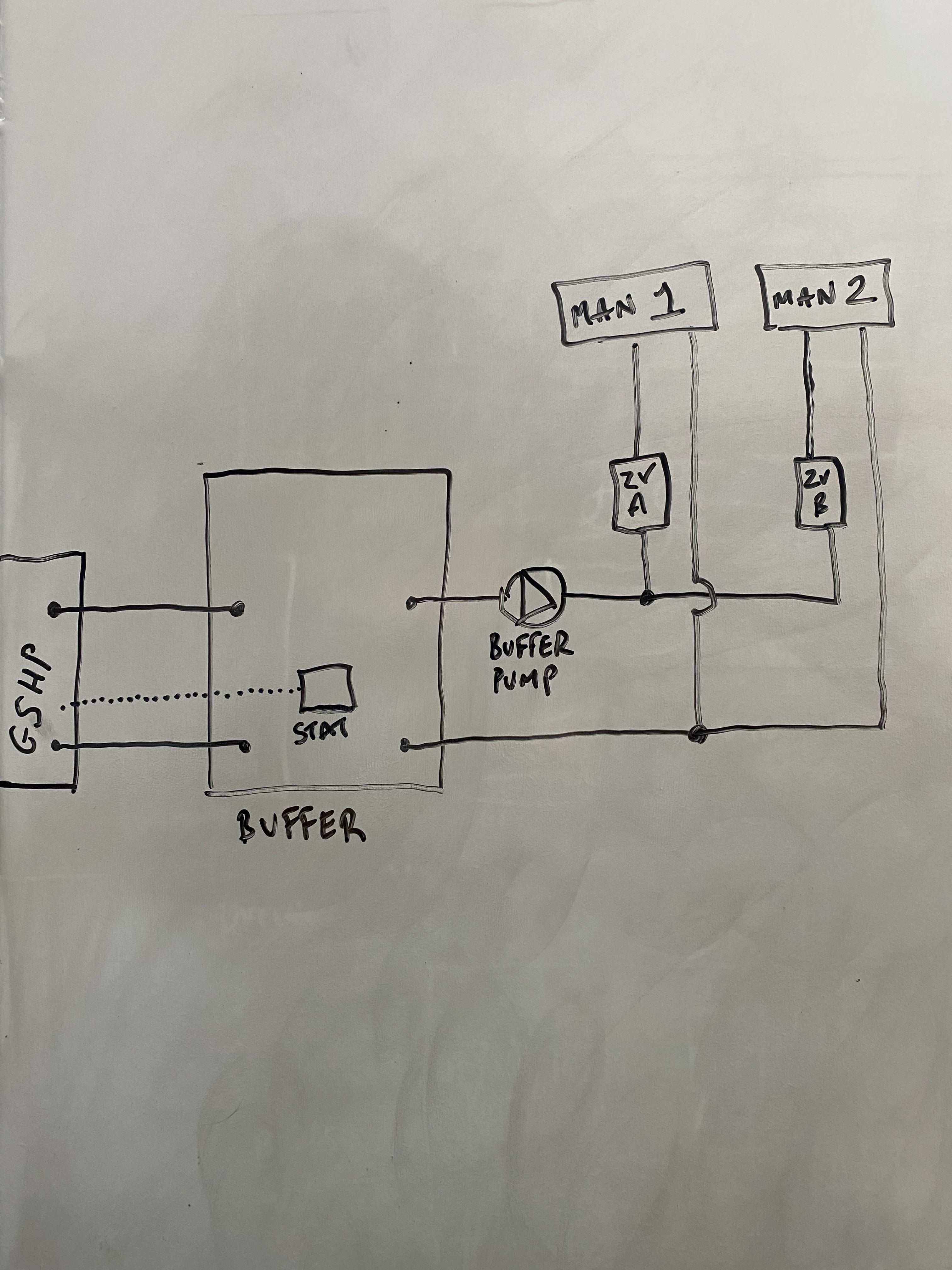
You cannot daisy-chain through the 2 manifolds as shown. The arrangement needs to be plumbed as per my scribbling. The bypass only needs to be installed if there is a situation where the buffer pump is on when the UFH manifolds are both satisfied and all zones have shut ( eg if you have an incorrectly installed / plumbed / wired system which you appear to have. The proposal for use of yur system from get-go is crude on a good day and is not a design |I would offer or promote, let alone install and walk away from. Stop asking about quick fixes, there aren't any -
It means you need to get 6.4kW of energy into the UFH to maintain an internal ambient of 20oC, in a nutshell. There are other dynamics like outside air temp but you can likely use that as a seasonal average heat input requirement to base a design on. Any gas boiler will do that on its head, but a lot will not go down as low as that on their minimum setting ( max modulation ) and still be happy, so hence the buffer tank needs to be introduced to stave off short cycling ( where the boiler produces much more heat than the heating needs at any one time even when the boiler is set to its lowest setting ). It's down to how much w/m2 the UFH can emit, at a set max ( safe ) flow temp, vs the heat the room requires to stave off the heat loss of that room. As far as hot water is concerned, you could fit a Vaillant 938 and that will run two 'just about ok' showers simultaneously but will be 100% reliant on cold mains pressure / flow whilst showering. If someone flushes a loo or the washing machine fills, you're Donald Ducked. Only an UVC or thermal store will give the top rates of flow to two showers. As you need a buffer for UFH, you may be better off with a thermal store ( a buffer heated by the boiler which has an instantaneous DHW coil inside it ) and go that way, but without room for a cylinder you may as well go for a heat-store ( high-flow ) combi like the Vaillant.
-
GSHP, Buffer tank and UFH
Nickfromwales replied to Fraser Lamont's topic in Ground Source Heat Pumps (GSHP)
-
GSHP, Buffer tank and UFH
Nickfromwales replied to Fraser Lamont's topic in Ground Source Heat Pumps (GSHP)
-
GSHP, Buffer tank and UFH
Nickfromwales replied to Fraser Lamont's topic in Ground Source Heat Pumps (GSHP)
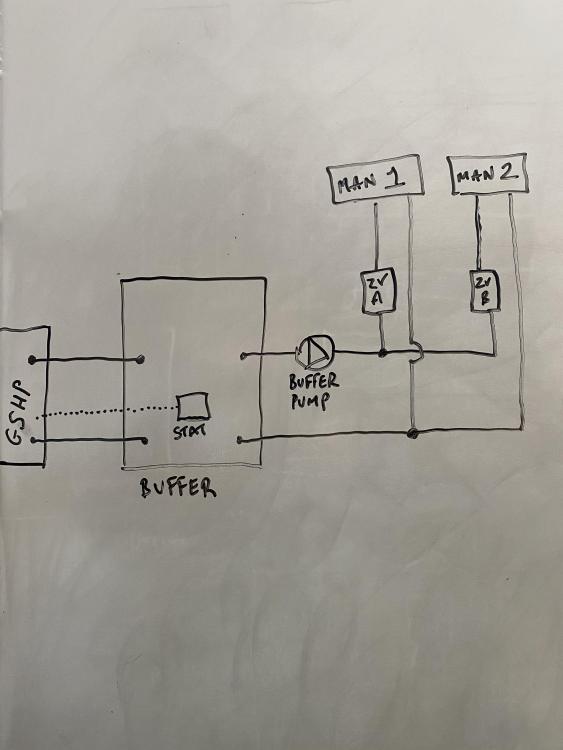
Zone valve A and B would be on the flow to manifold 1 and 2 respectively. -
GSHP, Buffer tank and UFH
Nickfromwales replied to Fraser Lamont's topic in Ground Source Heat Pumps (GSHP)
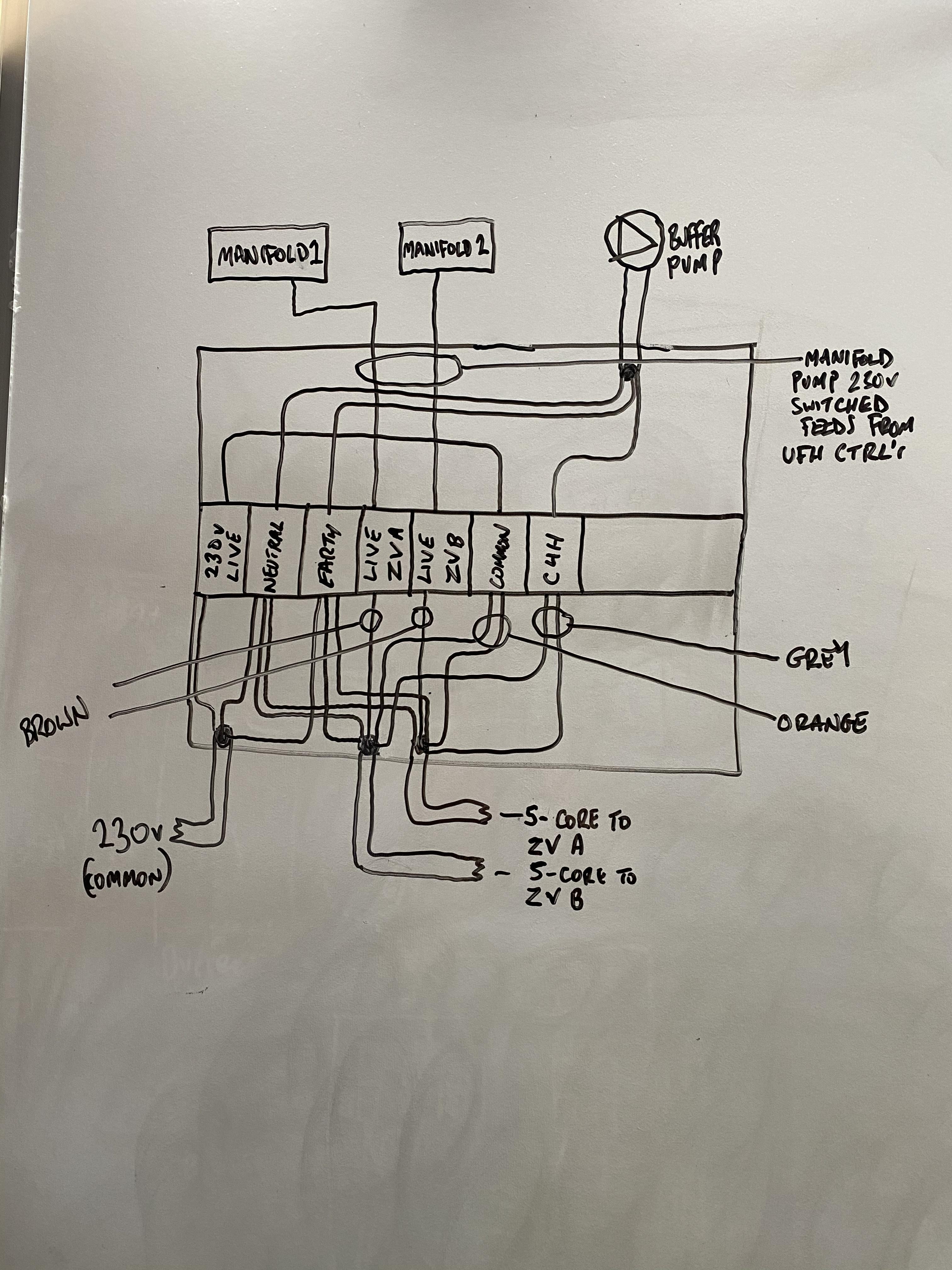
Buffer tanks do have coils, so they can promote true hydraulic separation whilst still maintaining heat transfer between mediums. Buffer tanks commonly have no coil, agreed, but the above is inaccurate. Then it's a shit design. The call for heat signal should be made to the GSHP from a tank / cylinder stat on the buffer tank. The GSHP will ramp down and switch off when that stat is satisfied, in heating mode aka winter, and then the energy in the buffer tank gets depleted and calls for heat again. The buffer should have been sized according to the system size and heat demand eg to stave off short cycling. The buffer tank should only be between the GSHP and the buffer, and the DHW UVC should see the GSHP directly. That means the buffer only heats in the winter This needs to be rewired by someone who knows what they're doing. It's not a million miles out, just needs tweaking to set it up properly. The pump you show should be brought on by the 230v supply that brings the manifold pumps on, but that needs to be via a pair of relays so the two manifold pumps cannot 'see' each other eg one manifold with demand cannot then inadvertently back feed the second manifold pump. At this stage ideally you want a 2-port zone valve on each manifold, after the buffer > UFH pump, and before each manifold. Then each 2-port zone valve will provide this separation and they then control the pump instead. That's how it should be have been set up in the first place imo. See diagram -
GSHP, Buffer tank and UFH
Nickfromwales replied to Fraser Lamont's topic in Ground Source Heat Pumps (GSHP)
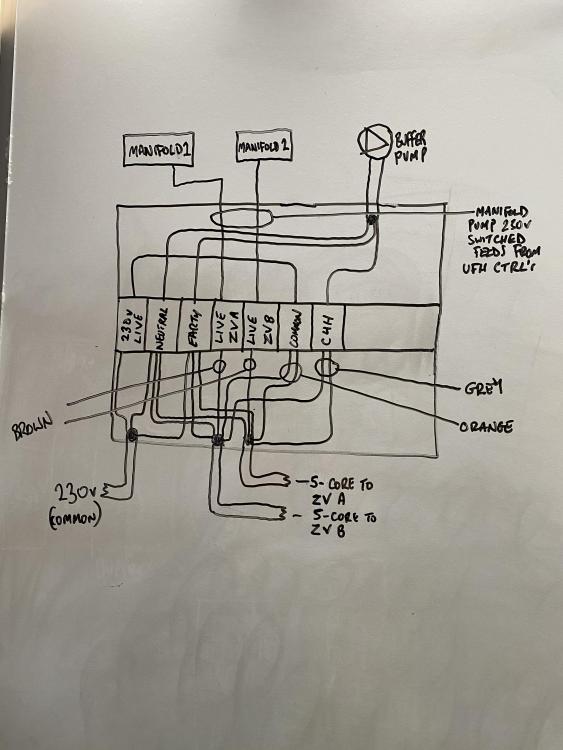
-
GSHP, Buffer tank and UFH
Nickfromwales replied to Fraser Lamont's topic in Ground Source Heat Pumps (GSHP)
Hi. When the heating is satisfied and no stats are calling for heat, does the pump you’ve indicated between the buffer and the manifolds shut off? -
I doubt if the offending pipes are in the bathroom, more like the long straight runs under the floors to get there. Usually it’s caused by the long runs between the joists which never get clipped in or are just rested on noggins, with the pipes free to bounce around a lot or just slide in one direction when the waters flowing and then ‘bang’ back to their original resting place when it stops ( hence the term “hammer” ). The noise may seem to come from the bathroom, but if you go elsewhere and ask someone to knock the tap on/off you’ll likely hear it further away. The cheap / quick fix is to install the EV. 8L is a lot bigger than I anticipate you’d need, but to diagnose this remotely means I err on the side of caution. Plus, you can never have too much expansion only too little. The cost difference is a round of drinks, so better off do it once and go a little overboard.
-
Can the toilet waste water flow straight down from the trap?
Nickfromwales replied to Ben100's topic in Waste & Sewerage
If you petition your building control officer, you should get him / her to agree to a deviation. As you have less than 1300mm between inverts ( the level where the water sits in the WC pan, and the lower level of the horizontal pipe you are connecting to 1000mm below, you don’t actually need either of the above. I would recommend an anti-siphon trap on the basin only as a belt and braces arrangement, but ( and I have assumed this ) you’re connecting into a horizontal stack then you won’t have any issues with vacuum deficit from flushing the loo, as the drop of 1000mm and then turning to horizontal ( so then getting a full air-break at that point ) a vacuum will it happen. Question is, what does the horizontal pipe....... .......service? If this goes to a bathroom then you need to ensure that adding to the soil pipe at the point you are suggesting doesn’t cause other issues. Does that terminate at a vent or air admittance valve etc? How do you intend to join to that gradual fall pipe? Replacing a bend with a T, or cutting into that existing the horizontal pipe at a mid-point? A pic of the topology would help, just scribble and snap and post it for us to give as best advice as possible. -
It can cause old joints to give up, but only in extreme situations really. The pipe is physically moving during generation of the hammer noise so it is something to address if possible. The UVC is a cold mains dependant device so hot and cold are married, hence the issue sometimes resides on both supplies, but giving the system some expansion at source ( stopcock ) should wipe the issue out systemwide.
-
If it’s a ‘bubble top’ cylinder ( which traps air in the upper 1/8th for expansion ) then all you do is completely drain the tank ( using a hose pipe to drain from the cylinder drain off cock, not by just opening the hot taps ) and then just refill the cylinder to replenish the bubble. Simple as. The pipe coming out of the top just extends down inside the cylinder, referred to as a ‘dip pipe’, and that makes sure the air cannot come out with the flow of hot water. The cylinder type needs to be confirmed somehow of course, but if you had zero expansion you’d be seeing water discharged out of the pressure relief valve on every single reheat cycle. The higher discharge for a few seconds is usually just the volume of expansion giving up its stored energy, and then you drop back to direct mains whilst the taps are open. When shut again, the stored energy builds back up ( cold mains incoming potential ) to allow the same to occur again. That tells me that expansion is present, otherwise you wouldn’t have that notable higher initial discharge. Having no water hammer on the hot fortifies that opinion, so I’d say you have an aggressive cold mains and that is being further exacerbated by poor mechanical fixing of the house cold water pipework. Buy a 8L potable expansion vessel and install it on the cold mains as close to the stopcock as possible. Do that first, before touching anything. To commission it you need to know the static cold pressure at the stopcock so you can set the 8L EV back charge pressure accordingly.
-
Vaillant Arotherm Plus
Nickfromwales replied to ash_scotland88's topic in Air Source Heat Pumps (ASHP)
Poorly fitted / incorrectly spec’d ASHP job Long story. -
It's unnecessary IMO, as you'll not be putting such a thermal break in the rising masonry work. Just install a robust perimeter insulation to keep the heated screed from losing heat to the walls and you'll be fine.
-
Replacing thermostatic head sensor
Nickfromwales replied to DIY_Amateur's topic in Underfloor Heating
Drain down and disassemble. Do the job properly -
Also, what is the purpose of the digital mixer after the buffer? Just to reduce the flow temp in the pipework? If so, do away with it and just insulate the pipes well. In actuality the ASHP flow temp can just be set a bit higher than the target temp, so the digital mixer is redundant tbh.
-
A buffer with an in and an out; so it can be in series with the ASHP pump and still promote throughput from that single pump. Your current schematic doesn't allow that throughput, hence my suggestion of the "secondary pump". No. That function is performed by the manifold pumps alone. Yes, exactly. The other risk comes from your better half beating you to death whilst wearing three jumpers to stay warm In cooling mode you would ignore the room stats, ergo the system needs no buffer medium in that 'state' as it has the entire system volume, unhindered, so max flow rate will easily be achieved and more importantly maintained. You'd have to have a diverter valve on the flow to the buffer to 'toggle' the buffer in / out of circulation. Pretty easy to do with the buffer you have ( I didn't realise you had already bought so ignore my 2 pipe suggestion ). If you install ( which I suspect you need to ) the secondary pump ( between the buffer and the manifolds ) then when the upper manifold shuts down, and the secondary pump potential is dedicated to the one manifold, and then that gets down to say one zone / loop, the bypass gives a runaway for the excess pump potential....... vs turning that pump down, which you cannot do as the system will need that full potential for cold start ups. The alternative flow path is simply back into the adjacent return, a bit like an infinite loop. Assuming zone valves not actuators? The norm is normally closed, so stick with those IMO. There would be no hammer, as the ZV's tell the pump to spin, ergo there is no flow during the closing of a 2-port zone valve.
-
Just chop it off at the first available clear bit of pipe, after a fitting, glue a fitting on, and bingo. No need to convert the stack if you’re happy to just take your time when cutting it.
-
Location of UF manifold, distance from boiler
Nickfromwales replied to gdal's topic in Underfloor Heating
15m is no problem at all. In any kind of “half decent” outhouse, eg draught-proof and weathertight, you will be fine with a regular domestic boiler. The requisite will simply be for a frost stat ( if the chosen boiler doesn’t already have one ) and all the pipework ( in particular the condensate drain ) are super insulated. The question has to be, why would you put it out there if there is a better place ‘indoors’? -
Where the waste pipe connects to the stack, the white waste has an elbow. Cut the pipe 40mm past that elbow, and simply pick up the waste from there. Do you know if that is 40mm ( 1 1/2” ) ? If not, then you’ll need to do as per @Temp’s solution above.
-
Hog tripe. If the joints are sound, it’ll be “all good”. Rodding access plus the speed upon which things will be getting to at that last bend = near zero risk of blocking IMHO. Only a blockage at the IC would cause issue, and that’s not an everyday occurrence.
-
The last bend is rod-able from the inspection chamber so ✅ and the bend upstream of it is rod-able if you put an inspection socket directly into the top of the rest bend. If it were me, I’d have the Y branch and 45 to vertical as the rest bend, and that would allow the stack to remain in one straight line. Show BCO that the Y branch is to be set in concrete, so it’s not taking weight / cannot move, and you should be allowed a deviation here ( unless it’s the BCO I’m currently working with who is, in the words of James May, a cock.