
Nickfromwales
-
Posts
31390 -
Joined
-
Last visited
-
Days Won
346
Everything posted by Nickfromwales
-

I’m confused about ubiquiti
Nickfromwales replied to Adsibob's topic in Networks, AV, Security & Automation
Currently looking to change the one ubiquiti Lite AP on my landing to an Ubiquiti AWiFi 6 Pro (U6 Pro). Hoping to get all of the inside of my 4 bedder covered by just the one AP. Everything fixed in my house now has a cat6 to it, so this is just for iPads / iPhones / guest etc. -
I’m confused about ubiquiti
Nickfromwales replied to Adsibob's topic in Networks, AV, Security & Automation
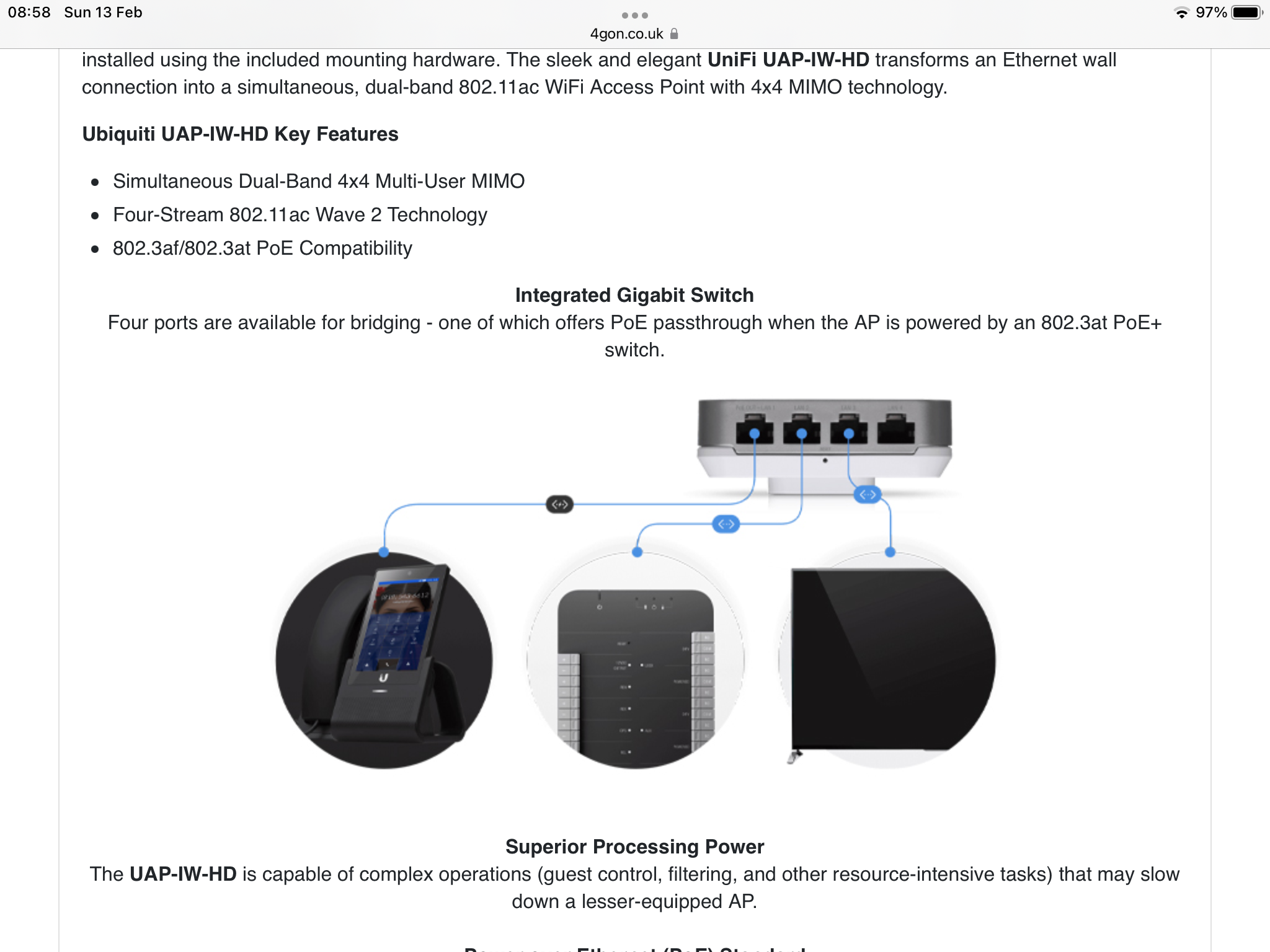
@Adsibob If you want simple and robust, and you don’t want to sacrifice any of the installed CAT6 points, the plug n play ubiquity wall mounted AP’s will create local WAP connectivity AND provide you with a LAN connection with data throughput in one device. Some have one port, others are mini routers ( juiced up by you installing a PoE injector upstream ), so mega flexible in one small wall mounted device which gets its power remotely.

-
Passivhaus window suppliers to UK - recommendations
Nickfromwales replied to markharro's topic in Windows & Glazing
How did they compare on price? Did you get ( like for like ) quotes from anywhere else? -
Welded vinyl will be more prone to failure at the start and end of the seams, plus it just looks soooo utilitarian. Tiles look a million dollars, and would negate the step in the wall with the skirt trim too.
-
crack in sand and cement screed
Nickfromwales replied to Porthole's topic in General Construction Issues
@JSH laid travertine over his constructional raft and no issues. If you talk too loudly around travertine it will break, so good enough for him, good enough for me……good enough for anybody. -
crack in sand and cement screed
Nickfromwales replied to Porthole's topic in General Construction Issues
Yup. Plus ring and intersectional steels. -
crack in sand and cement screed
Nickfromwales replied to Porthole's topic in General Construction Issues
Got 140m2 of tiles down over a passive raft with low temp UFH. Done loads, zero cracks, not even hairline. The clash of the tiling titans may now commence!! ?? -
crack in sand and cement screed
Nickfromwales replied to Porthole's topic in General Construction Issues
Low temp slab can usually get away without expansion joints, but deffo good insurance with screed. ?? -
They only get energised to change state, and that stores energy in a spring to return to the parked position ( Honeywell do anyhoo ) unassisted by electrical input. Your above statement is too general, eg “several different ones”. Which ones? State the valve type and model of the ones that consumes power 24/7/365 please. I’ve got Honeywell ZV’s that have been in for 20 years now and fitted for people I see frequently.
-
crack in sand and cement screed
Nickfromwales replied to Porthole's topic in General Construction Issues
Needs to be off / slab cold for at least 48hrs before going anywhere near it with tile adhesive. That’s for the Ditra too. Mop the dry screed with 50/50 primer and water until pretty much saturated. Old school janitors mop is the weapon of choice, and mopping gets all the dust / surface contamination dealt with. Not lost a tiled floor in nearly 3 decades of tiling. Do NOT turn the UFH back on for a minimum of 2 weeks after laying, and then start at the lowest temp and increase by 2oC every 48hrs. -
crack in sand and cement screed
Nickfromwales replied to Porthole's topic in General Construction Issues
Oh, and turn the heating down! 40oC is too hot for a new / fresh screed. That deffo didn’t help 30oC max for a month. -
crack in sand and cement screed
Nickfromwales replied to Porthole's topic in General Construction Issues
Hairline cracks in screed are commonplace. Lost count of how many floors I’ve had put down and had subsequently cracked in more than one place, and were tiled over without issue. Relax. At the VERY worst, if the crack was ‘serious’ or lots of them, you’d ask your tiler to install a decoupling membrane ( like Ditra Mat etc ) and sleep well. What size is the screeded area? -
Honeywell for me. Used them since day 1 and never had any issues. Reliable and robust. Industry standard afaic.
-
Off-grid water treatment
Nickfromwales replied to saveasteading's topic in Rainwater, Guttering & SuDS
Just a note: Don’t forget to run BLACK MDPE pipes NOT BLUE for anything other than potable water. -
Off-grid water treatment
Nickfromwales replied to saveasteading's topic in Rainwater, Guttering & SuDS
Building control doesn’t give 2 hoots about Bruce and Sheila mate They’re the ones that need appeasing. -
Off-grid water treatment
Nickfromwales replied to saveasteading's topic in Rainwater, Guttering & SuDS
Rainwater is category 5, which is about as bad as it gets in terms of its introduction into a residential dwelling where it can come into contact with / affect the health of humans. Im currently installing a RWH system, and the list of criteria to bring water for WC flushing and a washing machine is minimal in fairness ( 3 stage filtration with the facility to back-wash etc ) but in terms of it being ANYWHERE near potable systems then it’s a totally different ball game. To have the cold mains refill facility, eg a point where RWH and potable supplies converge, you need to fit double check valves to the cold mains fill point, have a 37mm ( A / A air break ) gap and label up accordingly, and that’s just for toilets snd washing machine. Borehole not an option? -
Depends how much heat energy the fabric of your home loses and what it then takes to recover it. Better off leaving it idle at a setback temp perhaps vs off?
-
80% guaranteed at the 10 year anniversary with SolarWatt, vs 70% with Solaredge. SW are using the same cell tech as is rolling out in the new BMW EV’s. SolarWatt are 100% owned by the brother and sister who own 80% of BMW. Pretty robust in terms of warranty longevity imho.
-
I’m tired. Just let me have that one ok. ?
-
?. Don’t you achieve that by not turning anything on much or at all? ?
-
Oh yea of little faith. I’m like a Swiss Army knife mate.
-
Chuck a DC Solarwatt battery on before the inverter and it’s not notifiable. You could put as much as you like in then as the only AC coupled stuff would be your existing equipment. ?.
-
It does if you want an MCS cert for the export payments, Baldric .
-
Agree with the above 100%, but it’s almost pointless going crazy in the extension and having that bolted to a draughty bag-o-carp You can have huge amounts of insulation ( to help with fabric heat loss ) but that will mean nothing without airtightness ( to help with ventilation heat loss ). With very good detailing eg attention to / knowledge of airtightness, you can then integrate an MVHR system, to recover otherwise lost heat from the infiltration. Infiltration can be from deliberate sources rather than missed opportunity, so be aware that a regular BRegs build would mandate trickle vents if you go airtight aka ‘draught proof’ beyond a certain ACH score. Also, you cannot just fit MVHR to the “good half” of a house MVHR will be one of the biggest rewards if you put the effort in, more so than just putting loads of insulation everywhere.
-
Over 9m2 area requires planning permission.