
Nickfromwales
-
Posts
31390 -
Joined
-
Last visited
-
Days Won
346
Everything posted by Nickfromwales
-
A veritable jungle, very much in need of a total and in-depth read, re-read, and digestion. Regardless of fault, ( eg if the fault cannot be resolved by a call-out engineer ), the owner is responsible for the removal of ( DE-COMMISSION OF ALL PLUMBING AND ELECTRICAL CONNECTIONS AND REMOVAL FROM THE RESIDENCE ), and the costs of transportation ( palletised ) to / from SA, and the re-installation of the unit. If this is your only source of DHW, then you will have a home which is inhabitable for that duration. "or ask you to return the product"....Deliciously shy on detail in that instance........ If you purchase outside of an approved installer, you will be subject to the terms and definitions, as set out by SA, and would likely be quoted "a non-standard installation" when refused your claim. For context, I went out to a property with a Telford UVC, some 5 years after its installation. It had failed and the owner asked me to come and replace it. I petitioned Telford and they DELIVERED FOC a replacement unit the following day, delivered by a courier they paid for, with the only condition given that they wanted the same delivery driver to be able to collect the failed unit at that same time. For further context, in 15+ years of being heavily involved in the heating and hot water industry, encompassing the installation and service of both unvented hot water cylinders and Sunamp units, I've only been back to the 2 aforementioned UVC's where the manufacturer paid up for one. Sadly, the number of failed SA units I was asked to attend to ( by both SA and the clients they refused to service ) is 'substantially' more. The message here is about the correct design and informed implementation of whatever your chosen DHW device is to be.
.thumb.png.506460699448825d14f66d20ed59a3d3.png)
-
One where they did = 0.88 ACH One where they didn’t = 3.02 ACH The internal face of the entirety of the house interior is your AT junction. Each to their own tbh, as results are results, and if you get the result then the method you chose is the one to be happy with. Parge for DIY or when using plasterers for the first time, even more so when it’s their first time on an AT project. Much easier to explain and execute afaic, plus you can check / polish off any areas of doubt before the boards go on. 100% dot and dab with woodcrete ICF.
-

Underfloor heating and radiators mix
Nickfromwales replied to Zentachi's topic in Introduce Yourself
Anywhere you like 👍 -
MCS would have insisted on maintaining margins all around the perimeter, that's how I knew it wasn't an MCS install
-
Self installing solar modules and inverter
Nickfromwales replied to Radian's topic in Photovoltaics (PV)
And the ends of the strings which need the MC4's crimping? PROPERLY? And the risk of death when they try to do all this during the daytime with zero prior experience. BAD idea..... -
Chill Winston.......your time will be coming soon. Then I will gladly kick the shit out of your idea! Oh, and never beg ok
-
Not an MCS installation? That's crammed in tighter than Brintey's postman!!
-
Minimum of £11k for a 4kWp system........
-
How did you get a price of £6k for 28kWh sized system?
-
Can you upload your plans? Not quite. Its the number of connected cells that dictates the discharge rate, which is then further 'choked' by the limit of the throughput of the BMS. It's the batteries that are the thing that slows down rates of charge and discharge. As above, no. Not very long! This will go up again after your initial 12 month contract with Octopus runs out. They will likely ask you to adopt a fixed rate tariff first, and then migrate you to the ToU tariff. The fixed will be >40p/kWh from the get-go. Correct. You would also be hammering the guts out the system every single day, so its lifespan would be reflected in that usage pattern. You would need to choose equipment that had a warranty based on unlimited throughput. Not even in the ball-park for a system such as the OP's requested capacity. Triple that, unless going for the cheapest of Chinese. @SBMS If AC coupled, have you yet done a DNO application? You would likely need a 3-ph solution, further increasing costs / complexity.
-
Deffo parge afaic, regardless of which woodcrete system. Just achieved 0.88 on one such build so "it can be done" Bolster that with Passive Purple / similar blower proof painted / brushed on ( liquid ) membrane for the tricky areas and junctions where timber meets ICF and you'll have great results. What stage are you in the build?
-
Self installing solar modules and inverter
Nickfromwales replied to Radian's topic in Photovoltaics (PV)
If you can convince yourself that you will self-consume at least the lions share of what you generate, then do as @ProDave @canalsiderenovation and others have done and DIY for as cheap as you possibly can. Any decent electrician should be able to do this from start to finish. Installing the trays / mountings etc couldn't be easier, but a roofer cannot run DC cabling and make off MC4's so I would not pursue that advice tbh. -
For anyone not well versed in this, and for pretty much guaranteed results, this is a good option. Fast, good airtightness, and walls can be made arrow straight. Fortify this with tapes / membranes and you'll achieve great results.
-
Be careful what you say to him.....as he'll talk you into an apprenticeship!
-
Underfloor heating and radiators mix
Nickfromwales replied to Zentachi's topic in Introduce Yourself
Link These are what I use for a retro-fit where gas vs UFH is the remit and space is tight as they are wall-mounted. The 25 and 50L show as out of stock, so ask about availability. Other sellers are punting the same unit out for more money. Telford are now doing small buffer tanks, so if you require such a unit, contact Trevor from Cylinders2go and mention the forum and he will give you a discount.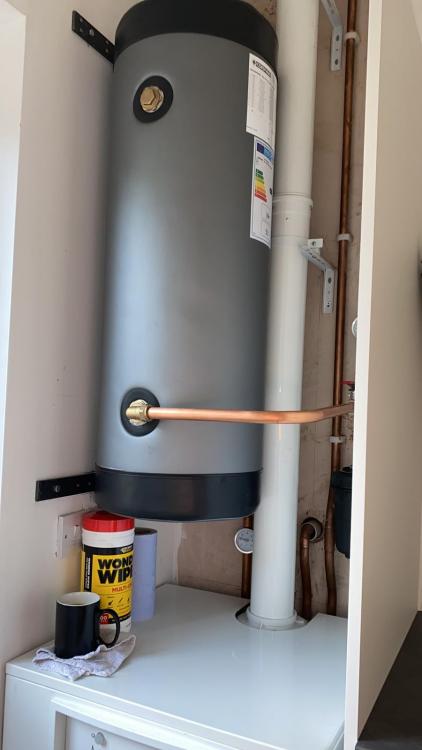
-
Read the small print Over 60's are 5%, and under 60's need to have left 60% of the installation cost ( in materials ) behind to attract 5%. That's assets only, and doesn't include labour / scaffolding etc. Best to check your individual eligibility first.
-
How are you 5% VAT? Is this part of a large refurbishment?
-
Underfloor heating and radiators mix
Nickfromwales replied to Zentachi's topic in Introduce Yourself
I have found these to be rather complicated and somewhat unreliable tbh. I won't be using that system ever again ( and I've been installing central heating for nearly 30 years now ). Have a good read of the existing content here first, as this has been discussed quite comprehensively. You will definitely need to introduce a buffer tank to this setup to allow the UFH to run independently and reliably without short-cycling the boiler. Do you know if there is any insulation in the existing floors / walls? What is in the attic? -
Hello - Caravan Act compliant buildings
Nickfromwales replied to Pinzameld's topic in Introduce Yourself
-
Hello - Caravan Act compliant buildings
Nickfromwales replied to Pinzameld's topic in Introduce Yourself
@Pinzameld Check out @Crofters blogs / posts. He’s done a demountable building under the same guidelines iirc. -
Have many on here had comparative costs to go from a regular foundation system ( block and beam over trench or the type of system linked a few posts back ) vs a passive raft ( assuming screw piles are not required in each instance )?
-
It is a bridge over the possibly unstable ground in between the trenches. A raft over trenches in essence. It also gives a uniform level platform for the insulation to sit on too. Not necessarily a problem with a poured floor / screed, but a nice surface to work from nonetheless. Ground conditions are everything with foundation designs so proposals will differ site to site.
-
Under cabinet lighting bars
Nickfromwales replied to Tyler's topic in Electrics - Kitchen & Bathroom
Yup. Male / female arrangement also, so no 'male' end on the light fitting itself can be touched when live and no connector inserted eg end of line fitting. -
Under cabinet lighting bars
Nickfromwales replied to Tyler's topic in Electrics - Kitchen & Bathroom
Agreed, and known. Yet OP pic shows that tooth which may be a manufacturer specific plug / connector vs the 'fits into anything, any way around' figure of 8 , and therefore it is likely the Interna plug / connectors will not go into the TLC fittings. Added for info so the OP can decide the best path. -
I think it’s assumed that the overlay would either be a compromise / get out of jail solution, or would be atop an already insulated substrate. Let’s not get our knickers in a twist over a retrofit solution “it is what it is”.
.png.af5188ffba18c1d9c021d58094f19d1a.png)