
Nickfromwales
-
Posts
30346 -
Joined
-
Last visited
-
Days Won
297
Everything posted by Nickfromwales
-
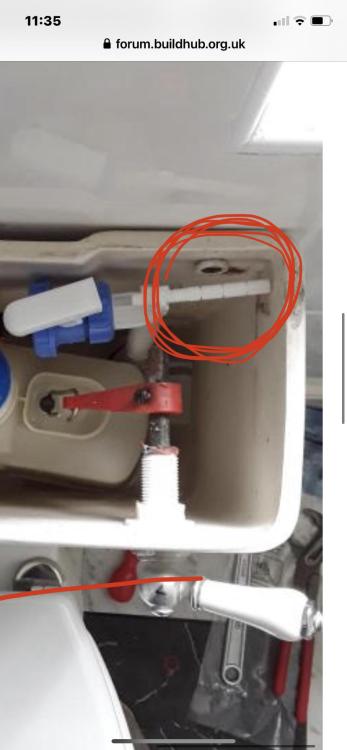
That has markers where you cut it shorter Just have it so it slightly stands off the cistern wall, but it’s there to offer opposing force when the float rises so is a functional part.
-

How to work out if any doors need to be Fire-Doors
Nickfromwales replied to NewToAllOfThis's topic in Doors & Door Frames
Things are further relaxed in a “single compartment dwelling” eg where there is an open plan hall / stairs / landing as a fire upstairs is assumed to be already downstairs and vice-versa. 2 storey, no need. Only on garage as already said. -
OK. Firstly, only use copper for the primary pipework whatever you do!! No other product is rated for boiling water / steam. That's why the gravity tanks should be galvanised steel, as plastic tanks melt and shower occupants with scalding water. People have been killed by this happening where they got scalded to death in their beds when the tanks just folded in and dropped on them. It's a very serious issue. These two bodies of water should not be meeting? The heated primary water should be going through a coil? Is this a failed / failing primatic hot water cylinder? Buy lots in the summer, as the cost of this system conversion will not be cheap!! Simple to achieve tbh, but the Rayburn will need to a) keep the galv header tank, or b) be garnished with a retrofitted cold mains fed quench valve ( which cools the solid fuel device with mains water ) but that may not be suitable / compliant for an existing device. Also being mindful that your cold mains is power-dependant, so adds another degree of complexity!! I'd just keep the header tanks tbh, renewing them to be sure of longevity / suitability / reliability etc. The ground floor cylinder could then just be a gravity thermal store, stainless steel to combat corrosion issues as best as possible, and a very simple device where all bodies of primary water are shared, eg your hybrid setup would simply converge there. Where is the current cylinder? In this 630mm wide location or elsewhere? If there is a second cylinder location available, I would go; Rayburn > TS TS > Space heating Oil > Space heating ( ignoring TS when Rayburn is not in operation ) future-proofs against old age / sick days etc. Oil > DHW UVC ( when Rayburn not in operation ) "" ditto TS > DHW UVC ( when Rayburn is in operation ) doubles up thermal storage capacity to maximise 'stored' heat, eg DHW still ( residually / theoretically ) available early morning before lighting Rayburn This house will never run off a heat pump. Flush that idea from here please!?! Doable Nope, not for heating anyways. Prob need the keep a CWS from the borehole for reliability. It's an attic, just leave it alone / utilise it to your advantage ( benefit ) imo. Not for the primary heating from solid fuel, copper best for the backbone here afaic. Nope. That means added maintenance for the old-folk, topping up, checking pressures, etc. Will also promote introducing leaks where weak spots currently reside. Poops on my idea for a dual-cylinder arrangement. If this is for the parents to grow old with, consider the en-suite / bedroom arrangement for downstairs maybe? Electric showers are shart on a good day, also not thermostatic unless you upgrade? Mixer showers off the TS or UVC would be far superior, plus pointless having PV diversion if it's going into a dead end whilst grid electricity is chewed up in parallel?? OK. Lets start there
-
To watertight only, or go all the way?
Nickfromwales replied to Mr Blobby's topic in Project & Site Management
They're graveyard quiet when built, and the roof ( 400mm with MBC ) is even more so. PIR based frames tend to be quite acoustically transparent, brick and block so / so, cellulose wins hands down. Seriously unimpressed with PIR ( SIPS esque ) roof designs, way too noisy for my liking. -
Need for making ceiling cut outs airtight with a warm roof?
Nickfromwales replied to Madasahatter's topic in Heat Insulation
Do you mean the MVHR will service the rooms in the roof space, eg you will have habitable spaces up there? Infrequently visited spaces will all need full building regs compliance, eg the guarantee of airflow to manage CO2ppm / humidity etc, which is not a "choice". Not all spaces in an airtight house need to be serviced directly by MVHR duct placement, as a house with MVHR running 24/7/365 will already be inherently 'dry'. What is your target airtightness score, eg to know MVHR ( certainly the heat recovery element ) will be of any useful functionality. If the design airflow raters are less than the residual natural infiltration rates then MVHR becomes a questionable choice. You should be aiming at a score of <1ACH if wanting to maximise the return on the investment. -
Oversized Air Source Heat Pump
Nickfromwales replied to Ambaz79's topic in Air Source Heat Pumps (ASHP)
Do you really want to have to heat a tank that size to over 60oC all summer just to get DHW? Any cooler would need a monster of a heat exchanger for decent DHW flow rates / temps? -
To watertight only, or go all the way?
Nickfromwales replied to Mr Blobby's topic in Project & Site Management
Amen..... -
Adhesive for wall panels (shower room)
Nickfromwales replied to WWilts's topic in Wall Tiles & Tiling
Mermaid specified Everbuild Stixall Crystal Clear ( which is basically CT1 in a different tube from the smell of it ) for a 4x bathroom install I did where the clients went with Mermaid panels ( same 'glue' specified for both thin PVC and the Formica laminated wood alike ). Same product used to bed the bottom of the panels into / onto the shower / bath / floors etc, and PLEASE do not use the ghastly base trim they recommend, as it's a huge trap for water / grot etc and is completely unnecessary AFAIC. Also a horrible detail where it needs to stop short eg at the end of a fixed bath or shower tray. -
To watertight only, or go all the way?
Nickfromwales replied to Mr Blobby's topic in Project & Site Management
"you can now manage without either of them" -
To watertight only, or go all the way?
Nickfromwales replied to Mr Blobby's topic in Project & Site Management
More than one near miss for sure lol -
That's a good job tbh, so defo worth the screws in that instance. Small head screws like No.3.5's leave more coverage for the skim over the screw head so be mindful not to use pan-head etc that's all as you dont want more skim on than the depth of the lip of the fitting ( which is what you're supposed to skim to ).
-
To watertight only, or go all the way?
Nickfromwales replied to Mr Blobby's topic in Project & Site Management
£5k. Final offer. -
To watertight only, or go all the way?
Nickfromwales replied to Mr Blobby's topic in Project & Site Management
👊 -
To watertight only, or go all the way?
Nickfromwales replied to Mr Blobby's topic in Project & Site Management
Don't make me ring your wife........ -
Eco Self Build - System Design
Nickfromwales replied to deancatherine09's topic in General Alternative Energy Issues
Whether SA or UVC, you defo do NOT want to be taking space heating from the point you show it entering "valve". Who's specified this? Also, having a SA means running at very high temps to get a speedy reheat of the DHW.......which PCM is the current flavour? 58? -
To watertight only, or go all the way?
Nickfromwales replied to Mr Blobby's topic in Project & Site Management
Crack The FCUK On Simples -
To watertight only, or go all the way?
Nickfromwales replied to Mr Blobby's topic in Project & Site Management
Sounds perfectly reasonable Just pay the man, he's got kids to feed !!! PS, as a BH Buddy favour, i'll come over and do the CAT6 for £9k, that's a saving of a thousand pounds Seriously....how do these people get any work? That's crazy money for this build.... -
The term is "exporting" the earth, vs "extending" it Exporting the earth is defo something a qualified spark would identify on site, and as this refers to work which would typically be notifiable the assumption would be that it is to be done by a qualified person. The distance and type of service need to be of significant interest to warrant not exporting the supplied earth from source tbh. Needs to be surveyed and understood, but if less than 15m or so from the house I doubt very much it would need the earths being made divisible etc.
-
Assuming just power socket(s) and lighting? If so, as per @ProDave, and just run it to a double socket, Use that double socket as a junction box, and branch off with 2.5mm2 ( regular twin and earth when inside is fine ) to a switched fused spur. Locate that where you want to be able to operate the light(s) from, and install a 3a fuse to comply. Run 3-core flex or 1.0mm2 T&E to the light fittings and job done. No need for a CU there then.
-
Yup. Plus they do nothing when screwed into 12mm of plasterboard. The caulk holds them rock solid, when completely dry. Screws just come out and get binned.
-
Plasterer skims flush to the lip, painter rollers straight over. Easy thing to get great results with.
-
That'll take some explaining lol 😆
-
Are these spreader plates salvageable?
Nickfromwales replied to ADringer's topic in Underfloor Heating
Ok, just not sure laying on the PB constitutes a "safety zone". Sparky should be able to decide that. Yup, wool used to force the panels up about 20-25mm higher than top of joist should work well. -
Are these spreader plates salvageable?
Nickfromwales replied to ADringer's topic in Underfloor Heating
OK, thanks. Not at all ideal to be installing cables in that heated space..... Have you consulted a sparky for compliance /de-rating the services etc? As its 1st floor, just do wool tbh, as you're already within the heated envelope. -
Are these spreader plates salvageable?
Nickfromwales replied to ADringer's topic in Underfloor Heating
!00mm under a heated floor is barely scraping regs btw.