

Nickfromwales
-
Posts
31387 -
Joined
-
Last visited
-
Days Won
346
Everything posted by Nickfromwales
-

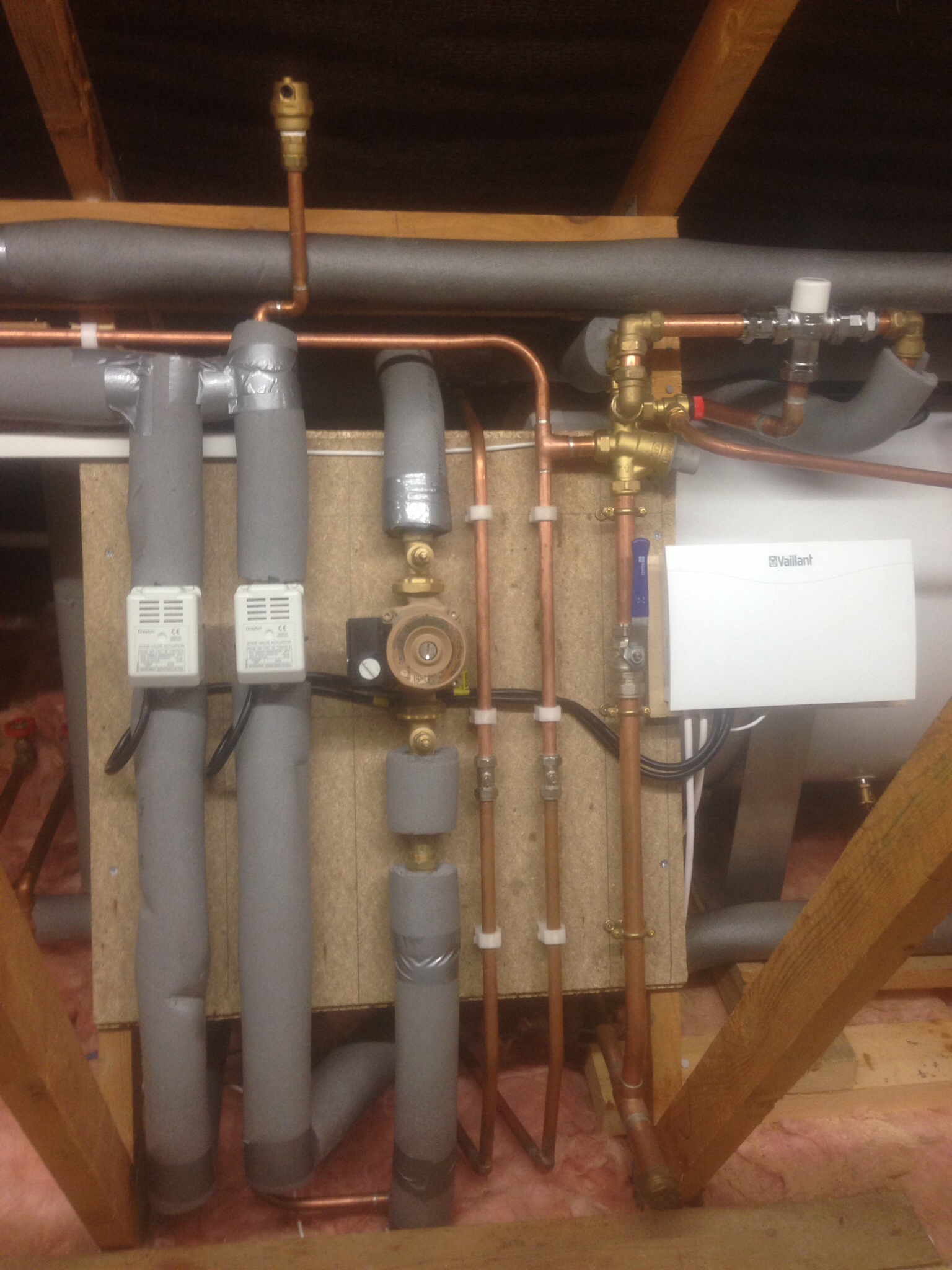
Installation of Vaillant AroTherm Plus - DIY
Nickfromwales replied to BartW's topic in Air Source Heat Pumps (ASHP)
I use screened Cat5 and put on of the twisted pairs into a bootlace for each core ( so 4 connections per Cat5 cable over 8 cores ( 4 pair )) -
How to ensure good tile adhesion - should I wet the wall?
Nickfromwales replied to Rob99's topic in Wall Tiles & Tiling
You need to prime these first, or the wet tile adhesive will just reconstitute the paint and the lot will fall off. https://underfloorheating-direct.com/ultra-prime-it-multi-surface-primer-39579-p.asp?gclid=Cj0KCQiAutyfBhCMARIsAMgcRJQDAkGRyn7AGC0-kosxI8Zl65oB8HirM96KPIT0ylPVK_u1EfnNRp8aAlUFEALw_wcB 50/50 with water and apply from a bucket with a sponge, with the solution not quite running down the wall. Wait an hour, then apply neat and leave to dry. After prob an hour or two you should be good to go.- 1 reply
-
- 1
-

-
First time plaster-boarding attempt
Nickfromwales replied to Dan1983's topic in Plastering & Rendering
Something like this will do tbh; https://www.google.com/search?q=gypsum+adhesive&sa=X&rlz=1C1GCEA_enGB860GB860&biw=1536&bih=754&tbm=shop&ei=r933Y46xFI7VgQa0tYmoBQ&ved=0ahUKEwjOxJKTzqz9AhWOasAKHbRaAlUQ4dUDCAg&uact=5&oq=gypsum+adhesive&gs_lcp=Cgtwcm9kdWN0cy1jYxADMgcIABCABBAYMgkIABAeEPEEEBgyCAgAEAUQHhAYMgsIABAIEB4Q8QQQGDILCAAQCBAeEPEEEBgyCwgAEAgQHhDxBBAYMgsIABAIEB4Q8QQQGDILCAAQCBAeEPEEEBgyCwgAEAgQHhDxBBAYMggIABAIEB4QGDoKCAAQgAQQsAMQGDoJCAAQCBAeELADOgkIABAeELADEBg6DggAEAgQHhDxBBCwAxAYOgsIABAIEB4QsAMQGDoJCAAQDRCABBAYOgYIABAHEB46DQgAEAgQHhANEPEEEBg6CggAEAgQHhANEBg6CggAELEDEIMBEEM6CwgAEIAEELEDEIMBOgUIABCABDoLCAAQHhANEPEEEBg6CggAEAUQHhANEBhKBAhBGAFQiRtY7DVgtUFoAXAAeACAAY8BiAHTCZIBBDAuMTGYAQCgAQHIAQrAAQE&sclient=products-cc#spd=9699038899737614391 -
First time plaster-boarding attempt
Nickfromwales replied to Dan1983's topic in Plastering & Rendering
Ah, schoolboy error. You have 600mm centres so should have one stud in the centre and one each end of each board ( hence 1200mm boards ). You can get some Knauf board adhesive in tube form, loosen the board off, and bond them onto the PIR and to each other. Use a scraper and a sponge to clean up excess, and don't go mad with the adhesive. -
Yup, absolutely, afaic.
-
It'll be of value to yourselves, as occupants. Just remember that our B.Regs in this country are absolute and total dog shite, so attaining the minimum of the minimum will yield.......... ( drumroll please ) ..........even shitter results. If this is your house, and you don't want to pull the boards back off afterwards, because the house has issues with acoustic transparency, then do it right, once, and put the thicker stuff in now
-
Did you tape up the Veka doors and windows? Are they 3g and rated 'airtight' or just good but regular uPVC stuff?
-
Ah, such a shame. I was looking for advice around getting a result of 0.31. I'll try a different thread. No bother. @Iceverge I watched the video, whats a "ceir" battery please?
-
Installation of Vaillant AroTherm Plus - DIY
Nickfromwales replied to BartW's topic in Air Source Heat Pumps (ASHP)
On 28mm pipe you can use 25mm wall insulation and then fix with a 3" waste pipe clip, with one every 400mm. That'll keep you nice and tight to the wall so you have less woodwork to do. If no appliances, use the plinth space and run them on the floor ( unless you bought your kitchen from a meat-ball vendor ). -
Installation of Vaillant AroTherm Plus - DIY
Nickfromwales replied to BartW's topic in Air Source Heat Pumps (ASHP)
Good idea. Crack on. Use phenolic insulation and do NOT clip to the pipe. You need to have movement in the mechanical fixings so you don't get any creaks. Also, you do not want to clip to the pipe if using cooling, as the stalks of the clips will be condensation forming points of contact. "Go for it" -
Fitting wet UFH into a very old cottage
Nickfromwales replied to blankton's topic in Underfloor Heating
Definitely do NOT put any kind of glue under the spreader plates, particularly . Just staple the living daylights out of them and that will take you to the max potential that you will ever see. Any kind of separation will have a massive impact on surface to surface contact, and the cured glue won't transfer heat. PU is an insulator! What we try to do here, is tell you the pro's / con's / caveats, and then you can make your own, informed, decisions. You're a bit past there as you've already jumped in and done the GF UFH. What you can do now is possibly look at the most efficient ASHP for your situation, and then also size it correctly ( so it doesn't get installed, and then simply scream until it dies early ). FYI, most ASHP's will have a stated service life of 7 or ( a few ) more years. After the stated warranty / service period, you're then on borrowed time and the design of the system will dictate how hard a life / how long it is then going to last. You may benefit from a high-temp split ASHP vs a mono-block for example, but if your brother only knows how to plumb vs how to effectively design a suitable installation and specify the equipment to compliment that design, then you may need to step on the brakes and re-think this before putting good money after bad / not getting the results you think you will. Not trying to piss on your chips, just better to stop and think for 5 than steam on setting fire to time and money -
+1, and I was going to also ask if the kitchen units are mounted on top of the floating wooden floor?
-
Installation of Vaillant AroTherm Plus - DIY
Nickfromwales replied to BartW's topic in Air Source Heat Pumps (ASHP)
Nope. This will likely only need a 25a breaker and a 4.0mm2 cable. Most I can see in the spec is a bit over 20a inrush, but constant power will be 6-7a max, or lower if the heat pump is running at very low temps. -
Installation of Vaillant AroTherm Plus - DIY
Nickfromwales replied to BartW's topic in Air Source Heat Pumps (ASHP)
Which model is it? -
Yup, looks like it. Shame really, as they deserve kudos for using that instead of scabby breeze blocks!
-
Do you know if there is a screed down? Do you have UFH?
-
Fitting wet UFH into a very old cottage
Nickfromwales replied to blankton's topic in Underfloor Heating
Yup, but the amount of heat lost in the transfer from the pipe to the deck and then to the floor will be significant. I've not seen the job, and I've not done the calcs, but I am speaking from experience of 30 years of heating and hot water, and I say you're off to a wonky start here. The ASHP is going to be running at almost full capacity, and that will likely also attract frosting when you need it the least. The FF UFH will have wooden floorboards over it, and then (?) more finished flooring. Thermal mass here is moot, as you need to worry about getting the energy in the water inside the pipe conveyed to the room interior. That's quite a journey. The spreader plates will all need stapling up from underneath so you have as close to 100% surface contact between the plates and the deck ( floorboards ) as is humanly possible. Neglect this and you'll be retrofitting rads afterwards. Can you tell us what is under all of this? Insulation thickness ( if any ? ). -
Hire a track saw, cut 25mm channels perpendicular to the joists, and drop in alu spreader plates. Pipe up, fill and test, and then apply a secondary 18mm deck atop with D4 glue and screws.
-
Fitting wet UFH into a very old cottage
Nickfromwales replied to blankton's topic in Underfloor Heating
This will be very crude, and an absolute bitch to balance out IMO. For the 2 different types of emitters, and the fact they are then over 2 different floors, mandates a second manifold upstairs eg so then 2 different flow temps are possible. You 5 million % need room stats and actuators and then each space can keep calling for heat as long as it needs to ( maybe after others have reached the set point and have closed off ). Don't worry about cycling the ASHP as you will also defo be fitting at least a 100L buffer tank, for this type of dwelling and with the type of system you have fitted / intend to fit. You underestimate, I think how much hotter the 1st floor system will have to run to do the same job as the ground floor one, so sending one temp via one manifold will be a recipe for major disappointment, sorry. Air rises, so a GF manifold serving FF UFH is an air trap waiting to happen. Unless this house is super insulated and very draft-proof then I fear this system may fail to meet your hopes and expectations. Do some heat loss calculations and revisit before taking one more step is my advice. -
W-I-W defo an extract, if sizeable. If a big wardrobe, prob nothing required / necessary tbh. Who's design are you working to? BCO will demand one in the utility regardless. Hall? I did the same in a project in Oxford were we installed an AHU after the MVHR, and introduced fresh ( cooled / tempered air in at the foot of the stairs and extracted stale air at the head of the vaulted landing seating area ). MVHR on it's own will do little to nothing there, unless boost rates are used in the peak of the summer months but will still only scratch the surface of moving stale warm air.
-
"Never let the bastards grind you down"
-
Minimum height of insulation build up on concrete slab
Nickfromwales replied to seano's topic in Barn Conversions
With todays energy prices ( and future ) I'd take that statement with a pinch of salt, sorry. I often suggest sand blinding > 25mm sacrificial EPS > DPM > 100mm EPS > 100mm PIR if the depth is there without £££'s, but same can be achieved with 150mm of PIR. IIRC 140mm is B.B.Regs for a heated slab, but I haven't slept much this week. The maths are further impacted on whether it's being heated by oil / LPG vs a well matched heat pump -
You can reduce to 2x 50mm pipes and rise to the attic, or 3x 40mm ditto, or 4 x 32mm ditto. They can be hidden in a stud wall and will have the capacity to deal with the same volume that the 110mm AAV provided. I would, at that stage, also install the mini AAV on the basin ( anti-siphon trap ) to further help out. Fitter #2 is wrong, and is using "wishful thinking", as there is no way that the 32mm anti-siphon trap is man enough to do the same job. The AAV is tiny on one of those. I've been redirecting SVP's to AAV's like this for a couple of decades, works fine and BCO have never said a word against it. Use compression AAV's not solvent weld as these do fail now and then. They must be accessible to, so factor that in when relocating them.
-
Yup, 10 pos and 10 neg iirc.
-
You still test room by room, but with the whole house pressurised. You're not looking to replicate Michael Jackson's "oxygen tent of eternity", so going full bore in each room may be a bit OTT? All I need now is somebody cleverer than me to tell me how to gauge the ACH from the DIY rig. The winner gets a half-eaten Greggs steak bake. Only been in the van for 2 days, still good.

