


Temp
-
Posts
10690 -
Joined
-
Last visited
-
Days Won
43
Everything posted by Temp
-
That snubber is a 100nf capacitor. Edit: Actually its a 100nf capacitor and 100R resistor but the capacitor is the main thing.
-
Is your BT modem/wifi hub in that cabinet? It's not a great idea to put a device that uses radio in a metal box as it blocks the signal. Have you recently put the cabinet door on?
-
I use an android app called WiFi Analyzer on my phone. It shows you the signal strength and details of other base stations that might be interfering. Could be the neighbours just set up wifi on the same channel. For reference: Three meters from my base station it reports a signal strength of about -50dBm. A base station the other end of the house is down to around -80 dBm. and speed is affected. I also use www.fast.com as a quick check of my internet speed. It just takes a few seconds to run a test. Currently I'm getting 33 Mbps over broadband and my house wifi to an old phone. Aside: BT use your hub to provide wifi to other BT customers but I would hope this doesn't cause performance issues. https://www.btwifi.co.uk/find/uk/
-
That would be my choice. Find a 4-5 day slot in the 10 day weather forecast and get the lot done right.
-
So a total of 175mm? The outside surface of the insulation is cold, the inside warm. In between these two places the temperature transitions between warm and cold. The definition of a "warm roof" construction is that the joists (or rafters) are located near enough to the warm side that condensation doesn't occur on them. If all of the insulation is above the joists then clearly the joists are on the warm side. Your proposal has part of the joist 75mm from the cold outside and 100mm from the warm side. So its actually nearer the cold side than the warm side which isn't good. Ideally you should get a proper condensation risk analysis done. Some insulation suppliers may do one for you.
-
Outline planning permission application requirements?
Temp replied to PXR5's topic in Planning Permission
The list for Outline Planning with all matters reserved seems simple enough. Are you talking about what needs to go in the Design and Access Statement? -
A version of BRE365 digest is here.. https://www.eden.gov.uk/media/1072/bre_digest_soakawaysdesign.pdf
-
What does that include? Perhaps ask the BCO what he needs for the drainage. If he knows the ground is free draining he may not need you to justify the size of the soakaway. Search online for guides like this.. https://www.drainagepipe.co.uk/soakaways-and-membranes/how-do-i-know-what-size-my-soakaway-should-be/ http://www.pavingexpert.com/drain08.html If you have clay or the BCO wants to see it all justified with data you may need a percolation test. If you also need a ground condition report to justify the foundation design do both at same time. If you can provide a JCB and driver it will be cheaper (ask your builder/ground worker?). I think if they have to provide JCB you could be looking at £1500 with the rest being for the drainage design. I might be out of date on costs. The BRE publish a guide to soakaway design (BRE365) which needs data from the percolation test to calculate the size. As I recall the design method in BRE365 is complicated but you might find a simpler method on line that is conservative (eg gives a bigger than necessary size). That's not necessarily a bad thing. In addition to sizing the soakaways you need to specify the location on the site plan and the layout of the pipes (soil stacks, man hole etc). A lot of this is in the relevant approved documents but it takes some reading. If you posted your house and site plans here someone might be able to suggest a layout but you couldn't sue us if it all went wrong.
-
Outline planning permission application requirements?
Temp replied to PXR5's topic in Planning Permission
South Oxfordshire have a check list here.. http://www.southoxon.gov.uk/services-and-advice/planning-and-building/make-planning-application/validation-checklists -
How frequently have they been unable to get to you? Our BCO turned up every time we asked.
-
We have two places where the gutter sometimes overflows. It's because gables and dormers create a lot of roof area feeding water to only a short length of gutter and one down pipe. Nothing we can easily do without fitting an enormous wide custom made gutter/hopper that would look ridiculous. Fortunately it only overflows in really heavy rain not the usual showers.
-
I think I would find 2200mm pretty darn oppressive and I'm not tall. In a design guide for London I found this... https://www.london.gov.uk/sites/default/files/housing_standards_malp_for_publication_7_april_2016.pdf The nationally described space standard sets a minimum ceiling height of 2.3 meters for at least 75% of the gross internal area of the dwelling. To address the unique heat island effect of London and the distinct density and flatted nature of most of its residential development, a minimum ceiling height of 2.5m for at least 75% of the gross internal area is strongly encouraged so that new housing is of adequate quality, especially in terms of light, ventilation and sense of space.
-
That's what I did.
-
I'm in Cambridgeshire where the weather men said it was 38c yesterday. Bedroom was 29C at 10pm. Felt cooler outside so i opened window and put a big oscillating fan on the sill. At midnight it was down to 27C. Fan ran all night blowing air in. Woke up about 6:30 to thunder and rain and stat says its 28C! We have mains pressure cold water at all taps. For last few days its been warm no matter how long you run it for.
-
Take lots of photos of anything you cover up just in case you need to switch back to the LABC.
-
Thread already running on green building forum.. http://www.greenbuildingforum.co.uk/newforum/comments.php?DiscussionID=16177&page=1#Item_0 Featured on BBC Radio4 last week.
-
Where do you stand regarding the building regs, escape from fire part B? Thought you needed windows that open. I mean getting fixed and opening windows to match up might be tricky?
-
I had a look to see if I could find a design guide from Westminster Council. Google found this which includes Policy CM28.4 on page 21. Google says "you" were consulted about it in October last year so it may have been formally adopted by now. Hope link works. http://www.google.co.uk/url?sa=t&rct=j&q=&esrc=s&source=web&cd=3&cad=rja&uact=8&ved=2ahUKEwifirbf28_jAhXwQUEAHeUnDFoQFjACegQIAhAC&url=http%3A%2F%2Ftransact.westminster.gov.uk%2Fdocstores%2Fpublications_store%2FDesign.pdf&usg=AOvVaw1Efq8zD6c4Z4Ik1p9NWxBK and I note it does NOT mention they must be setback only "subordinate" in other ways.
-
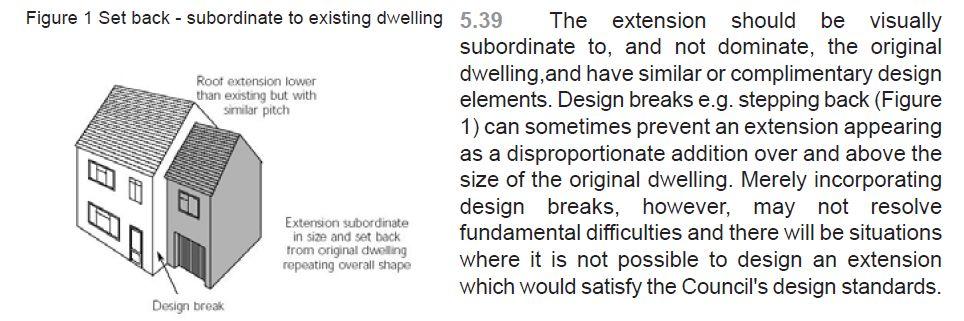
It's very common for planners to want extensions to appear differentiated or subordinate to an existing house. Sometimes it just looks wrong if you try to make an extension appear to be an original part of the house. The bricks rarely match perfectly and it can make the house look out of proportion. Many councils publish residential design guides that give examples of good and bad practice that mention this subordinate issue. Here is an example from Malvern in Worcs.. In a village near me they recently built a very large _new_ house and due to it's size (8 bedrooms?) they made it looks like a 4 bed house with about four side extensions on the left, each getting slightly smaller, some with set back and some in different materials. Looks fabulous.
-
We have a pocket/sliding door on an ensuite bathroom door. I would only have one as a last resort. In our case it was needed to save space. It may seem strange but the main problem is the extra time it takes to open and close them. You can't just whip them open and shut like a regular door. They feel heavier and you have to pull the door to get it moving then slow it down so it doesn't slam into the end stops as it opens or closes. That doesn't sound too bad but its enough to be annoying on regularly used doors. The door handle and set up also needs to be done carefully. The part of the door with the handle reduces the clear opening width because it cannot disappear into the frame (unless you have motorised doors?) so you need larger doors. If not set up correctly the handle can trap your fingers between itself and the frame when opened.
-
If I've understood your drawings correctly you want to add a room above the existing ground floor room. So the planners/architects proposal for a 200mm set back requires you to demolish the existing rear wall and rebuild it 200mm back before building the room above. Is it the need to demolish or the loss of 200mm that's the main problem for you? Would you have to demolish that wall anyway? You could stick with the original plan and offer to differentiate the extension in other ways, perhaps with a different external finish to the main house? Has anyone else done that?
-
Not sure exactly which model of the stat you have but the one I've been looking at has 4 wires (+,-,A1,A2). This will probably seem very obvious but the pinout is + A1 A2 - so make sure the pairs are connected like this.. Pair 1: + & - Pair 2: A1 & A2 not Pair 1: + & A1 Pair 2: - & A2 If that's OK you might try adding a 100nF ceramic capacitor between + & - at the stat end (but don't put one on A1/A2).
-
I don't think building it without planning permission means he has to pay to fix it. At best you might be able to claim damages for the cost of getting planning permission but that's just a few hundred £. Your best bet is to claim against any structural warranty he provided. NHBC policies require the builder to fix it in first instance and cover you if he goes bust.
-
The planners only have 4 years to initiate enforcement action (10 years if a change of use is/was required). So if it wasn't built with planning permission its now too late for the planners to do anything about it. If you wanted to regularise the situation officially you could apply for a certificate of lawfulness on the grounds that its too late for enforcement action and it should be granted no problem. Consider doing this before knocking it down. If the house has a structural warranty I would crack on and make a claim.
-
Their SmartStat has a feature called Ambient Light Dimming which if enabled turns down the brightness of the backlight when the room is dark.

