saveasteading
-
Posts
10074 -
Joined
-
Last visited
-
Days Won
82
Everything posted by saveasteading
-
Prices of building materials moving forwards
saveasteading replied to James Frome's topic in Costing & Estimating
You can get a good idea of the typical prices online, but local supply should be better. Go in to 2 or 3 of the local merchants and talk to the lead salesperson. They will remember you and take your first enquiry for a quote very seriously. Be perfectly straight that you will be comparing suppliers. A good merchant will be aware that they might not get all the job, as there are some areas where they can't compete. But a good relationship with one is ideal, for cost and service. For example, our drainage supplier advised that prices were about to double overnight, which they did, and so saved us a lot. Wickes is great for cost guidance. If they can sell 1 piece of wood/ ply etc at their published price, then you know your target is below that. And all their prices are published, to their great credit. And keep discussing here as someone else will have recent knowledge of best prices. BUT always remember that efficient design and avoidance of waste is worth more than any last few % you manage to extract. -
Site Boundary & Security
saveasteading replied to JWHIT's topic in General Self Build & DIY Discussion
Really? What cost do you have in mind? It should deter an innocent party. -
Site security, getting robbed.
saveasteading replied to Russell griffiths's topic in General Self Build & DIY Discussion
Agreed. A 'secure store' on site is guaranteed to be broken in to. Better left unlocked and it is not the half bag of cement and a shovel they want. Ah yes. Obv not barbed wire and broken glass, but some surprises can help. In my experience they give up when things are not going to plan. Perhaps superstition, perhaps having the wrong tools. Eg when the door is opened a light and siren lock in. Or my usual mess of stuff won't untangle. The opposite logic applies when making a building really secure. So when a well equipped thief cuts through metal cladding but then needs a stanley knife and then to cut another layer of metal or block or board...they give in. £1,000 damage but very expensive contents are safe. Have had that with several old clients. -
Site Boundary & Security
saveasteading replied to JWHIT's topic in General Self Build & DIY Discussion
It really depends on the chance of intruders. If there are children, animals or confused people around, then you do need to keep them out. If isolated and at the end of a drive, then not. If there was an incident then you need to have taken reasonable measures, which does not necessarily mean plywood or heras fencing. So use that as your guide. As a contractor we seldom hired heras. 4 months rent = purchase price. Plus any damage gets charged. We bought it from other manufacturers, used it 3 times or more, or sold it "as seen". -
At picture 6 i don't think it will flow. Splat as delightfully explained above.
-
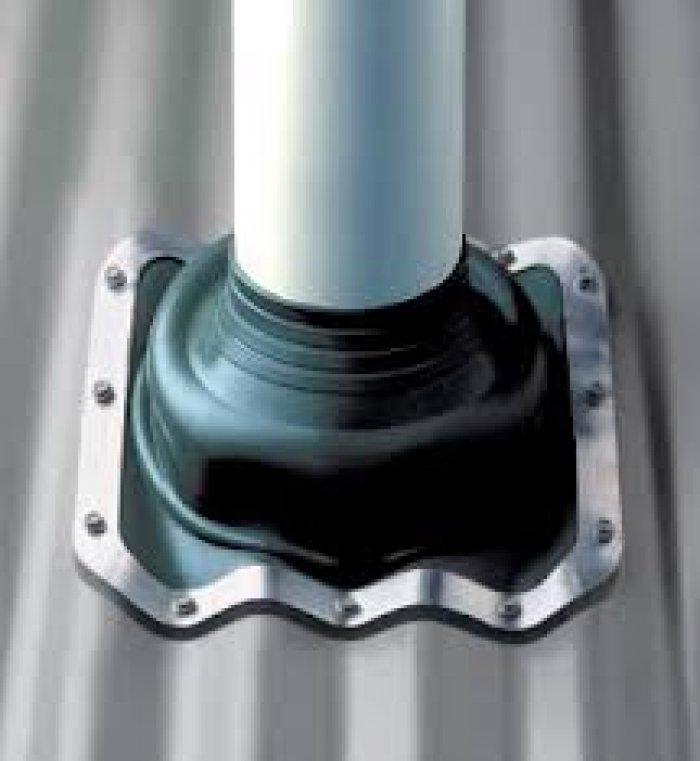
One of these. Needs to be suitable for high temperatures so it is likely to be red, but worth asking for high temp black if possible. They each have a range of diameters they can be cut to. Choose the biggest as that allows more tolerance and best fit on the pipe. On a steepish roof the silicon skirt has to distort from slope to vertical. I have known plumbers make a right mess of installing these, so don't assume the skills are there. Needs roof screws and mastic tape. In answer to how much prep to do...it depends if you think you or the roofer will do the better job. I would us an old fashioned plumb bob to get the hole in the right place, then a vertical pilot hole. NB the circular pipe requires eliptical holes through the roofing materials. .or oversized circles.
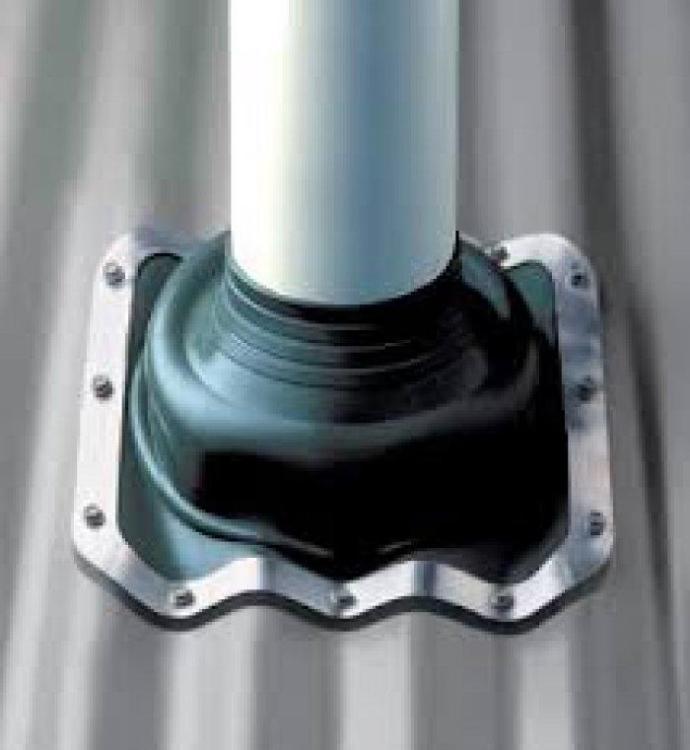
-
Lightning conductor
saveasteading replied to Russell griffiths's topic in General Self Build & DIY Discussion
I tried extremely hard to find any evidence of lightning damage to a building, other than to the obvious case of old churches. Stone, on a hill, high tower etc. Designed to be struck. Didn't find any. I don't suppose anyone wants to say there is no risk. -
Lightning conductor
saveasteading replied to Russell griffiths's topic in General Self Build & DIY Discussion
Ahh yes. I built about 300 steel sheds, about 30,000m2. Over 30 years. Lightning strikes nil. Our supplier has made 30,000 sheds around Europe. Lightning strikes that they had heard of...nil. My theory is that if lightning hits your metal building then it earths through columns to bolts to ground, like a Faraday shield. If it doesn't then it doesn't. Either way, no harm done. BUT. When the buildings were for a local authority, they insisted on a risk assessment by a specialist...who always advised that they install protection. This was a copper strap from the bottom of a column to a spike adjacent. If you have a metal roof on a non metal building I don't anticipate any increased likelihood of the lightning choosing your building....it will head for another building with greater conductivity, of steel, or with a lightning conductor. The risk is different for hospitals and churches. Always provide protection for them. -
As I understand pool / fish tank air pumps, it is only the disturbance at the surface that causes oxygen to mix with the water. The bubbles from the bottom are for show. In a sewage digester I guess and hope that the bubbles also keep an area of the surface clear of crust....I have had 2 installed for clients but never went back to look. I just replaced a fountain pump. £15. Air pump prob similar cost. So that will be the easy answer for any digester breakdown, even a revolving drum type.
-
Building a Block Workshop - ADVICE NEEDED!
saveasteading replied to stunotch's topic in General Self Build & DIY Discussion
Beg pardon. I had your neighbours' garage size in mind. -
Building a Block Workshop - ADVICE NEEDED!
saveasteading replied to stunotch's topic in General Self Build & DIY Discussion
You have applied for building regs I hope. If not, then do so before concrete. Best phone the local authority one....you won't get in trouble or told off. -
There is a lot to know in designing the bar bending dimensions. Otherwise they simply don't fit, can be impossible to fix or can inhibit the concrete pour. I was taught it but learnt about the real life problems when tasked with coordinating with the steel fixers in a huge hydraulics project. Lots of details had to be altered on site. In a biggish design office I found that the SEs delegated the Bbs to a highly skilled draughtsman. It depends how complex your design is, whether the schedule is easy or difficult. Burning question....who pays if the bars as delivered, don't fit?
-
I've got a single brick chamber like that. I have improved its performance by repairing the in nd out pipes, and diverting some rainwater connections. The final soakaway is on neighbouring land and inaccessible, so it blocking with muck overflow was a worry, but after the one and only clean out, the soakaway has also sorted itself. If I was to look to improve the performance then I would look into adding an extra small treatment, after the brick one has done the first sort. We got a signed statement from the previous owner that the 'country septic tank' had been in use since way back and the drainage authority dropped their initial demand for a new digester.
-
That's good. Pictures would be interesting.
-
Some day I may tell you of the cable we didn't cut, and that it would have turned off a whole power station.
-
Cutting and fitting mineral wool insulation
saveasteading replied to SteamyTea's topic in Heat Insulation
Agreed. The material cuts remarkably easily and exactly, as it is compressed within the packaging. -
Small cantilevered porch
saveasteading replied to Jilly's topic in House Extensions & Conservatories
Would this be an extension fixed onto your existing joists or all part of the original structure ( longer joists). 'Turning some joists round' concerns me. As above...a sketch please. -
joists - fixing to Nudura and blockwork
saveasteading replied to Tom's topic in General Self Build & DIY Discussion
Agreed. But NB that badly fixed ones will move. I once thought they were idiot proof, then encountered a different level of ignorance. DIY or supervise as follows. Hole to be just big enough. Never skimp on the length as the outer 20mm or so does very little. Hole must be clean Adhesive must be fully mixed in proportion...with a mixing nozzle discard any single colour emerging at first Screw, don't push, the stud into place If some adhesive doesn't come to the surface, remove and add more glue. Doesn't work in cold conditions. Nothing more to it than that. -
Is it very old? The brick condition might be a concern so jet wash should be on a gentle setting. Also have a look at the in and out pipes. They are likely to be clay t pieces going up and down so that there is no splashing, and to avoid sewage going straight through. If like mine then may be damaged. I also found a great lump of old roof, dumped by an idiot roofer in the distant past..... The pump obv could not remove it so was a messy climb in....have rubber gloves as minimum. And there will be other detritus in there too...toilet stuff.
-
Floor loading understanding check please (long(ish) & maths content)
saveasteading replied to dnb's topic in Boffin's Corner
I hadn't seen this discussion so I am late joining too. Very good points throughout. May I recommend a book to you....'why you don't fall through the floor.' If you can't find it then I can try harder with the title. Re builders thinking they know better than Engineers.....they don't generally know about the safety factors, and there is another one for build quality. Also they are usually long gone when any problems present themselves, and never hear of problems let alone have to resolve them. Safety factors for office blocks were revised down a few years ago, on the basis that not all rooms are stationery stores. The cost saving is huge. But in a big office loads are spread whereas in a house they usually apply room by room. -
Once dead in the attic, a mouse stinks for a day and a rat for a week. I assume there are lots of skeletons under the fibreglass quilt.
-
When it was new I met some of the people who set up the SAP and EPC processes. That made me realise that a lot of it was illogical and rushed through. Worse was that they didn't understand a lot of what they were doing. In fact the excuses for anything wrong was that these were temporary settings and would be changed. But they usually weren't. We bought the calculation programme and played with it, and it is easy to improve figures by illogical decisions. Any use of electricity was penalised. Air conditioning is programmed in to any epc, whether installed or not. And so on. Also it is clearly quite easy to get any epc assessment to say what you want. (This based purely on personal opinion and inspection of a property as compared to the certificate on the wall). Whether this was ignorance or worse I can't say. Solar panels will score points whether in sun or shade, so I generally showed the ones that the client would be fitting in due course. Fortunately I never had a project where the client demanded any particular figure so we only had to do what was best for the project and then find a way to meet the minimum pass mark without spending their money pointlessly. The same logic applies to SBEM, where there are points for fluffy animals on site, or a bus stop being near, which are not usually in our control. All very annoying but hey, just make a good building.
-
Decking paint failure, why and what to do about it?
saveasteading replied to ProDave's topic in Decorating
I have noticed a big change in timber preserver treatment. Traditionally, tantalised timber was quite oily, and it penetrated several mm into the pores due to vacuum treatment, even on side faces. Then it became less toxic, and more water based, but still penetrated. Recently (based on what we have received) it seems only to have a surface treatment. Perhaps you have a variety of these, including the original which is least accommodating to paint. -
How to achieve this soffit colour/effect?
saveasteading replied to Andeh's topic in General Self Build & DIY Discussion
I didn't emphasise perhaps, that we used standard pine, tanalised. 1/4 the cost of red cedar (which you have to be careful with re fixings/damp etc). A timber merchant (client , so knew well) pointed me to a report on red cedar saying it doesn't perform well in maritime, warm, damp conditions. They copy it to specifiers to avoid future claims on staining. So it will depend where you live. -
Dampness is nearly always a big problem and should be resolved. But to avoid it coming up in the inspection, spray with bleach and the colour may disappear temporarily.