saveasteading
-
Posts
10890 -
Joined
-
Last visited
-
Days Won
93
Everything posted by saveasteading
-
Heat pumps won’t work in old homes, warns Bosch
saveasteading replied to Temp's topic in Air Source Heat Pumps (ASHP)
Designing for a absolute worst case once in a 10 year event like -15C (where I live, anyway) is no way to design a heating system. My understanding is that most machinery works best at about half to 3/4 speed. So designing for an extreme is sensible as it will cope for that short time, albeit less efficiently. But most of the time it will be running optimally. I think many people, esp non numerate journalists, don't understand that plentiful heat is still present in the air at -15° as we all understand ice, but not absolute zero (-273°). -
Heat pumps won’t work in old homes, warns Bosch
saveasteading replied to Temp's topic in Air Source Heat Pumps (ASHP)
Have you seen recent Scottish estates, and new builds? White render almost without fail. -
Parkside,on balance I am fairly happy with. The durability isn't great...I had a tiny circular saw thing that just whirs instead of turning. And a strimmer that did not break down but the base plastic was very thin and wore through in a season. Manual tools have all (?) been good. Aldi stuff I'm not so sure. Just bought a soldering iron and the tip seems to melt along with the solder. And a heavily ratcheted, supposedly HD branch lopper, ,,,the first one seized and wouldn't open again. The replacement did the same and needed help to open at each use, then the blade shattered. I don't think they can do any tests or quality control. If I aggregated the bargains and wastes of money and time, perhaps I should use known brands.
-
How to support a (block and beam) beam at one end
saveasteading replied to Thorfun's topic in Floor Structures
Thats what they are. Sometimes it won't get through but the second one will. Just make sure they are called 'heavies' or clearly states it is for hot-rolled steel like yours. Others are made to go through cladding and purlins so won't make it. Check the length of thread so that it catches the steel. They work best if there is minimal thread through the timber, but these 2 wings cut a wide hole through the timber then break off at the steel. All that for 9p each. Yours will be more as longer. A hex head works better than screwdriver head. -
Screed thickness with UFH, over PIR. How thick?
saveasteading replied to saveasteading's topic in General Flooring
I just noticed I started this thread last June. So here is more info. We got 3 names from the local Cemfloor supplier. 1 was 25 miles away and the others about 40 and 60. All quoted thoroughly and the favoured price came down to the absence of conditions or travelling extras. The cost per visit was significant, so we changed programme and prepared all the floor. He did all the ordering but we would have had the resonsibility if wrongly quantified. At £400/m3 you don't want too much. About 1/4m3 (as extra allowed) was left and spread on the hardcore track. We had decided that if we were unexpectedly short, we could mix up a sand/ cement screed ourselves to fill in the gap. The stuff came in standard concrete wagons, and the contractor hired a small pump. He had 2 assistants, who did the extensive prep and then odd jobs, and the cleaning up, but never held the hose. I don't remember him ever going back to correct a level, as it magically flowed to the level markers (war of the world creature-like tripods). Chatting after, we found he is a general builder, but there is a lot of cemfloor work. Lastly. Tarmac concrete didn't offer cemfloor but offered a special mix which would do much the same (small aggregate and plasticiser). That may be of use where there is no cemfloor availability. -
Screed thickness with UFH, over PIR. How thick?
saveasteading replied to saveasteading's topic in General Flooring
I don't think cracking is proportional to thickness in this situation. Our specialist was thorough in putting crack inducing joints across doors and large expanses..just vertical strips of hardboard, not even straight. -
How to support a (block and beam) beam at one end
saveasteading replied to Thorfun's topic in Floor Structures
corroding even internally? No. Even if they get damp from the basement, the timber would fail first. Plus most teks are plated. If worried get external quality. There are trillions of them on steel roofs and the decent ones don't corrode. My career is mostly based on steel buildings yet I favour timber here. It cuts and planes and joins, and is easy to get . Long Teks to steel but also link to the new wall and fix anywhere that presents itself for extra stiffness with hangers off the t beams perhaps. Firstly tek a plank that fits into the web and fills to just outside the steel. Then fix a joist to your liking. This is barely structural but you would not want it to deflect. You don't need to ask the beam people. Once built, stand on it and jump up and down. Tested and approved. -
Screed thickness with UFH, over PIR. How thick?
saveasteading replied to saveasteading's topic in General Flooring
Yes. -
Screed thickness with UFH, over PIR. How thick?
saveasteading replied to saveasteading's topic in General Flooring
I was really surprised how liquid the screed was. I knew it had to be, to come through a 50mm pipe and to self level, but I was still surprised. This is not through excess water though, but the use of fine aggregates and plasticiser additive. The finished floor had a few cracks but mostly where 2 pours met and were reworked together. The thickness was about 60mm but varied thinner where there were errors in the base layer. 300m2 in 6 hours. Impressive how easy they made it look. -
Does a temporary habitation certificate count as this date? We are looking at using a self contained 1/4 then will be 6 months or more with the rest. The bco seems happy to issue one...perhaps we ask if he can turn a blind eye.
-
OK. Steel plates direct on concrete is normal. Anything strong enough to make a thermal break won't be making much difference. I've prob had 2,000 columns put direct onto concrete so a product is new to me ...can you tell me its name? I will await photos before further comment. What is the distance from outside of steel to slab edge, and will your cladding be outside that?
-
Cladding and how to Finish Bottom
saveasteading replied to GrantMcscott's topic in General Construction Issues
The original sketch is how commercial units were often built, but was not ideal. The closer flashing you show would be made to order using plastisol coated steel and cost about £10/m. It could look poor if not perfectly done, and can damage easily. Other issues start to appear though. Damp especially. Could you build the patio in timber so that there is free air flow and no damp? Then the cladding simply passes over the brick and drips to ground. -
Well done you, and good infornation for all of us.
-
Good drawing to explain the situation. A few questions. Is this already built to the stage you describe? If it is, then photos would be good. If not, there is perhaps more you could improve. Is the steel outside an insulated inner box?
-
Great Crested Newts -District Level Licensing
saveasteading replied to Furnace's topic in Planning Permission
Yes. Farms are messy places though, diesel, chemicals etc spilled for decades....but nobody makes a farmer clean it up. The danger is if you grew veg there or children played on the area. A client once had a survey showing arsenic in the ground and a need for more surveys.. I knew this would be an old treated fence post, and so it proved. Re oils you prob just have to say that you are not removing any earth, and capping it....as recommended by them. -
From a quick look, the fundamentals are the same, both referring to the same document.
-
Great Crested Newts -District Level Licensing
saveasteading replied to Furnace's topic in Planning Permission
In my opinion , not knowing the site... If you get a quote from an approved demolition company they will include the risk assessments and disposal. They will give you a certificate to show proper disposal to licenced tip. That should be the end of that. My construction company did this without specialists and even had an hse spot check once. It is easy. But we took to using demo cos just to avoid insurance issues. It is dismantling, not demolition. Don't grind it up and snort it and you are 90% there. Oil in the ground is normally only an issue for lawns and playing fields. Last time I checked it was preferred to cover with buildings or hardstanding (not permeable) than to take it away. Sounds like your consultants are pushing their luck, to be polite. Find another? -
Great Crested Newts -District Level Licensing
saveasteading replied to Furnace's topic in Planning Permission
As long as you know it is low risk asbestos, you simply need to refer to the HSE helpful documents. Copy and attach if you want. If you feel that the planners are suckers for thick documents then do a precis of it too, adding project specific detail. Then do it by the book. What material is it? -
And you finished how?
-
How to seal around the stove to insulation pass through?
saveasteading replied to Andeh's topic in Stoves, Fires & Fireplaces
It will be very hot indeed even up here....a lot of heat escapes from the fire and the insulated flue keeps it moving intead of escaping from a bare metal flue into the room. Of course the flue, being insulated, is protecting the surroundings, but adding 50mm more protection is simply sensible. It also allows some movement on heating and cooling. -
And as someone else on here pointed out , the best way to find it is not using the BH search but googling eg "buildhub foundations support" or the appropriate query.
-
Kitchen sink discharges into "open" drain?
saveasteading replied to mjsx's topic in Waste & Sewerage
The tidy solution would be a new inspection chamber. This would be below ground with a cover. Just downstream of the rainwater which can have its own entry. -
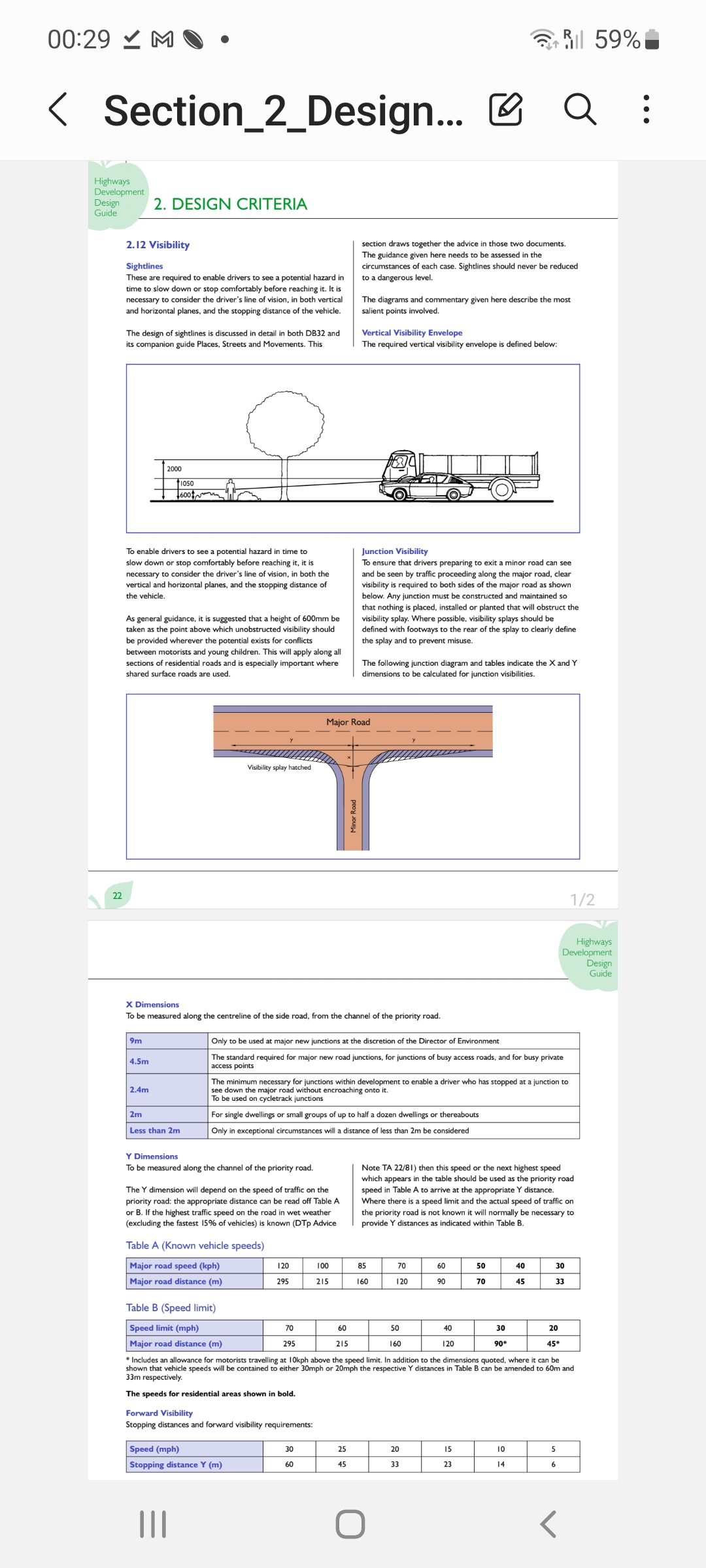
Easy to find. Google Highways, sightlines. 1 page attached. The principle is that you are sitting in your car, so you are low down and back from the road. How far can you see each way? It depends on the road speed, but you could make a special case if the road could not be driven at that speed.
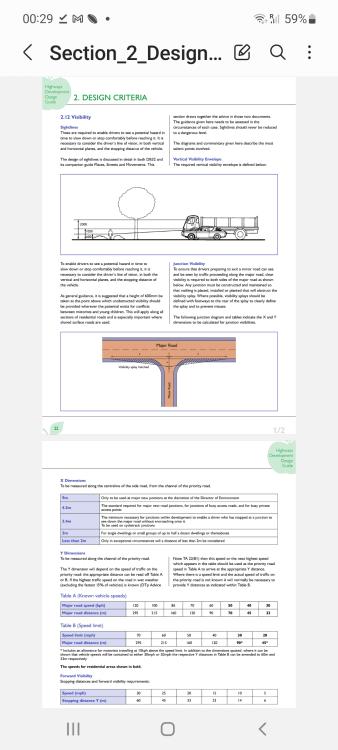
-
That looks pretty good to me. I like drain runs to be simple and to get out of the building ASAP All I would change, if possible, is right angled bends indoors. Either take these at about 45° and then have a 45° junction, or use a slow bend or 45° then short straight then 45°. Then they won't block, but if they do, they are roddable The downside is the multiple pipes through the outer wall/ footing but it just the once.
-
New member... over budget at the start, what to do?
saveasteading replied to worriedexpat's topic in Introduce Yourself
I went back to your first post. You gave the architect a budget. Tenders came back over double. Thd architect obv has no idea of costs or perhaps doesn't care. You would be entitled to dismiss without pay if your budget was fundamental and you can prove it. Change architect? I once had a project where we were recommended to resolve such an issue. Project twice the budget. I told the architect that i had an alternative solution but there was risk and the budget was not feasible. The architect said to me privately not to worry as clients always find more money. Appalling. I withdrew. Beware. Wise to stop and think for a while.