ProDave
-
Posts
30861 -
Joined
-
Last visited
-
Days Won
427
Everything posted by ProDave
-
Think out of the box. I would seriously be looking at "caravan" technology, i.e an LPG fired Morco instant water heater a bit like the 11KW one we are using in the caravan right now. It gives an acceptable shower (I say acceptable as I am used to a deluge from an UVC and good mains pressure and flow so have been spoiled) If sticking with electric, watch the volt drop or your 9Kw shower or water heater might be quite a bit less than 9Kw in practice.
-
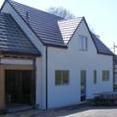
Another new entry in my blog
ProDave replied to ProDave's topic in General Self Build & DIY Discussion
Yes the Barriair is cheaper than the Intello that I started with (left over from what the builders used when making the frame) and yes it has built in air tightness tape at each side one on each face so when you join two adjacent strips it's a tape to tape seal. I know I complain about how much air tight tape I have used, but it would be a couple more rolls had it not been for the air tight tape built into the barriair. The built in tape certainly seems to stick well, but as all these things, you are trusting the manufacturer that it will stay stuck over many many years. Most of the tape I have been using is Tescon Vanna, but the last lot I got cheap off ebay is Icocell Airstop, that I got for just under £9 per roll. I have spent more on tape than I have on membrane, making the tape feel a lot less good value for money. -
Yes indeed the current regs up here demand you make provision to fit a shower downstairs including providing a drain point for it, but you don't have to fit it (we are not)
-
I'm managing to keep the build ever so slowly moving forwards so a new entry in my blog at the usual address www.willowburn.net Look for the entry "Air tightness detail upstairs" which not surprising is lots of photos or air tightness membrane and tape. Lots of tape. I can't believe how much air tightness tape this house is consuming. Fortunately I found another few rolls going cheap on ebay. Also before I could do the membrane upstairs I had to lay the proper chipboard flooring in all but the bathrooms (separate more complicated issue as those will be wet rooms)
-
If it's an opening window, I understand the wedge at the bottom goes at the hinge end, so the weight of the pane is taken at the hinge end. If you put the wedge at the outer end, the weight may distort the frame. The top wedge goes at the opposite corner.
- 1 reply
-
- 1
-

-
Lifting and Lowering (useful "rule of thumb")
ProDave replied to B52s's topic in Project & Site Management
I remember when cement came in 1 Cwt bags..... -
Lifting and Lowering (useful "rule of thumb")
ProDave replied to B52s's topic in Project & Site Management
So I cannot (as a man working on my own) pick up anything heavier than 10Kg off the floor. If I stuck to that, my house would never get built, sorry not going to happen. We don't all have a helper on hand to assist. Welcome to the real world. -
Interesting about doubling up. Most of our runs are long due the to mvhr being off to one side in a plant room above the garage. At building warrant time my designer got a quote from a different supplier (not BPC) and they designed a very similar system based on the same size radial ducting, and specified two pipes for each run, so that is what I am sticking with. The only short runs are the utility and en-suite and as these are high flow rooms I guess they need two pipes anyway.
-
That's what my designer specified for mine, and thought that was what everyone was doing?
-
How to get Howdens prices
ProDave replied to MikeSharp01's topic in General Self Build & DIY Discussion
They are a merchant. They don't publish prices, you have to ask. One of the things I hate about merchants. -
At the risk of teaching how to suck eggs. You are allowing two runs per vent aren't you? I should be starting my ducting soon, so I'll let you know if I have ran out.....
-
Ready made kit http://www.ebay.co.uk/itm/Insulated-Garden-Studio-Office-Room-Pod-DIY-Self-Build-Kit-Bespoke-SIPs-Panels-/222302350517?hash=item33c240acb5:g:UlQAAOxyBjBTT9wY DIY http://www.ebay.co.uk/itm/Structural-Insulated-Panels-SIPs-Self-Build-for-Garden-Office-Studio-Garage-/201916449561?hash=item2f03288319:g:6E0AAMXQ1d1THXL1
-
If you end up with a half roll spare, I might need some. My rough calculations showed I needed a total of 205 metres, so I have ordered 200 metres. So if I end up a bit short....... 75 metres does sound not very much. and I didn't think my house was very big.
-
The UFH I would always do one thermostat per room, the system lends itself to that perfectly. Room stats upstairs as well would be my choice as you get a setting in proper degrees rather than the usual 1-5 on a TRV. It will also be controlling the temperature at a useful point in the room, not down close to the floor. Though in a well insulated house that won't make much difference. Individual room stats also opens the possibility of programmable thermostats, e.g no point having the bedrooms heated all day when you only want them warm in the evenings to go to bed.
- 22 replies
-
- 1
-
-
- thermostats
- stats
- (and 1 more)
-
Yes indeed we do. Not only is the insulation amount very poor in the caravan, it is of a low decrement delay type.
-
The cooler weather is on the way. It was stinking hot this morning, I had to abandon lawn mowing at 9:30 because it was too hot (having started at 8:30 to try and beat the heat) but by mid day it was clouding over and now it's full, but thin cloud. No sign of the thunderstorms, just the odd spot of rain. house a comfortable 19 degrees, only 1 degree up from last nights open window cool down.
-
In a well insulated house that reacts slowly to ambient temperature, if you want to cool it, you open the windows ONLY when the air temperature outside is lower. I did this last night, left all the windows open a small amount overnight when the air had cooled down. The house cooled to 18 degrees as a result and now they are all shut again and the house is staying a nice cool retreat from the heat outside. You don't want to be opening them when it's hotter out than in.
-
Our new house, (not yet occupied so no heating, no passive heating from living activities, and no mvhr running yet) reached a peak of 21 inside downstairs today amd 22 degrees upstairs. To the south of our house are trees, and these are almost in full leaf now, blocking out a lot of the daytime direct sunlight, yet in winter when they are bare the sun floods in. It is really only now the sun is in the West that we get much direct sunlight. It's been 27 degrees here today, and the temperature in the caravan is unbearable. We have t keep all the doors and windows open and the best we can hope for there is to cool it to not much above ambient. All shut up would be stupidly hot. Thunderstorms and back to normal forecast for tomorrow. (British summer = 2 hot days and a thunderstorm)
-
You are addressing this from the wrong angle. I would be asking why are you even considering a 100mm frame today? Our previous house, built in 2003, used a 150mm frame. That was about the time up here that 150mm became the normal, because you simply could not get enough insulation in a 100mm frame. Now "ordinary" houses up here use a 150mm frame with added PIR on the inside. Our new house has a 190mm frame in our case with added insulation on the outside.
-
I recommend Knauf Earthwool frametherm 35 for between the frame, a lot less nasty to work with than other types of glasswool insulation. This was a top tip from the builders that built and erected my frame.
-
I did consider leaving out the floor insulation (suspended timber floor) under where the larder is going, but changed my mind as it would then be a major PITA to put it in later if we changed our minds and didn't construct the pantry. Our new house is performing well in this hot weather (it's even hot up here) remaining nice and cool inside. The inside temperature of the south facing walls is just 0.5 degree hotter than the inside temperature of the north facing walls.. Thanks no doubt to the insulation with a long decrement delay. The caravan on the other hand needs all the doors and windows open to stop it becoming like an oven. The ground slab under our suspended floor (there is one bit still not insulated and accessible) is still measuring 6 degrees today, so if we wanted to cool the larder a simple fan through the floor to draw up some cold air would probably work well.
-
Can I raise my wacky larder / fridge theory again. Think about how a fridge works. Basically the compressor etc is there to remove heat from a fridge. Most fridges expell the removed heat via some form of plate on the back. So the back of a fridge will be warm, expelling the extracted heat. The inside of a fridge will be cold. The front and sides of a fridge will therefore be cooler as that's where heat is drawn in to replace what has been extracted. So to sumarise, back of fridge is hot, front and sides are cool. My wacky idea therefore was to build the fridge into one wall of the larder, such that the font and most of the sides were in the larder, and the back was outside the larder (in my case it would have been in the hall) The theory that the cool surfaces of the fridge would continually be removing heat from the larder thus keeping it cool. It would need a fridge sized hole in the wall and the fridge sealed to that hole. And the rear side of the fridge would look silly sticking out of a wall, so I would have put a false wall up just beyond that with air vents to allow the hot air out. I won't be putting this into practice as SWMBO has decreed the fridge is not going in the larder, but if anyone ever tries it, do let me know if it worked.
-
We used the Baumit.com render system with their Silikon Top final coat. That is definitely very waterproof and robust. It might be asking if they think that would adhere to what you have.
-
The standard here is ordinary blocks laid block and flat. (one block on edge, two laid flat gives a wall about 330mm wide
-
Airbricks are below the desired finished ground level
ProDave replied to daiking's topic in Brick & Block
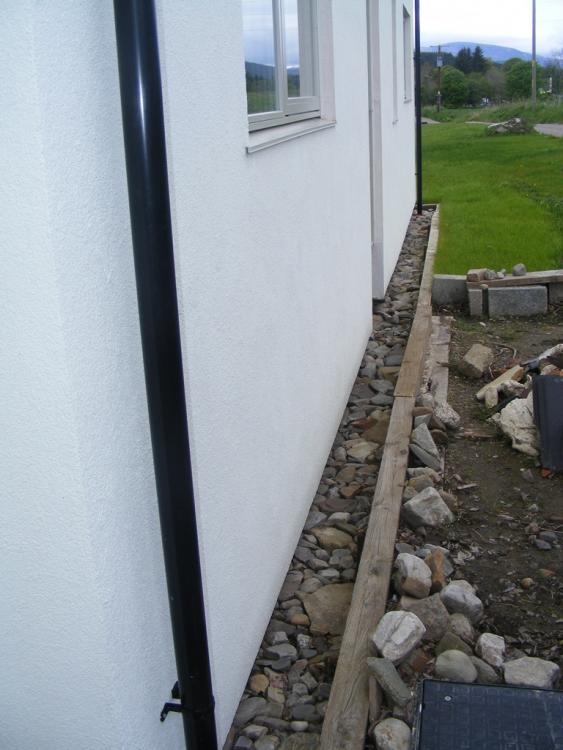
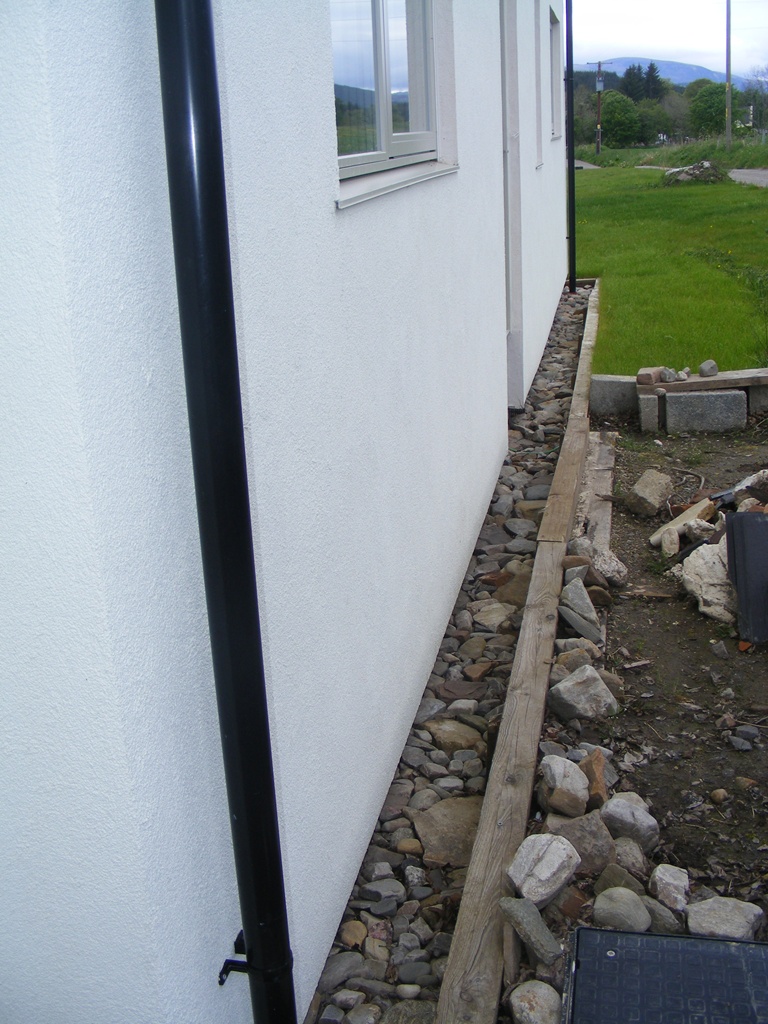
This is what I have done in the same situation A small retaining wall made of railway sleepers. A French drain along the front with the level of stones lower than the air bricks. In my case it will remain open like that. It's only along the front as the side and back the ground level has sloped down and it's not needed. I will bridge across it when I form the ramp and path to the front door. Could you do something like that with the paving slabs cantilevered over and keep the drain open at the ends for airflow?