

ProDave
-
Posts
30861 -
Joined
-
Last visited
-
Days Won
427
Everything posted by ProDave
-
That sounds a lot better that the fitting I had. I would put this in the category of a fitting you want to buy from a shop, where you can see it before you buy it, and NOT something to buy mail order, because I can assure you some variations on this fitting are rubbish.
-
I will be the stick in the mud here. I have used the type of mdpe to copper converter that has been recommended. I did not like them and would not want one buried in an inaccessible location. My "issue" is that it's just a rubber bung that gets compressed onto the copper. Even when tightened the copper can still flex / move a bit. Although it never leaked, it did not inspire confidence. I would much prefer the fitting Barney proposed, at least the copper connects with a proper olive in a brass fitting. I would not worry about damaging the plastic thread, you really would have to overdo the amount of ptfe for that. Actually my preferred solution is a brass sropcock that takes 25mm mdpe at the input and 22mm copper at the output. Those are really bomb proof.
-
A typical inverter for a typical 4WK system has two inputs that work independently, so lends itself to two banks of panels. So probably one facing south the other either east or west, depending if you think you are likely to self use more in the morning or evening. I think a gable ended house suits solar PV beter. The aesthetics of panels on a hipped roof, which usually means the bottom row of panels is longer than the top tow, does not look as nice. On s gable ended roof you can make them all the same length.
-
Nothing wrong with trestles and planks on top of scaffold, and the odd stepladder. One has to be flexible (not intended as advice)
-

Shall I install mvhr
ProDave replied to jpinthehouse's topic in Mechanical Ventilation with Heat Recovery (MVHR)
Definitely. It took me a weekend to install all the ducts. For a DIY install it is probably best go go for a radial duct system such as that sold by BPC and others, rather than a branch system. This uses semi flexible duct pipes that easily wind their way through posi joists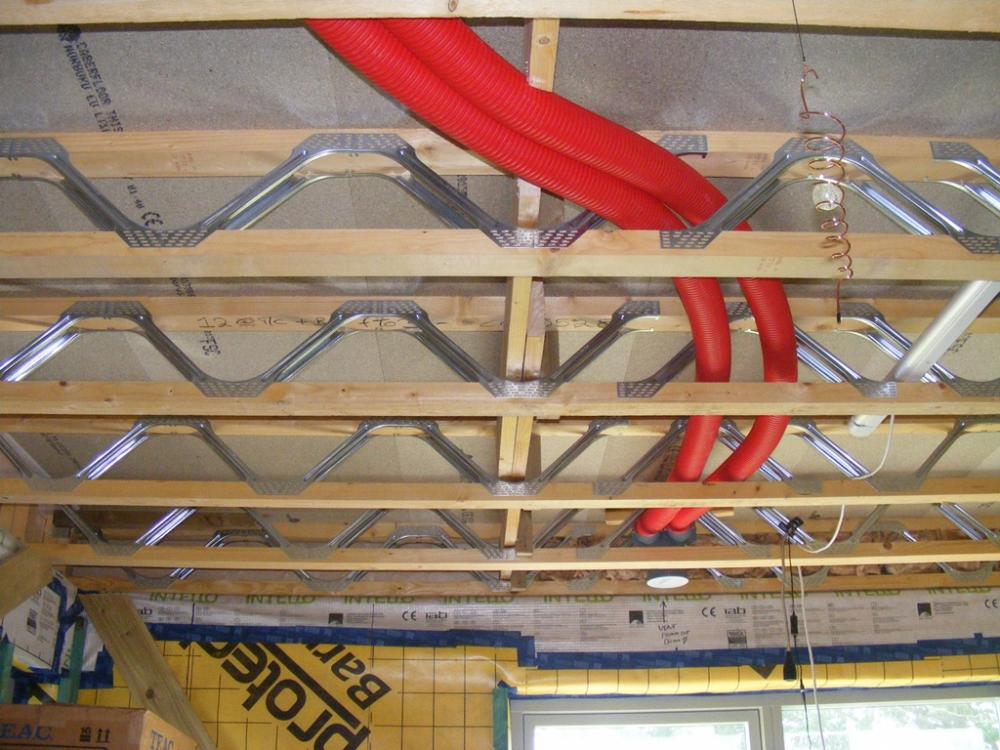
-
I assume the trees marked with a green dot are to be removed? I guess you are looking at a holding tank and pump to lift your sewage up to the public sewer?
-
Hi and welcome to the forum. That sounds like an interesting project and you are in good company now.
-
That is debatable and some have very strong opinions. If you just rod it and use a TT earth, then your earth impedance will never be as low as a PME earth. However I would never just export a PME earth that distance. By adding a local rod, you are reinforcing the concept of the multiple earthing. A true PME is earthed at many places along it's route though no doubt the DNO stick a PME sticker on any TNCS supply even if there is no multiple earthing (PME is always TNCS, but TNCS is not always PME) This is exactly what I have done for my house, even though my distance is about 20 metres. (my static caravan is on it's own TT earth as the regs prohibit connecting a caravan to a PME earth)
-
You will get recommendations from me and probably others on here for Rationel. Of all the windows I got quotes for, they were the cheapest, and the second best. The only ones that beat them in performance were internorm, at twice the price for a very small improvement in Uw values. These were tripple glazed ali clad. It does seem to vary a lot, and in spite of my internorm quote being so high, some have reported them to be the cheapest quality windows.
-
How much of your plans do you have to actually build?
ProDave replied to Adamantium's topic in Planning Permission
The council planners could issue an enforcement notice to order the demolition if that was a planning condition. Until they do that I don't see any rush. As there is no time limit on completion from a planning point of view, that would probably only happen if someone (who knows it must be demolished) complains. Since the new build is signed off by building control you have nothing to worry about in that respect. -
I would not rely on just the DNO's earth over that distance. I would probably still connect to it and add my own local rod(s) making it a true Protective MULTIPLE Earth
-
SWA can be joined and if joining underground you get a joint box that is then filled with liquid resin that sets and encapsulates the joint. As to re use, depends what size it is. My guess is volt drop did not figure in the original install, they just wanted something that "worked" EDIT: Typing at the same time as Jeremy and said much the same thing
-
Shall I install mvhr
ProDave replied to jpinthehouse's topic in Mechanical Ventilation with Heat Recovery (MVHR)
A friend near here is building a new house. He originally went for the daft sounding idea of trickle vents in the windows and mechanical extraction from "wet" rooms permanently on (a centralised extraction unit) Then he had an air tightness test done and it was too good. Building control told him he must have mechanical air input as well. He did look at adding a separate air intake system, I kept telling him the whole idea was bonkers (no heat recovery). In the end he has ripped it all out and installed mvhr, which is what I advised right at the start. My mvhr unit was about £500 and ducting etc about £1000 you should comfortably get a system for £2K At it's lowers speed (which I am hoping is what I can use as the trickle ventilation rate) my unit uses about 30W of electricity. Sure in summer, turn it off and open the windows. -
I assume your meter box is at the top of the picture? What size is the existing blue cable? it has after all served the existing house for some time. If it's large enough, why not re use it?
-
The time has come to fit the wet room tray.
ProDave replied to MikeSharp01's topic in Bathrooms, Ensuites & Wetrooms
Please don't tell me that all wet room shower trays must connect directly into 110mm Not only have I already plumbed for 50mm pipe to each shower (with solvent welded bosses) but I could not fit 110mm with enough fall as they have to pass through the web of a posi joist. -
Our last stair was fitted like that. The stringer was fixed directly to every stud and then the plasterboard fitted. There was no "movement interface" Nothing moved and the joint remained closed.
-
Shall I install mvhr
ProDave replied to jpinthehouse's topic in Mechanical Ventilation with Heat Recovery (MVHR)
It all depends what you want from your house? A lot of us here are aiming for very well insulated and very well sealed houses to make them energy efficient. Once you get to a certain level of insulation, then the heat loss becomes more dominated by ventilation heat loss (you must ventilate the house somehow anyway) and that is where an mvhr unit really comes into its own to reduce ventilation heat loss and so improve energy efficiency. It also improves air quality. Ventilation by natural means is so hit and miss and variable. -
The issue is not the current carrying capacity of the cable, if it was then 25mm2 would be fine. Rather, over that length, it's the voltage drop that will dictate the size of cable that you use. It would not surprise me in the least to find you do indeed have to use something as big as 70mm, I would need to look it up and do the calcs. The DNO use larger cables, here the main running down the road is 95mm2 which then they tap off a 25mm feed for the short tun to each property. If you get the DNO to move the supply closer to the house, the cost will be for such a large caable, and the non contestable work of them making the connections, which they will almost certainly do live. It will cost a lot more than you just buying suitably large cable. Unless of course moving it closer to the house would mean shortening the DNO's cable run? It depends where it comes from? +1 to getting a 3 phase meter fitted and running 3 phase to the house. By spreading the load over 3 phases you might be able to reduce your max demand per phase and use a smaller cable, though of course more cores in the cable. I would use SWA buried direct in the ground. Single cores in conduit is acceptable, but I am not sure I would describe an underground duct as "conduit" so I would not use singles.
-
Do you want it to switch directly from heat to cool at a certain temperature? If so a single stat and a relay will do that. But I would have thought you want a "gap" between the heating switching off and the cooling turning on at a higher temperature?
-
They always USED to do that. Remember when they had a throttle lever on the handle, put it down to idle when you took the grass box off. None of this dead mans handle and having to stop it to empty the box. My Suffolk Punch was like that. I bought it to mow the 10ft by 30ft lawn of my first rabbit hutch house. Everyone else mowed such a tiny lawn with an electric mower, but such was my hate of dragging a cable around........ I was also the first to make a gate in the back garden fence. Everyone else in the terrace carried the lawnmower through the house to cut the 10ft square front lawn, another bonkers idea.
-
Is this a condition that can be appealed if you can't meet the extra 40% allowance but could meet the basic 1 in 100 year flood risk? In any event you, or the vendor is going to have to dig a few test pits to establish the soil type and measure the percolation rate before you can proceed.
- 9 replies
-
- 1
-

-
- llfa
- consultee comment
- (and 1 more)
-
There is a lot to digest there, and I have to go out just now so can't give a full repply. Tread carefully here. If you make an offer to buy the plot, make it conditional on finding a solution to the drainage issue AND satisfying both building control and planning that the solution is okay. Drainage solutions can take up a LOT of space on a plot, make sure it will all fit and still leave room for the house. Remember is is possible to get PP for a house that is impossible to actually build.
- 9 replies
-
- 1
-
-
- llfa
- consultee comment
- (and 1 more)
-
Hi and welcome to the forum. I think that now makes 3 electricians on here.
-
I used one of the ECO+ brand tripple glazed roof windows. The quality of finish is definitely not up to the Velux / Facro standard, but in your case that may not matter as a roof light you are unlikely to look at close up. I had no trouble fitting it and that supplier provided prompt delivery. The cheap ebay one I would avoid. I am not even sure it would meet building regs.
-
I allow 1 our per point for first and second fix, and it's usually less than that. So 160 points is probably 80 hours work for second fix, so 2 weeks.
