ProDave
-
Posts
30862 -
Joined
-
Last visited
-
Days Won
427
Everything posted by ProDave
-
I used Jeremy's spreadsheet and it predicted the heat loss and therefore heating input needed vary accurately, far more so than the SAP report did. Overhheating is not an issue here, the trees grow leaves in the summer and shelter us from much of the sun.
-
Turning a plot into a Building Site...
ProDave replied to Mulberry View's topic in General Self Build & DIY Discussion
I did my own foundations with my own little ancient 3 ton digger. I pegged out and marked the centreline of each trench on the ground with ground marking spray paint, which was then easy to align with the centre of the bucket when digging. I dug down to what i thought was hard ground and then called BC to inspect and they were happy. The builders came along to take over, they looked at my trenches and said there was no way they were right doing it that way. They then spent a day with their surveying equipment and set up the profiles and at the end of the day said what a good job I had done, there was just one corner that needed squaring off slightly which we did by hand. They brought their own larger digger with a much longer reach for pouring the concrete. The one thing I did different to most sites, is I only stripped the top soil off the actual build area plus a metre or so just to give room to run the digger tracks while trenching. My reason was we only had limited space to store spoil on site, and all of the excavated soil will be used to raise the ground level and make it more flat on our sloping site. So all the soil surrounding the house there was no point removing it just to put it back and some more, so it was all left and just added to from the piles of stored top soil. -
Hi and welcome to the forum. That looks a nice site and a nice efficient house design, little wasted space. I don't know what insulation levels you are planning, but many on here build very well insulated houses with good air tightness, aiming for something close to passive house standards, and we find you don't need much heating. Up here in the Highlands (no doubt colder than where you are ) a small 5kW air source heat pump does all our heating and we have no heating upstairs, it is just not needed.
-
Best floor type for the discerning selfbuilder. Go. :)
ProDave replied to puntloos's topic in General Flooring
Our kitchen / diner, part of the hall and the living room are all engineered Oak as one continuous run. In the kitchen, we have a washable mat in front of the cooking area. and we learn to be careful, and the oak floor is showing no signs of distress. -
Best floor type for the discerning selfbuilder. Go. :)
ProDave replied to puntloos's topic in General Flooring
We have yet to floor our sun room, but carpet is not on the list because it is an "entrance room" and someone some time will come in with outside shoes on and so this room needs an indestructible floor just like the hall, so will probably be some form of tiles. -
I often thought of a true "smart home" where ALL appliances were controlled by a central computer that rationed power to each on a priority basis, so for instance the washing machine would only get power to the heater when there was some spare, so the washing cycle might take longer. and as you say freezer could cool a bit more just to use up a bit of spare if nothing else was able to use it. I can't see that ever happening as a commercial project but would be a fantastic project for a retired geek with too much time on their hands. I have been experimenting with the heating this last week with respect to best use of solar PV. We don't need much heating now so I have from time to time manually turned the heating on when nothing else was using the PV energy, and as you say that was thwarted by the room thermostats turning it off so I had to crack those up a bit. Over heating the house via the ASHP to use up free electricity is on the same level as overheating it with free wood in the WBS.
-
Best floor type for the discerning selfbuilder. Go. :)
ProDave replied to puntloos's topic in General Flooring
All to much of a personal choice, there is no right or wrong. In the previous house we had Maple flooring, that was only rated for UFH in narrow 70mm planks, but it worked well. This house we have engineered Oak in 180mm wide planks and it works well with UFH. Other parts of the house have slate tiles and those work well and are pretty much indestructible, unscratchable and perfect for the entrance areas. We have carpets on the stairs and in the bedrooms, no heating needed there so tog rating irrelevant. Don't assume all flat tiles are slippery when wet, and don't assume all textured tiles are not slippery when wet. -
It's funny how we never struggle to use all the solar PV power. Ours is only 4kWp, I can imagine it is much harder to self use with a larger array. Washing machine and TD have had their share today as well as mid morning ASHP heating the DHW. then it's the immersion that's been the beneficiary plus around mid day the little convector heater in the utility room. And we have spent most of the day tidying the lawn with the electric lawn rake, so nice to know that is solar powered as well. Last week was the best March week we have ever had so far for PV generation, and the lowest heating, HW use and lowest electricity import.
-
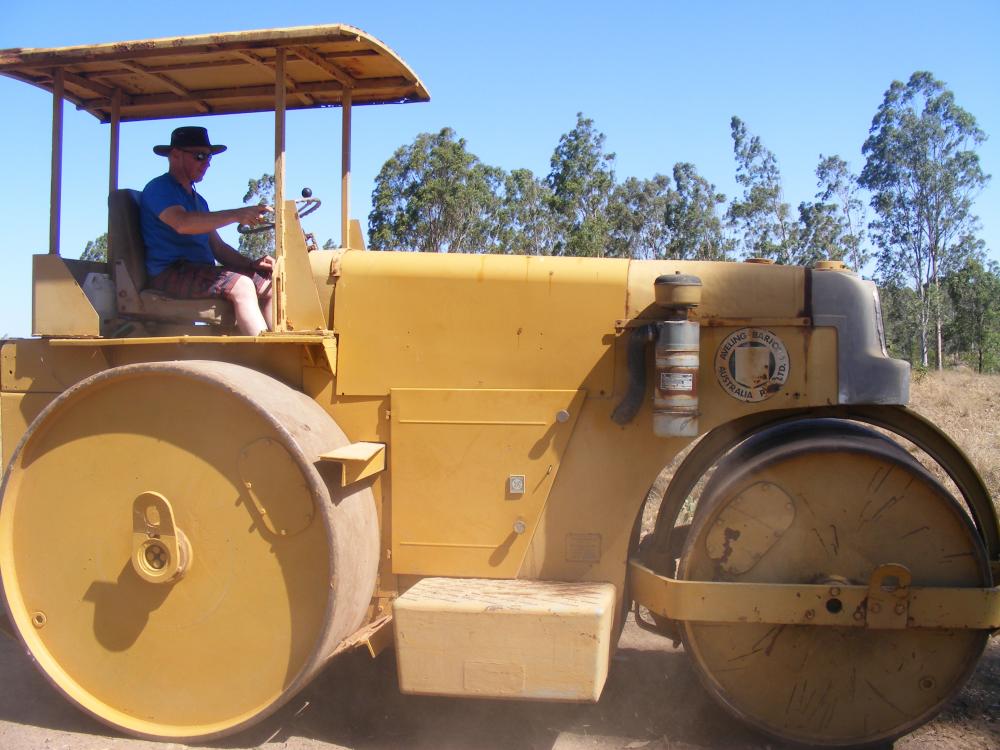
My BIL down under, a retired Diesel fitter has a collection of old machinery including a D4 dozer, a road roller and a scraper (forget the proper name) I had a go on them all. the concept of a decellerator pedal was somewhat alien to get used to. This is the only one I got a picture on that is me in the seat.
-
+101 to that. Our solar PV generates more than our heating useage in a year, but not at the time we really need it most. But still, as long as you are able to usefully use what it generates then all it means is you import a lot of your heating need in the winter then the payback is you import much less for other uses in the summer. If there was a golden goose that enabled all houses to generate all their own energy needs on site all year, then the energy crisis would be over and the inventor of that technology would be rich. And yes that elephant in the room, the poor state of UK housing. I looked at (only out of curiosity) a flat for sale near us. EPC G 7 That is 07 I struggle to see how you could get any worse short of taking the roof off, and shudder to think what it would cost to make it even half way decent. Yes some mug will buy it and then complain the bills are high.
-
Two threads identical title and question merged.
-
It's hard to make any comment not knowing where this wall is, what it is? Garden wall? House wall? garage wall? etc. And if there is a boundary dispute is the neighbour claiming the wall is entirely on his land and his wall not a party wall?
-
Almost. the 300mm cube is dug at the bottom of usually a 1 metre cube hole, so the actual test hole is 1 metre deep.
-
VAT abolished on solar panels insulation and heat pumps
ProDave replied to Radian's topic in Building Materials
you asked. https://www.dailymail.co.uk/news/article-10643903/Rishi-Sunak-says-thanks-Brexit-able-axe-VAT-solar-panels.html "Conservative MP Anthony Browne said: 'As energy bills rise, it was welcome to see the Chancellor recognise the important role energy efficiency can play by cutting VAT on energy saving materials such as solar panels, insulation and heat pumps to 0%." Nope, he has NOT cut the VAT on "materials" he has cut the VAT on supply and fit. -
Reducing accidents for elderly
ProDave replied to CalvinHobbes's topic in General Self Build & DIY Discussion
Our Rationel doors have "level threshold" entrances that actually means a step of no more than 15mm. But Rarionel did not do a level threshold sliding door. the step is mot much bigger and not a trip hazard but would not meet building regs as a primary entrance. -
We had to do the same. SEPA in Scotland seem less keen on draining to a watercourse and only allowed that for us after rejecting a different proposal. But insisted the discharge pipe pass through a small partial soakaway first (same as a rumble drain, different name) so when the water table is low, some will soak into the ground and reduce the discharge into the burn. I think it is to do with dilution rates, in the summer when it is dry the flow rate in the burn drops, so if you can discharge some locally and reduce the discharge in dry conditions, you maintain a good dilution rate.
-
The only time I approached an architect, they based their fee on a percentage of the build cost and then estimated the build cost at twice what it actually turned out to be. Had their build cost estimate been true, I would not have been able to afford it, and the house would have cost more than the market value. IF they had got the build cost estimate right, then their fee would have been half, and they might have got my business.
-
VAT abolished on solar panels insulation and heat pumps
ProDave replied to Radian's topic in Building Materials
It is obviously NOT about maximising the amount of green energy products installed but all about prolonging schemes like MCS etc and trying to make it so DIY is impossible. -
What about this bloody monstrosity!
ProDave replied to SuperJohnG's topic in Rainwater, Guttering & SuDS
If it's all about symetry, move the left downpipe so it is the same distance from the garage door as the right one, then a downpipe from BOTH ends of the island gutter one going each way to join up with each of the 2 downpipes. -
VAT abolished on solar panels insulation and heat pumps
ProDave replied to Radian's topic in Building Materials
If you can find such a VAT registered person to do that, it would probably work, to justify that he would surely have to do some "install" work, perhaps fix the rails to your roof and let you do the rest. but unless it is someone you know, I doubt many would be wanting to put a substantial sum through their books with all the VAT paperwork for little income. -
Is this a good price for oil installation?
ProDave replied to harry_angel's topic in Boilers & Hot Water Tanks
At what stage are you with your build? Is it too late to improve the insulation and air tightness and make it work with an ASHP? You pay once for insulation and during construction of a new build that is 0% VAT so there is never going to be a better chance than NOW. -
VAT abolished on solar panels insulation and heat pumps
ProDave replied to Radian's topic in Building Materials
Sorry to be the bearer of bad news, but as I feared the 0% only applies to supply and fit. Sales of equipment only will still be 20% VAT https://www.bimblesolar.com/budget22 More jobs for the boys. They don't really want us to install green energy products. Don't shoot the messenger. -
Socks and slippers The only place we routinely walk bare foot is the en-suite sand then only when you are going for a shower. The bathrooms are the only place upstairs that has UFH, just to take the chill off the tiles in the winter.
-
A wayleave question: Underground HV power cable
ProDave replied to ProDave's topic in Party Wall & Property Legal Issues
That's where I am, having a friendly discussion, finding out what they want and if it indeed even possible with out plot. I am not about to sign anything without a LOT of due dilligence. -
A wayleave question: Underground HV power cable
ProDave replied to ProDave's topic in Party Wall & Property Legal Issues
No it was a mix up with addresses. the initial letter was addressed to me at the old house but the plan shows they want to put the cable through the garden of the new house. Their surveyor has not impressed me with his skills so far. the old house is let only because the market was dead when we wanted to sell and letting it was a least bad option. It still needs to sell and fairly soon now, we want to retire, so the prospect of a cable under that garden that might deter buyers does not hold much appeal.