

ProDave
-
Posts
30862 -
Joined
-
Last visited
-
Days Won
427
Everything posted by ProDave
-

Why might my hot water tank not be working?
ProDave replied to jamieled's topic in Boilers & Hot Water Tanks
When you did the resistance measrements, was that at the 2 terminals actually on each of the heaters, or between the blue and brown of the incoming flex which will probably have landed at one of the thermostats? If the latter then the fault is not at the tank. Try and think of something common to both heaters, it would be unusual to have 2 faults together. It's not related to the RCD assuming the RCD turns on again okay? -
Weird plaster issue at 400mm centres
ProDave replied to Adsibob's topic in Lofts, Dormers & Loft Conversions
Yes nail or screw heads popped. That usually happens if the screws were not tight so the board was not pulled tight to the timber, then it can move and pop the plaster off the screw heads. If there are only a few, remove the loose plaster, tighten the screw and skim over it again. -
Our washing machine broke a few weeks back, motor armature burned out and I was not paying half the cost of a new machine for a new motor. Had a hell of a job finding one, so many places out of stock. I even got Howdens to price match Curry's only to then find out they could not supply one for 2 weeks. We ended up with an inferior, but cheaper machine from Argos as they were the only ones that could supply one in days rather than weeks.
-
Why might my hot water tank not be working?
ProDave replied to jamieled's topic in Boilers & Hot Water Tanks
Turn the power off, there is usually a double pole isolating switch where the flex from the immersion meets the wall. Then with the multimeter on ohms range measure resistance between brown and blue where the flex joins onto each heater and post the result. Post a photo as well so we can see what thermostat you have on the heater. -
Why might my hot water tank not be working?
ProDave replied to jamieled's topic in Boilers & Hot Water Tanks
Do you have any test gear like even a simple multimeter? -
It seems NIE have some strange ways of doing things. I would not put the earth rod and pit under the cabinet, where the ground is going to be drier. I would put it off to one side of the cabinet with a duct to feed the earth cable through. But i also get the impression you must do things their way, even if their way defies all logic.
-
Normally you can get to the terminals of the heating element from the back to check it without removing it. Try re positioning the hose so it goes up from the machine to a high point then back down to the drain connection.
-
Yes it takes a genious to formulate a law that gives the headline "0% VAT on insulation" to give the impression that is what they want, but make it so that is only on fitted insulation so not many will actually bother. Or to put it another way "lets get some good headlines without it actually costing us anything or actually making much difference.
-
Raising up a freestanding bath
ProDave replied to Happy Valley's topic in Bathrooms, Ensuites & Wetrooms
Well I never. I assumed all these sorts of baths had been designed to be easy to fit. I never for once thought someone would be so stupid to design this one the way it is. -
Raising up a freestanding bath
ProDave replied to Happy Valley's topic in Bathrooms, Ensuites & Wetrooms
Yes but looking at the profile of the bath, I would say that is the top of the bath I am seeing on the right of the picture? So the trap would not be there. Sorry I am just having a dumb moment. I would be contacting the manufacturer, I have never seen one where you have to cut a hole for the trap. What do the instructions say? Do they say you need to cut a hole in the floor for the trap to hang down through? Seems a pretty rubbish design if that is so. -
Raising up a freestanding bath
ProDave replied to Happy Valley's topic in Bathrooms, Ensuites & Wetrooms
That photo makes no sense to me. -
Raising up a freestanding bath
ProDave replied to Happy Valley's topic in Bathrooms, Ensuites & Wetrooms
That's my point, these baths should not need a hole in the floor to accommodate the trap, it should all fit in the space inside the base tub. the only hole needed in the floor is for the flexible hose and you can easily make that miss the joists. I took a dislike to the flexible hose thing, I used a standard low profile trap, attached the required bits of solvent weld pipe and lowered the bath into it's base. Then I connected the waste from below. I know doing it that way if I ever need to remove the bath I will have to cut a trap in the utility room ceiling to disconnect the solid waste first. -
Raising up a freestanding bath
ProDave replied to Happy Valley's topic in Bathrooms, Ensuites & Wetrooms
Yes that's just as the trap kit for ours, the actual trap does not extend below the bottom of the bath surround so no need for a hole in the floor for that. You then have that flexible hose coming off the trap and that is the bit that goes down through the floor to connect to your waste pipes. You have lots of flexibility (literally) with where you drill the hole for that to avoid your joists. -
Raising up a freestanding bath
ProDave replied to Happy Valley's topic in Bathrooms, Ensuites & Wetrooms
Are you sure you are not over thinking this? We have a similar bath and they connect with a waste fitting that fits entirely inside the enclosed bottom tub. I actually changed the way it was connected because I did not like the flexible hose they supplied, but it should not need the trap to descend through the floor. The actual trap on ours is right above a joist but that does not stop it working with the pipe going down through the floor next to the trap. -
A simple resistance check with a multimeter will confirm if the heating element is okay or not. It is normal for the drain hose to run high up the sink unit and then down to the drain point, this should stop syphoning of the drain water. Does it always empty fully then somehow refill slightly over a period of time?
-
Raising up a freestanding bath
ProDave replied to Happy Valley's topic in Bathrooms, Ensuites & Wetrooms
Picture of bath? -
You just turn the fan switch on before entering the room as you do the light. Or a pull cord switch inside the room for the fan.
-
My favourite was a switch next to the light switch for the fan. Then you can choose fan but no light when showering in the day, and light but no fan when you just want to use the loo in the night.
-
ALL of them. They will all compromise the building from it's original design, and in an extreme case building control could refuse to issue a completion certificate if they are not happy. They are all easy to correct, some at no cost (item C for instance, that is just poor workmanship)
-
A wayleave question: Underground HV power cable
ProDave replied to ProDave's topic in Party Wall & Property Legal Issues
This had gone quiet for a few weeks, but it is still ongoing, they are now wanting to come and survey my garden. -
Will this super small bathroom layout work?
ProDave replied to Dan_the_man's topic in Bathrooms, Ensuites & Wetrooms
Check your building regs, e.g. if this was supposed to be an accessible bathroom in Scotland it would fail most of the "activity spaces" -
Will this super small bathroom layout work?
ProDave replied to Dan_the_man's topic in Bathrooms, Ensuites & Wetrooms
We have a rainfall head that drops water vertically in the middle of the shower space, and a normal rose on a riser rail in the middle of the short wall of the shower. The shower area is 900mm by 1200mm and the shower screens are both 700mm wide that leaves a 300mm gap at the corner. Not very much splashes out or very far through that. These were shower screens from B&Q. These were cheap and readiliy available. The alternative if we really wanted taller and wider would be buy bespoke glass from a glass supplier specifying dimensions and holes etc and attach the hinges ourselves. We too the cheap and easy option and they do the job well. Oddly enough these glass screens seem to get dreadful reviews, but the issue with them is when used above a bath, the rubber strip that comes with them is very poor at actually sealing water. but we don't use them like that and don't even use the silly rubber strip so they work well. -
Will this super small bathroom layout work?
ProDave replied to Dan_the_man's topic in Bathrooms, Ensuites & Wetrooms
Make the floor a wet room and use a wet room former, then a pair of hinged glass shower doors to stop water splashing very far. A bit like what i did That's a pair of glass hinged screens intended to go on the top of a bath, but used as shower screens, set about 100mm above the floor. Not much splashes over and not much splashes under. They are there to stop the wooden towel storage and vanity unit getting wet and I am sure that is closer than your bathroom door is to the shower. When not in use as a shower, the screens fold flat against the wall leaving the room open.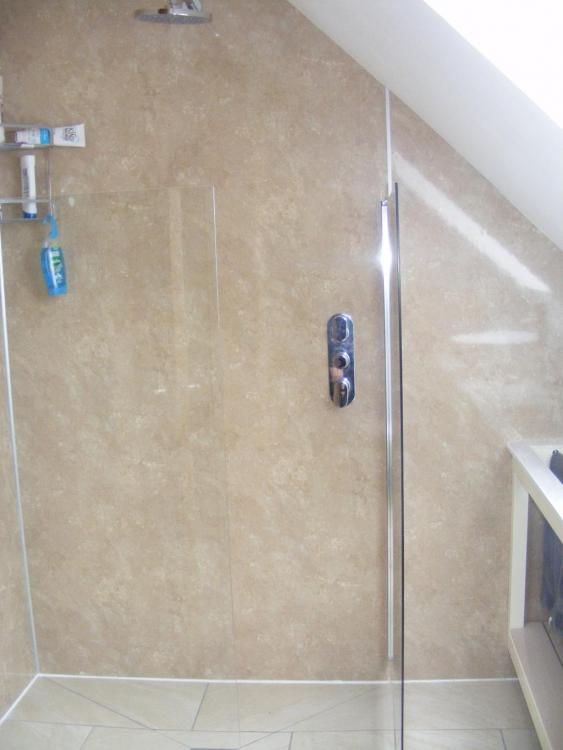
-
I experimented with "summer bypass" when I first installed mine (different make to the one being discussed) and I found the window when you could actually usefully bypass the heat exchanger was very limited. As pointed out, when it is warmer outside than in, you want the heat exchanger back in circuit. I found the simplest way to cool an overheated house was keep it shut in the day to keep the warm air out, and keep the heat exchanger in circuit to stop drawing in warm air. then in the evening when the temperature drops open up all the windows for a night purge of cool air to cool the house down for the next day. Once cooled down a well insulated house will stay cool for the next day when closed up again to keep the heat out. Then you only need to consider active cooling if the night time temperature does not drop below what you consider a comfortable temperature.
-
Ivt air x 50 ashp ebay bargain or .... not
ProDave replied to Jacob's topic in Air Source Heat Pumps (ASHP)
Yes it must hurt when something like that costs so much. My pet gripe is if you need a new PCB for a boiler, something that looking at it and with the components it has would cost about £10 if you were buying it to fit in a television, has a silly price tag.

