


Stones
-
Posts
3762 -
Joined
-
Last visited
-
Days Won
23
Everything posted by Stones
-
I've been mulling over what the best shape and size of silencer would be. I think foam is the way to go as the silencing material if for no other reason than there is more surface area available (assuming egg box etc) compared to the mineral wool type I linked to previously. The question really is do I build a box and line it with foam as per @JSHarris or get lengths of 200mm plastic duct (or bigger) line with foam and use reducers to take the diameter back down to 150mm to fit to the existing. I have enough spare MDF to build a box for the supply side 600 x 600 x 300 and for the extract 600 x 300 x 300. I also have half a tin of MDF sealer and some silicone to help make the box airtight. If I were to down the plastic duct route, in effect making my own version of the one I linked to in the OP, I could fit two silencers, in series on both the supply and extract (one horizontal, 90 bend then one vertical into top of plenum). Whilst there would be slightly more foam surface area if I went down the homemade box route, clearly there would be more length and a bend if I went down the duct route. Any views / thoughts about which would be the most effective?
-

self-build- Viable solution to energy efficient homes!
Stones replied to Ted Nicholls's topic in Introduce Yourself
@Ted Nicholls I think other members have already made perfectly reasonable observations in respect of what you're asking. To be blunt, your last post isn't phrased in a way that will encourage many, if any to participate. Take on board the comments that have already been made if you want us to help. -
BT/Openreach New Connection
Stones replied to worldwidewebs's topic in General Self Build & DIY Discussion
Likewise, and that's been the case for the last 4 houses that I've built. It continues to surprise me just how much of a regional difference there seems to be in how OR deal with self builders. -
+1. I wouldn't consider not having sarking even if I had the choice.
-
??????? Care to elaborate on the establishments you frequent?
-
Getting the phone connected at my new house...
Stones replied to ProDave's topic in General Self Build & DIY Discussion
If nothing else, should at the very least keep you updated. I share your pain... -
Were you not charged the standard SW £192 Building Water charge or £338 Infrastructure charge as part of your connection fee? I have had to pay both for every house I've built.
-
Getting the phone connected at my new house...
Stones replied to ProDave's topic in General Self Build & DIY Discussion
@ProDave Did you email the Chief Exec? If you haven't already, I would now. Not that it's much consolation, you will be entitled to some paltry compensation from your original install date. -
A cunning plan? What do you think?
Stones replied to ToughButterCup's topic in Central Heating (Radiators)
I agree with much of what @Ferdinand detailed above. If you really do feel you need to put in a boiler so that you can tell people there is a CH system, how about an electric boiler? https://www.plumbnation.co.uk/site/ehc-slim-jim-10kw-electric-flow-boiler/ Relatively cheap, and should plumb into the existing wet system. Not going to help the EPC, but I doubt you are going to make any meaningful improvement to that and anybody who wants an old cottage probably isn't going to care. Absolute musts - deal with anything that would show up in a survey, de-clutter as much as you can, and clean, clean clean so the place sparkles. Make sure the cat (and litter tray) are banished from the house. -
@8u1LD3r You reference other of the house being built. Are you a (small?) developer or a serial self builder?
-
Jamie, Appreciate these are not the best of pictures (didn't take any specific snaps of this detail) but this is how our window reveals were finished: Battens were used on the inner face of the ICF block to square off the window opening. The windows themselves were fixed with straps (packed as required) off the timber formers which closed the opening in the ICF core. Lengths of batten were then cut and fitted (again, packed where required) between the straps so that there was a solid and level point of fixing at both ends of the reveal to screw the plasterboard onto. I would just adopt the same method but use the 6mm ply you have already identified.
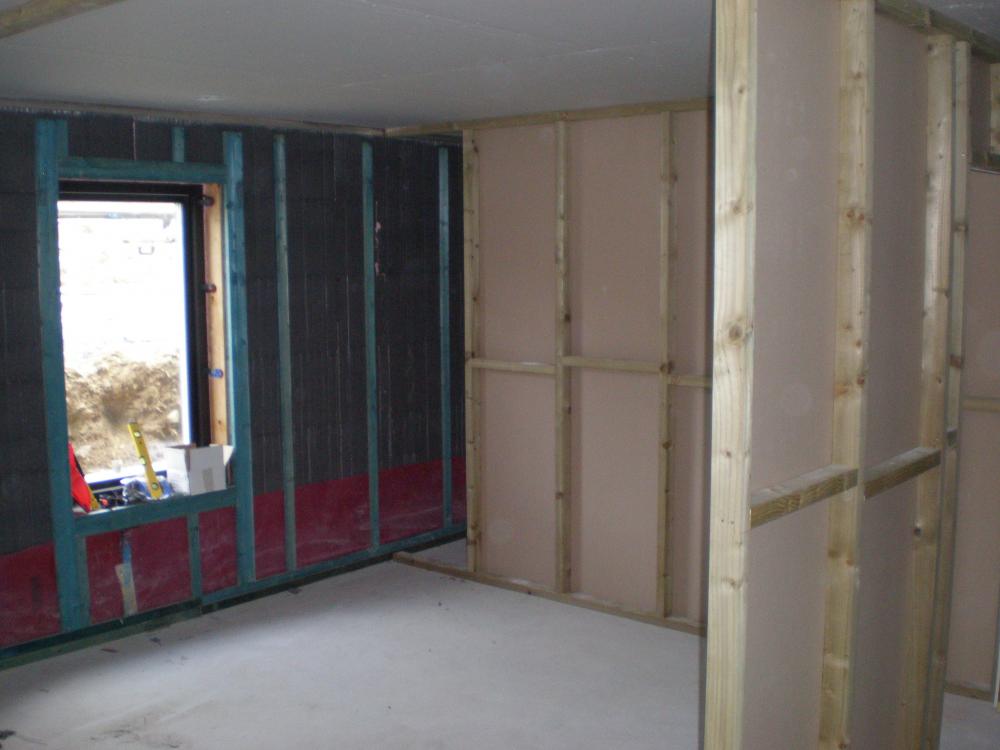
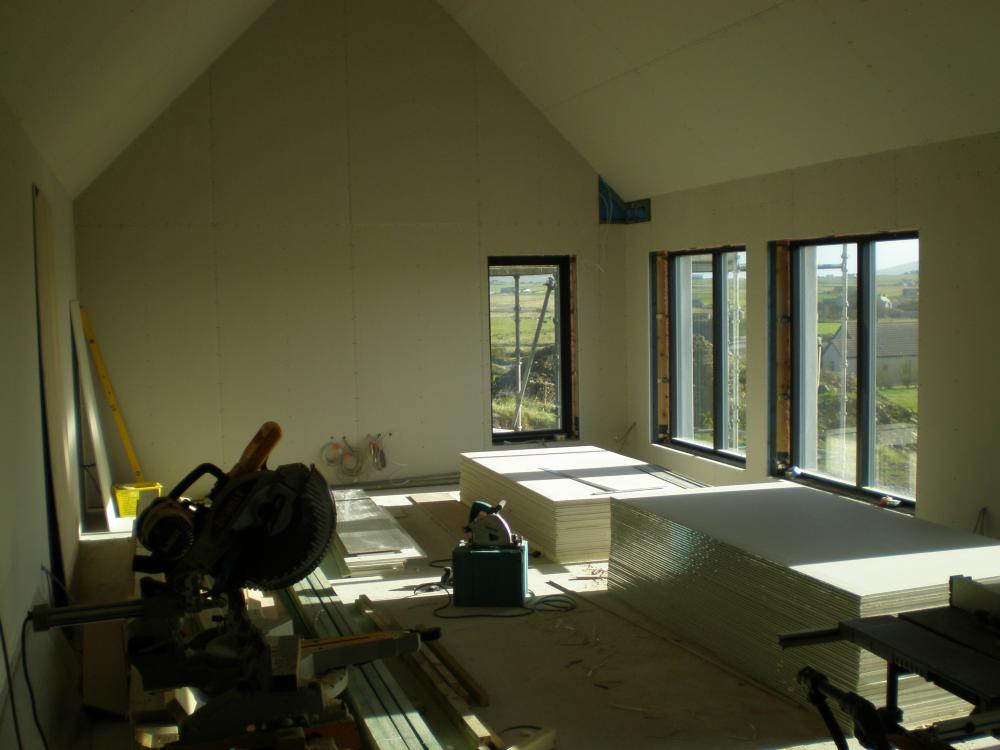
-
Welcome. On top of all the advice you have had, I'm going to throw in a little more. Don't discount other construction forms (block, ICF) as there may well experienced contractors close to you that use alternative build systems. 5 of the house we have built were timber frame and I was positive our current house would be as well, but having relocated, I found two local contractors who built with ICF, pricing work in direct competition with builders using TF.
-
Getting the phone connected at my new house...
Stones replied to ProDave's topic in General Self Build & DIY Discussion
My connection was likewise delayed. I learned long ago with BT that the only way to get a resolution is to email the Chief Executive. I'll PM you his email tomorrow. All complaints sent to him get dealt with by a UK based executive complaints team. They are quick to acknowledge, quick to make first contact and certainly keep you updated if there isn't an immediate or quick resolution possible. -
Looking for a better electricity supply deal
Stones replied to ProDave's topic in General Self Build & DIY Discussion
New entrant wanting to build market share? -
Drying Towels in an MVHR fitted bathroom
Stones replied to TerryE's topic in Mechanical Ventilation with Heat Recovery (MVHR)
No, the flow temp was never high enough. -
Drying Towels in an MVHR fitted bathroom
Stones replied to TerryE's topic in Mechanical Ventilation with Heat Recovery (MVHR)
In our last house we ran a low temp oversized radiator system (33C flow temp at 0C ambient). We had a wet towel rail in the bathroom. Made no difference in terms of speeding up the drying process as it didn't / couldn't throw out anything meaningful heat wise. Not worth the effort IMHO. -
Looking for a better electricity supply deal
Stones replied to ProDave's topic in General Self Build & DIY Discussion
@ProDave I'm in the process of switching to Iresa, 12 month fixed, 20.65p S/C. 11.136 p/kWh https://selfservice.iresa.co.uk/sales/home?bsbId=AA Edit to add - this is based on North of Scotland area, may well be a different price elsewhere. -
I don't think fixing to the existing fence panels will be a robust long term solution. The method you describe is how the timber cladding is fixed to our ICF house - 45mm batten fixed through 165mm of EWI to the concrete core. Long fixings in our case, but a decent drill and drill bit should see you okay.
-
Drying Towels in an MVHR fitted bathroom
Stones replied to TerryE's topic in Mechanical Ventilation with Heat Recovery (MVHR)
Have to admit to being another member of the hand blade method you mention. We've now lived in several houses with MVHR and have relied on simple air drying of towels in bathrooms. A lot depends on the time frame between uses of towels. Our experience is that towels will dry out overnight or between morning and and late evening use. Handtowels, which get used continually throughout the day remain damp (depending on use) through the day, but do dry overnight. We dry all our laundry inside on airers in our utility, and have done for a number of years, simply because MVHR is so effective at drawing moisture out over several hours. This method of drying replaced our tumble drier many years ago (cue discussion on fluffy towels!) -
I noticed this very phenomenon when I was decorating our house. To save me have to clean paint spray from the roller off our windows I masked them all up with lightweight polythene. When wind speed was over a certain m/s you could see the polythene billow into the room gradually until it was taught, and the polythene on the leeward side billowing out until it hit the glass. Shows how big an impact the pressure differential makes. Air will always find a way in under these circumstances
-
Price?
-
Controlling underfloor heating in passive house
Stones replied to dogman's topic in Underfloor Heating
I have 12 individual loops arranged in 8 zones. I am currently running this as a single zone off the ASHP master controller / thermostat but did fit individual room stats in the bedrooms so I would have the option of running the bedrooms at a lower temperature than the rest of the house if I wanted. I can achieve a 2C reduction in room temperature by using those room stats but far prefer running as a single zone. It's purely a comfort rather than an energy saving device IMHO. -
Working on the basis that it's surface area that's going to have the biggest impact, acoustic egg box foam would seem to be the more sensible option simply on the basis that the surface area will be that much greater (double / triple?) compared to a flat surface? Jeremy, you mention a baffle in your blog. Was this simply a piece of foam in the centre of the box with space all around for air to flow past?
-
My MVHR is proving to be a little noisier than I would like, so it is my intention to fit a silencer / attenuator to the supply ductwork between the MVHR unit and manifold. So far so good. Price wise, around £50 seems to buy me a ready made unit: https://www.bpcventilation.com/attenuator-silencer The silencing material in this case is mineral wool enclosed by a woven mesh material to prevent wool fibres entering the air supply. The alternative is a homemade unit / box which I would line with mineral wool and woven mesh, or alternatively, with acoustic foam. The question is what is the best material to use, and what is the best shape to make a silencer if constructing rather than buying off the shelf? Does increasing the thickness of the absorbtion material (wool or foam) dramatically increase performance (reduce noise level)?
-
Experienced something very similar with the last hedge we (or more accurately I should say I) planted. Very little if any visible activity in the 1st growing season, but 2nd season, they rocketed away.


