
Stones
-
Posts
3761 -
Joined
-
Last visited
-
Days Won
23
Everything posted by Stones
-
Welcome. I'm curious, When you say permitted development, can you say what section of the relevant PD rules you are working under?
-
More details in this blog entry https://forum.buildhub.org.uk/blogs/entry/329-part-24-finishing-all-those-little-things/
-
We weighed the floor down after injecting the adhesive, using a bucket of water, the idea being that this levelled things out and ensured you were not overfilling (excess will come out the filling hole when weighted). Couple of different approaches to drilling the floor, you can either drill a bigger hole then plug it, or a smaller hole and fill the furniture repair wax. We tried both and I preferred the latter.
-
@Russdl Noisier than units I've had from other manufacturers (albeit that could be the radial type ducting being the problem), collection of condensation in core (which I've not had in previous units, but again, may be due to our marine climate) but most importantly, feel the quality of the outer body (plastic) and the screws / fixing points that fix the front and back panels to the main body are flimsy and break easily (I think @Declan52 has experienced breakage of a fixing point as well). Plus point is the variable auto boost adjusted by humidity sensor.
-
We have outward openers that are hinged on one side - they have a ventilation setting where the window is open half an inch but can be locked in place, and some outward opening reversible windows. No leaks or problems with them, and they get a battering in winter.
-
Depends where you live!
-
How about a mini wireless spy camera positioned inside the cover to monitor the indicator led? Something like this https://www.amazon.co.uk/NIYPS-Portable-Wireless-Surveillance-Detection/dp/B07PPM2RCC?ref_=Oct_CABSellerC_1330831031_0&pf_rd_p=82a37368-9c09-51e9-9c4f-41f561902eec&pf_rd_s=mobile-hybrid-6&pf_rd_t=30901&pf_rd_i=1330831031&pf_rd_m=A3P5ROKL5A1OLE&pf_rd_r=TCWN616J0TSHASRKH3H6&pf_rd_r=TCWN616J0TSHASRKH3H6&pf_rd_p=82a37368-9c09-51e9-9c4f-41f561902eec
-
@steve77r - if the system is that low cost and easy to use, consider why it has not been adopted more widely. If there were a cheap, robust, good looking finish that was half the price of everything else on the market, everybody would be using it (or prices for alternatives would be dropped to match). Not to say you can't save money with clever thinking or careful sourcing of materials, but that all takes time.
-
Sound advice. We have built 6 houses over the last 25 years and it is a LOT of work. Heed all the advice an go in with your eyes open.
-
Likewise the stone, no reason cannot be tied to the frame as the block wall would be (subject to you checking with the TF supplier/your SE)
-

Air Source Heat Pump vs Oil Boiler
Stones replied to paulc313's topic in Air Source Heat Pumps (ASHP)
I started on the basis of using the same assumptions in terms of both hot water storage and heat distribution method - so UVC for hot water storage, and UFH for heat delivery. That way I was comparing the combined capital and running costs of connecting to predetermined systems. Thereafter it was a case of ascertaining the (installed) capital costs of various systems - I compared direct electric (willis heaters x 2, timeclock, master thermostat / controler, circulation pump, immersion in UVC), oil boiler and oil tank, ASHP. I assumed set figures for efficiency - 100% direct electric, 85% Oil, 350% ASHP (heating)/ 250% (DHW). Finally I worked out running costs (fuel costs) over 10, 15 and 20 years over a range total consumption figures staring at 1500kWh for DHW and 1500kWh for heating, up to 5000kWh for each in 500kWh increments. That gave a range of basic figures for each option and different usage requirements. I also added in expected servicing costs. -
Air Source Heat Pump vs Oil Boiler
Stones replied to paulc313's topic in Air Source Heat Pumps (ASHP)
I did a cost comparison as suggested by @JSHarris prior to deciding which way to go for our house. Taken over a 10 year period, ASHP came out on top for us against every other form of heating / fuel source (based on 5000 kWh each for heating and DHW). Direct electric becomes viable if you have very low heating demand / DHW requirement - below 2500 kWh each. Oil couldn't compete at any level based IIRC on 40p per litre. -
The different fixings used were due to the difference in the depth of insulation - 100mm vs 140mm, and the plastic type plug fixing being more cost effective. I suspect what may also have played a part was the fact that the 100mm insulation was marked such that it could easily be fixed to the plastic webs (markings on EWI lined up with markings on ICF blocks, whereas the 140mm insulation came in large sheets without markings. I suppose you could fix the EWI beofre pouring, but I'm not sure it would really do much in the way of adding much in the way of bracing / stability, and I certainly wouldn't advocate doing it differently. Ultimately, there will be movement / ripple when the concrete is poured and the braces do two jobs. Brace during the pour, then allow adjustment and support after the pout to ensure the wall is true. The latter is as important as the former.
-
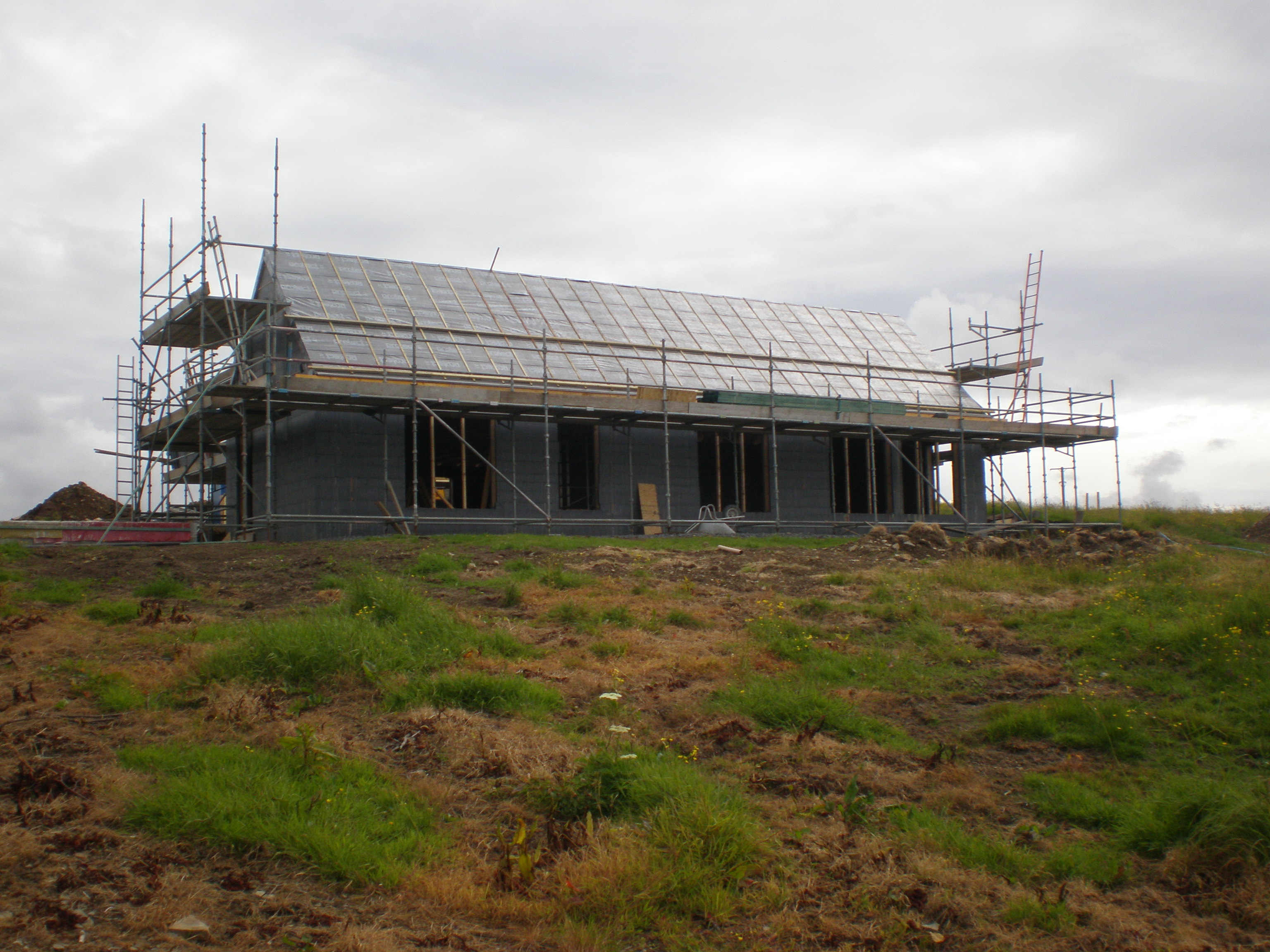
As much if not more time was spent bracing our walls and the corners than actually building the blocks to wallplate. My contractor was very clear that attention here was critical to ensuring a successful pour. Have a look at my blog for more info and pictures. I do indeed!
-
Perfectly doable, and something I seriously considered - all your doing in effect is adding another loop to the circuit. I decided it wasn't worth the bother given the size of duct cooler that would be needed to make any meaningful difference to the temp of the incoming air.
-
Yes. Accessing the cooling function will differ from manufacturer to manufacturer. In our case (Mitsubishi Ecodan), flipping a dip switch in the control box enables the cooling control function.
-
Garage green roofs / wildflowers
Stones replied to Moonshine's topic in New House & Self Build Design
A friend of mine has a green roof - EPDM single ply membrane as the waterproof layer, sand soil mix then turfed with 'grass' stripped from a maritime location (low growing). Pitched roof, but trusses had to be substantially beefed up to cope with the weight (it's the max weight when wet / loaded with snow that's important). His doesn't require much ongoing maintenance but it isn't a wildflower roof. Currently the grass is yellowing as we have not had rain for a while (well we do now). Personally I wouldn't even consider it on a felt roof. -
Law unto themselves or potentially human beings having to square an impossible circle - you want to move the house for very good reasons, but doing so may create an entirely new development (i.e. impact others in a way your current plans do not). Consequently there is a process to go through. Why should you be able to do whatever you want when others cannot? Frustrating yes, but whats the alternative, unhindered development at the expense of everyone but the developer?
-
I'm curious - what is your experience of engineered boards not lasting or wearing well?
-
I'm guessing steel is a far better transmitter for heat. For robustness, would plastic not end up being thicker and therefore in comparison to steel, the radiators would be bigger?
-
Attached is a plan of our single upstairs room which we use as a study office. I currently use an old office corner desk but want to construct something more permanent so my desk sits under the window which affords a good clear view out (might not get any work done, but hey). Mezzanine.pdf The room is 3.5 metres long, and I want to return around each corner by about 1.6 metres to create a shallow U shape. Ideally we would like to have an oak finish, and the obvious choice would be oak kitchen worktop. The problem is the cost of doing so due to the additional haulage costs I have to pay. An alternative is to build the actual structure with plywood, then top with either MDF veneered in oak, or with engineered oak flooring. The biggest issue that I can foresee is that of deflection - I am aware that single spans of 18mm ply or MDF would be limited, although a sandwich of the two glued together would presumably offer more scope for unsupported lengths. Likewise I know oak worktop would need some support, albeit at 40mm thick, less than the ply or MDF used on their own. What is the maximum length of span before some form of support is required and how best to provide support without having support legs at the front?
-
Save the world, install an LPG tank.
Stones replied to epsilonGreedy's topic in Environmental Building Politics
Talk about jumping on the bandwagon...
-
I do wonder how worthwhile any EPC is going to be -when we sold our last house, which of course had an EPC, we were required (still applicable in Scotland) to obtain a home report, which includes an EPC derived via rdSAP. Try as I might to argue the case with the surveyor that we already had an EPC, it had to be refreshed as part of the home report. It wasn't an issue for us as we had fitted additional Solar PV which scored highly with rdSAP, but the surveyor refused point blank to accept any of the information from the previous SAP worksheets.
-
@ProDave did you ever get a chance to have a look at that internet radio I dropped off some time ago - just wondering if you could cannibalise anything from that?
-
Save the world, install an LPG tank.
Stones replied to epsilonGreedy's topic in Environmental Building Politics
Dragging this back from aliens, there is I think an issue with the way the arguments about climate change are presented, that makes people wary - how many times have we heard we are at tipping point / point of no return / only have x years to save the planet? The media (at least in part) do bear responsibility for this as they tend to sensationalise doomsday scenarios in their never ending hunt for audience share. On the other hand are the warnings being made intentionally so terrible / dire as there is an understanding or even acceptance that governments and individuals are not going to put in place extreme measures, but may be willing (and able) to make small changes which gradually make a difference ? - think the large run into speed limits at roadworks - the spped limit is there to protect the workforce but really isn't needed (for that purpose) half a mile back from where the work is being carried out - lengthening the run in makes it more likely drivers will have lifted off the gas and their speed reduced by the time they reach the critical point.