


Wil
-
Posts
319 -
Joined
-
Last visited
Everything posted by Wil
-
Now that is good news, they might finally get around to changing our rubbish little T/x. I wonder how ridiculous the connection charge of getting our 60A fuses changed to 100A fuses will be then!
-
Despite asking for two, I was persuaded to have a single immersion for PV dump at the bottom of my tank. This means the 300l tank can sometimes take up to 14kWh of PV dump until it’s up to 80degrees (stat 2/3 of the way up) and the immersion stat cuts out on overheat. This works great for dumping loads of heat in summer and in winter I find that what little diversion I get tends to heat the top of the tank by stratification anyway. The lower the immersion, the more capacity it has to go at unless you have some way of overcoming the stratification (I’ve not tested that theory so maybe it doesn’t matter where your immersion is, it all gets to the same temp in the end for a given input). But having a second immersion at the top allows you to heat the top section quickly for boosting HW for additional guests etc.
-
Fan Coil Units for use with a (cooling) ASHP
Wil replied to ProDave's topic in Air Source Heat Pumps (ASHP)
Or the link to the oversized 4kW unit? -
I have several Shelly EM and 3EM products and can confirm as standard they use the cloud. You can disable this and have them internal only to your network but you then need to run some sort of Home Assistant server to keep all the logging features. I have no issue with Shelly logging how horrendous my energy usage is for the ease. The HA server is a WIP. I have solar and a diverter as well and they seem to work well. I’ve not done an exact comparison so can’t confirm accuracy against the meter. I have heard some on the forums complaining about the 3phase metering aspect, but can’t remember exactly what this issue was.
-
I'm going through exactly this at the moment only with Natterjack bats. 'possible maternity roost' due to loads of poo. Actually 2-3 bats doing circuits each evening. The bats are awesome and we love watching them, but there's about 20 other perfectly suitable existing roosts around the farm for the little darlings. The heater has got to be taking the urine.
-
Sadly I'm already talking to the CEO who is insisting I send it back. But your point is exactly correct, I wouldn't take a boiler off the wall to RTB so why an ASHP. I'm lucky I have a second and the technical know-how to change them over. If I was a standard consumer I'd be screwed. I wish it was, I have one site which has had 8 compressors and associated PCBs go in the last year! I asked Chris about this before I bought it too. Ah well, they're still helping at least so I suppose I better go get on with palletising it...
-
Just a note to watch on the CE pumps. I bought in October and self installed (with a plumber) in December last year. Both my pumps running fine until 2 weeks ago when all of a sudden my IVT18 tripped out and is refusing to start with a ‘HW Overcurrent’ issue. Chris has been really good and responsive (even at weekends) to emails asking for help. Sent me a controller update and logged on remotely to see what’s going on. However remote diagnosis has been unable to fix the issue (‘it’s usually a supply or setting issue, we’ve never had a compressor fail’). Now the request is to remove the entire outdoor unit and ship it back to them (at their cost to be fair). However this means removing both pumps to get the second one out due to positioning and the associated plumbing and electrical works to do so. If I was non-technical this would be a complete non starter. Not to mention the physical requirements of moving a large unit on my own or paying for help to do so. Also a bit (!) disappointed it’s stopped for no reason (the second unit doing Heating only is fine so I’m happy it’s not a supply issue). I deal with hundreds of VRVs and heat pumps on a daily basis at work and all parts are fully serviceable on site. In this case I’m told that the only option is to go back to the factory ‘because we have a test bay which would allow diagnosis not available on site’. This just doesn’t sound right. TL;DR I have to send the whole external condenser back rather than have an engineer come and fix it. I understand they’re a small company struggling with huge demand, but I’m now out heating and HW for a few weeks (plus diagnosis time) and if it wasn’t summer, this would be a massive problem. If you’re self installing these, it might be worth thinking about access if you’re required to send the unit back. I’m glad mine’s not on a roof! Hopefully it’s an easy fix and turnaround and it’ll be back to me soon.
-
Yes, well worth mentioning the snubber as I’ve had problems with low voltages keeping the input of shellies live and them not switching off. I’ve used a 330kOhm resistor successfully in places from advice on other forums.
-
Pair of Shelly 1’s would do fine- one switches on via the flow switch, sends a signal directly to the other and it starts.
-
In terms of ROI; All electric here, installed 14 panels May'21 5kWp panels, 3.68kWp inverter, goods cost around £3.5k (self installed) that should have been less but I changed my mind and bought a second inverter and haven't got round to flogging the first one. They've generated: 4.66MWh I've exported (for free): 692.35kWh at our old rate of 23p per kWh during the day that's roughly £1070 generated and £159 given back to the grid. I've 'saved' £911. Slightly less than 4 years payback. Given electricity is now 30p per kWh and heading up, I really ought to get on with the other two phases. Although I'd just end up exporting loads for nothing in the summer it'd help somewhat in winter!
-
Is it possible for PV diverting the opposite way round
Wil replied to Gone West's topic in Photovoltaics (PV)
So you need something measuring the inverter output and then putting exactly that much power to the TS immersion? You could do as above and put the diversion CT around the inverter output +ve wire so that it tries to divert exactly the solar amount. Problem is what then happens to any excess PV- this wouldn't then allow you to go back to 'normal' diversion without manually moving the CT back to your main incomer. But as you're effectively choosing to import energy to get your tank hot sooner, I go back to my previous point about just boosting the immersion when the sun is shining and getting the TS hot ASAP. Or if you don't need the TS hot immediately, turn off the oil boiler until the end of the afternoon. Might struggle if you're calling for heating from it and only using an immersion though. -
Is it possible for PV diverting the opposite way round
Wil replied to Gone West's topic in Photovoltaics (PV)
Wouldn't you just 'boost' the immersion as soon as the sun was shining to do this? Then Immersion is running at full chat, so tank heats up fast. Any PV produced is self consumed and you then import any electricity needed? Why mess about with diverting if your intent is to get the tank hot as fast as possible? Then once finished 'boosting' to say 65, let your diverter do it's thing for the rest of the day? Beats me why you'd want to do this, except if speed of getting heat in is the priority, but it's possible. -
Yeh, as above, get a diverter! I have a Solic 200 and it's been great so far. It only handles up to 16A though and does tend to throttle if it gets too warm so care needed where you site it. It put 335kWh into my HW tank in May. It paid for itself in 2 months! It even managed to put a few kWh in in December looking back!
-
I got 35kWh of solar yesterday. Accidentally exported 2.5kWh 14.5kWh went into the 300lt HW tank (was 80degC in the middle) 5.4kWh went into the Heating tank 5-6kWh went into the car The rest must have gone to running the house between 4am and 9pm when I was generating.
-
The cool energy ASHPs have a contact pair that allow you to choose a time to bring in a backup heating source. You run the ASHP as lead until it decides it can't cope and then bring the Oil burner in behind it. You could also use the ASHP to 'pre heat' the water going into the oil burner so that it doesn't have to work so hard but I have no idea of the efficiencies and was persuaded to just drop the oil burner altogether and run the ASHPs only. If you've already oversized the rads, you could run the oil burner at a really low temp too. It's a tough combo and would need a bit of fettling to run an ASHP in parallel with an existing Oil burner rather than buy a hybrid.
-
Additional electricity load on home with GSHP
Wil replied to 8Coops8's topic in Consumer Units, RCDs, MCBOs
Aren’t the 4 cables on the pole L1,2,3 and N? Can’t you just ask your DNO for a 3phase upgrade unless the other phases are used for something else. If two of those black wires enter your property, Shirley this is L and N? Have DNO confirmed only 2 phases available? You only have L&N on your internal photo unless other phases are terminated in the fuse box chamber? -
Having spoken to ITS this week, it seems they're short on lots of bits (like everyone else) so struggling to quote for full systems. My solar came from Midsummer Wholesale fwiw.
-
Electrician should be able to help you size it if you know how heavy your ‘workshop’ loads will be. A single armoured is fine if it’s big enough. Obviously the lights will then need to be back from from the workshop… You’d have more flexibility if you installed the cable for the lights in a duct with a decent draw wire to your future workshop position and then pulled a new armoured through as and when needed. Save you putting a potentially big cable in the ground now which might not suit your requirements.
-
If you’re with WP, you’ll almost definitely be forced to limit to 16A or 3.68kW max output as their network is oversubscribed for solar and they’re being difficult about new connections. You’re in a different part of their area so you may be luckier than me. If stuck with a limit and a big array you’d either have to zero output or G100 and limit to the above.
-
Reducing Energy Bills - How goes it?
Wil replied to Ferdinand's topic in General Self Build & DIY Discussion
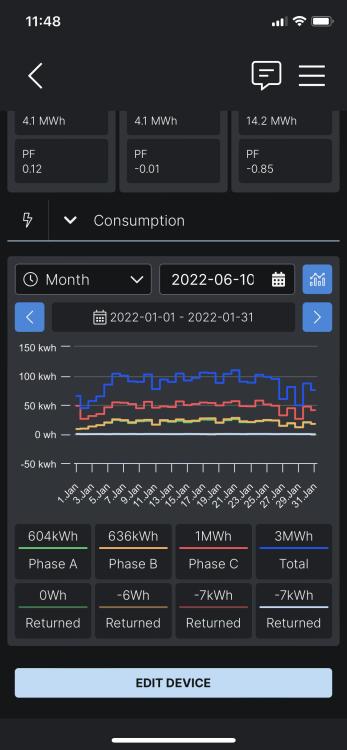
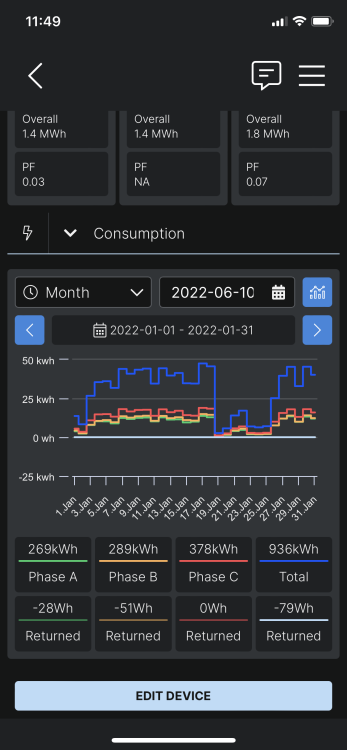
Yup my heat pumps (mostly): 3MWh overall, 2MWh roughly on heating, 0.25MWh on car charging and .75MWh on the rest of life… Total above, HPs IVT18 Left IVT26 right. You can see where I experimented in late Jan with running the 26 as primary…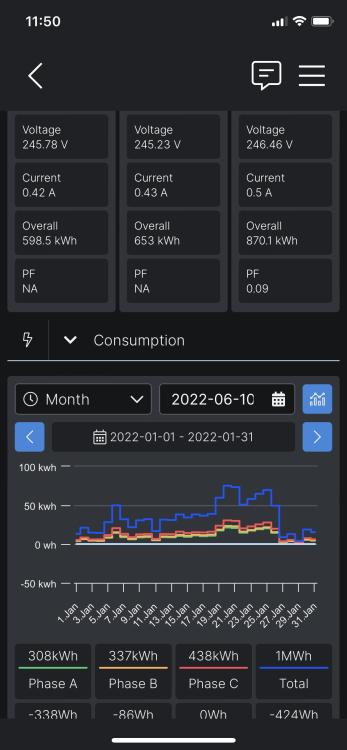
-
Reducing Energy Bills - How goes it?
Wil replied to Ferdinand's topic in General Self Build & DIY Discussion
Sheesh, my Elec bill was over £500 in January… 😞 that was before the price rises. -
Solar Controllers - Difference between "load" & battery supply?
Wil replied to Solarexploits's topic in Photovoltaics (PV)
Doesn’t this act as a backup ‘essential loads’ in the event of a power outage? How else are you getting your battery power out of the batteries again- is there a separate DC-AC inverter for this? -
I think a lot of the noise in my 4YourHome unit is to do with the mounting and vibration rather than airflow. I'd be interested if Ian's solution with the magnets held strong enough or if some rubber gaskets were needed to try and prevent too much vibration. On the mounting I was thinking of the fans being at the top but angled at 45degrees pointing up and out to the room to try and throw some air as opposed to just a straight throw. This goes back to some kind of enclosure around the fans and rad to hide all the ugliness anyway.
-
I only have data for the last winter, but my fairly unshaded 5kWp array on a 3.68kWp inverter generated 85kWh in Dec for an average of 2.5kWh per day. November was 185kWh and Jan was 205kWh. So it was only really deepest darkest Dec when I wasn’t getting much output.
-
I haven’t had the time or skill to devote to this yet, but FCUs are incredibly simple when it comes to it so Shirley it can’t be that hard. Perhaps a collection of AliExpress parts would be the way to go. This was the post that put me onto the DIY FCUs in the first place: https://originaltwist.com/2018/11/14/diy-fan-coil-heater/ Some interesting ideas there.



