Wil
-
Posts
319 -
Joined
-
Last visited
Everything posted by Wil
-
GSHP - RHI payments - went better than expected
Wil replied to Ajn's topic in Ground Source Heat Pumps (GSHP)
Phew, yes, we're a retrofit! Thanks for clarifying! -
GSHP - RHI payments - went better than expected
Wil replied to Ajn's topic in Ground Source Heat Pumps (GSHP)
I have a valid EPC from a couple of months ago, as I understand it has to be recent and not show any 'recommendations' outstanding. Not that it has to be AFTER the MCS cert date right? Technically the ASHPs were there are the time but he couldn't put them on the EPC as the oil burner was still running. Thanks for posting this though- the above is a good reminder for those of use trying to make the deadline! -
GSHP - RHI payments - went better than expected
Wil replied to Ajn's topic in Ground Source Heat Pumps (GSHP)
Well done, I can't get my MCS visit/ cert til 16th Mar earliest and I'm bricking it that I might miss the deadline over an admin error! Must be nice to be in and assured! -
Interesting. I'm considering more solar on our roof with marley ridged concrete tiles. The bituminous felt underneath is a bit knackered where it meets the chimneys, so was gearing up for a full roof off and re-felt job with in-roof panels. ? Hopefully make it a warm roof at the same time...
-
Start with a DM and a couple of access point. Add more until satisfied. I think I'm at 8APs and 2 small switches now ? Stupid stone walls acting as faraday cages!
-
Generation meter immediately after the inverter (you didn't mention an inverter though, so how does it get from DC to AC?) on the AC side before it goes down to the CU. Or can sit next to the CU before it enters the breaker there so it's readable without going in the loft.
-
Insulating a pebbledash solid wall and damp concerns
Wil replied to Ben Weston's topic in Heat Insulation
Really? I've not had this with either our last (G2 Listed red brick Georgian with a terrible injected damp course) or current old farmhouse with no visible damp course. Lenders didn't ask any questions about damp courses. More interested in wall and roof construction. Please don't do the injection job- it's terrible. Some old mill buildings don't have damp courses and sit in water all day long! Many references online to not damp proofing by injection. -
If that's the Quettle tap, make sure you put an in-line descaler if you're not treating your water elsewhere...
-
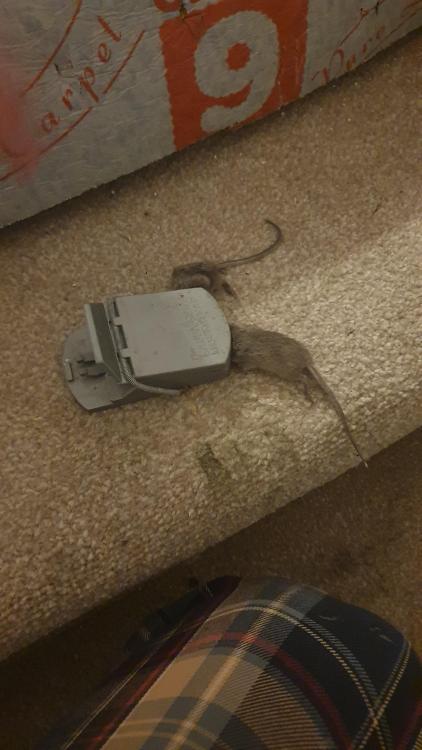
We have some interesting problems with mice- usually when the contractors move the straw stack near the house and they decide to move in here instead. I woke up to one making a hell of a racket the other night. Lay there for 2mins getting cross before deciding to switch the light on and do something about it. Turned out the bold b@gger was on my pillow! I moved fairly quickly at that point. Put a mouse trap with peanut butter down next to the bed and there was a loud snap a couple of mins later. Took the mouse outside to give to the feral cats who I'm fairly sure now consider me their butler... Proud moment was getting two with the same trap...
-
The Tesla inverter is only to convert AC/DC for the batteries and back again- irrelevant to the grid. You do still need G99 for grid connected storage, but could limit it to 3.68kW output max (or if they've already said no, go back with zero output). In reality, once you've filled the battery you want to keep it for the dark hours unless you're doing some sort of clever time-based exporting. I just have a 3.68kWp inverter and allow summer excess after the water tank and car are full to go back to grid. Now I have the ASHP, I'm considering more solar to offset their usage! I do have 3phases to go at though. Edit: Actually the Tesla inverter is relevant if it can export and therefore needs to be set to zero export too...
-
Shirley you can get agreement under G99 to NEVER export, rather than a response to a DNO limitation. Perhaps you're trying to have cake and eat- export sometimes, but not when DNO says no. As I understood it (with your DNO's permission) you could limit or zero your export on any level of panels. You still need to ask first though as opposed to G98 where you can do it and tell them later. as I understand it the inverter just changes the power factor to limit or zero the export of power to whatever you set. If in your case your inverter is under 3.68kW and G98 compliant, there's nothing they can do to stop you connecting? What was your request?
-
Sorry I meant mounting system for the pole and furling system. The blades are well held on fortunately!
-
Eeenteresting. Hadn't thought of that approach. Only problem with that is I need to come up with a better mounting system too!! ? Will go and google GRP firms locally... thanks!
-
7.25kWh- What a lovely thought. I monitor my electricity closely and my daily usage before heat pumps was around 25kWh to 32kWh depending on PHEV charging. I had a day earlier this week with an average temp of around 2-3degreesC and my usage was 100kWh. We had the log burner on in the living room too.. This is a family of 4 in a leaky 300m2 farmhouse exposed to the elements though. I've gone about it a bit backward in putting the pumps in then doing the renovation and insulation in order to try and get in on the RHI... hopefully things will improve from here.. Hence any efficiency measure possible would be a bonus to get me away from 333Wh/m2!
-
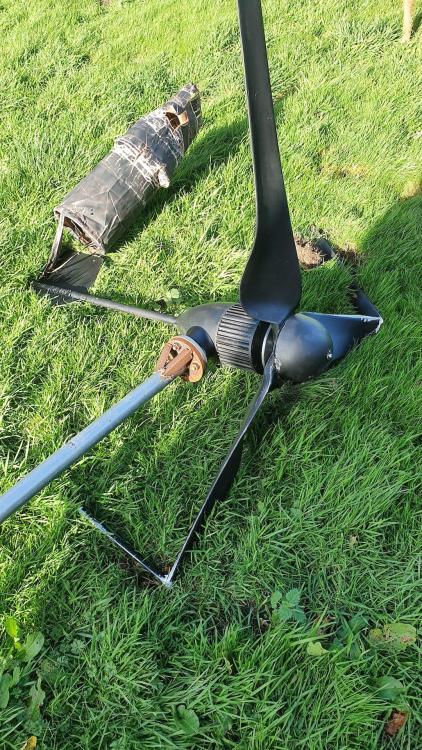
That one I posted that died above, was about £800 all in for inverter and controller plus probably another £100 of scaff and mounting brackets. As above, stuck on an old stable away from everything else. It tended to gust (funnily enough) rather than constant and would often overspeed and dump to a resistor. In a strong wind it would do about 100Wh constantly with peaks of up to 600W instantaneously. Currently wondering whether I can homebrew some VAWT blades to attach to the hub as it's only really the blades that are knackered.
-
They're independent but hit the same buffer tank so I suppose also cascaded. the 18 does heating and DHW, the 26 does heating only. The stat for the 26 is higher up the buffer tank so always reads a little higher and therefore allows the 18to lead until it can't cope/ goes off to service DHW and then the 26 comes in. It then drops off earlier and lets the 18 finish off the heating cycle. They'e at Diff 5/ Stop 0 for DHW and 3/2 for Heating. I also have another pump doing the whole heating circuit (rads until we refurb, pump set at max speed) so the HPs pumps are only really circulating to the coils/ buffer. I'll try dropping the min speed to 30 and see if that helps at all. Interesting you think the WC won't do much, because of minimal variance in daily temps? today is 8 high low of 0 so I know I want the temps around the 42/43 mark to keep us comfortable tonight. I should just set them there and leave it to do it's thing? Do you also have an internal heating constant? I'm potentially overcomplicating at the moment with morning and evening warmer and setbacks during the day and night.
-
Interesting topic. I have 2 of the Cool Energy pumps installed before Christmas and still trying to work out what the best way to run them is. My elec bills are horrific in these low temp days. The only setting I was brave enough to change in the 9999 menu was the 0degree heating curve to 42.5 so the weather compensation is a bit warmer at 0 than the default 40. For those with these systems @dpmiller@Marvin Did you change any of the pump settings at all? I often see them running at 50% which is the set minimum- is there any harm in letting them ramp lower or is it an efficiency measure? My current 'best guess' setup is Weather Compensation with DHW set to 48 and standard curve with change as I mentioned above. Before this I tried to time the DHW to go to 50 at 6am and 50 at 5pm for our showers/ kids bathtime, but it only ever came on once the first shower was had in the morning. Then it went into defrost and sucked the rest of the heat out of the tank and the second shower was... chilly... did you have this issue with the time programmes? Now I just need them to come and visit and do my MCS cert!
-
It was a sad day indeed. It's still sat in the shed awaiting a new set of blades and a better mounting structure! It managed to bend a scaff pole to 45degrees on it's way down too... My self installed bodge didn't include a good way of getting it up and down in the event of high winds, so was kind of inevitable it was going to overload at some point.
-
I did have a self installed 1kW wind turbine... It died in a storm after about 9 months of generating very little. It was a total bodge job, but in comparison to my solar it did almost nothing... It was good to have and I miss it's minor contributions on overcast winter days and nights.
-
Your meter should do net metering. So if you're generating 2kW and using 1kW on all 3 phases (3kW total), then you'd only be charged for 1kW. Or a kWh if you kept it constant for an hour ? I have 3 phase and a 1phase inverter and ended up loading everything single phase onto the 3rd phase and keeping the 3phase stuff across all 3. Had I thought more about it, I could have left alone. Does make my power monitoring a bit more obvious though and the house only has a single phase board which is far and away the highest constant loading.
-
I had the Acova ones in my previous house and they were great. No experience of the others, but everything looks to have shot up in price!
-
As we're sharing data... I self-installed a 5.2kWp array with a 3.68kWp inverter at the end of May. I put in a HW diverter and have no FIT (or MCS cert). I also have E7 so use that to charge the PHEV and run dishwasher to try and push major consumption overnight (because consumption would be greater than my solar is guaranteed to produce and having the dishes clean in the morning is handy! I've just installed 2 big 3phase heat pumps so now considering doing the other 2 phases with 3.68kWp arrays as well. My electrical bill will be heading significantly north in the near future once I run my oil tank down. Since the first of May my consumption has been: Consumed 4.1MWh (ouch) Solar Produced 2.96MWh (minus the export this has avoided £453) Solar Export 901kWh (I've effectively 'lost' £198.22 or been nice and given it away) We're coming into winter so I've had the best moths an I can't accurately extrapolate across a full year yet but assuming I get to an avoided cost of around £600 pa (seems reasonable) then my payback will be less than 6 years. The kit was more like £3.5k by the time I'd bought all the bits and the kit new. I could have done better on that as others have.
-
Help me to understand GSHP performance
Wil replied to Benguela's topic in Ground Source Heat Pumps (GSHP)
Using Steamy Teas as a measurement of a unit of temperature seems like something that will destroy the minds of our US inhabitants. Cup or mug? With milk or without? Does sugar effect the relativity? -
Help me to understand GSHP performance
Wil replied to Benguela's topic in Ground Source Heat Pumps (GSHP)
Given their sponsorship of Exeter Chiefs, they're probably in that direction. They don't look particularly small from their website/ team, but who knows. Wasn't a recommendation or otherwise... -
Help me to understand GSHP performance
Wil replied to Benguela's topic in Ground Source Heat Pumps (GSHP)
During my research on GSHP I came across one manufacturer (Kensa) who ONLY made direct speed GSHPs and claimed that it was more efficient to run hard and stop rather than have an inverter driven unit. Possibly to do with the almost constant ground temperature for the brine? Also no inverter to die on you at some point... ASHP needs an inverter all the way.