


Wil
-
Posts
319 -
Joined
-
Last visited
Everything posted by Wil
-
I have one of the ‘sit on top fans’ from your second link as well. (I have a lot of solutions without getting the right one yet!) It’s a bit noisy, ok when the TV is on, but couldn’t be used in a quiet room. I didn’t feel it massively improved my rads either (but that’s anecdotal in a room with undersized rads and no proper testing). Possibly could be taken apart and used to create the DIY FCU discussed above.
-
Ah that’s good research. I knew they were Italian and a Reverso unit but hadn’t gone as far as looking up the manufacturer. I’d like to think my issue is a one off and if the deck wasn’t catching it would be fine. I had to supply my own controls and actuator for it which was fine but needs added to the cost. I had a chinesium controller I had been testing which happened to fit fine. The eBay unit is interesting. I’d be far keener to hide it behind some ‘radiator cover’ and let the fan do the work in spreading the heat. The rad cover shouldn’t kill the output as it does with a passive convective rad. It just depends if it was quiet! I can’t find a decent tangential fan to build my own FCUs using cheap Type 22 rads in an enclosure with some fans. Had considered using multiple 120mm computer fans but there seems to be a reason someone hasn’t tried this before.
-
Hmm, the plinth heaters require a plinth though? Although I suppose one could get creative with built in furniture/ raised floors. Also interested in the noise. I bought one of the Fan Coils from Cool Energy when I got my HP. It’s got an unbalanced fan deck so sounds like a clacker which is irritating. I’d asked about repair but have had no joy so I’m trying to go through a returns process soon. I’m sure the unit would be excellent if it weren’t unbalanced and the heat output seems good. Still looking for better and cheaper options…
-
This is exactly what I’d like to do, except swapping the diesel genny for grid (as it’s still cheaper per kWh) and put a WBS through the TS coil to be that secondary source of heat when the PV isn’t performing. For me it’s that I’d like to minimise grid dependence, I don’t need to go as far as the genny and fuel storage to remove it, however tempting to stick fingers up at the DNO. True grid independence can only be achieved as Nick says above.
-
God what a generally useful response from a DNO. I wish WP responded with anything other than ‘computer says no’!! The G100 export limiting just means both your AC battery inverter and the PV inverter would need to be set to limit the export to under 4.8kW or whatever your agreed limit was. As long as you buy inverters that are G100 cert and is set up by someone who can prove the limiting is in place if the DNO wish to see it, then you should be fine. W
-
Anybody using Hubitat systems?
Wil replied to MikeSharp01's topic in Networks, AV, Security & Automation
I use a Homey, but am also experimenting with Home Assistant for the heating. Homey to be fair has been fairly foolproof for several years now. -
Oil to ASHP. Can I? and do my numbers workout?
Wil replied to pacemaker1000's topic in Air Source Heat Pumps (ASHP)
Another oil to ASHP user here. Although I ended up with 2. Big ones. The second has been mostly redundant since March but was very much in demand Dec, Jan, Feb. Still awaiting my PP to do the renovations to unlock the fabric improvements I hope to make. WBS in the main living room (also coldest least insulated room) as a backup/ top up. House loss anywhere between 50 and 200W/m2 for something that wasn’t built from the ground up to be energy efficient so you’d be a little on the lower side with that assumption… W -
Yep, just this. We’re closest to the ancient 15kVA T/x that feeds us and 3 other properties. They’re all single phase but I’m 3phase. If we all stuck 3.68kWp systems on and I did all 3 phases (which I will) we’d be running very close to the limit. Particularly if I took the above approach and just smashed on with maximising the solar on my roof space, I could probably blow that T/X by myself if I went away for a day or two. That said I could also technically pull almost all of the 15kVA available with 60A fuses on my incomer at 240V and Western Power are utterly disinterested in any more solar or upgrading our T/X unless I pay for it. So surely me zeroing myself out of the equation is a positive!!
-
Yep, as the contact closes for the nest controller, it closes power onto the two port zone valve. Once that opens, it starts the pump. When the pump starts, I use a Shelly 1 to take the pump start voltage as it’s switch input and close it’s relay to close the volt free call for heat on the HP controller. The HP is then enabled and the controller decides whether it needs to run the HP of not depending on the temp of the buffer. When the next call for heat drops (temp satisfied), it opens it’s contact and the zone valve, pump and HP call for heat all drop together. The HP controller will overrun if it needs to to avoid short cycling but this isn’t an issue in my house as there’s no such thing as a short cycle due to my heat losses.
-
I use a Google Nest in the hall to call the heating pump on or off. This also enable the ‘call for heat’ from my CE Carel controller. This means the HP only runs if the buffer tank temp is low AND the heating pump is running. Which prevents the HP running just to ‘top up’ the buffer when the house is warm enough. I run my primary HP at 45degrees for heating and the secondary in weather compensation mode (just looking at buffer temp) so that it only kicks in if the primary isn’t coping with the heat loss in the heating circuit and the buffer temp continues to drop. But this isn’t relevant for those with a single HP. Edit: I just set back the Nest thermostat by 2 degrees (17) at night. Any programmable thermostat could do this. In winter the ‘learning element’ of the google was bringing the heating on VERY early in the morning to achieve the morning setpoint at 19. I just can’t bring myself to set it to 19 and leave the thermostat alone but in shoulder seasons that should be easier.
-
The problem with this is, you still need permission. It’s a G99 or G100 application minimum. As long as no one dobs you in, there’s potentially no harm done (if the install is up to scratch). But at that point, why not just apply for the G99 anyway? In the event of a fault or poor configuration, you ‘could’ end up exporting the full amount of your solar and batteries simultaneously. If like me you’re on a piddly little local T/X you could damage it and then be liable to your neighbours as well for the lack of power. The (particularly irritating) DNO rules are trying to prevent issues such as this. Don’t get me wrong, I think your approach is fine if it’s properly and safely configured and I’ll be following a similar approach if I can work out how to self-install more solar on my fairly steep roof!
-
I know, I know, I’m even an electrical engineer so it’s just slightly upsetting to get caught getting it wrong. I’m still waiting for ST to come back and tell me that’s more than he consumed in his one bed flat for the entire week… 😂
-
Ah the missing h. I apologise for my sit units. It was apparently 313.31Wh if we’re being pedantic. And only applies to the iVT26. And I’m on economy 7 so it was less than 10p in standby for each unit for the day. But hopefully the information is actually useful to the thread.
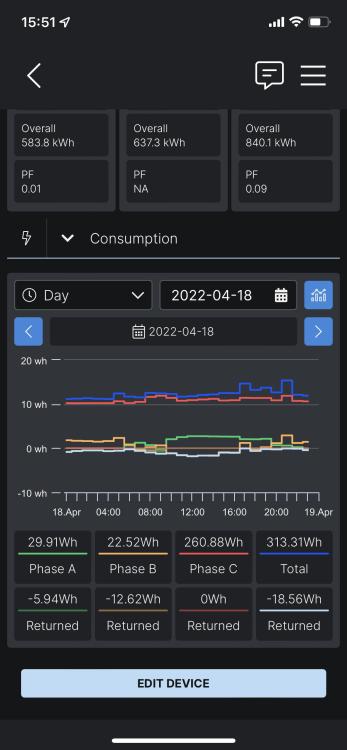
-
2x Cool Energy 3phase, IVT 18 and IVT 26. That 313W was total across 24h. Or 10p a day on standby.
-
I have a Shelly 3EM on each HP. My 3phase IVT18 sits idle at 13.1W, 3W on phase A, 10.1W on phase C. The pump appears to run from phase C when it does run at around 90W before the compressor kicks in. The IVT26 sits idle at 12W. Edit: just found a day it didn’t run the compressor and it consumed 313W across 24H with 29.9W phase A, 22.5W phase B and 260W on phase C.
-
So does @Marvin I believe.
-
He told me he did before I bought one... Had a few long chats with the owner before I signed up.
-
What's the issue with running the 'clean' out from the treatment plant to a ditch which is occasionally dry? Surely, there's a small wet patch in the ditch where the pipe exits and no other issues?
-
Just out of interest, doesn't your electrical meter do net metering? So if you have 3 phases totalling 10kW, you can draw 10kW on a single phase and the meter will not roll up? Doesn't cover all your installation problems, but should allow you to use all 10kW of your array without (charged) import?
-
Science and Art of specifying ASHP
Wil replied to severnside's topic in Air Source Heat Pumps (ASHP)
2v1: Benefits: Some level of resilience depending on config Lower start-up currents - less impact on grid if sequenced properly Ability to heat and HW at the same time Greater capacity on single phase supply Efficiency during summer months when second unit not needed Drawbacks: Higher installation cost and maintenance increased complication in controls Increased pipework -
baseload, I just can't seem to get below about 400W! CCTV server,UDM Pro various HA parasitics seem to be about 150-200W, Fridge freezer, gate charger, couple of trickle chargers seem to do the rest. However now I've got the ASHPs for the heating HW, I used 2040kWh in Feb, so averaged a load of 3kWh permanantly! Pah to your puny 1.5kW average... 🤯
-
I'd have to retrofit Solaredge to my existing array, unless that was aimed at Thorfun? I have a basic Sofar Solar 3.68 inverter.
-
Following this as I'm also trying to work out best way to generate and offset some usage. I still have 2 phases of solar to fill. I'm supposedly 'in a queue' for a powerwall, but slightly suspicious as to whether it'll ever turn up. Have also been looking at Hybrid solutions. How much battery storage have you decided to get (and based on what?). For true off grid reslience, I'd need any inverter to be able to deliver 12kW instantaneously on phase 3 which is waay more than even the PW2 can do. I'm attempting to find a system I can charge on E7, use for the morning, charge on solar and cover my evening usage before starting again. If the batts haven't charged enough during the day, they just do what they can until the next E7 period. I need about 20-30kWh to carry through an evening (including the HP).
-
OR buy a Shelly EM for £50 which can monitor your export. If it reaches a level you're happy with, switch on the built in relay and enable the HP (assuming your HP can take a simple 'on-off' switch input). When the export drops below a certain level switch it off. Probably add a timer so you don't flick on and off as the sun goes behind a cloud. Your GSHP is unlikely to get the water as hot as an immersion, so depending on how much solar you have to divert, it can be a lot simpler to use a COP 1 Immersion to get the water really hot...
-
Have you spoken to them about battery storage (now or future)? If not, this is irrelevant. They may be telling you that to add batteries, you'd only be able to do AC coupled in the future rather than direct DC? Put the gen meter between the AC Isolator and the MCB in your garage DB. That way it's only metering PV generation. Not sure why the gen meter would need to be within a certain distance of the Utility meter? They're not on most of the commercial buildings I've seen (or my house). Edit: for metering I use Shelly EM or 3EM products to provide metering direct to my phone so I can get the smug feeling of knowing my PV is working wherever I am.


