


A_L
-
Posts
652 -
Joined
-
Last visited
-
Days Won
1
Everything posted by A_L
-
First hello and welcome, Here is a possible 'off the wall' solution. Seal wet suit neoprene to the inside of the toilet cistern. It does not have to be a perfect seal, a small amount of water getting between the neoprene and the cistern should be O.K. The neoprene insulates the cistern from the mass of water preventing it cooling the air below its dewpoint, preventing the formation of condensation. A small amount of water getting between the neoprene and cistern will heat up quickly and any slight condensation should evaporate before it forms large enough droplets to run down the cistern. An alternative would be to pre-heat the water entering the cistern?
-
Looks like 0.15W/m2..K, Part L1A (Wales) https://www.labc.co.uk/professionals/building-regulations-guidance-documents/approved-documents-and-technical-guidance-wales/wales-approved-document-l-conservation-fuel-and-power Table 1 bottom of page 18
-
Celotex has a thermal conductivity of 0.022W/m2.K and the usual open cell Icynene has a thermal conductivity of 0.039W/m2.K. This means that 100mm of Celotex has the same insulating effect as 177mm of Icynene.
-
Thermal store sizing for oil plus solar/hydro dump loads.
A_L replied to Rendall's topic in Other Heating Systems
1) Can you detail how the electrical demand is made up? For an ordinary off-grid house it is unusually high. IMHO you are going to need at least two days worth of batteries. Also remember that electricity consumed for appliances then turns up as a 'casual' heat gain within the heated volume. 2) Is the heat loss rate really an instantaneous 15-20kW? or do you actually mean 15-20kWh per day, in which case it would be covered by the casual gain referred to earlier. If the former can you describe the property? Insulation and draught-proofing would seem to be called for. 3) I would meet the DHW by using a small dedicated ASHP along with Waste Water Heat Recovery (WWHR) if your space heating demand is actually 15-20kWh per day. If your heat demand is 15-20kW then DHW would be heated as a by-product of the space heating solution. 4) Electricity to be provided by Hydro/PV with an air cooled backup generator (Lister) -
The bottom of the footing should be at least 450emm deep to prevent frost heave. Bottom of Page 37 here https://assets.publishing.service.gov.uk/government/uploads/system/uploads/attachment_data/file/429060/BR_PDF_AD_A_2013.pdf
-
MVHR + ASHP Post Heater control
A_L replied to john0wingnut's topic in Mechanical Ventilation with Heat Recovery (MVHR)
1) Every other room, not calling for heat, will receive some and overheat. 2) The post heater will only receive water at the temperature of the buffer tank and the heat transferred will be very small 3) Why does the heat pump not keep the cold room(s) up to temperature? -
Hello and welcome, Space heating, domestic hot water and cooling are all separated in time, i.e. only one function at a time. The hot water may come on for 0.5hr then it returns to space heating then back to hot water etc.
-
@ash_scotland88,makes a very valid point. If as it seems from the 'in progess' thread you have a heated volume through the original wall there will be no heat loss over its area but you will have a very significant thermal bridge at the points where the new extension walls and ceiling meet the original wall. The heat shortcuts through the original wall to the outside. That not withstanding I favour @Declan52 's position that poorly fitted board insulation allows 'thermal bypass', air movement from outside to inside (or reverse) and this is the major heat loss. Board insulation simply lying on plasterboard is inadequate. It should be tightly fitted to the timber or loose enough to use foam around the edges of the board.
-
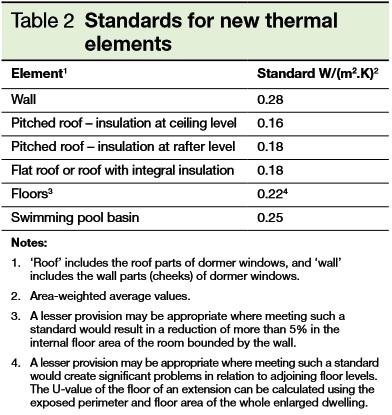
It does compute, from Table 2 walls only have to achieve U=0.28W/m2.K but ceilings have to achieve 0.18W/m2.K. That implies 56% more thermal resistance (insulation). B regs stipulate a max U-value, as in Table 2, which insulation and thickness you use to achieve it is up to you Sorry, in that case you need to find someone who does Cold is always coming in, it is just the rate that we control with insulation
-
O.K. , assuming the 'rigid stuff' is PIR or similar and the timber holding up the ceiling plasterboard does not fully penetrate the insulation i.e. there is at least 50 mm of insulation covering the timbers then 150mm should be sufficient, see attached table. If the insulation is fully penetrated by timber, creating a thermal bridge, then 200mm between the timbers will be required.
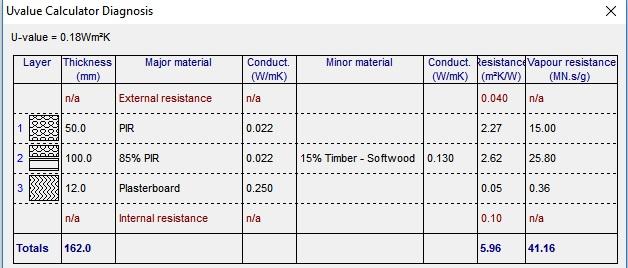
-
Referring to Note 1. For a wall, insulation between studs, 200mm of unbranded loft roll (Thermal Conductivity 0.044W/m.K) is needed For the ceiling 300-350mm are required dependent on exact configuration
-
Table 2 (particularly the notes) page 16 https://assets.publishing.service.gov.uk/government/uploads/system/uploads/attachment_data/file/697629/L1B_secure-1.pdf
-
Decentralised MVHR
A_L replied to MrSniff's topic in Mechanical Ventilation with Heat Recovery (MVHR)
Here are some:;- https://renergise.ie/shop/energy-saving-products/ventilation/ https://www.inventer.eu/ https://www.lunos.de/products-from-lunos https://www.suedwind.it/en/ambientika-eco/4893273177366-1-1 -
Building site electricity provider/tariff
A_L replied to Olly P's topic in General Self Build & DIY Discussion
@Olly P I'd say as a low user you should minimise daily standing charge, EON have a 1 year fix with a 7.35p/day standing charge (on U-switch). There are 'minows' that offer marginally lower total costs but I'd stick with a big six company.- 1 reply
-
- 1
-

-
Agreed, if the airspace is about 15mm then can add about 0.15m2K/W but only if airspace unventilated. Just trying to illustrate small difference between options.
-
The thermal resistance of 13mm of even insulating plaster is 0.07m2K/W and 13mm of plasterboard is 0.05m2K/W. The difference, 0.02m2K/W, is insignificant when you consider that the minimum thermal resistance for a new build wall is 3.33m2K/W and most builds on here are greater than 5.0m2K/W
-
@Oxbow16, is any part of the marked pane within 800mm of the floor or 300mm of a door and the other not? Yes as Ian has said that is the toughened identifier. A laminate pane would also be a minimum of 6.4mm There is a claim that the reflection of a flame is a different colour (bluer) from a glass surface with a low-e coating (and some you tube videos)
-
I would expect every pane of safety glass to be etched with the appropriate BS EN number. Only panes with a low-e or other coating would have a front/back Search for 'detecting low e coatings' will give plenty of detectors for at least double glazing, not sure about triple, prices start at about £48.
-
The U-value will depend on the insulation material, assuming PIR/PUR, and the exact area and shape of the floor, but looks reasonable. Foil only has an insulating value when there is an airspace in front of it, it will also be destroyed by contact with screed, although you will have a polythene slip layer above it. The other problem with seconds is that they may be bowed Loss of 10mm should still be within the limits
-
Essentially it is the fuel 'efficiency' of putting usable energy into the house. e.g. It takes 1.22kWh of primary energy (where gas is the fuel) to put 1kWh of heat into the house. It takes 3.07kWh of primary energy (fuel) to put 1kWh of electricity into the house. N.B. certain electrical consumption e.g. appliances are not included in SAP
-
Any except the 'combis' have a heat pump that provides cooling - https://www.genvex.com/en/products/air-ventilation---air-heat-pump just do not expect them to cool an 'oven',
-
as for ADLIan, only more so, there must be timber in your layers 2, 4 & 5. (or more elsewhere). I have copied your table and added 15% timber to 2, 4 & 5. Result - U value falls to 0.216 adding a cavity and brick façade reduces U to 0.205
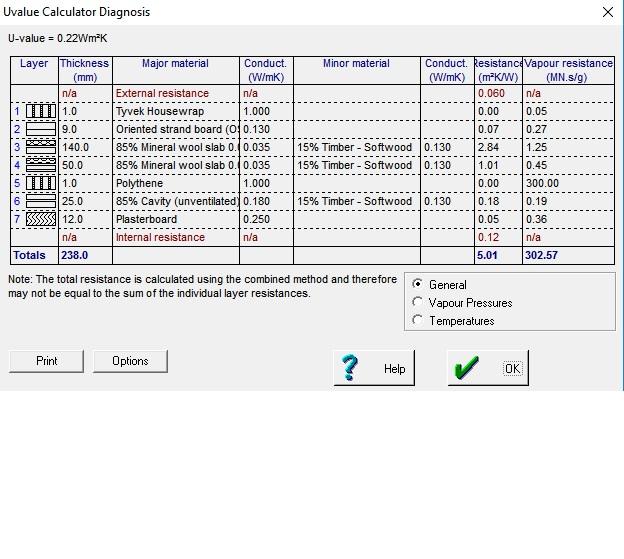
-
Bad Airtightness Test Result
A_L replied to AliG's topic in Mechanical Ventilation with Heat Recovery (MVHR)
https://www.gov.scot/publications/building-standards-2017-domestic/6-energy/62-building-insulation-envelope/ The downside is the CO2 difference between 4 & 8 on your DER which has to be less than the TER. If your insulation is better than the minimum it should not be a problem. -
Sizing up 6k Solar PV, am I on the right track?
A_L replied to magutosh's topic in Photovoltaics (PV)
I would ask Scottish Power how much they would allow you to export without grid reinforcement and see how far you get without paying up. You can only try. Attached is pdf of how SP handle things, although it is fairly standard. All on site consumption is satisfied first, the inverter changes its electrical characteristics to reduce the output to just meet the onsite consumption + export limit if there is actually more potential available. It might be an idea to see if you can get a three phase supply, then you can get three times the export. Finally I think you should contact Home Energy Scotland, (actually the Energy Saving Trust) on 0808 808 2282 an see if they have a Renewables Officer with experience of this situation ESDD-01-008.pdf -
12k + 6k Daikin Atherma 3 HT ASHP user experience?
A_L replied to magutosh's topic in Air Source Heat Pumps (ASHP)
I cannot see your heat loss as being as high as 250W/K and given some gains of casual occupancy a 8.5kW ASHP would be adequate down to at least -3°C. This assumes air tightness around 0.6ach@50Pa (Passive house standard) or 1m3/m2/hr@50Pa (units used in SAP)
