A_L
-
Posts
652 -
Joined
-
Last visited
-
Days Won
1
Everything posted by A_L
-
How about an air conditioner with no outside unit? just two circular holes in wall. https://www.olimpiasplendid.com/without-outdoor-unit
-
I litre of water contains 111g of hydrogen, which is ~4.5 kWh. I'm using 12,000 kWh per year of gas at the moment, that translates to ~3m3 of water - less than a 5% increase in my annual water bill. And if we condense the exhaust gas (H2O) and generate our own hydrogen from it, or use it to replace the quantity required for another use the net amount required falls to a fraction (to replace losses).! ? I,ll get my ...............
-
For the purposes of RdSAP/EPCs 1.8m is the maximum vertical wall height. Pages 118/9 here https://www.bre.co.uk/filelibrary/SAP/2012/SAP-2012_9-92.pdf So I certainly would not go above this.
-
Hard wired smoke alarm brand compatibility
A_L replied to Tennentslager's topic in Electrics - Other
@Tennentslager , I had a 'nuisance tripping' smoke alarm. Solved problem by hoovering the alarm and surrounding ceiling area. -
BS EN 10077-1/2 https://passiv.de/former_conferences/Passive_House_E/window_U.htm
-
That value requires a 25mm air space on both sides of the insulation. 200mm of fibrous insulation will have an equal or better thermal resistance at half the price. Then there is the question 'does it actually work? https://www.superfoil.co.uk/wp-content/uploads/2020/10/5575ps1i1.pdf
-
As good or better than any other fibrous insulation and a better 'bang for the £' than PIR/PUR/Phenolic 'plastic foam' types.
-
you have to assume that 15% of the tf/insulation layer is timber and calculate the U value accordingly, see my 2nd last post above.
-
Or about 2.9kWh stored at about 6.9kW (assuming 50°C uplift)
-
Can I ask, are you using <500mm2 per m length for vertical air layers as defining vented but unventilated, if you see what I mean?
-
N.B. the m2 is wall area, remember it is energy lost through wall, allow for any inefficiency in turning fuel into heat, e.g. saving 1kWh of heat saves about 1.2kWh of gas
-
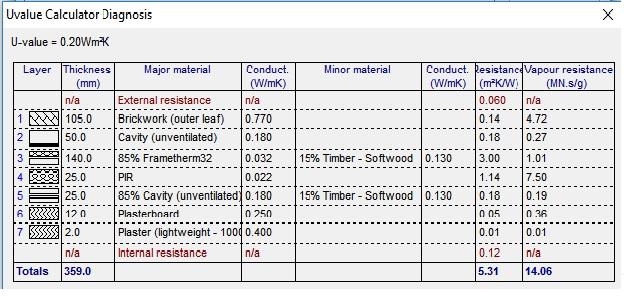
Typically this would save about 1.7kWh/m2 /yr in Central England Here is a similar wall below, U=0.20. If Protect TF200 Thermo, a low emissivity layer is added to the unventilated cavity the U value will improve to 0.17
-
@pdf27 The 19% reduction is saying that the SAP CO2 emissions must be at least 19% better than a building of the same shape and size built to the notional building specification in Appendix R of SAP2012 (page108). Can also be found in Part L1A. IMHO The 28% is so undefined as to be impossible to quantify
-
relative to what? particularly if insulation/mvhr can be considered an energy efficiency measure Usually by an OCDEA (On Construction Domestic Assessor) who would also do the carbon emissions as part of the design SAP assessment
-
Yes, a U value of 0.19 implies a thermal resistance of 1/0.19 or 5.263m2K/W, removing layer 4 (R=0.77) and adding in the value for increased external surface resistance (R=0.29) makes the thermal resistance 4.783 - 0.77 + 0.29 = 4.783m2K/W which gives a U value of 1/4.783 = 0.209W/m2K (0.21)
-
Both values include a thermal resistance for layer 4, and as @ADLIan and myself have indicated this is contrary to convention. See section 4.8.6. page12 of the attached pdf. Suggest you point your architect to this. BR_443_(2006_Edition).pdf
-
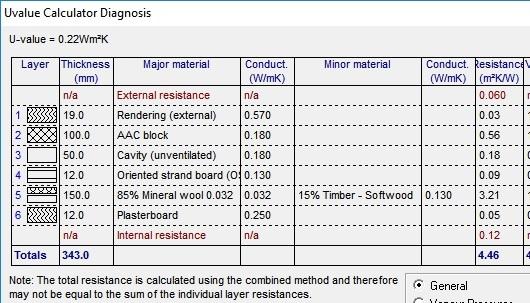
To clarify, a straight swap of 140mm PIR for 140mm of Frametherm32 would reduce the U value of a wall of 0.22 to 0.16. As ADLIan comments about the wall build up posted I had previously said the same. https://forum.buildhub.org.uk/topic/19745-sap-calcs-advise/?tab=comments#comment-318670
-
If this is Frametherm 32 then the PIR alternative will be U=0.160W/m2 .K
-
It was more a matter of what is practical/possible/necessary for the OP.
-
????...........Part L1B requires 0.22 for floors (Table 2 page 16) .......7m x 7m floor with 70mm PIR is 0.21, better if larger. But I would go for 100mm or more (U=0.17 or better)
-
Yes, or another insulation to the same effect, it should cover the timber studs to reduce the thermal bridging effect of heat being transferred through the timber. The walls have been dealt with above, the floor is O.K.(ish) but re-visit what I said previously what I said about having it in one layer. Have all/any of the horizontal and sloping ceilings and vertical walls all been considered?
-
If you can reduce the U value of the walls to the levels I have suggested then the insulation is reasonable. The major consideration after this is the air infiltration rate (draughts). At levels 'in tune' with the insulation levels the house could be heated perfectly well with an ASHP.
-
Removing layer four would increase the U value and in theory make the SAP score worse but in practice may be to small to actually affect it.
-
@Mike_scotland, The floor only has 110mm of insulation not 150mm and is correct. Also because layer 4 is next to a ventilated airspace its thermal resistance should be disregarded, a small additional thermal resistance, 0.29m2K/W can be added to allow for a thicker external resistance layer because of lower air velocities. This would be quite significant.
-
You have previously said the ground floor is 19m x 7.5m and I gave a U-value 0f 0.11 for 150mm PIR. What is the thickness and type of the insulation? Do you have a floor on the first floor which has outside environment below it? Is some of your ground floor suspended and some 'slab on ground'? Here is a simulation below. So about right. As I said before you should add about 100mm of same insulation or equivalent to get about 0.13. The roof is O.K.