


A_L
-
Posts
652 -
Joined
-
Last visited
-
Days Won
1
Everything posted by A_L
-
or condensation
-
To me the volumetric energy density is the most potentially impressive aspect, 1000kWh in about 100litres - https://www.sciencedaily.com/releases/2017/11/171116105004.htm
-
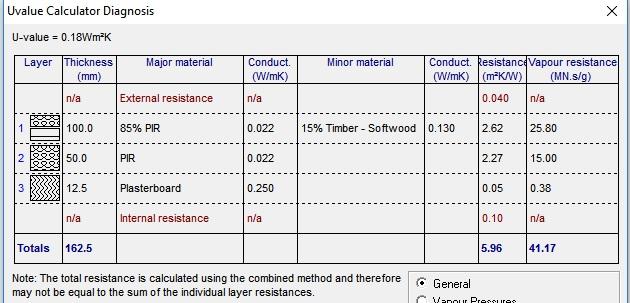
Only in the sense that it will be thinner, not in return for money spent. It will achieve 0.18, just.
-
Not much, a symmetric 'L' is about 0.18W/m2 .K
-
At 7m x 14m it will have a U-value of 0.17W/m2 .K. Well below the maximum allowed by Part L1A (0.25, Table 2) but significantly more than the value used to calculate the TER for CO2 emissions 0.13W/m2 .K (Table 4) and you would have to upgrade elsewhere to compensate at probably poorer return. 150mm would give U = 0.12 W/m2 .K
-
The hot to mix temp is the difference required to achieve cut off time of the hot in the event of cold supply failure. They will operate with lower hot to mix diffs. Horne make quality TMV which will operate at 2-3°C diffs. https://www.horne.co.uk/products/water-products/
-
@Tom, assuming OAT is about 5°C I would add 50% to handle -3°C days and add a factor to allow for running the heating less than 24hrs/day. I would add at least 2kW for DHW
-
About 80% less heat conduction relative to dry autoclaved aerated concrete
-
In the U.K. all Japanese Knotweed is propagated by vegetative cuttings from a single female plant. https://www2.le.ac.uk/departments/genetics/people/bailey/res/f-japonica
-
Positive Input Ventilation (PIV) will provide filtered air for the attic rooms for £3-400 but cooling effect of night time air will be limited because there will be little thermal capacity to provide 'coolth' storage for daytime. Providing cooling really requires a heat pump, air-con units with no external box are available, just two grilles on the wall. e.g. https://www.olimpiasplendid.com/without-outdoor-unit
-
If this is the usual two pitched roof with the ridge in the middle then the ridge needs to be at least 2 * 0.27m or 0.54m above the eaves. If it is a single pitch roof then one side has to be at least 0.27 * 4m or 1.08m above the opposite side.
-
Not enough info. The vertical difference/horizontal difference must be 0.27 or greater for at least 15°
-
Yes, @Dianne, https://forum.buildhub.org.uk/topic/17860-caravan-act-build-technical-source/?tab=comments#comment-289019 about 65ft by 22ft
-
No longer publically available.
-
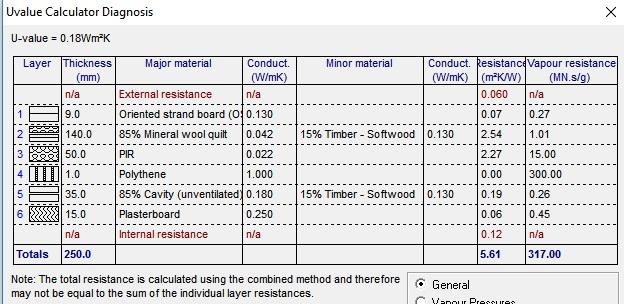
better, U=0.18W/m2K, do not compress mineral wool as it increases the thermal conductivity by an unknown amount
-
The original install may have been under the renewables obligation and transferred to the FIT scheme as described (page 4) here https://www.ofgem.gov.uk/publications/letter-accredited-independent-microgenerators
-
I may misunderstand your layout, but if the coil is between the outside and the MVHR heat exchanger how will you, unless you have a summer bypass, prevent the outgoing air heating the cooled incoming air? Similarly if the coil heats incoming air the the outgoing air will cool it in the heat exchanger. Is the condensate drain not only on the outgoing side of the heat exchanger?
-
The floor will not be at these temperatures. A well insulated building can be heated with a floor at 2-3°C above the required air temp. The fluid in the UFH pipes may be at these temperatures but 5-7°C above the floor temperature would normally be sufficient for continuous heating. Yes heat losses will be higher than an unheated floor but only by 20% or so.
-
The foil works because it has 'low emissivity', it radiates less energy to the cavity than an 'ordinary' surface (a black body radiator) The air gap is necessary to prevent loss of the heat by conduction. It will help to keep heat out in summer because they are also highly reflective of the same wavelengths.
-
The temperature of the slab has to be raised before it starts to heat the room
-
@learner , it can be. It will slow the response time of any UFH but will enable you to store more energy in the slab.
-
Engineering the hydrogen home - The Engineer magazine
A_L replied to MAB's topic in General Alternative Energy Issues
@MAB et al, - 2017 Off-grid hydrogen home - https://www.linkedin.com/pulse/true-pioneer-goes-off-grid-michael-jensen -
Mains water stop valve / cock value for 32mm MDPE
A_L replied to PI build's topic in General Plumbing
The brass alloy is resistant to corrosion caused by zinc being leached by Chloride ions. (Google 'DZR brass') -
Because it resists heat transfer from skipping around the frame in the bricks as I suggested earlier.
-
Is it worth paying £9000 more for better U value
A_L replied to Happy Valley's topic in Windows & Glazing
The lower U-value windows will lose around 14kWh/yr per m2 less than the higher. The lower U-value Sliders will lose about 43kWh/yr per m2 less than the higher. The figures are for central England but are indicative for the U.K. This does not include differences in solar gain but this should be small.

