


Ian
-
Posts
751 -
Joined
-
Last visited
-
Days Won
3
Everything posted by Ian
-
2 metres is the minimum in the Building Regulations but that would look too low in all but the smallest of rooms.
-
Glass balcony explodes in this heat
Ian replied to Tennentslager's topic in General Self Build & DIY Discussion
a sheet of toughened glass can sound like an explosion if it shatters. As @Mr Punter said and I've said in previous threads, balcony glass is best made out of two sheets of toughened glass that are laminated together. If one pane shatters it stays fixed to the other pane so (1) no broken glass everywhere, and (2) you've still got a functioning balustrade The 2 most common reasons for failure of toughened glass in a balcony are due to nickel sulphide inclusions (best to specify heat-soaked glass) or that there is a mis-match between the steel brackets holding the glass and the pre-formed holes in the toughened glass. Steel will expand & contract with changes in temperature and if it is too tight to the edge of the glass it will break it. -
the optimum gap between panes of glass is about 16mm so typically 4, 16,4,16,4 = 44mm Our 3G units have the middle and inner panes as low E glass and all 3 panes are safety glass and low iron. I believe it's important in a 3G unit that the middle pane is toughened because of the unequal thermal stresses. Other things to look out for also apply to 2G units ie whether the gap is argon filled and whether the unit uses super spacers.
-
Sorry I don't know the cost of it. I've only used it once which was on a commercial project a while ago. It worked very well and was very quick to install. I also used this product on a large domestic extension quite a few years ago. https://onduline.co.uk/products/ondutile/ I couldn't meet the minimum roof pitch for an interlocking roof tile so installed the Onduline under the tiles. As far as the Building Inspector was concerned the Onduline was the roof that gave the weather protection and the concrete roof tiles were purely cosmetic.
-
There's quite a few proprietary systems on the market for roofing that would allow you to do exactly what you asked eg: https://www.kingspan.com/gb/en-gb/products/insulated-panel-systems/roof-panel-systems/slate-tile-support-roof-panels-ks1000-ts
-
Internal partition walls Stud work Vs block work
Ian replied to romario's topic in General Construction Issues
The plasterboard is only on the outside faces Ian. The two separate studs make a big difference to the acoustic qualities of the overall wall as there's no direct transmission path for structure borne sound. British Gypsum has a very good website which lists various partition wall types together with their acoustic ratings. As with everything else, the detail is important eg not putting sockets back-to-back on either side of an acoustic wall. Sealing any air gaps is also v important. -
3 years ago mine came in at £259/sq.m for Rehau 3G upvc fitted
-
about 150 W is our base load.
-
@Piers My calculator shows a U value of 0.2 for the wall build-up that you described. I've assumed that the ratio of timber stud to rockwool is 15% - 85%. I agree with @Ed Davies that it is usually recommended to have the least vapour permeable insulation on the inside (your Kingspan) and the most vapour permeable ones toward the outside (your Rockwool)
-
Free Planning Permission and Pre-Application Advice?
Ian replied to RobinH's topic in Planning Permission
the only circumstances I'm aware of where the PP process is free is for Listed Building Consent. -
I've noticed that quite a few members of the forum are using or planning to use zinc roofing. It's a system of roofing that has been around for many decades and can be trouble free if detailed correctly however I'm also aware that there have been increasing numbers of problems over recent years with zinc roofs where the roof build-up has been incorrectly specified and zinc can corrode through in less than 5 years if the roof build-up is not what it should be. The attached report from Denmark is a good explanation of the issues to look out for. Durability_problems_with_zinc_cladded_roofs_due_to_inproper_underlays_Erik_2014_01_15.docx
-
*HELP* UFH overlay system with Insulation or Screed or (Insert answer)???
Ian replied to Da-Dad's topic in Underfloor Heating
Re the efficiency discussion comparing UFH to radiators, I’ve found with our UFH that, for the same levels of comfort, we can set the thermostat to a lower temperature than would be the case with a conventional radiator system -
Anyone know how how to compare insulation values?
Ian replied to gwebstech's topic in Heat Insulation
You could try this website which is very good although it is German so a lot of the branded materials are German rather than UK. Nevertheless, it does have options for standard generic insulation materials such as mineral fibre, EPS, PIR etc. https://www.ubakus.de/u-wert-rechner/index.php?# -
You'd get there in the required overall thickness by having a 140 timber frame filled with PIR and with a 150mm layer of external PIR insulation then a ventilated rainscreen timber facade
-
its to avoid creating a slip plane in a masonry wall. Edit: Extract from BS 8215
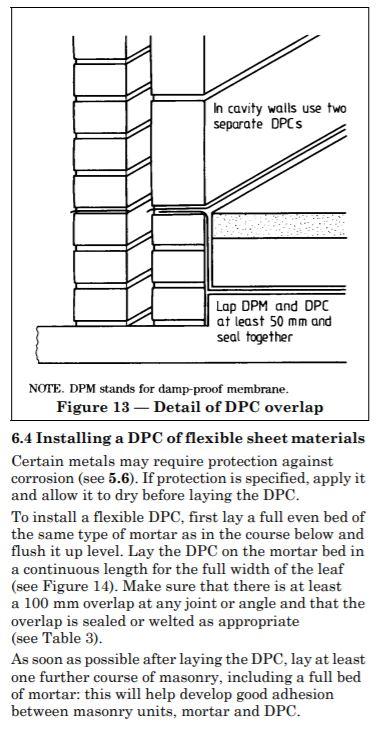
-
When are fibres in concrete not structural?
Ian replied to epsilonGreedy's topic in Floor Structures
@epsilonGreedy the main advantage of the plastic fibres over the steel variety is that you can easily burn off the excess fibre ends that stick up from the surface of the slab once it is cured. -
When are fibres in concrete not structural?
Ian replied to epsilonGreedy's topic in Floor Structures
@epsilonGreedy I suspect they are asking if you want steel fibres or plastic ones -
+1 for the Osmo. We used their Polyx-oil on our solid oak kitchen worktops and on the oak veneer doors and it still looks like new 2 years on. Red wine, tea spills etc just wipe off.
-
Had the glass in 2 of my roof lights replaced by Velux for free due to this issue
-
It’s heavily dependent on shape of your building and other factors such as choice of energy source, renewables etc. 2 years ago I built a holiday home to the minimum current (Welsh) Building Regs. Area weighted U values for walls, floor and roof were 0.15. Windows were 0.8. No MVHR or PV. Air tightness was 3.7. Fuel source is bulk LPG. SAP score was only 71 The building is a small 2 bed bungalow
-
The British Standard is purely a recommendation. It is not compulsory however all commercial work is specified to be compliant with British Standards
-
You’ll need to give them 3 years of audited accounts. They will be interested in your audited earnings from the business (drawings are not relevant)
-
is it difficult to borrow if you have a deposit
Ian replied to Amateur bob's topic in Self Build Mortgages
Normally you’ll need to be able to show them accounts for the last 3 years -
Evaporation: curing liquid screed - an explanation please.
Ian replied to ToughButterCup's topic in Boffin's Corner
How long has your screed been down? Screeds will only dry to the same humidity as the surrounding air so you’ve done the right thing in keeping the windows & doors open during the day. The air temperature in the morning at the moment is still quite low so I suspect that if your screed has now dried as far as it’s going to then your plastic sheet may be protecting it from getting surface dampness in the cold night & early morning air Edit: the relative humidity of the air inside the partly constructed house with no heating will be a lot higher at night than during the day -
Agreed. Not difficult to provide. Here’s the regs quoted: Emergency egress windows and external doors 2.8 Any window provided for emergency egress purposes and any external door provided for escape should comply with the following conditions: a. the window should have an unobstructed openable area that is at least 0.33m2 and at least 450mm high and 450mm wide (the route through the window may be at an angle rather than straight through). The bottom of the openable area should be not more than 1100mm above the floor; and b. the window or door should enable the person escaping to reach a place free from danger from fire...”

