


Ian
-
Posts
751 -
Joined
-
Last visited
-
Days Won
3
Everything posted by Ian
-
@JSHarris Thanks Jeremy, As you can tell, electrics is not my strong point! Its good to know that 150 W sounds about right. Although it's only a small house it obviously has all the usual bits of kit that need an electric supply that bigger houses have so the size of the house isn't actually that relevant. Ian
-
Shower, tray, tiles, and all the rest...
Ian replied to Crofter's topic in Bathrooms, Ensuites & Wetrooms
@Crofter yes, probably best to locate the bottom of the wall to suit a 1500 tray but what I'd then do is form a ledge at the end of the shower at a suitable height for shampoo bottles etc and move the line of the wall back in above the ledge position to maximise shoulder room for you getting in & out of the shower past the glass screen -
Back in Feb/March this year we completed our small (71sqm internal) single storey holiday home in Wales and I've been checking the meter regularly to record our electricity usage since then. It's been pretty steady at about 29kW per week. We are only using the building at weekends and it seems to make very little difference to the overall power we use. I reckon our background electric load must be about 150 Watts per hour (IE the load when we are not there). I was wondering if any of you have data on the background electric loads of your houses that you could share? Does 150 watts seem high to you? I was surprised when I did a list of the various bits of kit that get left on all the time: Burglar Alarm Sewage Treatment Plant air blower (on 50% on a timer) Edit - this uses 2.7kW per week Combi Boiler WiFi + Hive thermostat controller (don't need this on now we're in the summer) Nest smoke and CO alarm Clocks on oven Fridge Various bits of kit on standby such as Dyson rechargeable vacuum, dishwasher, washing machine
-
@Archer yes, I've used Metrotile 'slate' in charcoal grey and I was very impressed by them although I wouldn't describe them as cheap by any means. Also, it's a personal choice but I think they are better suited to a stand alone building rather than on an extension where I think they might look odd next to existing roof materials. The main advantage of the Metrotile mineral coated tiles compared to the more typical plain metal roof sheets is the improved noise reduction. They are well suited to sites which are exposed to high winds as the tiles are mechanically fixed top and bottom.
-
Shower, tray, tiles, and all the rest...
Ian replied to Crofter's topic in Bathrooms, Ensuites & Wetrooms
@Crofter....as long as it is safety glass e.g. toughened or laminated. -
Shall I install mvhr
Ian replied to jpinthehouse's topic in Mechanical Ventilation with Heat Recovery (MVHR)
If you are aiming for an airtightness value of less than 3 m3/hr/m2 (which isn't difficult) then the BCO will want you to install MVHR. Natural ventilation is normally only acceptable as a solution when air tightness exceeds 3 m3/hr/m2 -
Nightmares: a calm analysis
Ian replied to ToughButterCup's topic in General Self Build & DIY Discussion
@recoveringacademic Local topography can be so important when it comes to wind! I grew up on the north west coast a little further south of you and know how bad the prevailing wind off the sea can be anywhere near the beach - you'd normally expect the danger to be from the west but your photos eloquently demonstrate the problem you had that night. Did you ever read about the 1960s failure of the concrete cooling towers at Ferrybridge?: https://matzagusto.wordpress.com/2011/12/14/vibration-damages-towers-case-ferrybridge-cooling-towers-collapse/ It's a prime example of the dangers that can be caused by wind being channeled and the unexpected loads that it can create on structures. Ian -
@Badger visibility splays...maybe a long shot but is there any way you could locate the new bungalow on the site layout drawing so that it shares your parents driveway? The Planners argument about extra traffic in & out of the site can be argued with some advice from experts. I had a commercial project with that issue and we successfully got around it
-
@Vijay There's no advantage to having more than a 100mm step unless it helps with the natural level differences between the garage and the house. Personally I wouldn't want a sloping floor to my garage as I have floor mounted racks etc in mine and a flat floor is obviously better if you use your garage for storage.
-
The regs in Part B call for a minimium of 100mm so 150mm is okay. The alternative to a step is a ramped floor to the garage.
-
One my neighbours in rural Wales with unlimited free wood uses one of these to heat his (small) pool. http://www.woodenspasolutions.co.uk/product/wood-fired-swimming-pool-heater/
-
Sometimes nightmares are real.
Ian replied to ToughButterCup's topic in General Self Build & DIY Discussion
@recoveringacademic If your architect produced a written specification for the building then its highly likely that the key requirements for the Durisol would be in that. Most architects use the NBS system which is very good for making sure that kind of issue is covered. -
Sometimes nightmares are real.
Ian replied to ToughButterCup's topic in General Self Build & DIY Discussion
That's 'good' news then as it should be a really simple fix. Your builder should be able to sort this out very quickly and you'll be back on track in no time. The important thing will to find out why exactly it happened but from what you've said it sounds like it was simply that the builder erected too much free-standing durisol block and didn't prop it adequately against high winds. Don't let it get you down - it will seem like a disaster right now but I'm sure it's all fixable. Ian -
Sometimes nightmares are real.
Ian replied to ToughButterCup's topic in General Self Build & DIY Discussion
@recoveringacademic It looks like the Durisol blocks had been erected but not yet filled with concrete - is that correct? -
Sometimes nightmares are real.
Ian replied to ToughButterCup's topic in General Self Build & DIY Discussion
@recoveringacademic I'm so sorry to hear that Ian. Let me know if you think I can help in any way (I'm fairly local to you in Manchester) Ian -
The only method that is accepted by the British Standard and therefore the only method I'm supposed to accept when I'm working as an architect is the hygrometer test method which involves sealing a digital or analogue hygrometer meter onto the surface of the slab in an insulated box and leaving it in place for a minimum of 72 hours. Other methods are available which are quicker, some of which I'd be happy to accept for personal work - these typically involve drilling into the slab and measuring the humidity of the concrete at the centre of the slab. The only time as an architect where I've allowed vinyl to be stuck on top of a concrete floor which had an RH reading of more than the recommended 75% was on an industrial project where there was a very large packing hall. We had an RH of 80% and managed to save the cost of a surface applied dpm by switching to a spirit based adhesive rather than the originally specified water based one. With the clients full agreement we took a gamble and got away with it as we only had about half a dozen of the vinyl tiles that lifted and they were easily stuck back down again. Vinyl tiles and planks are a little more tolerant than vinyl sheet flooring - I'd never take a gamble with vinyl sheet flooring as I've seen some horrid stinking messes when it's gone wrong. Water migrating from the slab has got nowhere to go and it turns the adhesive into a very smelly soup - if you've ever had a car with a blown cylinder head gasket you'll know what the resulting oil/water emulsion looks like.
-
@chrisb Hi Chris, Re the spec - if you do nothing else, make sure you test the relative humidity of your concrete slab before laying the vinyl. If takes ages for a slab to dry out naturally to the recommended 75% RH. Typically a 100mm slab would take about 4 months to dry sufficiently. If it doesn't get down to 75% in time to suit your programme then you will usually need to apply a liquid surface dpm and unfortunately they're not cheap. If you powerfloat the surface it can have the effect of doubling the drying time needed. There are also some underlays for vinyl that claim to get around the problem but I have no personal experience of using them.
-
If you install a door into the house then it will be a porch which is exempt from Building Regs
-
Just thought I'd resurrect this old thread rather than starting a new one. We received our VAT reclaim in full last week. Our claim included the VAT on materials that we had bought after the date of the Building Regs Completion Certificate. (We rang up the VAT helpline before submitting the claim to ask if we could claim for external drive and path materials as well as fencing & gates and they said it would be okay as long as it wasn't later than 3 months after the date of the Completion Cert.)
-
There's nothing in the Building Regs which would stop you from doing this but it carries risks of water leaks, surface condensation and noise intrusion. I've done it on commercial buildings quite a lot but using metal pipes with mechanically fixed (crimped) and sealed joints. If you get any blockage you'll need to be able to rod the pipe without the risk of dislodging a joint. Another alternative would be syphonic drainage. I'm not a big fan of it personally but this method is commonly used on commercial buildings as it is very cost effective: https://www.cibse.org/getmedia/699c149b-f37e-4634-9607-58248550b3c8/SYPHONIC-RAINWATER-SYSTEMS.pdf.aspx
-
A chamfered profile to the top edge would help prolong its life here in rainy UK
-
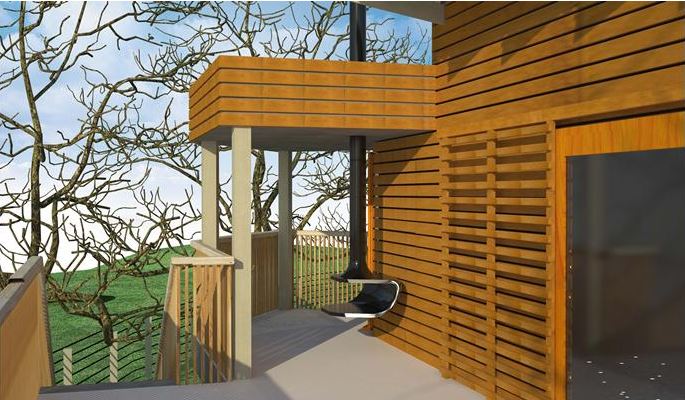
Yes, if its a proper breather membrane it will provide full weather protection. Obviously common sense needs to come into it as it won't take a snow load etc. Your main issues: UV resistance (difficult to assess quality?) is an insect barrier required? Colour of the membrane will probably need to be black or dark grey This 'Grand Designs' build did just what you've been looking at but they had a coloured membrane and no insect barrier that I could see: http://www.walesonline.co.uk/lifestyle/welsh-homes/grand-design-eccentric-mr-strangeways-10061276

-
@Barney12 maybe all you need behind the timber is a black coloured UV resistant breather membrane and black battens.
-
It will make it a lot worse as the assumed air tightness figure is 15m3/h.m2
-
Building Regs / Construction drawings - what is needed?
Ian replied to Weebles's topic in Building Regulations
@Weebles In practice MBC will be able to provide 90% of the information that is typically needed for Building Regs approval. What extra information is needed will depend on your individual approved inspector. Assuming that you are in England or Wales its always best to submit a full plans application rather than a building notice. The benefit of this is that you should then be able to get your approved inspector to give you a written list of the items of info they will need before granting approval. Some inspectors will hardly need any extra info apart from the structural info (that you'll get anyway from MBC) and the SAP (Part L) info. Its important however to get them to 'sign off' on your drawings before you start work on site. This will help avoid any future issues with things such as compliance with Part M.
