Ian
-
Posts
751 -
Joined
-
Last visited
-
Days Won
3
Everything posted by Ian
-
Admins - Just for the record there's no need to alter or amend anything on this thread on my account. It's a very useful exchange of views (warts and all). Unless you are a self builder who is loaded with money (so unlikely to be reading this forum) I think the process of engagement with an architect outlined by @Ferdinand and @Barney12 sounds like a good approach. For those with a limited budget that sounds like a really sensible way of working. The other thing I'd say is that its critically important that you let your designer know what your budget is for the build and also your intentions regarding the build process - ie are you doing all the work yourself or are you getting a main contractor to build it - budget is (or should!) be one of the major design constraints that are considered.
-
@jack @JSHarris I’m a partner in a medium sized architects practice. We mainly work on large scale commercial projects for national clients and don’t do any work for self builders. The reason for that decision is that its very difficult to make a profit on that type of project whilst also giving a proper professional service whilst having normal office overheads and PI Insurance costs. Self building your own house is naturally a very personal business where every decision is extremely important and analysed much more so than on commercial work. The only self build houses I’ve worked on have been for myself or (working for free) for family and close friends. We also occasionally get asked to design houses for our individual wealthier commercial clients - we can’t make a decent profit on those either even though the builds sometimes cost in the millions on occasion. As an architect my largest self build house for one of our commercial client was £5M+ but we still didn’t make a proper profit. I think most architects who design one-off houses work as sole practitioners or in practices with less than 5 staff. They typically have lower overheads and PI Insurance costs. They also earn less money but maybe they get better job satisfaction from the rare self-build clients who don’t think they are tossers :-)
-
I trained for 7 years to be able to use the job title 'architect'. It is a job title that is protected by law and we are all required to have PI Insurance. I'm sorry you think all of us are tossers - personally I've always tried to be helpful on this forum where I feel my input might be useful. 'house designer' - that's not a job title that's protected by law and could be anyone - no training or experience required.
-
I agree with Peter. In the situation you described with the floor joists running parallel to the wall you would normally only need a steel beam if the wall carried on up through the first floor. Possible exceptions - the existing ground floor wall will be providing restraint (extra stiffness) to the other ground floor walls that intersect with it. When removing a wall like that sometimes its necessary to provide something to replace the restraint that you lose when removing the wall. Usually its done by leaving a small wall stub at the intersections but occasionally I've also seen engineers provide this restraint via the use of extra steel.
-
What type of construction is it? If it's timber frame then he may be asking for the 20% upfront to pay for the timber. After all, once he starts cutting and fabricating the frame it can't be used on anyone else's build if you suddenly cancel your order. If you decide to proceed with this I'd strongly recommend doing a credit check on them before handing over the money.
-
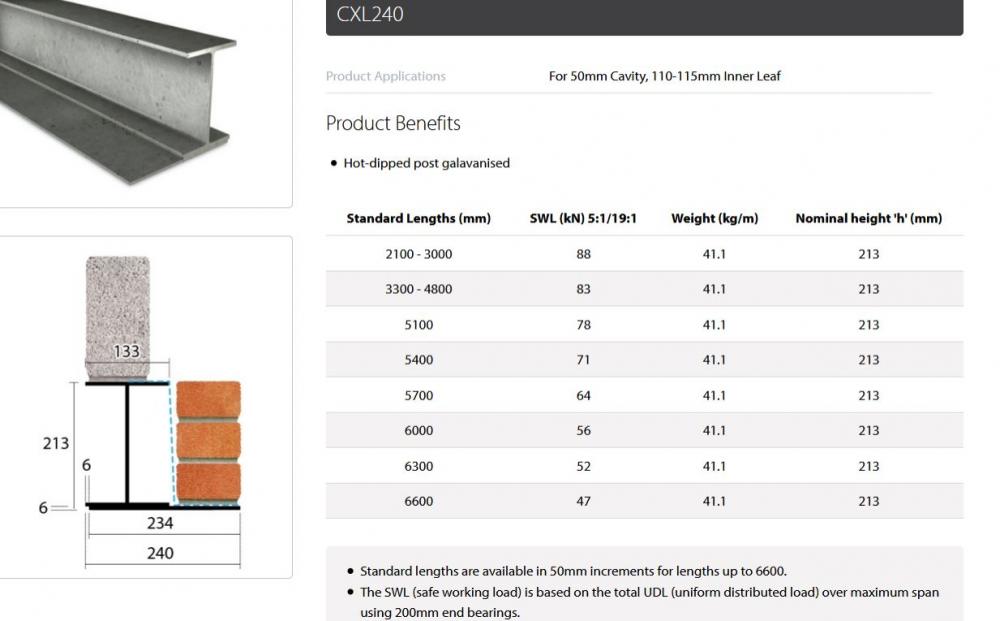
Try looking on the Catnic website. Here's one of their standard cavity wall lintels. It's designed for a 250mm cavity wall (you need to check the width of your own wall) and is in the "extreme duty" category (you may not need something this heavy duty). https://catnic.com/products/cxl240
-
I suspect that the concern from your architect and builder is simply that the two masonry leafs of your external cavity wall each need a support and the single beam that your engineer has specified is not wide enough on the top flange to provide a support to each of the two leafs. Typically each leaf of the external wall will be 100mm thick and they will be spaced apart by the width of the cavity with steel cavity ties so that the wall acts as a single structural unit. Typically these cavity walls are between 250mm and 300mm wide. If your engineer has specified a single I beam it would mean that the top flange of your steel beam would need to be 250-300mm wide to match the width of your cavity wall. I think your architect and builder are suggesting that two separate beams would be a more practical solution - ie two beams, each 100mm wide for the 2 leafs of the cavity wall.
-
Is it the heights of the first 2 newel posts? They look different?
-
Finance: we financed our complete build using a mortgage that we had on our existing house - it's an offset savings mortgage which provides a very easy way of getting access to any excess equity you may have on your existing house. https://www.moneysupermarket.com/mortgages/what-is-an-offset-mortgage/
-
3 months seems very quick. Surely that can't be for the whole thing from digging foundations to you moving into a fully finished house? Our own build was a similar small size to yours with some similar issues such as a sloping site and it took 8 months start to finish. It would have been possible to finish the build a couple of months earlier if I had built it using a main contractor instead of separate trades and if we hadn't done some of the work ourselves but 3 months would have been totally impossible.
-
In that situation it would all be considered as the same room rather than separate ones
-
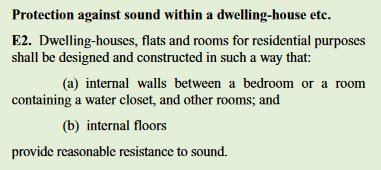
Hi Peter - the short answer is to ask your BCO as they will have their own view. Part E (sound) may be a problem: Part L (thermal insulation) This would apply only to doors that open into unheated areas of the building so not likely you'd be wanting to leave those off.
-
I can't really comment on the UFH issues but I've just had a normal central heating system power flushed - 2 plumbers for 1 full working day cost £300 + Vat.
-
Rear extensions are a common cause of dry rot in cases like the one you describe. The problem occurs when the continuity of the under floor ventilation system of the original house from front to back is broken by the extension. The original house will have had air bricks front and back and continuity between the two needs maintaining - this requirement for ventilation continuity is often ignored when a modern extension is added - they often have concrete slab floors rather than suspended timber.
-
If you want use an "Approved Inspector" for your building regs rather than the Local Authority then they need to give 1 week notice before you start work on site.
-
@swisscheese you should be looking to apply a Class 0 surface spread of flame rated varnish. Matt will look better than a gloss finish. Edit: With regard to the ply itself there are various grades available - make sure you're happy with the finish.
-
@MikeR Actually you don't have to be a member of the RIBA to be registered as an architect. The RIBA is simply a professional association. The ARB is the body that all architects need to be registered with by law.
-
@archer if you are interested in a solid wall construction have you seen the range of insulated clay blocks by Porotherm? http://clay-wienerberger.com/expertise/our-latest-developments-1366178159710
-
What's the going rate for a topographical survey?
Ian replied to Andrew's topic in Surveyors & Architects
@Andrew Just in case it applies to you?: on any site which is in a Conservation Area or where you have trees covered by a TPO you will also need the survey company to pick up the line of any tree canopies. -
@Archer There's nothing to stop you appointing your Approved Inspector now. Once appointed they will be able to give you their guidance on the issues that you are facing with the the 3 storey design and fire. Your architect should be able to recommend someone but the appointment of the BCO would normally be direct with you. Edit: don't worry about the fact that you don't have a full set of Building Regs drawings - appoint the Approved Inspector now and based on your existing set of drawings they will give you their ruling on the 3 storey fire escape issues. They will also give you a list of the other items of information that they will need from you, most of which the modular comapny will be able to provide.
-
@pocster @PeterW I think there may be a misunderstanding here on what the British Standard is recommending. When it refers to "air-open" and "tight" coverings it is referring to the final roof finish - IE are you using a "tight" fitting interlocking roof tile or an "air open" loose fitting slate. In my view If you have tight fitting interlocking roof tiles in the scenario that you've described then you do need batten space ventilation. I know your architect has specifed a tightly sealed VCL on the warm side of the roof as well as a very high quality LR underlay however its still possible to get situations where you get condensation on the underside of the roof tiles - IE in warm humid summer weather - when you get a sudden drop in temperature such as during a thunderstorm you get sudden cooling of the roof tiles with condensation occurring within the roof void. In a situation where you have tight fitting roof tiles its best to have a ventilation gap to allow this condensation to rapidly evaporate. Ian
-
How much should fire protection / intumescent painting cost for steel
Ian replied to AliG's topic in Costing & Estimating
@AliG If you have any beams that will be cased in plasterboard then that normally gives 30 minutes protection per layer of board so you wouoldn't also need to use intumescent paint on those. -
How much should fire protection / intumescent painting cost for steel
Ian replied to AliG's topic in Costing & Estimating
@AliG Its well worth double checking with your BCO exactly which elements of steel need a fire rating (and why). For example columns and beams that are only supporting a roof do not normally need fire protection. Edit - extract from Part B of the Building Regs for houses:
-
How much should fire protection / intumescent painting cost for steel
Ian replied to AliG's topic in Costing & Estimating
@AliG Why not do the intumescent painting yourself? If it's for internal areas of steel the cost of the paint starts at about £8 per m2 provided your primer is compatible http://www.smlprotectivecoatings.co.uk/intumescent/steelmaster60wb Edit: how much of the house steel structure are you looking at painting with the intumescent paint and which areas? 78 sq.m sounds like a lot! -
@DavidFrancis Thanks for that link to the meter. I'll give it a try. (Edit - I worked out that if we were using the building full time we would be using about 5.2 kWh/day.) At the end of last weekends visit I turned off the WiFi router and Hive box, the TV and the Dyson and I'll see if that makes any noticeable difference