


Russell griffiths
-
Posts
7971 -
Joined
-
Last visited
-
Days Won
65
Everything posted by Russell griffiths
-
 Do yourself a really really big favour and send that back and swap it for flexible ducting. I don’t know what your design calls for but I would go 90mm rather than 75.
 -
What air in pipes. does your house now not have pipes in the loft. the bungalow I live in now certainly has pipes that go from a cylinder up into the loft and then down to a bedroom
-
Presence detection
Russell griffiths replied to Pocster's topic in Networks, AV, Security & Automation
I have absolutely no idea what you are talking about. -
Keeping cavities clear.
Russell griffiths replied to syne's topic in House Extensions & Conservatories
Lay a batten on the last row of wall ties you installed and lift it out to clean off any droppings. if you put a cavity closer in you will need to put in a cavity tray above it to shed moisture to the outside, this could create a weak joint all around the building. -
Really this is all a bit pointless without knowing what it’s to be used for. it may well be better to put it up on 4 ground screws with a timber floor with insulation between the floor joists.
-
@sam I’m not keen on your walls being so low in the ground, I would put both layers of insulation inline on top of each other so the outer edge is flush, then fit the sole plate on top of both layers. I would look at a denser insulation for the perimeter maybe xps300 or eps 300. I would stagger all the joins in the insulation and glue it all together to form one big slab. I would also glue the chipboard flooring down so it all acts like one big chipboard insulation sandwich, sort of. your bigger problem will be stopping it blowing away. 1m long threaded rod buried in the ground below your drainage layer, coming up through your sole plate could fix this. what do you want to do in there as 4m square is rather small. and the cost per m will be extremely high, it won’t cost much more to make it a bit bigger.
-
This weeks Short Read: Population
Russell griffiths replied to SteamyTea's topic in Environmental Building Politics
Didn’t we have something that could have thinned down the aging population ? -
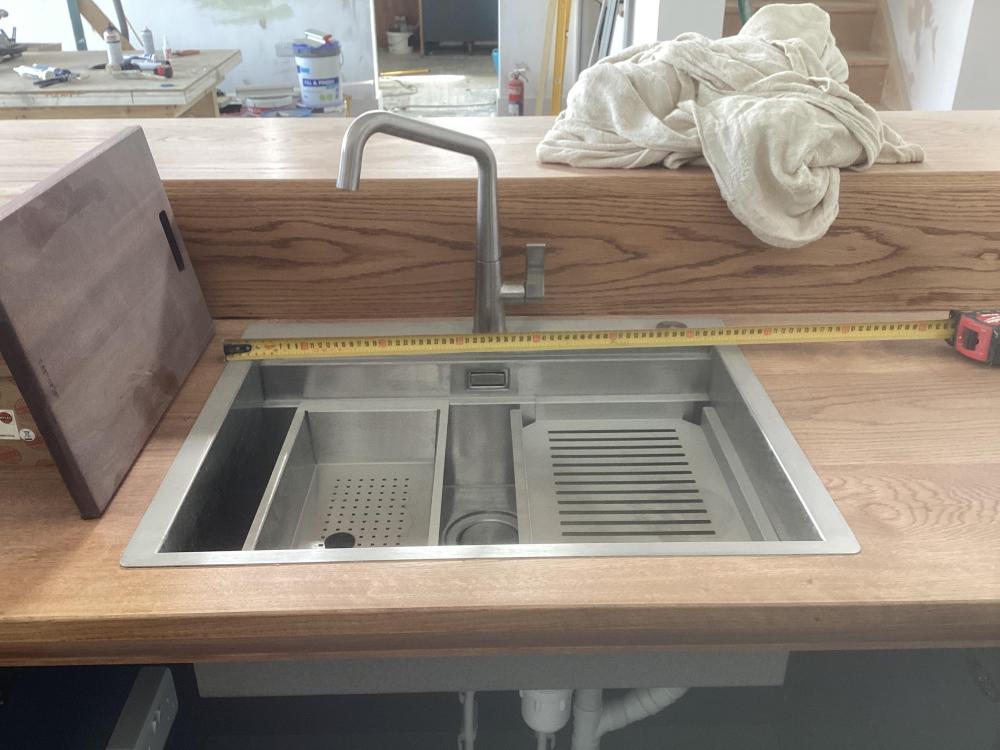
Worktop is oak.
-
any good. clearwater urban I think the sink is proper cushty don’t know if the tap is any good to you. der, just read you want a drainer. 🤷🏻♂️
-
Wetroom shower drain UFH+B&B on FF
Russell griffiths replied to iMCaan's topic in Underfloor Heating
If you have already screeded the floor, how are you going to get the water to run to that drain ?? if you want a square 150x150 stainless grating then mcalpine do a good selection. -
Advice for lining plant room
Russell griffiths replied to Omnibuswoman's topic in Building Materials
Osb is horrible to paint, use ply if only using wood, I used fermacel on top of osb as it has a fire rating. if you don’t think you need a fire rating then just ply, don’t paint with standard emulsion it will have every single workman’s handprint on it, use a gloss or I used eggshell as it’s not shiny. not particularly cheap though compared to a 10 litre tin of white Matt. -
Soak with a sponge and the paint should wash off. key the surface up if it’s a bit shiny. 40 grit sandpaper will give it a key.
-
Gate intercom systems
Russell griffiths replied to Russell griffiths's topic in General Self Build & DIY Discussion
Can they do that distance?? or would you have a wi fi point at the gate ?? -
Why put something in the floor where you cannot get access to it, when you have a large void over the entire house that is being unused I’ve built two bungalow type houses and everything goes up in the loft for easy placement and easy maintenance later.
-
Screeding up to Floor Boards
Russell griffiths replied to JLAB's topic in General Self Build & DIY Discussion
For a start those wall need lowering and insulation placed over them unless you want a cold spot. what’s the floor finish going to be. and what’s the screed thickness. -
No idea, I wouldn’t use them if they were free.
-
If your thinking of using thermalite blocks, for both inner and outer you need to have a serious re think. or are you thinking of the single block that does solid wall construction did this in the 90’s lots of problems with the blocks crumbling. not for me.
-
Isn’t it only suitable for a certain type of block ?? if you want to be so hands on I would either go icf, or timberframe with a block outer skin. I didn’t use block n block for my own house, and I’m an ex bricky. it just looked far to hard on my own.
-
Why not sister but with ply, 18mm ply ripped to 100mm strip, fitted to the side would significantly strengthen the original level these all up and it would give a nice flat top to then cut a full length shim/ packer to glue onto the top. some might only be 5-6mm so a table saw would be needed. mad idea 🤷🏻♂️🤷🏻♂️
-
Advice for lining plant room
Russell griffiths replied to Omnibuswoman's topic in Building Materials
I used 18mm osb, then sheets of fermacel then a couple of coats of eggshell paint so any dirty fingerprints wash off. as has been said, bring your floor level up either level or higher than ffl in the house, you don’t want a drop down in there when the main house is done. nice ply would work just as well, I just wanted something with a fire resistant rating in case bc becomes a plonker. -
Gate intercom systems
Russell griffiths replied to Russell griffiths's topic in General Self Build & DIY Discussion
Leave it !!! -
Anyone used Alloy Aluminium Splashback?
Russell griffiths replied to KitchenPotcher's topic in Wall Tiles & Tiling
I thought it looked like a good idea but someone pointed out that it dents easily if you knock it. -
Gate intercom systems
Russell griffiths replied to Russell griffiths's topic in General Self Build & DIY Discussion
Anybody else know about this stuff i thought all you nerdy types @Pocster would have some points to share. c,mon I’m a Luddite and need help. -
Privacy during bedroom activities.
Russell griffiths replied to Pocster's topic in Skylights & Roof Windows
If you chuck your skiddies up there they would probably stick. -
Mains water pipes dripping cold water
Russell griffiths replied to puntloos's topic in General Plumbing
It’s normally handled by removing the metal pipe and replacing it in plastic. 😂




