andyscotland
-
Posts
638 -
Joined
-
Last visited
-
Days Won
1
Everything posted by andyscotland
-
What operating system / browser do you use? Does it only happen when you open from SharePoint? Should be fairly straightforward to find and fix the file-type association but the precise steps vary by platform.
-
Whoops! And I'd not been aware of the actual vat treatment on conversions, just went with the OP on that. Just had a look now, seems weird that they still end up VAT free but the contractor has to charge at 5% for you to reclaim, rather than the 0% new-build rate... I guess there'll be some esoteric reason that makes sense to HMRC.
-
Good point. Although I would have thought ultimately the main contractor would be pricing on the basis they'd want to cover their overheads and make a reasonable profit on the job as a whole? So if they don't get to mark up the materials they'd perhaps just uplift the labour rates instead? Other factor of course is a main contractor might be able to get better pricing from suppliers - that might cover some / all of their own markup. Conversely they might just go to their normal merchant and you might be able to do better (at significant time cost) by shopping around for each item.
-
The main contractor will pay 20% VAT on the materials, but assuming he is VAT registered he will then reclaim that 20% from the government. He will then charge you 5% VAT, which he will pay on to the government. (This isn't a special process BTW, it's the same thing that happens if buying and selling at 20%. In practice once a quarter he will be adding up all the VAT on purchases and sales and just paying/reclaiming the difference). Therefore overall it won't make a difference to the main contractor's figures. However he may be out of pocket for a short period. That will depend on when you pay him, when he has to pay the supplier, and how those two dates fit with the timing of his quarterly VAT returns. If the main contractor is not VAT registered (fairly unlikely unless a tiny firm) then he won't charge you VAT at all. However he will have paid 20% VAT on the materials, which neither he nor you will be able to reclaim - so in that case you would definitely be better getting them yourself.
-
I'm using Green Building Store
-
Thanks for that supplier tip - looks promising. But more particularly for making me feel a whole lot better about the current tidiness (or otherwise) of my site ?
-
Party garage wall insulation methods - help!
andyscotland replied to Gooman's topic in Garage & Cellar Conversions
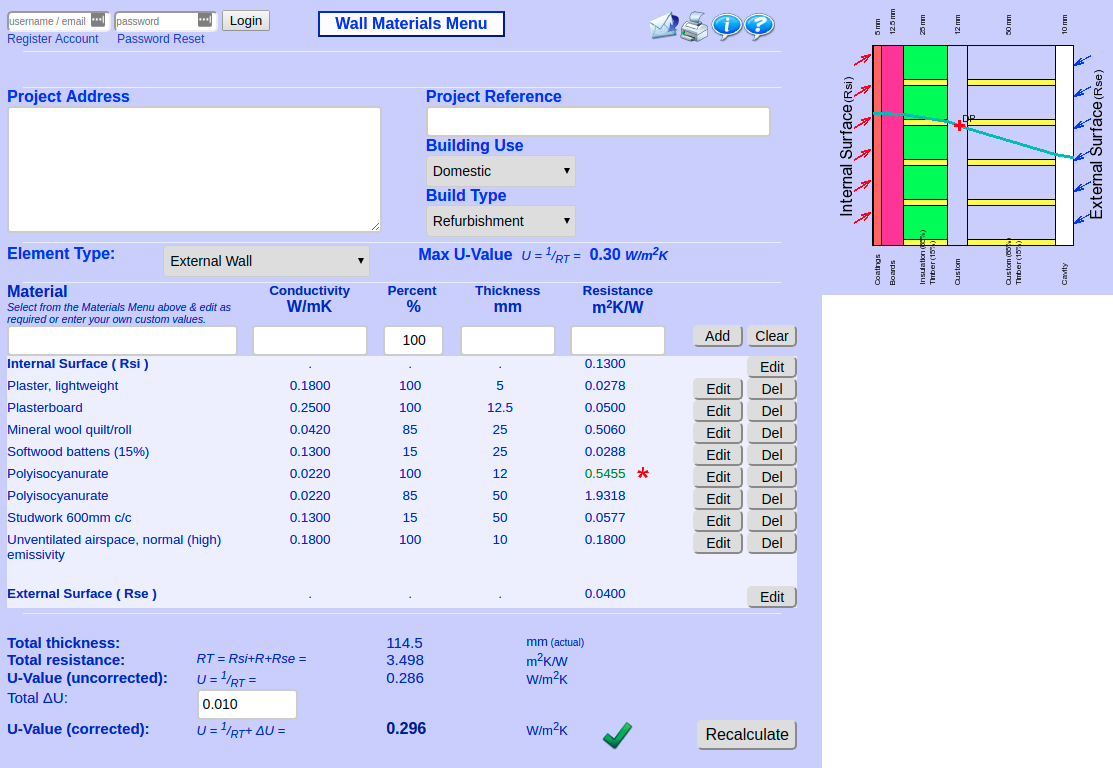
I've had a quick go on changeplan (not at my Windows machine so can't double check in the BRE tool). I get 0.296 for that construction: In case you were still unclear on the thermal bridging - unfortunately it's not as simple as just amending the R value by the % area - the heat tends to want to flow through the path of least resistance, so the software essentially has to calculate all the individual thermal paths then work out how much heat will throw through each route. The good news is changeplan will do this for you - you just have to add each material type with the relevant % of the wall area. E.g. as above with the 85% mineral wool / 15% timber battens. Couple of other things to consider: Do you have a source for 12mm PIR? I have a hunch that 25mm is the thinnest generally available - I think you can get slightly thinner mounted on insulated plasterboard but that won't work with your service void detail. I'm not certain but I would suspect a 50mm stud (especially on 600mm centres) might be too wobbly in practice. You could turn thicker timbers sideways, or reduce the centres, or fit extra noggins - but all of that would increase the timber fraction of that layer and reduce the u-value. If you're planning to use PIR as part of the buildup, you might be worth contacting Ecotherm technical. They were super helpful when I was trying to optimise wall thickness compared to u-value and ran off various different options for me (for free). They'd need to know your target u-value and any other constraints. They will potentially also use a higher resistance for the cavity due to the low-emissivity foil coating on the boards, and possibly also a better allowance for the unheated space next door. Also, not sure about England but in Scotland you are allowed to have a component that is worse than the target so long as you compensate for it by increasing the performance of something else. So e.g. your garage wall could have a slightly higher u-value if you "over-insulate" the roof. Or indeed if you just specify a window / door that exceeds minimum building regs values. Obviously the calcs for that are a bit more involved (not too bad - basically multiply each u-value by the area and add them all up) and you don't want to take it to extremes for your own comfort and energy usage. But might be worth considering if you're really struggling to get that wall thick enough.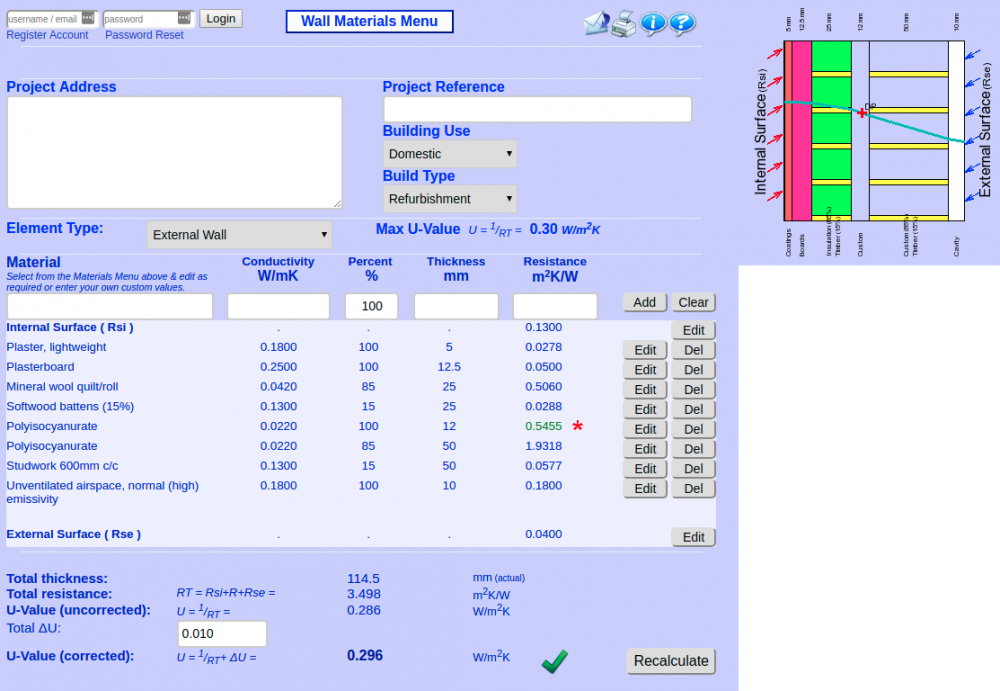
-
Party garage wall insulation methods - help!
andyscotland replied to Gooman's topic in Garage & Cellar Conversions
The studs will still bridge from the plasterboard through to the cavity, bypassing the PIR/wool so you will need to include both those insulation layers as bridged by an appropriate fraction of timber. -
Party garage wall insulation methods - help!
andyscotland replied to Gooman's topic in Garage & Cellar Conversions
This free online calculator allows for fairly comprehensive calcs http://www.changeplan.co.uk/u_value_calculator.php - haven't thoroughly double-checked its accuracy but used it early in my project and results appeared to be about right. If you want to be able to print off something a bit more professional-looking / save things and come back to them later the BRE tool at https://www.brebookshop.com/details.jsp?id=139470 is £60. Only works on Windows PCs though. If there's an enclosed unheated space on the other side of the wall you can include an allowance to reflect that won't lose as much heat as if it was open to the outside air. There's a section on how you can work that out in BR443 https://www.bre.co.uk/filelibrary/pdf/rpts/BR_443_(2006_Edition).pdf which I believe is still valid for use. -
Fancy making your own off grid gas supply?
andyscotland replied to Robert Clark's topic in General Alternative Energy Issues
Yeah in a rural area and with WC waste I could see it being viable for something relatively cheap (which I assume this is, given it looks to be a posh duffel bag with some valves). And especially if compared to bottled gas. City centre kitchen bin and lawn not so much... -
Fancy making your own off grid gas supply?
andyscotland replied to Robert Clark's topic in General Alternative Energy Issues
Intriguing idea, though with a recommended input of 12 litres of waste a day providing 12 litres of liquid fertiliser (a day) I wonder how useful it is for UK domestic? Can't see us producing anything like that volume, or having the time to cut back the jungle that amount of fertiliser would create. Presumably at lower volumes it might not produce enough gas to be useful? -
I wouldn't recommend GIMP or Photoshop - these are essentially both "paint" programs for editing raster files. A raster file (e.g. a JPG) is basically a list of every dot and what colour it should be. The combinations of coloured dots might look to a human eye like a house, but as far as the computer is concerned there's just a grid of blobs of "paint". If two lines pass through the same dot then only the colour of the front/top one will be saved. Editing in GIMP / Photoshop is essentially just a digital "tippex bits out and draw over it with a pen". It will probably be tricky and time consuming to do that neatly. Additionally, converting to and from JPG is likely to cause issues with image quality / scale / etc. A PDF of a CAD drawing is a vector file. A vector file is a list of shapes together with the co-ordinates where each one starts and finishes. The file format basically started out life as the instructions for an old-fashioned pen plotter (move the black pen to the bottom left, put it on the paper, move it vertically upwards for 5 centimetres, lift it off the paper). It's only ever converted to dots (pixels on a monitor, blobs of ink on a printer) when necessary - so you can zoom / scale / print it happily with no loss of quality. And for example if 2 lines overlap both of them still exist in the file - so you can easily delete one or move it about a bit. Most PDFs can be relatively easily edited in Inkscape (also free) - it can open and save PDF files directly, no need to convert. You can delete old lines, draw new ones, drag and drop things around till you're happy with where they are, etc. You can also change colours (e.g. if you need to mark things that are different to the original drawings) and put in explicit co-ordinates and dimensions e.g. in centimetres to ensure things come out at the right size/scale.
-
Cutting down a TPO tree by mistake - Enzo's homes
andyscotland replied to Moonshine's topic in Planning Permission
I'm not certain but I think it can only be transferred for trial, perhaps on the basis stiffer sentences deserve a more robust process? -
In a previous flat, I was advised by thermafleece that netting below the joist would be ok but they recommended a breather membrane to further reduce movement of cold air from the underfloor void through the insulation / any wee gaps. This was with sheep wool insulation which I understand is better than e.g. rock wool as it sucks moisture out of the air / surrounding timbers. Perhaps the advice for synthetic wool would be different.
-
Kevin McClod on Self Build
andyscotland replied to SteamyTea's topic in General Self Build & DIY Discussion
It's a definite thing in my business, to the continual frustration of my colleague. We now routinely round up estimates to allow for it, except then I get optimistic about having such a big contingency and underestimate the actual work even more ? -
On the u-value calcs ecotherm did for me, they rated a 25mm horizontal unventilated cavity with their foil face one side (plasterboard or blockwork the other) as 0.665 m²K/W. Fitting a separate polythene VCL against the insulation reduced that to 0.184 so the low-e facing definitely makes a big difference. Not entirely sure where they get their figures as I'm conscious the 0.665 is quite a lot above the guides in BRE 108.
-
Duct hole through cavity wall - shape/size?
andyscotland replied to andyscotland's topic in General Structural Issues
@nod a platform / tower I'd be ok with - have done that before. But don't have one at present and this is probably the only job I'd really need it for so not really worth it. -
Duct hole through cavity wall - shape/size?
andyscotland replied to andyscotland's topic in General Structural Issues
@nod thanks - I'd thought of hiring a core then ruled it out as I also have to drill a (different) vent through blockwork 2.5m above the floor and don't fancy core drilling up a ladder. But of course actually there's no reason I have to make both holes the same way. I'll maybe get a core for the airbrick duct. -
@PeterW afaik tarrifs always apply at the time items are landed at the dock/airport/etc. Hence why in the recent imposition of USA/China tarrifs there was a big cargo ship of soybeans doing loops out at sea for a month to see if it would all blow over or if they could find another buyer in another country because it was cheaper than landing the goods. I'm in a similar place with windows, almost ready to order but not quite and nervously eyeing the 8 week lead time and the calendar in the hope I can get them into the country before the end of October. Both to avoid any tarrifs and more fundamentally because in the nightmare scenarios if food/medicines/etc are all getting backed up for a while I can't imagine anyone will be rushing to clear my shipment through the border.
-
Duct hole through cavity wall - shape/size?
andyscotland replied to andyscotland's topic in General Structural Issues
@Russell griffiths thanks - if a round hole I'd just have used a normal round duct terminal. As presumably doesn't need to be an actual airbrick so long as there's a big enough ventilation area. But I will go for rectangular to make it easier to chisel. -
Duct hole through cavity wall - shape/size?
andyscotland posted a topic in General Structural Issues
Possibly a daft / over-cautious question... I need to drill through our existing brick cavity wall to fit a duct for a relocated airbrick vent. From a structural perspective, does it make much odds if I make a circular (125 mm dia) or rectangular (210 X 65) opening? The outside wall is pebbledashed so I won't easily be able to find and remove a single brick, or line the hole up neatly with brick joints. I can probably get fairly close though by measuring along the wall from one of the existing airbricks. I will be stitch drilling and chiselling out so I think a rectangle would be easier to cut but I have a feeling a circle (arch) would support the wall above better. But perhaps it's such a small opening it doesn't make much difference? -
Is this BR-compliant for garage conversion walls?
andyscotland replied to Gooman's topic in Building Regulations
I'm currently doing a garage conversion - single skin pebbledashed blockwork. Ecotherm advised that for my construction it would be better from a damp/condensation risk perspective to batten the insulation away from the wall. Their dot and dab detail is more designed for cavity walls. So 25mm battens fixed through strips of DPC into the block, then continuous PIR, then another run of 25mm battens screwed through to the battens behind, then plasterboard. I submitted it with Ecotherm's u-value and condensation risk calcs and didn't get any questions from building control (in Scotland) at the plans stage. As you say it does make a fair difference to have the insulation continuous without thermal bridges. -
It only applies where a VAT registered building contractor supplies to a VAT registered building contractor. Instead of the supplier charging VAT, the customer effectively charges it and then (usually) reclaims it all in the same VAT return. It won't apply to self builders because A) they're not usually VAT registered B) it doesn't apply if the customer is a main contractor / developer building property to sell or rent out themselves C) it doesn't apply if the customer isn't registered as an employer under the construction industry scheme D) it doesn't apply to work that's zero rated The main place it will kick in is subbies charging a main contractor. This is because historically there's been an issue where a subcontractor charges VAT but doesn't actually pay it on to the government (e.g. because they're not actually vat registered or because they keep some invoices off the books).
-
Well metal grows and shrinks over time (due to temperature). All materials move, hence I think the key thing is that the legs/framing of the "wall" sections of the overhang should ideally be the same as and continuous with the actual wall above and beside the overhang. E.g. if they're a render carrier board on metal/timber battens then that system should extend across the face of the overhang too.
-
Seconded. I've been trying to work out something similar and my school physics kept getting me almost there but not quite... Really helpful to see your worked example!