


andyscotland
-
Posts
638 -
Joined
-
Last visited
-
Days Won
1
Everything posted by andyscotland
-
Getting it first sounds a very good idea. If it's originally intended to have been a freestanding cabin I'd assume there's some framing / structure below whatever the flooring is (it wouldn't have just been tongue and groove planks on soil/driveway). That may be easy to omit, or may have implications for walls etc so be easier to keep. Various ways you could do it so best to see what you have first then we can help you make a plan. I'd go for OSB3 - the 3 signifies load-bearing / moisture exposure class according to the standard - class 3 is "load-bearing boards for use in humid conditions" in other words protected from direct external water but ok to get damp from airborne moisture.
-
"Padding" GRP to improve falls at raised edge / above rooflight
andyscotland replied to andyscotland's topic in Flat Roofs
Thanks very much. Exactly that - I'll get cracking (when it's dry enough to take the tarps back off!). And yes re the corners - those photos are before I took the sander to radius off the corners, got them broadly the same radius as on the drip trim. The bandage / squares of mat still took a little coaxing over but formed to the shape ok once they were thoroughly wetted out. And obviously now there's a layer over them the main laminate will have a bigger radius again. -
"Padding" GRP to improve falls at raised edge / above rooflight
andyscotland replied to andyscotland's topic in Flat Roofs
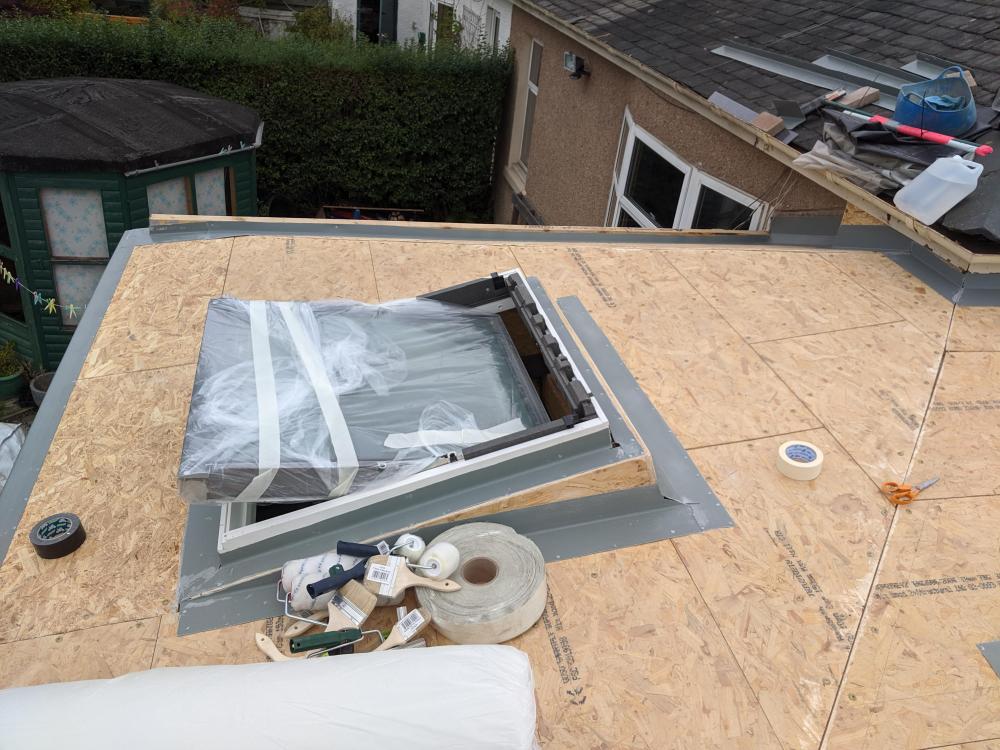
@SteamyTea thanks. These show one of the kerbs and you can see the small sloped triangle / parapet in the background of the second one. Haven't got any post-bandaging yet as it was dark by the time I finished doing it, so was going to take the next round after sanding / before laminating on Thursday before the rain came... I did think the parapet had a very slight fall, and it basically does but there's a little bump up where it meets the bigger rear section (that the rooflight is in) so it's holding water there. The kerbs aren't holding much, I think primarily the issue is the bandaging at the corners is again just creating enough of a bump that a thin line of water (like a cable / thick bead of sealant) gets held along the line where the trim bends up away from the deck. With this I'm as much wanting to avoid a line of dirt/algae etc as being worried about the water itself, since the roof is overlooked from the house.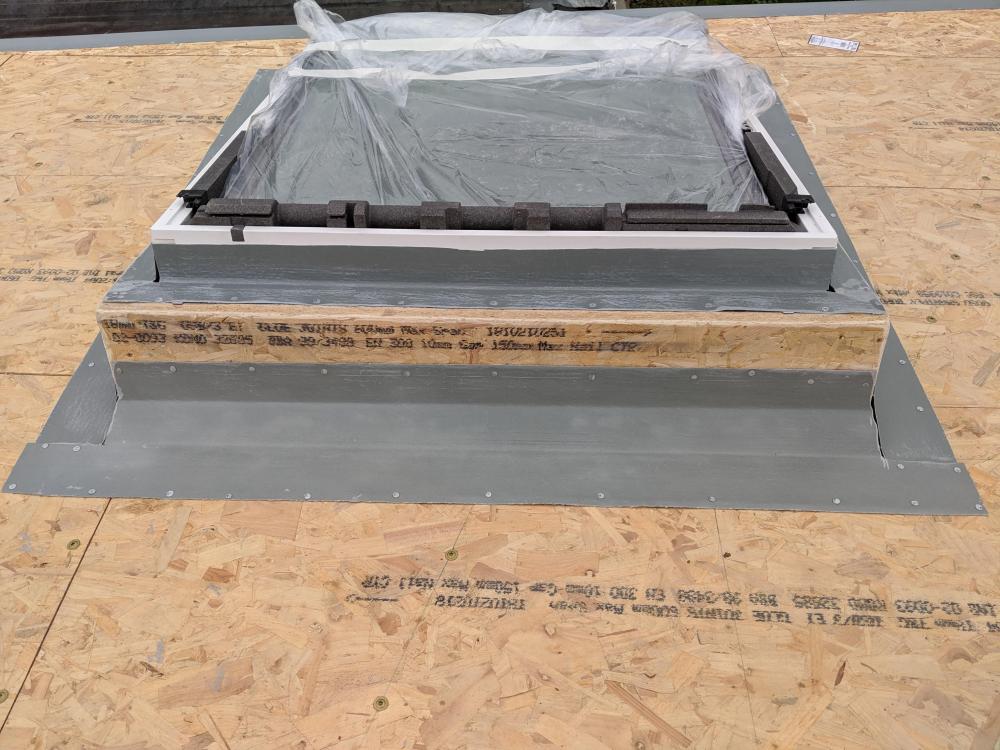
-
"Padding" GRP to improve falls at raised edge / above rooflight
andyscotland replied to andyscotland's topic in Flat Roofs
Thanks - I can probably tolerate a bit of awkwardness shaping the PIR offcuts vs buying something else, if it will otherwise work. It's only 5 pieces. Will maybe have a go and see how I get on and fall back to PU if it proves too much hassle. -
So, I am still plodding on with my GRP. Turns out the manufacturer "2 operatives in a day" thing might be viable for a small square, but miles off the time needed for an L-shape with 4 rooflight kerbs and getting harder and harder to find a guaranteed-dry day. Got everything bandaged and the rooflight kerbs laminated a couple weeks ago but ran out of time to do the deck so gave it a thin coat of resin per manufacturer. Thursday was beautiful so took all the covers off, thoroughly sanded and acetoned ready to laminate : just as we were about to go mix the resin a torrential downpour blew in out of nowhere (we were soaked through in the time it took to get tools off the roof). Now built a tarpaulin tent above to let it dry properly..... ? Anyway. What this has shown up is that water is slightly ponding against the parapet/concealed gutter at the bottom of one sloping plane, and along the upper edge of the rooflight kerbs. Not masses, but more than I'd like. So, I ideally want to put some sort of thin profile in both these places to create a bit more of a fall. For the parapet gutter just a long thin strip down to drip edge, and for the rooflights perhaps a sort of wedge shape leading from the centre of the kerb down/out to the corners. These will be on top of the GRP trim / bandage, and below the main laminate (so ultimately encapsulated by GRP). What can I use that will be easy to profile in quite thin bits / not attacked by the resin / not expand and contract unhelpfully? I know polystyrene will melt. I have plenty of offcuts of PIR insulation - considering fixing these to the deck with the trim adhesive and shaping them with knife / rasp to get them to the profiles I need. Thoughts?
-
Oh yeah if the cabin above already has a floor then just stick it on your structure, no need to board. I presumed from your Q maybe it was just walls and a roof. And the front open deck just put the deck boards direct onto the frame with a gap between each for drainage/expansion. This obviously assumes your frame/joists line up to support both ends of the deck boards (not sure of your orientation). One thought, if your cabin sits atop the frame then presumably there's a void between cabin floor and the insulation between your joists? May be worth putting insulation around the perimeter of the cabin base otherwise heat will get out the sides there and reduce the effectiveness of your celotex below.
-
You could, or clamp the joint into a bit of a sandwich with ply/OSB either side to hold it flush and square as you nail it. But for your case I'd probably just recess them a tiny bit as you suggest. Depends what you're putting on top. For decking people normally just put the decking boards straight on. If you're going for your exposed balcony bit still (lost track, sorry) then decking boards with a small gap between will ensure water can get through and off the deck. For the cabin something like exterior grade OSB or wbp ply might be enough (instead of decking) depends what's cheaper/easier to source/easier to handle on your own.
-
@zoothorn or, put the noggins in as you go, and fix them to one joist first. E.g. nail a noggin to the middle of your first joist. Put the joist in position with the noggin facing into the open space. Put another noggin between first joist and outside frame (you have easy access to both ends. Now, nail a noggin to your second joist, offset the other side of centre. Put the second joist in position and nail through it to the noggin from the first joist. Rinse and repeat. This way you're always nailing from open space.
-
Very true, metal isn't a magic fix-all and definitely with conduit/trunking fire stopping and workmanship becomes much more important. ISTR there's a thing somewhere in the IET info at the time they made the change about the importance of ensuring all openings/knockouts are properly closed too. Valid point and definitely more they could have tackled. All the same even if the quality of the terminations was improved there'll always be a risk of someone not actually making the connection properly and a metal box (absent nesting vermin) has a lot less combustible material near the terminals so the chance of an arc developing into a full-blown fire, and doing so rapidly before occupants are aware of smoke, is undoubtedly a lot lower. Suspect that they thought that was enough of an idiot-proof easy win to bring the risk to acceptable levels. No argument there - but in my time I've found plenty of the old brass screws that just haven't been done up properly, or terminated sloppily with loads of exposed core and floating unsheathed earths etc. There'll always be homeowners/cowboys making dodgy connections so as much as improving manufacture quality (and idiot-proof-ness) would be good, I don't think that would 100% sort the problem - improving containment/separation from combustible material is a good fallback IMO.
-
Completely true from a regs point of view. And certainly some regs change somewhat "for the sake of it" and really not worth thinking about on an older installation. However worth noting the regs on plastic consumer units changed because of their role in a number of domestic fires, ISTR including some with fatalities as the consumer unit was under the stairs and blocked exit from the building. In those cases the root cause was loose connections but the plastic contributed to the rapid early development of the fire. So it is worth at least understanding why the new regs are what they are, and making an informed decision of the risk/reward of leaving it as-is (which you're perfectly entitled to do). This will also depend on circumstances : e.g. if the only thing above it is an old dry timber staircase that's the only means of exit it's a higher risk, if the cupboard has a plasterboard ceiling and you have other ways out you may be less worried. Similarly if it's near anything that vibrates there's more chance of something coming loose over time, if not and the connections have been tight for decades they probably aren't going to magically undo themselves in a hurry. If it was me and I knew I was planning work in the area in the short to medium term I would probably leave it till then. But in the meantime I'd think about other potential control measures e.g. perhaps putting a smoke/heat alarm directly in the consumer unit cupboard for early warning and getting semi-regular inspections of the connections (perhaps every couple of years, between full EICRs) to check they're all in good condition with no sign of loosening or arcing. That said loads of houses with plastic consumer units haven't burnt down, only a few have, so you may think it's not that big a deal. Just depends on your risk appetite / whether there are other things in your life more worth worrying about. I wouldn't worry at all about RCDs on lighting circuits and missing drawings : just be aware of it if changing screw-in lamps / drilling walls / changing fittings and make sure things are off before you work on them (which they should be even if you had an RCD). Though the cost can bump up if during the CU change they find other things that need to be done (e.g. a cable with a lower-than-acceptable insulation reading that can't be connected to the new board till that's fixed). Advantage here is you have a generally-satisfactory EICR so that's less likely to happen, but still worth bearing in mind.
-
Electrical sign off
andyscotland replied to Mike_scotland's topic in Regulations, Training & Qualifications
It does seem to vary in Scotland depending on local authority. As @ProDave says, in theory under the legislation there are two options that the customer can choose between: Use an "Approved Certifier of Construction" to sign it off - you get a 3% discount off the warrant fee if you tell the council at the time you submit your building warrant application that you'll will be doing this. If you've already paid for the warrant AFAIK you can't get the discount later. Some - but not all - SELECT and NICEIC members are on the approved certifiers register. I believe the legislation allows for an Approved Certifier to certify the electrics even if they didn't do the installation, but in practice it's hard to find one that will. Don't use an "Approved Certifier" and it then falls to the local authority to verify that the installation is satisfactory. Unfortunately if you go the second (old-school) route, local authorities have quite wide discretion to decide what they are/aren't willing to accept as evidence that the installation meets the requirements. Some broadly follow the minimum requirements in the regs / procedural handbook and will just accept an EIC (which as @ProDave says can be done by anyone if they know what they're doing) and may ask for information about the qualifications / experience of the person that produced it. They may also choose to do some on-site checks of their own. In Edinburgh, however, their checklist for the completion certificate requires "Certificate of Construction (Electrics) or electrical compliance certificate and copy of electrical installers trade card (SELECT or NICEIC)". Their line is that it's a statutory requirement for the electrical work be done by a competent person, and the only evidence of competence they will accept is Approved Certifier status or membership of the schemes. They are not open to discussing any alternate routes for demonstrating competence and compliance. So I would suggest checking with your local council direct what they will / won't accept. With luck yours will be one of the more flexible ones. If your council is more obstinate, but you still want your friend to do the install, then you would have two potential options (which might still be cost effective if he's giving you a good price on the install labour): Get him to complete the "Design" and "Construction" parts of the installation certificate and then get a NICEIC/SELECT member to sign off the "Inspection & Testing" section. You may need to shop around to find someone willing to do this - even though the certificate quite clearly breaks down the responsibilities of the different people signing it, some firms are nervous that they might become liable for problems with the install. I think also some of the schemes restrict their members from doing this, for whatever reason. Your friend may have contacts though? Or, get your friend to complete all three parts of the installation certificate, but then get a NICEIC/SELECT member to do an Electrical Installation Condition Report and submit both. It may be easier to find a contractor to do this : an EICR is a standard service, and there's no doubt at all that the firm doing it are only responsible for the inspection & testing. Either way get the eventual-signer-offer on board as early as possible and make sure it's clear if e.g. they want to do an inspection at first fix, that they're happy with how your spark is planning to do it etc. You don't want to complete the work and then discover you can't find anyone with the right paperwork that's happy to give it a clean report. -
@zoothorn it only really matters if you need them to line up with joins in other materials (e.g. sheets of wood/plasterboard/insulation/whatever). If not (assume you're just cutting the celotex on site) go with whatever is easier. Far as I know the only reason for staggering noggins instead of putting them in line with each other is to make it easier to fix them e.g. if nailing through from the other side. Don't think it makes any odds structurally. So again just go with what's easiest for you. If you're using hangers you may find it easier to fix them to the sides of the joists (carefully measured, obviously) before you put the joists in position rather than having to do it when you've only the 400mm gap to swing the hammer in.
-
It went into 17th for access and egress routes as those were considered the highest risk, but AIUI that then prompted a lot of jumping through hoops by big developers to try to define things as not being access and egress routes to save a bit of cash. So the 18th made it apply everywhere to avoid any argument. AFAIK the intention is actually to support wires before ceilings have burned through : in the fatality fire the ceilings were intact, the problem was the cabling was all in surface mounted plastic trunking which failed very rapidly. My understanding is once sheets of plasterboard start raining down the firefighters will be withdrawing anyway. "Premature collapse" in this context means "while the building is otherwise structurally sound" eg the cables are not the first thing to go. Certainly cables that are passing over joists etc at fairly regular intervals are unlikely to be an issue unless the ceiling is very low. I know some of the certification scheme providers require clips everywhere (and tbh there's often no real reason not to on new build / major refurb : it doesn't hurt and isn't really that expensive in the grand scheme of things) but that is a very strict reading of both the intent and wording of the regs. Also worth noting that in some cases vertical runs may need support, depending on where they are, how much free cable is involved, and how/if fixed at either end. Although less likely to tangle BA they could still pose quite an obstruction at floor level/to other kit if they can sag too far away from the wall. E.g. I would be more concerned about a vertical surface run up to a plastic light fitting/PIR detector/WiFi access point than a horizontal run above the plasterboard ceiling.
-
It completely depends. There are lots of different "standard builds". The insulation can be below or above the slab. If it is above the slab, it's not always considered part of the groundworks and it's not uncommon to build the shell first, get a roof on, then do insulation and screed later rather than get it all wet and ruined. Again, you are asking us to guess what might be happening, and forming your own definite opinions and midnight certainties based on "clues" like one trade apparently being finished on site, but it is entirely possible you are misinterpreting all of this. And no amount of us telling you the variety of things it might be is, at this stage, going to help you establish what it actually is. Draw a line on the wall for the FFL you want, then talk to your builder (and from a point of "I'm confused, have I misunderstood?" not "your groundworks guy is obviously a fkn idiot and got this totally wrong, how are you going to fix it").
-
Right, but I give the example to say a) when it does you need to make it much, much, clearer what height it is that you have specified or you will get another "dreadful mistake" and b) your drawing is not as explicit and clear as you think it is. I'm not saying fire them, or don't fire them. I'm saying if you get another builder, give them the same drawing, and deal with them in the same way you are setting yourself up for similar problems. It is all abundantly clear to you. It is not abundantly clear to me, certainly not looking only at the drawing without hearing your explanation. A drawing is a method of communication, and should speak for itself. "I have 4950" - well yes, you may do. But at this point you have no idea what you have measured that 4950 to. Is it the finished floor? The bottom of the screed? The bottom of the insulation? Heck, from the information we know it could even be the top of an oversite with a void and suspended floor to be built above. Unless you know for certain what point in the structure the 4950 goes to, there is no point even attempting to compare it to the 4500. It could be out by miles, or it could be bang on. Why is it now your hunch that insulation has already been put in? You've said you watched carefully and didn't see it. Surely you'd have seen it delivered to / sitting on site even if you missed the moment it went in the hole? This is my point : you are working yourself up to a point of panic based on hunches, because a) you don't have a drawing that would answer your question and b) in the absence of that you're not willing to just ask the builder. You really need to try to stop letting your imagination run away with you, and focus on improving communication (including ideally drawing lines on bits of paper or on the structure, as a much more foolproof way to avoid misunderstandings). If you continue as you are, you are setting yourself up to continue panicking and to continue having problems. It well may be that you also need to fire the builder - their attitude as described to us is very concerning, but we only have one side of the picture.
-
SketchUp is brilliant if you actually need 3d visualisation of anything. But I find it very slow to use for anything more like 2D line / detail drawings. May just be that I'm more familiar with a traditional cad-style interface. I use QCad for anything like that.
-
@zoothorn looking ahead, the other major thing that jumps out at me on your section drawing is door frame height. It is not clear whether the 1900 is the clear opening inside the frame, the height of the actual door, or the structural opening that the frame will sit inside. 1900 is low for any of those, but significantly so for a structural opening as by the time you have frame, movement gap, etc you will be well down into the low 1800s. This is further complicated as the 1900 on the ground floor appears to be measured from the underside of the cill (which is some arbitrary amount above floor level?) but to the inside of the frame at the top. And the frame appears to be rebated into the wall above the height of the ceiling. It will be very hard to fix this later if the heads of the door openings get set at the wrong height so I'd really strongly recommend revisiting how those details are specified, drawn, labelled and dimensioned...
-
@zoothorn you are going in circles. First thing's first, you need to take a deep breath and a step back. Next, you need to work out how to move forward. Please try to read the following as an attempt to help, not an attack. We all understand you are on a build notice, not a full plans. The problem is, in normal circumstances - regardless of how you choose to deal with the council - you would have a drawing showing e.g. whether the insulation is above the slab or below, how thick it is, how it and the screed meets the external walls, all the questions you are asking us on here. You may not care about the u-value, but you must understand the insulation has a thickness. And therefore it will affect the depth of dig and, depending on position, the height of the slab surface, since it needs to sit somewhere between the ground and your finished floor. It is quite possible that the insulation is going on the slab, that this and other construction elements are going to add up to about 350mm and that your builder is bang on track to deliver the floor height you wanted. If so, it is also possible that your builder is finding you hard to work with, that reassurance and detail he's attempted to provide doesn't appear to be going in, and that he's doing his best to deliver your project through a flurry of continual panic attack, second-guessing and secret measuring. It is also quite possible he has it wrong, and plans to belligerently insist you accommodate or pay to fix his mistake. If you had a set of drawings, it would take you seconds to look at them and establish which of these possibilities is the case. It would then be easy to either relax, or to put your foot down and insist the builder puts things right before payment. You chose not to pay a professional to produce those drawings. You chose not to spend the time to research the detail of building construction and draw them yourself. I understand why @Onoff's "fag packet" comment upset you, but I can also see that - against advice given here - you have spent a lot of time producing a beautifully presented drawing that does not actually communicate any more information than a rough sketch would have. Further, one in which things that are critical to you - like the height from existing house floor level - are not explicitly labelled but rely on implied knowledge (there are lots of things a dashed line could represent). The builder may well be happy with it, but that does not change the fact it is not clear enough to give you certainty or confidence over what's being built. When you complain on here that builders have huge power, and that there is "nobody in the client's corner" : that is not normally the case. You have chosen to have nobody in your corner by choosing to run your project based on trust, informal communication, and the sparsest of details about what you want. Your builder didn't prevent you using an architect, and nor did we. It is important to take this on board, because if you do not get to grips with your role in the process you will continue to have the same problems whether you continue with this builder or (as some have advised) sack and replace him. So, moving forward you essentially have two options: * Convince yourself that your plan is perfect, that you have crossed every t, that only a "fkin idiot" could misunderstand it, and that you have the best builder in the western world. If so, trust them to do their job, stop asking questions, go on holiday, come back when they're done and enjoy the extension. * Accept that you have created a situation with a lot of room for error in which ongoing conversation is going to be crucial. Approach your builder with this tone - come from a place of "I'm worried I didn't make the floor level clear enough, and it looks low to me : can you talk me through what's going on top of the concrete and mark on my wall where the floor level will end up?" If that's not as expected, discuss the options for resolving it. Stop asking us to guess what your builder may or may have done or be going to do and ask him.
-
That depends on the doorset. For the Green Building Store performance range an 800mm clear opening has a 1039 frame and needs a 1060 opening. Rational auraplus was I think 998 frame for 800 opening, haven't gone with them so didn't double check that size. Don't know about composite but suspect a 900 opening will be tight?
-
Not sure where you've got the 900mm figure from, I believe the minimum clear opening entrance door for a private dwelling is 775mm in England & Wales, 800mm in Scotland? There's a diagram in Doc M of how the clear opening is measured, but I decided was easier to spec the door based on the clear opening it needed to achieve and then asked the manufacturer to provide the structural opening dimensions. And then built a hole to fit the door unit.
-
Sounds like you just need a bigger ratchet (as the cheapest solution). If you over drill the pilot holes then there will not be enough thread gripping the timber. Buy a long wheel-nut bar for your socket set. Or slide your existing ratchet up a rigid pipe/box section/whatever to extend the lever arm.
-
@zoothorn it may reassure you to know that one major cause of weak concrete is actually allowing it to get too dry during curing. One acceptable method of avoiding that (not especially common in UK as a polythene sheet is cheaper and fine in our climate) is to pond cure the concrete - by building a dam round it and flooding the area above and keeping it flooded for a couple of weeks. Water in the trenches when you pour, or very very heavy rain during the pour, may mix with the concrete and make the mix to wet. As soon as you stop moving it though it will very quickly form a skin and then cure as expected. This of course is why you never pour cement mixer/tool rinses down the drain as they will quite happily solidify in the u-bend etc. You do ideally want to avoid fast flowing water over the surface as that may drag cement / fines out of the top of the mix and make it flaky. Not the end of the world for foundations tho unless extreme. If it's trench fill and you have a full-on river flowing over the site you may actually be better sticking timber/earth round the trench edges to form a small pond and slow down the flow at surface level. If you're just covering the bottom of the trench any water that gets in after isn't going to hurt. You've said a few times your builder is experienced and well respected, I'd be inclined to trust him. He will have worked in the rain before. There will probably be a reason he's pulled off those to do yours tho. They may be waiting on materials arriving / plaster drying / concrete curing / trades turning up / whatever so not automatically easy to swap them about. Few (good) builders just jump between sites whenever they feel like it.
-
I would, the pressure treatment doesn't always get all the way through especially on thicker stock. Not going to cost a lot/take long and worth it for the peace of mind.
-
Just about to start the first fix electrics
andyscotland replied to Triassic's topic in Electrics - Other
Also extra sockets. And if there's any possibility a bedroom might get rearranged in future, I would put the bedroom lights on wireless switches so you can more easily move them to be next to the head of wherever the bed gets shifted to. Once stayed in a B&B where, lying in bed with the room light on you were staring across at a pair of lightswitches either side of the dresser thinking wouldn't it be handy if they were on this wall! Similarly, sockets on every wall at least in the bedroom. Don't have downlights in the bedroom, ceiling or wall wash is much nicer. Make sure you have supplies to the bathroom counter/cabinet/mirror for shavers, toothbrushes etc. Put sockets and Cat6 in all your cupboards, never know where you're going to end up wanting to put a charger/audio controller/WiFi repeater/smart device. Likewise the attic/eaves space if you have one. If you have a porch (or even a hall) with some glazing an inside light connected to the outside PIR with a slight time delay is a nice touch - welcoming, bit more light to find your keys, saves finding the inside light after you open the door and as it looks like someone's coming to the door can be a good deterrent. Don't forget about socket(s) in sensible locations on the drive & in the garden. -
@Ed Davies Or, better example, it's not uncommon in a venue to find a permanently installed 63/3 or 125/3 commando socket or even a set of 300A powerloks off radials with much lower ratings. Sometimes you even find one of each all on the same 63A circuit.. They're provided because touring dimming & distribution kit commonly has those plugs and the load/diversity is then managed downstream. Of course that environment usually counts as being under competent supervision, but it's definitely possible.



