
Conor
-
Posts
4165 -
Joined
-
Last visited
-
Days Won
12
Everything posted by Conor
-
I did it on loopcad. The ground and top floors were done precisely to meet the heat load requirements and I used the optimal spiral pattern. Sprayed out the pipe routes in advance. Took two days to do 175m². For the basement, we basically skipped all the design and went straight to simply marking out the pipe centres in each room and roughly calculating the loop runs in our head. Laid using the serpentine pattern. Much easier and faster. 115m² done in half a day.
-
Cool Energy. Was set on an Mitsubishi ecodan but couldn't find one in stock. Cool energy was competitively priced and got a package with tank, buffer, controls etc so didn't have to think beyond the order. Tank is plumbed in but not got the ashp connected yet. @dpmiller seems happy with his.
-
I ended up doing the same. We had a lot of tight loops so not really any slower than the stapler.
-
I'm afraid the only course of action to take is to completely demolish your house and start again ?
-
In the grand scheme of things an extra 100m or so of pipe and a 8 port instead of 6 port manifold is pittence. We went for 200mm spacing in bedrooms and smaller rooms, 100mm ish in halls and large open spaces.
-
If anything your pump might be slightly undersized, not over. I've double the insualtion you have and are under 300m² and we are going for a 9kW pump (double our peak head demand) Search the forum for the heatloss calculator and give it ago.
-
Stapling ufh pipes into PIR is easy. We laid our 100m² basement pipes in 4hours, and that was with a dodgy pipe stapler.
-
I'm now thinking it's not 25mm... Could be thinner. I could check but Im enjoying my hot soup right now.
-
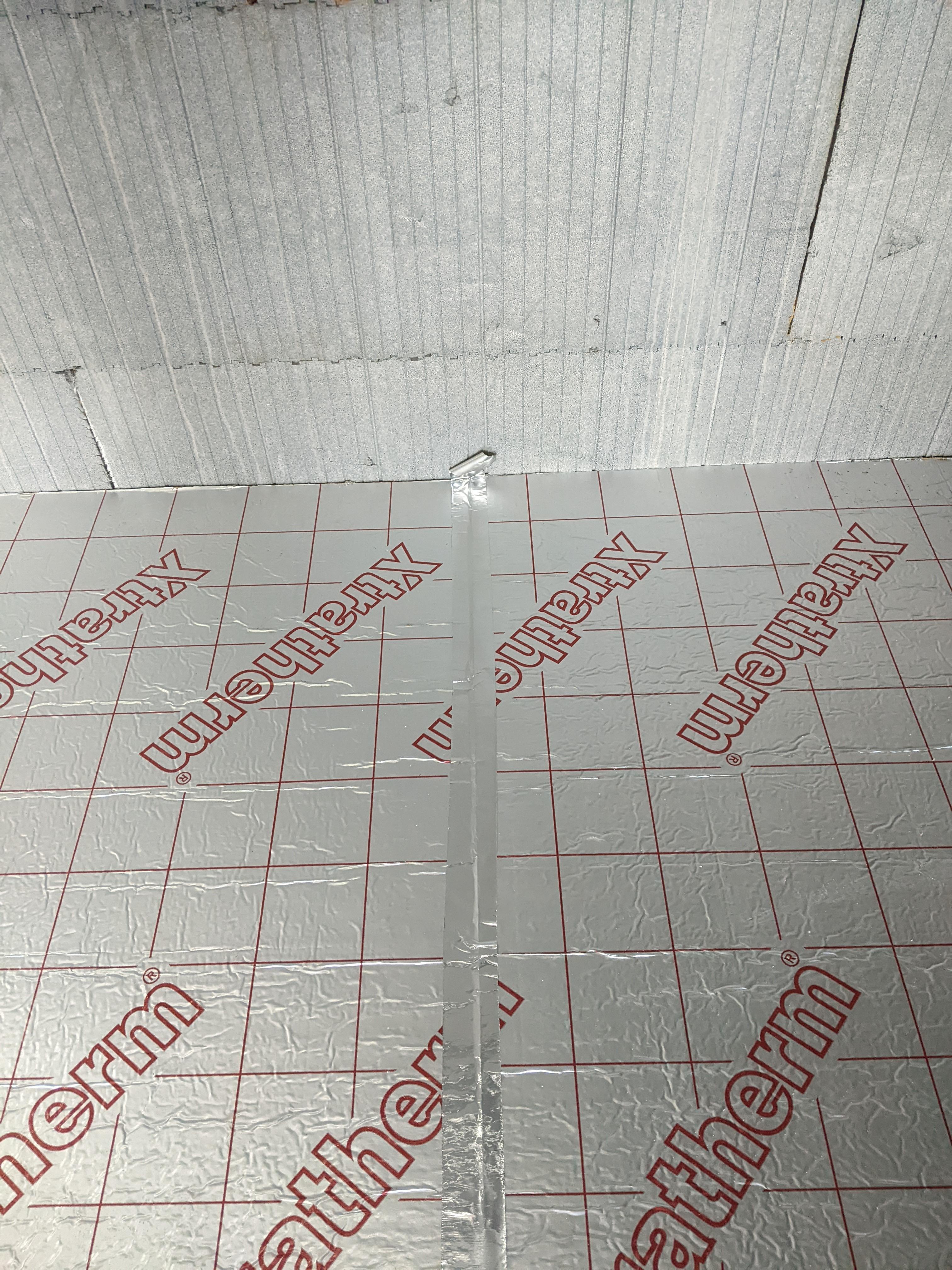
The guy from the screed company is here today laying the polythene and taping a 25x100mm expansion strip around all the walls.
-
Should I tape between the boards and wall?
-
I had this conversation at my plumbers supply which now does heatpumps. They reccomended the normal 28mm pipes with the outdoor wrapped insualtion. Main reason for this is that's it's half the cost and much easier to work with.
-
 Good decision, ours looked ok on paper but when they were finally installed we realised they were rediculously small, they are narrow then my shoulders!!!
 -
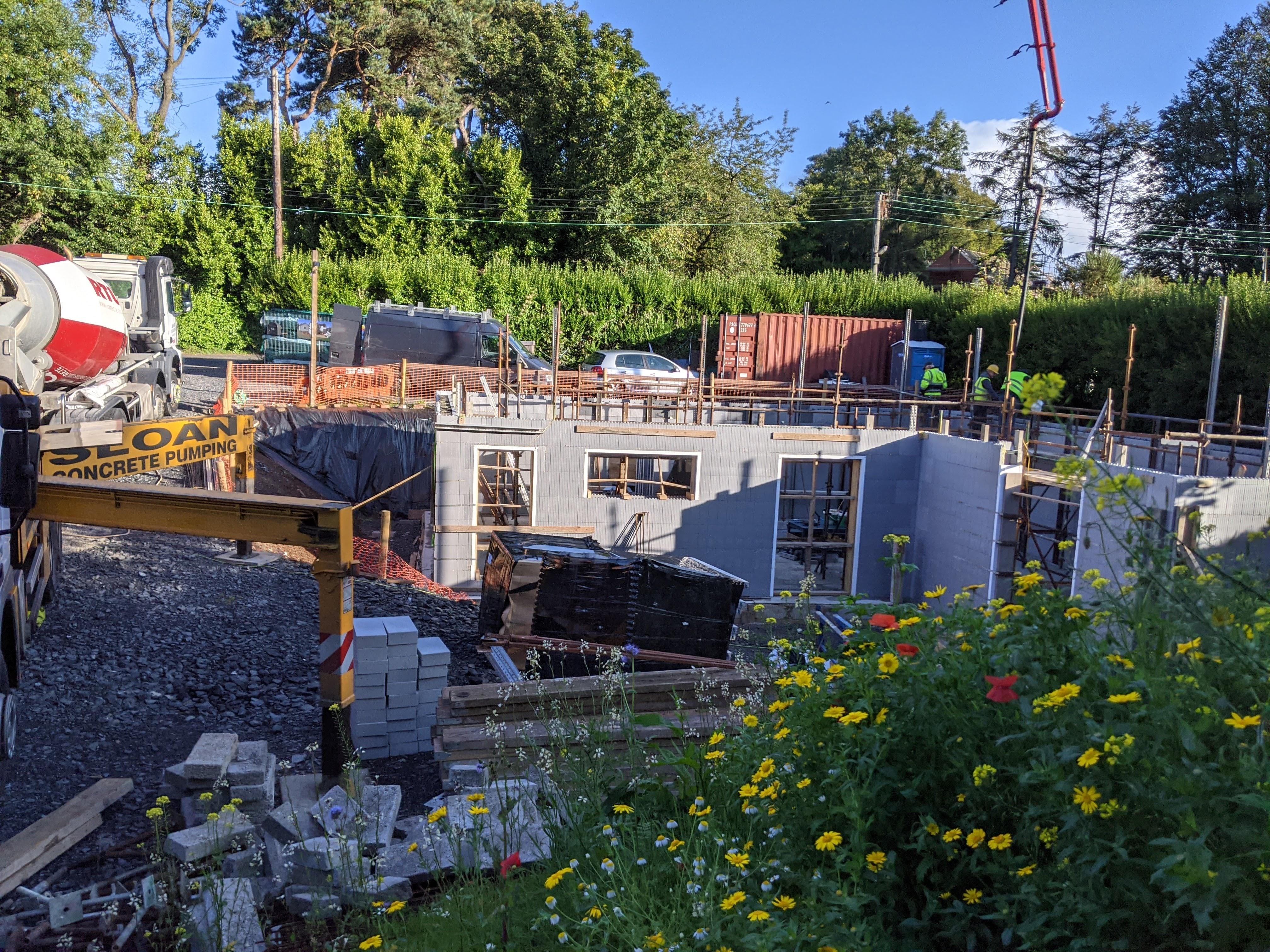
Our surveyor said not to get him for the first draw down until we had the walls up to first floor level. He said there's little value in ground works and foundations, even though it's one of the most costly stages. I think we'd spend £40k digging a hole and laying a slab, but it only took another £11k to get the walls up for our first valuation. Another pint to note is that the valuation is done in the context of the final expected value. So if the final value has gone up 10% since your initial application, then you can expect to get a little bit more at each stage (until you hit the total available). As property prices rose so much in the last year, we got our final drawdown long before we finished as the final value went up by a rediculous £100k.(I think it was undervalued at the start)
-
I'll do a decibel-o-meter thing tomorrow.
-
It's pretty much like a hair dryer on min setting for all of the above. You wouldn't want to have one in your bedroom at night unless you like white noise.
-
We bought three £100 dehumidifiers from screwfix and hired two "commercial" ones from local firm. The cheapies were extracting as much as the commercial ones so sent them back and bought two more 12l Screwfix ones. They work brilliantly and only a couple hundred watts so you can have multiple off the one extension. At the start they were drying about 25l a day between them. Now, it's more like 10l now that we've dried out. I know from searching gumtree, we'll be able to sell them on for £80 each. Bargain.
-
I contemplated using 50mm EPS boards on our first floor before the UFH and screed. The staples pull out easily and the EPS falls apart. 25mm will be a nightmare to work with. I'd just stick clip rails to the slab and screed straight over with 50mm liquid. Keep it simple. If you do use the EPS, use the self adhesive slip rails instead of staples (tho you'll still need staples at bends and through the ends of the rails as they will be only stuck to the polythene).
-
I've a small desk fan running 24x7 in my shipping container to keep condensation at bay, works really well when it's weather like this.
-
Keep the topsoil in a separate heap. It'll soon be covered on grasses and nettles. The subsoil would benefit from the wild seed mixes as they prefer poor soil anyway. Ours did really well even though we didn't sow until June. Field marigolds, wild mustard and cornflowers did particularly well.
-
An alternative to RSJ in providing joist support
Conor replied to Annker's topic in Lofts, Dormers & Loft Conversions
UC and UBs are used because engineers and builders are familiar with them. Look at universal columns rather than beams, they can provide the same load rating as a beam but for less depth. -
Our bedroom is 4x5m and we have a central dimmable pendant plus two bedside wall mounted dimmable lights. We have spots in our current rental and hate them, even though they are dimmable.
-
Depends on the specific modulus of the soil. Ours has a modulus of two and were able to batten slopes to more than 60°. This will give you a good idea of slip angles. http://www.geotechdata.info/parameter/angle-of-friction NB, enough rain can wash away and collapse any type of soil bank at any angle.. We planted a load of wild grass and flower seeds on our spoil heaps, really helps keep the surface together and reduce wash off. We have a silt fence at the bottom of the site to prevent wash off to the river (planning condition)
-
Check your static water pressure at your house. I've gone for 10mm pipes for all washbasins and WCs. When we connected up last week, the main bathroom washbasin was little more than a trickle, just about enough. (~13m pipe, up two stories) We've 3bar static with 25mm pipe all the way to the manifold.
-
Actually, just looked at the quote again and the screed is £15/m². Still a bit cheaper. But more importantly faster drying time.
-
It only worked out cheaper as I had enough extra 50mm EPS available as we decided to use TLA on the upper floors after it was bought. The liquid screed at 50mm is £13.50m² and 100mm sand and cement is £17m²