
Radian
-
Posts
2586 -
Joined
-
Last visited
-
Days Won
15
Everything posted by Radian
-

Learning to live with mistakes. 5 Amp circuits
Radian replied to ToughButterCup's topic in Power Circuits
You can guess my opinions on this already. Also I've had a bulb totally shatter exposing the live prongs - however, fortunately, glass envelopes are now a thing of the past. The one 'biggie' that really gets me is the 'ring final' - a peculiar British invention whereby we can save a bit of copper by letting a load get its current from two sources at once. Until, that is, a loose connection somewhere in the ring means all the current comes down one cable only. Not only does this allow the current to potentially exceed the cable's rating despite being sized to meet regulations but it easily goes unnoticed because all the sockets can still provide electricity. Awkward to diagnose as well. -
Learning to live with mistakes. 5 Amp circuits
Radian replied to ToughButterCup's topic in Power Circuits
At least things have moved on in the safety department from the previous century, when 5A plugs didn't have insulated pins like their 13A counterparts did. Now these I would have trusted my kids fingers with: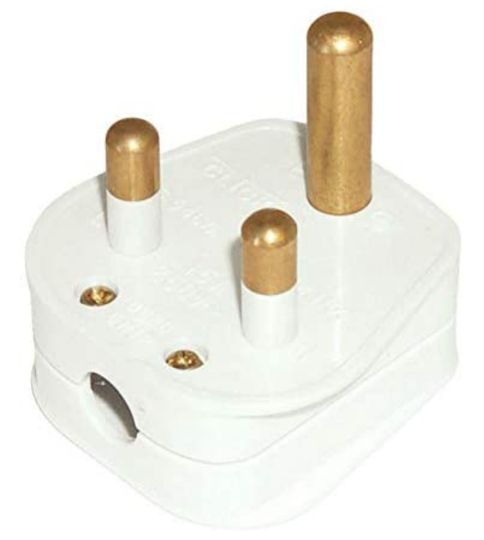
-
Looks quite flat overall. Is that a field to the North? Possibility of a broken land drain (ancient) if so.
-
I don't know if this is restricted to particular regions in the UK but it certainly isn't uncommon here on the South coast. Cornwall, South Wales and Counties adjacent to the English Channel see more of the Atlantic airstream and this occasionally carries in mild moist air, on the prevailing SW winds, during the Winter. We had a particularly good example for a few days in early January and I noted a number of posts on these forums where people were suffering from unexpectedly high amounts of condensation. I suspect we will experience more of these types of condition in the future and would suggest everyone factors it into their design stage to some degree.
-
What's the topology like in the part that floods? Is there an obvious reason - like being lower than everywhere else?
-
Learning to live with mistakes. 5 Amp circuits
Radian replied to ToughButterCup's topic in Power Circuits
25 years ago it seemed to me like a good idea to scatter wall-switched 5A sockets for table lamps around the place. Some in the Lounge wired back to a DMX512 dimmer pack for scene control. Soon after the sparky had left, those horrible little plugs all got swapped for regular 13A outlets (I was scared by the lack of insulation at the top of the pins - do they even have this now?). Obviously anyone plugging in a kettle would instantly trip out the 6A MCB for the lighting circuit but it's all intrinsically safe. Just a 'user interface' issue. I don't think this kind of thing has a place really anymore. Smart lamps are the only way to go IMHO. -
"Luxury" bath/showeroom planning
Radian replied to markharro's topic in Bathrooms, Ensuites & Wetrooms
So why keep this CD hanging around?
-
I never like the idea of large volumes of air trapped in unventilated roof spaces. Yes you can apply vapour barriers to keep out the moisture from occupied spaces below but air infiltration from outside will be much more problematic. Without insulation the inside temperatures will follow the outside far more rapidly than the RH levels, bringing the structure close to the dew point on occasions. Most of the year this will not be a problem but sometimes it may lead to condensation that has no safe way of being dissipated. I'd be interested to know what the experienced builders think about this because the inexperienced ones I've discussed this with seemed oblivious to the notion.
-
I'm not sure my previous reply makes sense without further info: Does the 150mm pir stop at the raised tie level or go on all the way up to the ridge? From what you described the space above might even be ventilated.
-
The enclosed void above your raised ties is unvented and will be even more thermally decoupled if you insulate it with 350mm rockwool. So what happens to water vapour if it's not prevented from getting up to the ridge? Even without the rockwool the lack of airflow will result in a significant temperature drop leading towards the dewpoint. It never ceases to impress me how much mildew can develop behind freestanding cupboards or inside fitted wardrobes in poorly insulated homes. The lack of conditioned air circulation in these spaces is all it takes.
-
Good spotting. Hopeful then, but there is a diagram of three phase connection to a mains supply elsewhere ?. The Fan is also shown as brushless three phase.
-
We built our house back in 1996-7 and used exterior grade plywood for soffits dormers and lining porch ceilings. I kept all the surplus and decent offcuts at the back of the garage and have been feeding off them for the past 25 years. Numerous Garden projects have also come out of them and all the painted and unpainted surfaces I can see today are still perfectly fine. So for our recent extension works, I had no qualms about using plywood for soffits. Soon after the sheets were delivered I noticed some mildew developing so I cleaned down with dilute bleach and applied Zinsser 123 to seal all sides. Now its all fitted and finished in Zinsser satin topcoat I'm seeing the damned black spots reappearing six months on. Second Middle School? WTF China???

-
A buffer tank features in all the schematics as might be expected for a bang-bang compressor control. I couldn't see a figure for the actual starting current - only mention of using appropriate size conductors (with a generic looking list spanning 20A to 240A) to "to avoid difficulty in starting the compressor from the initial voltage drop" (p.13). It would help somewhat if they gave the actual effing current ? Whatever, it would be interesting to see the real-world performance of these crates. Look at the photos of the ripply sheet metal reminds me that we used to be good at producing inexpensive metal-bashed products like these back in the days when the UK had a manufacturing industry. I see nothing much to suggest a factory door price of over £500. A 2HP compressor is in the order of £100 and the rest is the kind of engineering that goes into fridges or even car radiators. Lots of soldered copper tubing. The electronic control boards are the kind of thing I used to knock-out for theatre lighting manufacturers for use in their moving head projectors and club lighting effects. Almost any of today's Arduino fanboys could probably produce a workable design for an ASHP controller in a week or two. I'm sure I once read that Ebac was going to make ASHPs, one of the few manufacturers running production lines in the UK.
-
From the Chinesium table on page 22 of the PDF you uploaded: malfuction (sic) code FA : DC fan motor protection (honestly, you couldn't make this stuff up and be any funnier ?) So it looks to me like the fan is DC powered, possibly with a variable speed controller that they choose to call a 'super inverter'. I may well be wrong, but you'd obviously be looking for an inverter controlled compressor (the real power guzzler that could properly modulate the hot water output temperature).
-
I had looked at these a while ago from Orion Air sales. As there wasn't any good data there, I gave them a ring and they said it had no inverter. But the Chinese can never make the same thing twice so maybe it's got one now? I'm having some difficulty understanding the manual you uploaded. e.g. " Not have this now " does the crossing out mean it has now ?
-
https://www.ebay.co.uk/itm/Panasonic-Compressor-6KW-Air-Source-Heat-Pump-AHP-60-ASHP-3-years-warranty-/302964624843 Non inverter style, usually marketed for swimming pool heating.
-
Probably had dry heatshrink sleeving. Capillary action will pull moisture through in time. Needs to have some decent Glue lined heatshrink over the original although I can't vouch for the stuff in that link. Farnell or RS might be more trustworthy. We used to keep the Navy's hydrophones watertight with the stuff we got from RS.
-
Much better sensor for temperature alone IMO, 5 for £11.75 seems reasonable. Got one in the ground here.
-
The only thing I can think of is that the temperature there is directly coupled to the fabric loss - put another way, to take an extreme example; if the wall was made from a really good thermal conductor like copper then your delta would be very small indeed. Another case of regression at work.
-
1800 CRANKING AMPS ?
-
If the neutral did touch to earth then it stops current in other circuits returning via the same RCBO neutral (which now has earth potential at both sides) causing the imbalance that trips it out. This is how they sense leakages from the neutral to earth as @Marvin describes.
-
As you were discussing with Terry earlier, I'm also trying to use regression to give me the optimum heat input for the required room temperature but I'm definitely feeling the strain on the brain trying to piece it all together with the training data I have at hand. Good fun though.
-
Which is why I'm going through this right now: https://www.futurelearn.com/courses/introduction-to-machine-learning
-
Battery Storage installed
Radian commented on MikeGrahamT21's blog entry in Back on the self-build waggon...
We've had an identical pair of freezers stacked next to a tall fridge in our kitchen for over two decades now and apart from the electric costs they've proved to be very handy. When we built the house it was the only way to get a decent capacity out of a vertical format. Being ancient they do require regular defrosting (about once a year) but they get done one at a time, shifting the food between them. -
At home, how much more electricity are we consuming
Radian replied to ToughButterCup's topic in Power Circuits
In 2005 the gadget to have was a plasma TV. Our 55" Panasonic can pull over 700W and still manage to look dimmer than a 70W LCD equivalent.