
Radian
-
Posts
2586 -
Joined
-
Last visited
-
Days Won
15
Everything posted by Radian
-

Solar PV & battery installation on the cheap!
Radian replied to Solarexploits's topic in Photovoltaics (PV)
No, he said he got it wrong on the drawing. The series connected batteries are charged in parallel at 24V from two controllers. -
Solar PV & battery installation on the cheap!
Radian replied to Solarexploits's topic in Photovoltaics (PV)
I can't see any real problem with your arrangement then. Yes you need to trim the output voltages to match each other otherwise you'll be losing out on some charge potential as one controller thinks it's done too soon. But that's a simple tweak. When I first contemplated your setup I instinctively thought it might be problematic but the output of two voltage regulators in parallel isn't necessarily a bad idea. Your charge controllers should have float and absorption voltage settings, something like 27.6V/28.8V for 24V AGM batteries but your batteries may have specific values depending on their chemistry. There is potentially an issue with your batteries becoming imbalanced over time - you ought to periodically check the two measurements at the 12V terminals and make sure they're within a few percent of each other. If there's a regular imbalance there may be a problem with some of the cells. -
Solar PV & battery installation on the cheap!
Radian replied to Solarexploits's topic in Photovoltaics (PV)
Hold on a minute... Your schematic shows the two solar battery charger units connected to their own pair of paralleled 12V batteries. Those, in turn, are series connected to provide 24V to your inverter. For a start, the 310W panels would probably deliver peak power at around 37V so would not be a good match for 12V whatever the chargers do. But then you say the (charge) controllers show 27.4V/28.4V why would they when connected to 12V? So did you draw it wrong, and in reality have two controllers (with >40V input capability) wired in parallel across your series connected battery pairs? -
Solar PV & battery installation on the cheap!
Radian replied to Solarexploits's topic in Photovoltaics (PV)
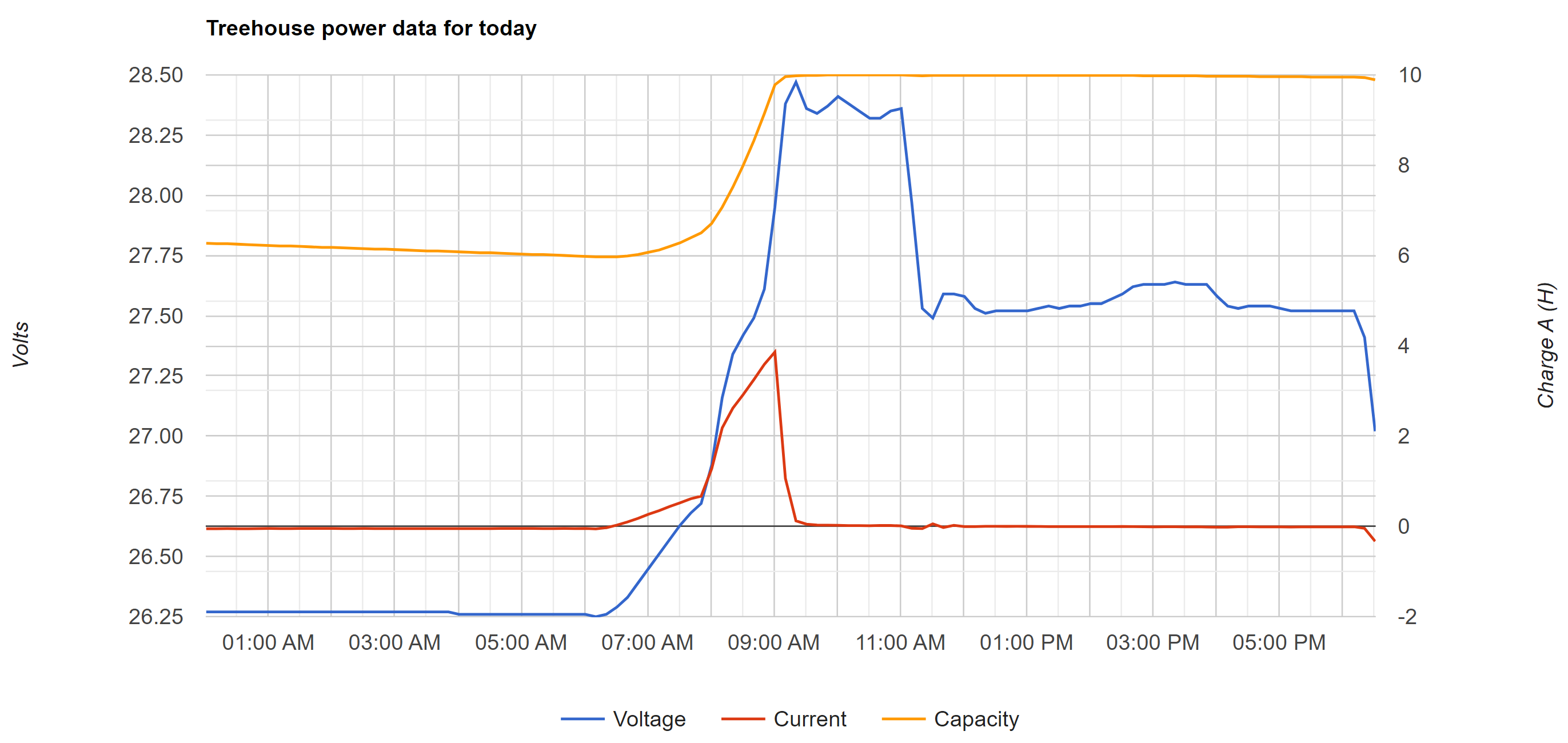
Once the controllers see the batteries are full, they will shut off all charging current. Here's a plot from a single 250W module, 24V LiFePO4 battery PV setup I have for my garden lighting: Once charged, absolutely no current goes into the batteries until dawn (just started to discharge at dusk as I grabbed this plot).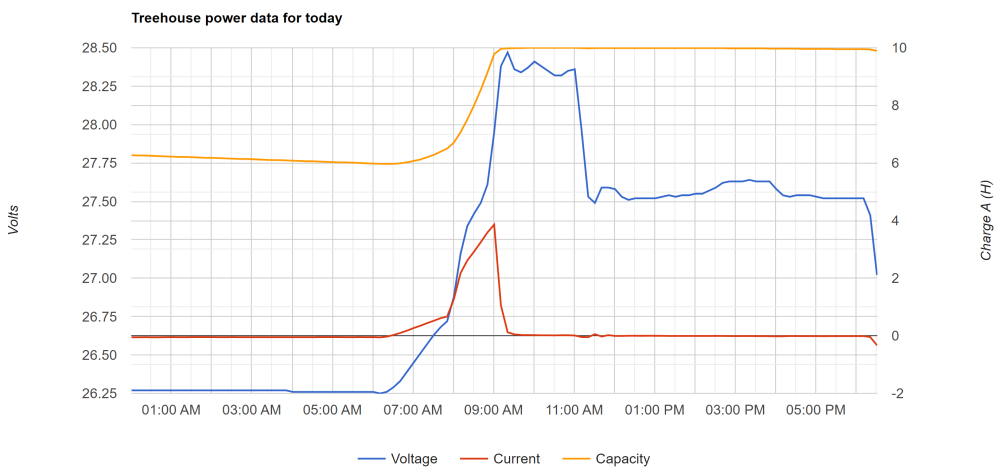
-
The limitations are also where the opportunities reside. My argument isn't with the present situation but with reference to a potential future that capitalises on the willingness of people to participate in a nation wide cooperative. There are already numerous small scale cooperatives like Brixton Energy in London. I would just like the latest UK energy strategy to mention microgeneration. If you search for that, it all seems to have died a decade ago.
-
EH? You wouldn't want the battery to export, and nor will it as the software prevents it iirc? Moot discussion. I disagree, there's a lot that can be discussed because there's a missed opportunity to reform the grid using microgeneration. Obviously we wouldn't want to export at the current punitive SEG rates when we can offset our expensive imports with storage but that would not necessarily be the case if exports were properly valued. The old FIT scheme was possibly too generous, but grid balancing by encouraging export from micro-storage when demand was high could make a big difference. Like the Red Queen, common sense doesn't seem to prevail with the network operators.
-
I got some more answers in the the thread I started about infrastructure upgrade. I was particularly interested in the fact that developers can pay to have new electricity substations installed if existing capacity is insufficient.
-
To me it all seems like something out of 'Alice in wonderland'. What is the essential difference between exports from a battery or direct from Solar power?
-
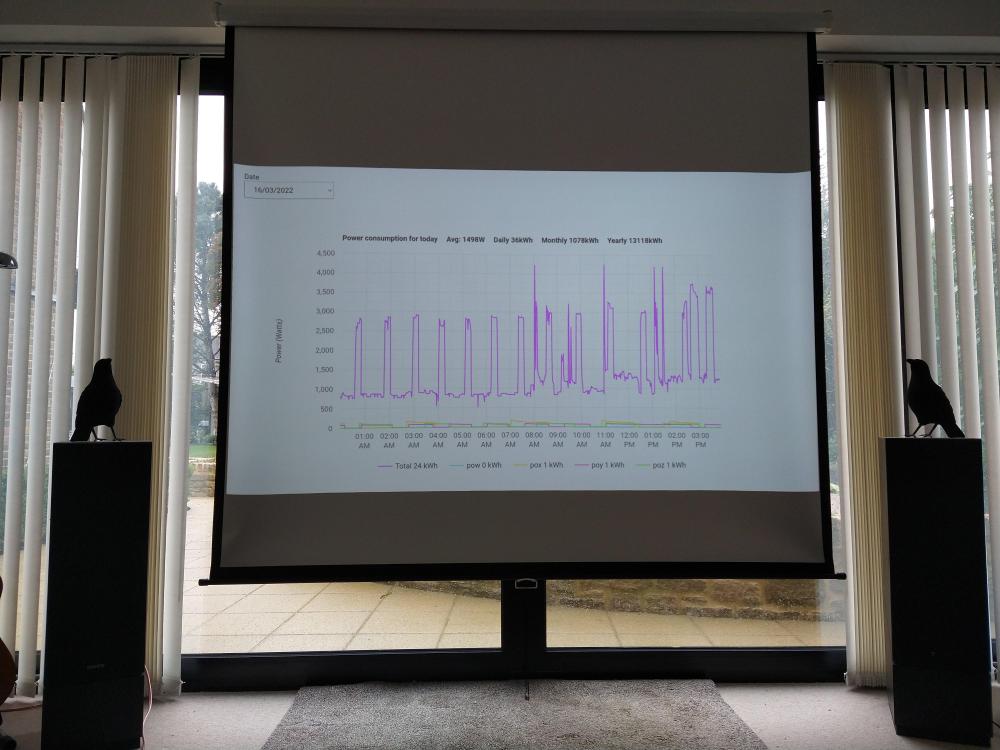
OK, you win. 😫 Except, of course, I heat the house with gas. The only electric heating is in the theatre room (2kW resistive convector) which blips away night and day keeping it from going below 17C. I should try that. Wondering if an inverse log scale for the Y axis might be useful?
-
That's what I've been trying to get across. But it's guesswork at a distance. A proper section needs to be taken to understand the build-up. A few small drill holes might just reveal the issue. I agree with you that a section of skirting could be removed and in addition to drilling horizontally, I would suggest a vertical hole to explore the floor layers. Once the skirting is replaced nothing will show.
-
Yes but that advice was to not let a roofer plug in the modules. I can't do that work on the roof and an electrician is not the appropriate trade to call on for working with a slate roof so I would have to end up getting both trades involved. Apart from the impossibility of getting any to respond at the moment, and the coordination required to get them both on site together, I just can't see how this could work. If I cost out that exercise realistically, then the installer we've found isn't far off the mark. Roof survey or not. Plus if ever there is a day when the value of energy put into the grid is properly realised then an MCS cert. may be worth having. Frustrating for sure.
-
Solar PV & battery installation on the cheap!
Radian replied to Solarexploits's topic in Photovoltaics (PV)
There's a great deal of variation from one LED to the next. Decent ones have regulated drivers so will reject 'noise' on the supply and give consistent lighting but the more 'bargain basement' varieties use unsophisticated capacitive droppers and these tend to exaggerate noisy AC rather than hide it. If the inverter is putting out something other than a pure sine-wave, then cheap LED's will almost certainly have a problem. The Victron Battery Monitor is about the only off-the-shelf product I know of that matches what you're after. £190 is a bit steep I'll agree. How familiar are you with the Raspberry Pi? For £30 you could probably piece together a battery monitor using a 4 channel power monitor or a Hall Effect Current Sensor if you need more current. You could also add a relay board and get it to switch on a charger - the sky's the limit if you can scribble some code! -
Solar PV & battery installation on the cheap!
Radian replied to Solarexploits's topic in Photovoltaics (PV)
Hi @Solarexploits At least you've got a 24V system! Expecting kW from a 12V inverter is crazy. I only got one hit on a 'GOBER' inverter and that was in a listing for the equipment on a yacht so can't find any real details. Have you got any photos of it? -
I win! I win! 🤣
-
Thanks for the update @S2D2 You've just reminded me to fix up the batten LED I bought for my loft. Had it plugged in under the sofa for 'ground lighting' effect. Nobody else liked it so I unplugged it and forgot about it.
-
Is that concrete I can see underneath your inside door mat? If so how can there be any insulation between the concrete raft and floor tiles?
-
There's supposed to be a government announcement in the coming weeks about an update to our energy independence strategy. Mention was made in a Times article (behind a paywall) about help with the cost of installing PV. That in itself will push up prices 🙄
-
To me, the wet sounds like condensation yet it seems everyone else is approaching this as if it were a leak. Condensation would be because the skirting is cold. The inside floor level seems to be the same as the concrete slab - i.e. not insulated. Therefore a cold floor. Can we establish whether or not the floor has insulation?
-
Interesting but pricey. So just two 160mm holes in the wall to outside. Doesn't say anything about how far apart they need to be though. From datasheet: 700W in 1650W out = COP 2.35 which is not very promising. Very little info to go on though.
-
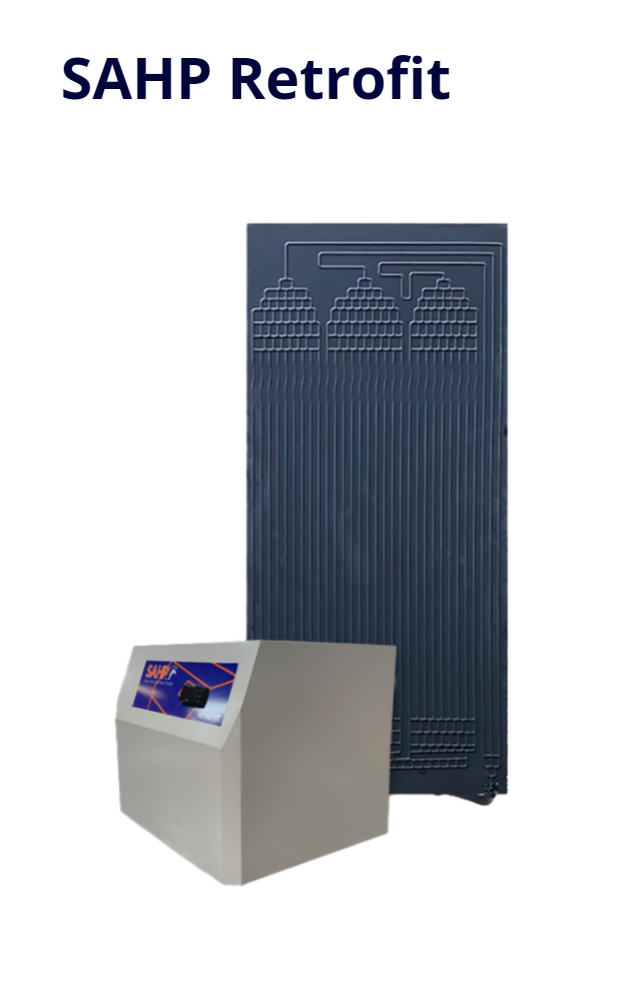
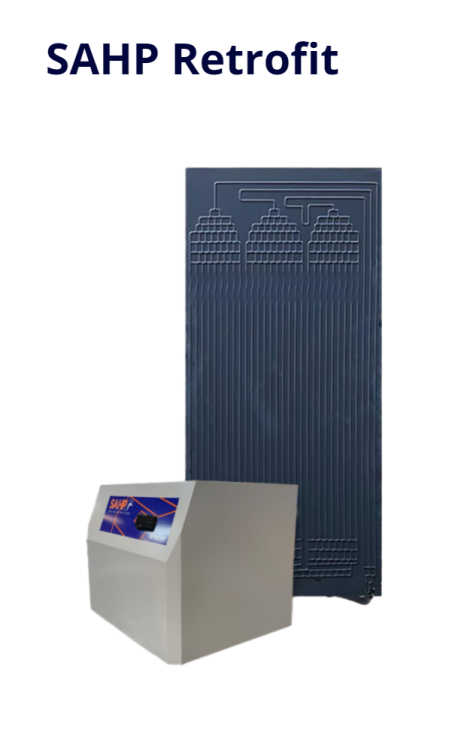
Very intriguing, not seen this before! Says the panels can be wall mounted. 2kW out for 500W in. Perfect... If only I could find a price someplace. My kind of hack alright, but not much can be done without messing around with refrigerant which is a no-no. Yes, well that was the plan before the prospect of paying 50p/kWh reared its ugly head.
-
Rainfuel cathode?
-
It seems that both hydrophobic and hydrophilic properties may play a part in 'self cleaning glass'. Obviously having a hydrophobic surface would mean water chasing away rather than pooling but a hydrophilic surface would also promote complete wetting and allow rain to wash away the dirt leaving a streak free window.
-
The loop in question forms a 24m2 area so for 75W m2 only requires around 1.8kW All the 'small' ASHP I can find start at 5kW output and are physically too large as I only have a 1.2m wide corridor to fit the outdoor unit into. Technically I see no reason why a system couldn't be made to the kind of spec's I need. After all, certain EV's use them for heating the cabin. I just can't seem to track one down. Air-to-air compressors are also sized about right for this but aren't going to get me hot water.
-
Is there a polymer coating you would recommend?
-
Only a week ago I finally got around to climbing on our flat roof to clean a Skylight which had a film of fine sand (and algae that grew on it) that got deposited when we had Saharan dust blow our way last year. That's obviously been a cue for more sand to be dumped on us today. 🙄 Why does it stick so well? I would have thought it would wash away - the fall on the glass is around 1:60 but it stayed there for over a year, through all kinds of storms. I'm looking up at it now and it's raining quite hard but the stained area I got spotless last week is already looking to be invincibly stained once more. I worry that microscopic scratches left from cleaning the glass are serving as nucleation sites for further staining.