

Radian
-
Posts
2586 -
Joined
-
Last visited
-
Days Won
15
Everything posted by Radian
-
Yes, I called up the relevant menu entry on my meter just to make sure it was capable. I don't know if you've read through all the posts in this thread, but I'm trying to work out why an installer is telling me that either they can't put a battery in my detached garage with PV and inverter or they're telling me I must have a battery in the house (whether or not I want one) in order to have a PV on the garage roof. Neither scenarios make any sense to me so I've been running through all the possible reasons in the absence of a reply from the installer. I've been trying to communicate with them and several installers and am getting no replies from anyone. I think the current energy crisis has got everyone calling up Solar installers. I wish I'd made a move on this when I started looking last year when I started this thread.
-
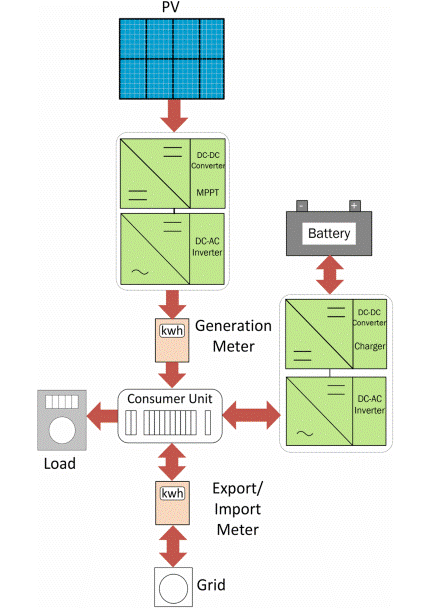
...Either way, the only logical place for an export meter is inline with the grid supply like this: So there's nothing I can conceive of that would make it necessary to place a battery inverter in the house rather than have it located on a sub-main in the garage. I'm still waiting for an answer to the question I posed to the company.
-
Maybe it's a confusion between generation and export metering. The old Feed-in Tariff scheme had this to say: I guess this must still apply to SEG. I can understand then how this might affect things but having a smart meter should get around this shouldn't it?
-
I only wish I was capable of doing the roof work to self-install as every other aspect is easily within my capabilities. The only contractors I can find that are geared-up for this kind of job are the usual MCS accredited types. Builders are just too busy to want this kind of work it seems and I'm not sure I'd trust any around here anyway. Now that's interesting, there must have been something that prompted this although it'd be a pretty bizarre stipulation given the highly variable arrangements of arrays and their inverters.
-
I think you were the one extolling the virtues of the Currentcost meter? I have a few homebrew current clamp meters but I've also got my original Scottish Power branded CC-128 metering the 100A incoming. Still going strong since 2009 although I did desolder the RJ45 and glue in an ESP8266 to relay the serial data to MQTT for logging. Handy that. A while ago the clamp packed up so I dismantled it and found the winding was open circuit. It all looked OK on the surface, but not being able to see the connection going into the middle of the coil I took a punt and broke away a corner of the former then pushed a header pin all the way in under the windings. To my delight this remade the connection and got it working again. As far as I can tell it didn't affect the calibration at all.
-
Yes, I asked for a costing with and without battery storage. The saving in VAT (5% vs 20%) makes it somewhat attractive to have it done during the PV installation. The statement "If the inverter is to be mounted in the garage with no separate connection to the mains / meter position, then your only option would be an AC coupled battery at the house end" doesn't make it clear if it means that if we wanted a battery system it would have to be the AC connected variety, located in the house - or that if we wanted a PV on the garage roof at all, then it would require us to have an AC coupled battery in the house! Electrically speaking, A DC coupled hybrid inverter would look no different on the AC side to a regular PV inverter so I'm unable to see how the statement could mean that the only type of battery system available to us is an AC coupled one in the house. On the other hand, if the meaning is that the only way we can have PV connected to the garage sub-main at all is by having a battery in the house then that'd be mighty mysterious. I've asked and am waiting for a reply, I'm just impatient and a little frustrated that I can't work out what's going on myself - i.e. am I missing something that should be obvious to me.
-
I've realised now that the generation meter is purely for personal interest. You can bet I'd meter the hell out of it!
-
I know, however if current can be fed into the cable from both ends then surely it's necessary to have a breaker at both feed points as a fault can occur anywhere along the length? Yes I'm talking to an MCS installer but as I mentioned above, they say it can only use the existing cable between the garage and the house if we have an AC coupled battery in the house. This makes no sense to me so I was trying to list the issues I knew about in case anyone could spot something I was missing. I would not buy something that I was being told I needed without understanding why I need it.
-
Ok, so no additional metering is required - just the supply companies smart meter. I'm just trying to figure out why a PV installer I've asked to set us up with a system has come back with this statement: That makes no sense to me at all.
-
I'm still scratching my head about the issue of connecting an inverter to the grid supply via a cable that already links a sub-main consumer unit in our garage to the consumer unit in the house that connects to the meter tails. The issues as I see them: Cable safety. The SWA cable joining the house and garage can be protected by having a 32A MCB at both ends. Overloads from either the grid supply or the inverter generation ends will disconnect the cable. Cable safety ✔️ Earth Leakage protection. All other circuits, i.e. those coming off the two consumer units have their own RCD protection. Current sourced either from the grid or inverter must be balanced through L and N. User safety ✔️ Over-voltage through generation. The 20m long 6mm2 SWA has a resistance 3.08mOhms/m so 0.123 in total. WIthout intermediate loads (loads connected to the garage consumer unit) the maximum current of 10A from the inverter (proposed 2.4kWp PV) would create a 1.23V rise at the output of the inverter. Safe levels of Over-voltage ✔️ The only other issue I can think of is how export metering might be affected. In this diagram from smartme.co.uk the meter sits in parallel with all house circuits so meters everything coming out of the PV whether consumed locally or fed into the grid. I'm a bit confused by this aspect. Perhaps someone can explain how the amount being exported is determined? My circuit diagram would look similar to the one below except for another consumer unit connected in parallel with the main one at the break between 'New AC installation' and 'Existing house AC installation'.
-
Glad it seems to be working. I have two of the first generation of RaspberryPi zero's configured as security cameras. Both need force_turbo enabled to make them stable. I don't recall having to do this with more recent iterations, inclding zerow versions.
-

Electric Boiler with Underfloor heating costing a fortune
Radian replied to Richvet's topic in Underfloor Heating
Looks like those wooden shelving inserts might give easy access if screwed into place.- 38 replies
-
- 1
-

-
- electric bolier
- boiler
- (and 2 more)
-
Electric Boiler with Underfloor heating costing a fortune
Radian replied to Richvet's topic in Underfloor Heating
If gas and ASHP are not an option I don't think you can do this without tackling the insulation. This will probably mean biting the bullet and removing the plasterboard to access the cold areas you've identified - unless you have enough space to give up to fitting interior wall insulation over the top. But this would need re-lining anyway so it would make more sense just to investigate gaining access and fitting insulation behind existing. Also, the loft area - is it accessible? How much insulation does it actually have? How long to you intend living there?- 38 replies
-
- 1
-
-
- electric bolier
- boiler
- (and 2 more)
-
Easier to read if you stick the url into an online json viewer like this one
-
Ah, so you're running that experiment... I'd be interested in what happens in various weather conditions.
-
What's the deal with the junkyard/desert just outside the walls of those places? I guess it's just because they're actually built in the desert. Seems pointless investing so much in such crummy surroundings.
-
They're somewhat variable from board to board. Maybe subtle differences in layout between issues? Anyway, been there, fixed that. I think that the instabilities are arising from dynamic changes in clock speed. This can be fixed by forcing on turbo mode by adding the following line to the /boot/config.txt file: force_turbo=1 Another tweak some people swear by is raising the default core voltage with: over_voltage=2 I think it's safe but unnecessary. YMMV
-
How does infrastructure get upgraded?
Radian replied to Radian's topic in General Self Build & DIY Discussion
BOC should be able to afford some serious PF correction if they're paying 1.5 times as much as they need to. I wonder where all their kVAR is going? BTW that spreadsheet is published in this Long Term Development Statement -
How does infrastructure get upgraded?
Radian replied to Radian's topic in General Self Build & DIY Discussion
Thanks @Carrerahill Good to see some actual numbers. I think its just where the transmission system connects to the distribution system, but no doubt it used to be fed from Fawley which is nearby. I found an SSEN spreadsheet which details current and future estimates for demand which is quite interesting. Weymouth's load forecast is shown as falling in 23/24 compared to 22/23. -
How does infrastructure get upgraded?
Radian replied to Radian's topic in General Self Build & DIY Discussion
The Construction Levy for this development will be something in the region of 3 million but that doesn't buy much road. It's about the market value for four detached properties around here. Can't see it bringing much in the way of improvements. I have no feel for the likely capacity of the network and the way consumer usage is modelled. I know there is this wonderful notion of "Diversity" in domestic electricity loading. No doubt a similar concept applies to the other services. The word salad glossary didn't help me at all e.g. "This is one of 4 scenarios from National Grid’s Future Energy Scenarios (FES). WPD create Distribution-FES (D-FES) and our scenarios align with National Grids Scenarios. The D-FES translates the national FES to a regional (licence area) level. The FES scenarios are used on the flexibility map to give a scenario based view into the future as to what flexibility services may be required in an area. Users can select the a scenarios they think are most likely to play out over time. " Words like Flexibility, Scenario, hint at things like adapting to change so I guess you're pointing me in the right direction here. As I type this I'm idly looking to a distant 400kV "L12" pylon coming in from the GSP at Nursling from the sofa in my garden room and wondering how much more current the two routes into Weymouth and Portland can take before another transmission line has to be constructed. Probably enough for another 300 houses, but 3000?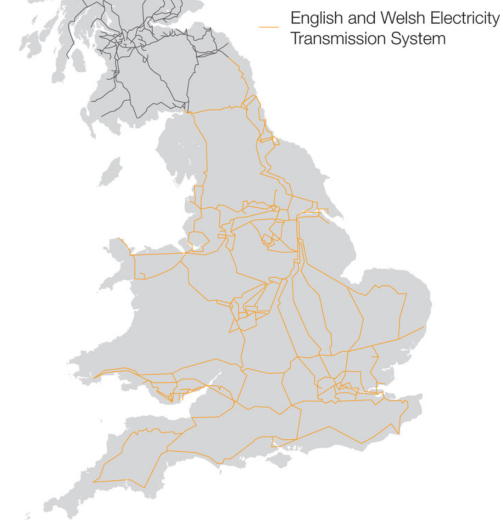
-
Too bad 3G about to be switched off ? LoRa is supposed to be workable to 10km (in ideal conditions) - that would be my preferred communication system. Even if the motor is 240V it could be powered by a 24V inverter connected to a 24V LifePo4 battery + charge controller + 250Wp PV module. Probably costing less than the drum of SWA.
-
You lot have prompted me to start a new topic how does infrastructure get upgraded. I'd be grateful for some insights into the nuts & bolts of how large developments get connected.
-
We live in a semi rural area half way between a town and a small village. On the other side of the narrow connecting road was nothing but farmer's fields. That's all changed now as a developer has started work on well over 300 new homes. How this ever got planning is beyond me as it fills a swathe of green fields with unbroken housing linking a town and a formerly outlying village. Whatever. But when we built our house there were a number of hurdles to overcome regarding the services, e.g. sewage which required us to install a pump to get up into the nearest connection. The electricity supply was also supposed to have caused a headache for the DNO. Gas was available but the line was constantly needing repair in the main road and has always seemed to me to be on its last legs. I can only describe the Water pressure as being unpredictable. Bearing all this in mind, I can't see how 300+ homes are going to get 'plumbed in' to our local infrastructure without detriment. This leaves me pondering on the practicalities for the developer - where do they 'tap in' to things like electricity? There must be a Higher Voltage cable in the road as there's a nearby substation with transformers for the nearby houses. I don't think there's room for more at this site and they claimed they were reaching maximum capacity 25 years ago. So will they get a new one built with transformers for their development? What about water? I've always been fascinated by the hidden world of underground services but now it's becoming more of a morbid fascination. What, if anything, should I watch out for as this development starts to go live?
-
Vdrop=I * R so from these tables Resistance per metre of copper conductors at 20°C Conductor cross-sectional area (mm²) Resistance per metre run (m ohms / m) 2.5 7.41 4.0 4.61 6.0 3.08 for 2.5mm2 cable the round trip would present a resistance of 1.4*7.41 = 10.37 Ohms and a therefore a volt-drop of 6*10.37 = 62.24V ditto 4.0mm2: 1.4*4.61 = 6.45 Ohms and a therefore a volt-drop of 6*10.37 = 38.72V ditto 6.0mm2: 1.4*3.08 = 4.31 Ohms and a therefore a volt-drop of 6*4.31 = 25.87V Starting current will probably be the issue. They seem to be happy with something in the region of 200V to get the motor started but you might be able to get them to tell you the minimum voltage. You should be able to see that for a 1A charger on 2.5mm2 you'd get a volt drop of 10.37V which would be fine for a battery charger.
-
Learning to live with mistakes. 5 Amp circuits
Radian replied to ToughButterCup's topic in Power Circuits
Poor @ToughButterCup who's still getting notifications about our digressions here ? The only hint you might get that the ring is incomplete is the nasty burning smell coming from a backbox. The last time it happened to me it was in the kitchen of our rental property. The tenant said there was a funny smell in the kitchen whenever they used their tumble dryer. But that was in the utility room next to the kitchen. The cable that was melting was around 5m away in an unused socket. The actual break was in an upstairs bedroom at the opposite side of the house. Could have been anywhere. In the name of safety we also get lovely bonded copper pipes in our bathrooms. Within two days of moving in I got a serious gash on by big toe from one of the wafer thin aluminium tabs. I've lost count of the times the safety device has been the cause of an accident.