
Radian
-
Posts
2586 -
Joined
-
Last visited
-
Days Won
15
Everything posted by Radian
-
Outdoors PLA lasts about a year in my bitter experience. Yours may do better as you painted it.
-

3M VHB Tape to affix Corten steel cladding
Radian replied to thefoxesmaltings's topic in General Self Build & DIY Discussion
I don't know if it's specified for you application but for a liquid adhesive you could test sikafast-2590 which is a fairly serious two-component super glue. Sika say It has gap filling properties up to 5 mm. I've not tried it myself but eyed it up for fixing some aluminium cladding to plywood. In the end I used Stixall and it worked a treat. -
I guess there's an opportunity to dispose of goods that can't be sold as new stock, with bits missing - perhaps I should be more adventureous. I often lament the idea of serviceable/easily repairable stuff going into a skip. This happened recently when I bought a signal generator on Amazon and it had an illuminated button that didn't light up. I knew it would be an easy repair but having just shelled out a couple of hundred quid for it I sent it back. Almost guaranteed it will end up as unnecessary E-waste.
-
Alternatives to silicone for fitting sinks
Radian replied to markocosic's topic in Kitchen Units & Worktops
Interesting. I'm a big fan of Stixall for fixing panels and skirtings etc. It has good grab and cures fast, and is over-paintable. I rarely use it as a sealant except when wiping down joins with a wet cloth. Never thought of using it in place of silicone for sealing between worktops or sanitary wares though. Is that a practical use? I've got some that's holding up ceiling coving that must be going on for over 10 years now - everything else I tried cracked apart but Stixall has the flexibility and adhesion to remain in place. -
That's great! I think we all have our own particular 'thresholds of pain' and for me it's around a couple of hundred quid - which it seems it has always been, which is odd now I come to think about it. It may be that my income has fallen in step with the half-life of money.
-
Phew that's a relief.😅 I was very tempted by the 5kW one when I went through their listings but I've got a rule about not buying anything over a couple of hundred quid on ebay. Maybe I'm too paranoid but the number of times ebay bargains have turned out to be useless in one way or another makes me just too suspicious.
-
Fluctuating mains voltage tripping Shelly 1PM relay (I think)
Radian replied to Russdl's topic in Electrics - Other
If it's right on the 3.5kW Sheely trip point, I'd want a 10% reduction in power to make it stick as a fix. That's about 10V drop across 0.75 Ohms, which at 13.3A is a dissipation of 133W. A length of mains cable dissipating that much heat wouldn't be pretty! You need a different solution like a contactor or SSR. -
Chances are you're gonna have to before you get a sensible answer... anyway, welcome to these forums 😃
-
I always enjoy watching Big Clive's teardowns. For your delight, here's a complete investigation of a Poundland LED: If you watch the video you'll see it uses the cheapest kind of 'driver' - not really a driver at all. Just a reactive capacitive voltage dropper (hence the PF of 0.5). This is most likely the sort found in the base of the filiament style LED's where space is at a premium. The problem with these is that the expected reactance of the capacitor Xc) only applies when fed with a full sine wave: Xc = 1/(2 π f C) which, In the case of the 6W poundland LED above, C=1.1uF so Xc= 1/(2 π 50 1.1e-6)=2894 Ohms This limits the current in the ~180V LED string to something like (240-180)/2894 = 20mA A conventional leading edge dimmer switches in the AC supply voltage by a variable time delay each cycle so rather than a smooth sine wave the capacitor sees part of a sine wave introduced with sudden sharp edges 100 times a second. The harmonics of this go way up so the f term in the reactance formula becomes much more complicated but essentially higher - hence the reactance decreases and the current increases. It's all very messy because at the same time the delayed peak voltage is reduced. The manufacturer simply slaps a non-dimmable label on the box so the problem goes away. Except when it doesn't. The other kind of "trailing edge" dimmer doesn't hit the capacitor with a sharp edge 100 times a second, but whips the voltage away at some point before each half cycle ends. This is less stressful on the circuit but still has harmonics that alter the reactance. One other relevant point is that capacitors can make audible noises as the charge flows in and out due to piezoelectric forces. The higher harmonics introduced by phase angle dimmers make this noise more apparent.
-
LOL that plot is the power usage of my fridge/freezers 😄
-
The problem with unheated workshops is that throughout the year there are times when the internal temperature is considerably below the outside temperature - unless it is deliberately ventilated (think slatted cow sheds). Then the relatively higher humidity of outside air condenses on relatively colder internal surfaces, tools etc. So yes, insulation can have a detrimental effect if it delays the two reaching equilibrium. I think you were initially considering the reverse of this situation - where internal warm/moist air would condense on cold surfaces on the other side of the insulation. This would be non-negotiable in a normal living space but for an outbuilding you can consider increasing ventilation all round. It's somewhat frustrating I'll agree. My own workshop is insulated and marginally heated by a dehumidifier and small electric convector. The dehumidifier is a compressor type that consumes around 250W and consequently raises the room temperature by a degree or two. Thus it serves two purposes. If I had to replace it I would get an electric Desiccant Dehumidifier which works better at cold temperatures but has the same positive heating effect. Even a marginally heated workshop is proving to be a luxury though so I'm looking at other options.
-
Shower pumps are typically activated by pressure drop - i.e. when shower valve is opened the decrease in water pressure in the pump body trips a switch that activates the motor. If your water supply pressure exceeds a certain amount then the pump might not run. Opening another tap or shower may reduce the overall pressure and allow the pump to run. I take it the hot feed is from a UVC and cold directly off the main? There must be a pressure regulator and gauge somewhere - what does it say?
-
That kind of 'fliament' LED bulb is often a bit crude in terms of the driver electronics inside the screw cap (note there's not much room down there). Despite being claimed to be dimmable I wouldn't put it on a dimmer. If it isn't on a dimmer then it's even cruder than the usual Chinesium offering.
-
Got to love the Journo that wrote that piece... Pedants hat on: Zero (Amps) times tens of thousands (Volts) equals zero (power). Very useful. In fact, there is some current just not very much. In the order of a few microamps. Maybe a milliwatt on a good day. Not to say that a static shock isn't potentially painful... When I was at my first job with the MOD I'd just fixed a load of component drawers to a brick wall in my lab. This was over a long lino-topped workbench and I'd let the brick dust from the fixing holes I'd drilled drop down onto the bench top. Being the clever ideas man that I still am, I pinched the caretakers hoover and lifted it onto the bench, climbed up and began hoovering. It worked like a charm until I got to the bit under a steel gantry just above my head. The first I knew of it my hair started to rise up then suddenly SNACK! As if the shock wasn't painful enough I recoiled and smacked by head on the steel. The Triboelectric effect taking place between the lino and hoover's rotating bristles taught me a lesson I'll never forget - leave the cleaning-up to others.
-
Distributed battery power banking
Radian replied to Radian's topic in Networks, AV, Security & Automation
Clearly an idiot. If I were to replace my 25 year old fridge and two freezers with up-to-date units it would potentially reduce their annual electricity consumption by about 66% saving around £200 each year. Substantial, but at current like-for-like replacement costs that's only going to break even after 10 years or so. Better, I think, to see them until the end of their natural life - or mine - whichever comes first. 👻 -
Working on reducing mains power by best use of PV (without batteries).
Radian commented on Marvin's blog entry in ASHP, MVHR, PV and EV combo
I'm wondering why you don't seem to be interested in battery storage? I can't think of many 5kW loads that would be present for hours on end when you're in peak generation season. -
RTFM and the interpret what you read correctly😁
Radian replied to BotusBuild's topic in Tools & Equipment
Odd that there was an unused terminal. Is that the OEM's connection block? Looks like it's bolted to a scrap of FR-4. -
Distributed battery power banking
Radian replied to Radian's topic in Networks, AV, Security & Automation
I suspect the biggest inefficiency is with heat transfer between the external condenser loops and the inside of the fridge. No easy way of increasing the insulation there I'm afraid. It would be fantastic if you could relocate the condenser somewhere useful e.g. laid flat on the floor under the kitchen cabinets, with a fan to provide a kick-panel heater in the winter. -
Distributed battery power banking
Radian replied to Radian's topic in Networks, AV, Security & Automation
Fridge/freezers are certainly good candidates for solar PV as their consumption peaks on the hotter days. They can even be slightly delayed/advanced to 'bank' a certain amount of energy before the Ice cream gets too mushy/hard. The gains would probably be fairly marginal from this approach though. Over a 24 hour period my fridge/freezers typically consume 3kWh (units) costing roughly £300pa at present rates: (amusing how all the three units fall into sympathetic resonance despite being in separate kitchen cabinets) While I couldn't justify the expense of replacing them with inverter refrigerators, my current units are fairly close to the 2.4kWh target I've set here so yes, an "islanded" 240VAC inverter could work out.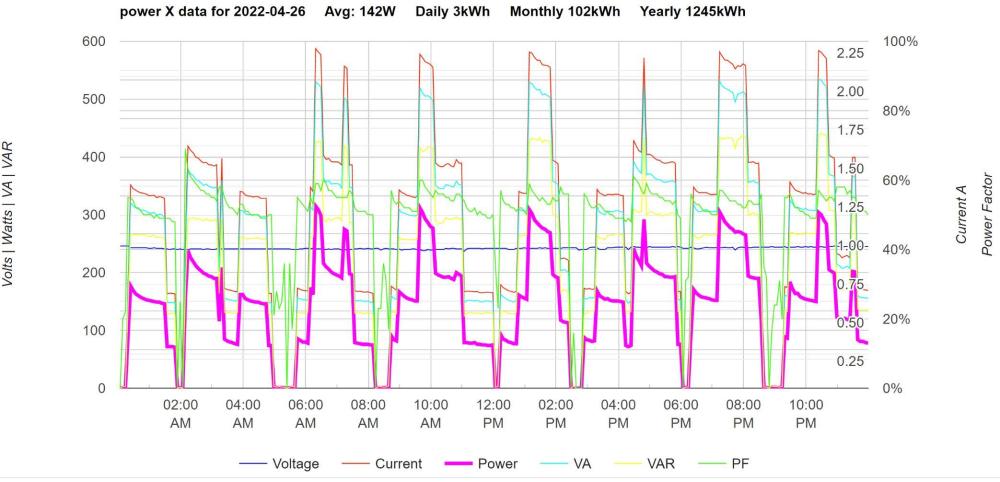
-
Distributed battery power banking
Radian replied to Radian's topic in Networks, AV, Security & Automation
Good point. Probably. Our LG direct drive washer dryer has a SMPSU delivering a number of DC rails (I know because I fixed it a few years ago). Unfortunately it uses 240VAC to heat the water (Oh for the days of hot & cold feeds) and the dryer element. The latter is crying out for some ducted hot air (AKA @Onoff's soda can contraption). -
Distributed battery power banking
Radian replied to Radian's topic in Networks, AV, Security & Automation
I jumped from owning a succession of Samsung Galaxy Notes when their prices got plain silly - to a Moto G Pro with a pen. Really impressed with the value for money. However, a whole house, wired ethernet backbone is non-negotiable for me. -
Similar to the concept of micro-inverters for solar PV, I've been thinking about micro-battery storage to time-shift self generation in a different way. I brought it up in this thread yesterday: @SteamyTea asked about the 200W target I have for a solar PV offline battery storage solution for distribution using Hi-PoE (IEEE 802.3bt). The devices I have in mind, which are powered 24/7, would be the four WiFi access points I use to give full coverage of house garage and garden - each averaging around 25W and powered by 12VDC. The other 100W is accounted for by a NAS, broadband modem and a significant number of WiFi equipped microcontrolers (ESP8266, ESP32) SBC's (Raspberry Pi cameras etc.) and assorted Amazon Echo devices all operating on 5VDC. There is also some scope for Laptop and phone charging. The idea would be to utilise four 50AH 12V LiFePo4 batteries each with their own floating 240VAC charger but wired in series to provide the 48V PoE supply. This provides 2.4kWh or up to 200W for 12 Hours for a capital outlay of £775, preferentially charged using excess solar PV. This bucks around £0.70 imported power per day with full payback after approx. 3 years. Not accounted for is the hardware required to interface non PoE Powered Devices (PD) but this is an area generally covered by inexpensive off-the-shelf solutions and a little electronic tinkering. Apart from the obvious advantages of having uninterruptable power for all the key networked components, the reason for going down this route is that I can't make a case for an off-the-shelf grid-tied battery system in terms of ROI. And such a system would require additional expensive integration components to make it work offline. If every 240VAC load in the house had to be catered for, the capacity required would be more in the region or 10kWh. On the other hand, all the networked devices represent a distinct group of things that are permanently sucking power and already connected to pre-wired infrastructure in the house and outbuildings. And I can just about afford the outlay! If successful, I would also consider extending this principle to another targeted load - lighting. As the house lighting circuits are relatively easy to isolate and populated exclusively with LED's which will typically operate from 80V~240V (AC or DC as it happens) there is an opportunity to do some more time-shifting with relatively small batteries. Again, 2.4kWh or 20 x 10W Lamps for 12 hours seems to be in the right ball-park. The same ROI argument makes this seem like a no-brainer to me.
-
Already been cracked
-
Anyone identify this door handle manufacturer?
Radian replied to Bemak's topic in Doors & Door Frames
The pentagram is there to ward off evil spirits. Very thoughtful of the manufacturer! Seriously though, I bet you ggogled it too and came up with the same superstitious nonsense that I did. -
Couldn't have been tied down too well! The thought of panels flying through the air is going to give me nightmares now.