


mvincentd
-
Posts
495 -
Joined
-
Last visited
-
Days Won
1
Everything posted by mvincentd
-
interior finishes - board marked concrete?
mvincentd replied to Tom's topic in Insulated Concrete Formwork (ICF)
I'd think a simplistic comparison would show icf as cheaper, but an 'all things considered' project specific comparison might provide a different answer. -
interior finishes - board marked concrete?
mvincentd replied to Tom's topic in Insulated Concrete Formwork (ICF)
With single sided icf like this I think you'd be in a world of pain trying to modify it to get board marked finish.....you're buying the jointing web structure but would have to deconstruct it totally to get the boards in, and the boards won't substitute the ply, you'll need to fix the boards to the ply. Compared to the pre formed 'decorative' boards people have linked to I don't see you saving money.....just being subject to a more risky hit and miss result. I would say if you skip icf and end up doing shuttered concrete, don't be deterred from board finish on its expensive reputation. Materials are cheap, just rough sawn timber (which will mostly be re-useable), nails and wax. It's labour intensive but totally unskilled. Having witnessed every moment of the process on mine i'd say he absolutely wants a specialist reinforced concrete contractor...there's plenty of them.....i'd certainly recommend mine if he's in range (dorset or bordering). My board finish; My fair faced ply finish; -
I'm using Protec.......they are pleasingly 'undemanding' in that they agreed to let my independent bldg regs inspector also cover their warranty inspections (they weren't previously associated, I just said this is what i want to happen and this is how you get my business), and they have pretty much left it to him to determine what the appropriate stages of inspection are. I do however question the 'insurance' value of the policy in that so many elements rely on the installers guarantee anyway.
-
Building into a sloping site. Methods and details.
mvincentd replied to Dee J's topic in General Self Build & DIY Discussion
I'm building very much like the scenario you outline. Too early to say if my approach will have been a good one. There's a fair chance your average architect, detailer, building control officer and builder won't have encountered many of the details and as a result those details will potentially take considerable effort to work out. It depends on your own mindset, skillset and time involvement but i'd caution against getting working drawings from anyone who hasn't 'built this before'. I've had to trouble shoot my drawings every inch of the way and thats been incredibly wearing and expensive. Your structural engineer will end up as a major factor...dont penny pinch and find one you can get a good rapport with and involve him very early. The size of your house relative to the plot may be a big factor in ease of build-ability and cost on a sunken house in a sloping site and will also potentially dictate some of your 'chosen' building methods. Don't expect it to be cheap. Someone here a few weeks ago already mentioned Charlie Luxtons current personal project; https://www.youtube.com/watch?v=-hiRazqQFrU&list=PLwMzOUIf2_b6FIG18FbvgQZUrBMxOsO_r -
So your architect who recommended this builder should in his role of Principle Designer be advising you not to let this contractor on site until you've received his RAMS with sufficient time to review it. I'll bet if the builder can't manage time to do the contract he hasn't done RAMS, so maybe use the architect to insist on all relevant paperwork...including contract...after all how can the RAMS be correct if it isn't referring to whats contracted. Real world...over and above whether paperwork is present and in order, trust your instincts.....if this builder is being dismissive of you before he's already started how well are you going to communicate throughout the build.
-
I'm in NDDC territory. It was noted at last nights parish council meeting that a monthly planning meeting had been cancelled for the 4th time in a row and they are thought as a department to be busy/disorganised in the background. We had a known and proven 'sticky' planning officer, best not name names here. You can't phone questions in easily.....email them...to be fair I found response time ok to these. Nice house, good luck.
-
As far as I understand it up until a few years ago the concrete alone might have been deemed waterproof enough......but then damp leaky basements were the norm too. its all a risk tolerance thing really. If you were to need to fix ICF how would you even trace the point to fix? Your fix could end up being a cavity drain (possibly same with most systems....blocks, rc, whatever). Not needing a guarantee is a big help......so long as you really don't.
-
Precisely this...ok out of the ground maybe but in a basement situated such that there's 1 chance only, i got scared off icf. Gutted about it, would have loved to build with it instead of handing over such a large part of my build to a specialist...spoilt some of the dream. Look into how you'll get a waterproof guarantee on icf basement, that's actually a guarantee worth having, without installing a cavity drain inside (my quotes for this alone were circa £25k)
-
I did the Nudura 1 day course and wanted to build with it. At that time the SE prelim drawings specced 200mm thick walls with modest rebar content. ....but things escalate and I end up with wall thicknesses ranging between 225 & 350mm plus a maze of steel. Nudura do vibrate, Polarwall seemingly not. I struggle to understand how the icf companies determine those differing approaches, particularly where waterproof additive is involved....Sika for example will turn up unannounced to check a pour and would likely not issue their guarantee on wp concrete if it wasn't properly vibrated. Anyway, my point is that it's another complexity to choosing icf....can the final specced design accommodate (i.e. literally fit) a poker. If concrete needs vibrating, you don't want to not have the process achieve its purpose.
-
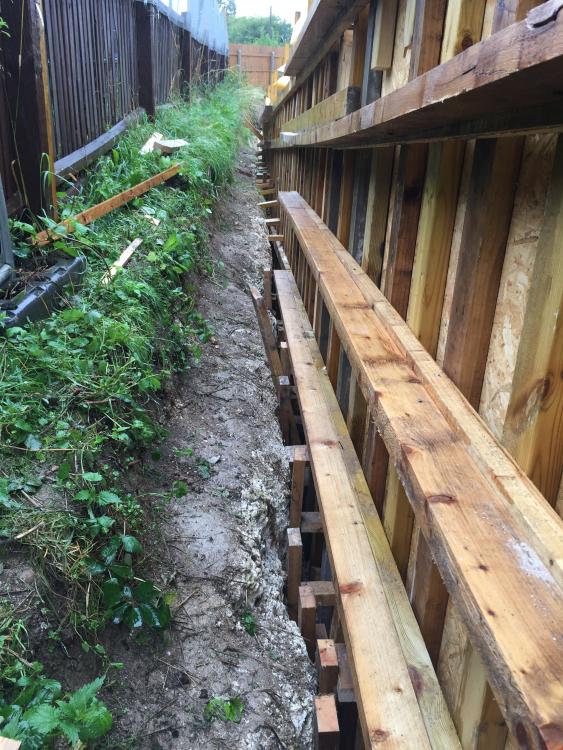
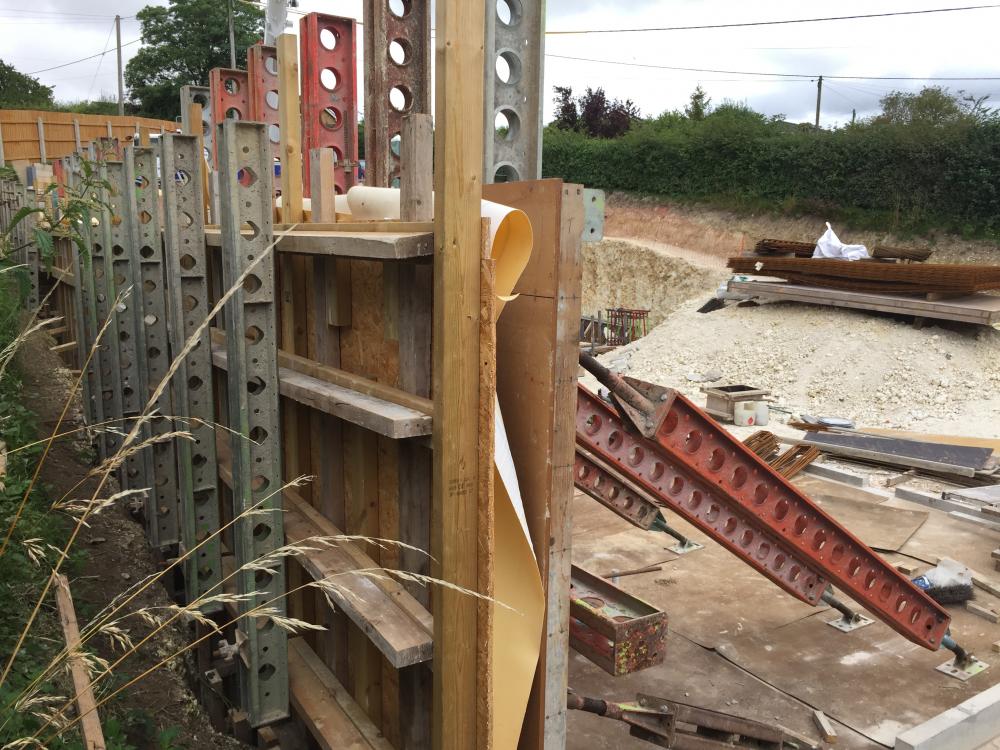
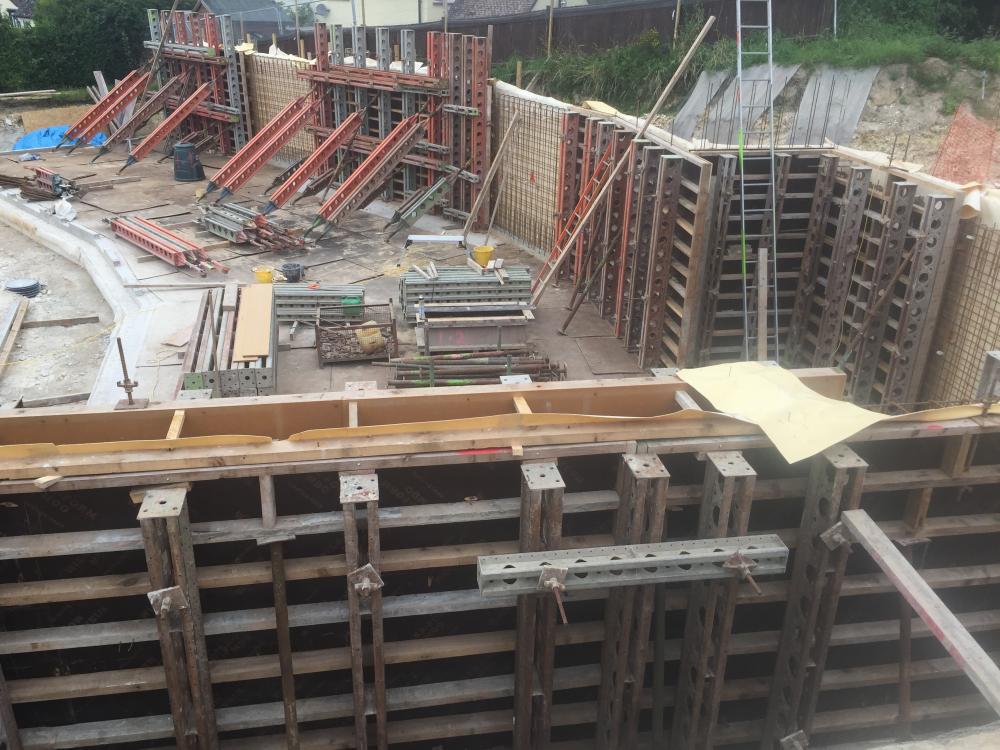
As Bitpite suggests, do not underestimate the complexity of shuttering and the heavy duty-ness of it. Part of my construction was 'single-sided' shuttering.....in other words too near a boundary for them to be able to form their usual shuttering so I had to create a sacrificial face to cast against. I used 18mm osb on vertical 4x2's which i concreted into the ground....then I added horizontal 4x2's...then i chocked it against the chalk face with more wood...and added more bracing where I could. The rc guys just laughed...well, rolled their eyes. When we'd done all we could with wood they added metal soldiers to tie my rear shutter to their front shutter....then they added huge diagonal push-pulls so they could wind the whole structure back during the pour to keep it vertical. Their front shutters are also held in place by captive bolts that were cast into the kicker along with the slab...helping to fight the lifting forces that the poured concrete exert on the shuttering. This is the tip of the iceberg as far as the complexity and intricacy of the shuttering work goes. They were on a fixed price...i don't think they'd do all this stuff if it wasn't necessary. One of my vertical 4x2's still snapped during the pour, thankfully to no significant effect.
-
I wouldn't step in the door at TP without an account. I have a cash account ...easy to set up....prices stated on shelf reduce by typically 50%. Absurd approach. That said, I find they're still rarely the cheapest.
-
Absolutely agree...but the illustration suggests the tap is merely dripping...so assuming we don't have 'depends on flow rate' as a get out from answering the question, I believe it's F.
-
Perhaps I was just lucky with a very nice guy at OR who handed me both ducting and cable free but the impression I got was that they actively wanted me to pull the cable...less work for them.
-
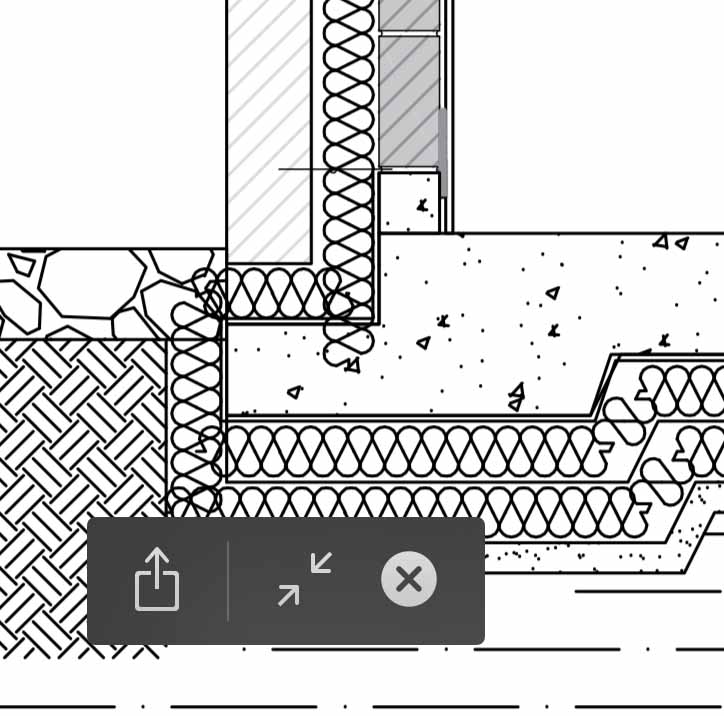
@TerryE that's v interesting...in essence you had the same problem that i've got and it was while searching for info on how bad the thermal bridge's effect was that I found the article I posted. Did you consider Marmox thermoblocks but favoured Foamglass.....if so what reason? I had the detail below, where flint block external skin bears onto xps300. No precedent can be found for it though so BC don't like it, even though the xps manufacturer 'imagines it would work'. So now instead of that piece of 100mm xps there'll be a Marmox thermoblock followed by a 'customised' coursing flint block to bring internal/external skins into level line. I just wish we'd arrived at this before pouring the slab so at least we could have modified the height of the cast upstand to aid coursing. So my next problem is just as yours was.......bringing the doors and windows (all mine are floor to ceiling) forward to sit mid cavity ...I haven't gotten so far yet as to solve their currently 'levitating' condition.
-
Time short so might have misunderstood but; With your drawings do you have one or two entitled 'structural notes' maybe....which might have a section on 'steelwork', subsection 'connections'. Mine say for example; "All connections to comprise 4 no' m20 (8.8) bolts unless noted otherwise". Then on my plans it'll just say "steel beam to be face fixed to concrete"....otherwise they're sitting in beam pockets which have individual detailed drawings for how they're cast.
-
Sealer for power floated finished floor surface
mvincentd replied to mvincentd's topic in Floor Structures
heh...sadly i won't have a housekeeper so i'll keep looking for a more low maintenance solution Lizzie -
Sorry....penetrations in vertical walls (hmm, what other kind of walls are there!)
-
Just stumbled on this...maybe it's old news here but figured it might fuel some thoughts. http://www.realreview.ie/architecture/2016/04/thermal-bridging/
-
Thanks Bitpipe. According to my RC guys they'd avoid vertical wall penetrations if a viable alternative existed but are happy with Stopaq type solutions so long as cables are centred in the sleeves and singular rather than massed in a bundle, so the stopaq can get fully around.
-
https://www.ournetwork.openreach.co.uk/property-developers/site-registration.aspx - a new site that will be built in one phase I seem to remember phoning them after submitting online to confirm it was right as it does feel a rather 'non-domestic' process. They acknowledge that,.. just plough through it and tidy up any facts by phone later once you've been given a human contact.
-
My experience was that with the sole exception of MBC (and eventually Beattie) all timber frame companies ultimately failed to quote, I believe because a development still pending planning permission didn't represent a serious enough prospect for them to spend time quoting....they were that busy. Certainly i'd approach them outside of any major self-build show when they're 'snowed under' with casual enquiries....too likely you get tarred with the same brush.
-
I've just arranged mine to come 3 metres across public land into the corner of my plot then 7 metres along a trench i dug to a meter box I installed into a boundary wall, which is 10 metres across the drive from my house. £437 (my drive will be just about my most convenient thing to dig up if ever that was needed in future) My understanding is that the gas must come out of the ground prior to entering the house. Combined telecom and electric pole just outside boundary at same corner of plot, so same treatment for those. Registered my development with open reach...recieved a letter with phone number of survey officer, he couldn't be more helpful, supplied duct and cable free. I haven't yet contracted for a connection in any way or paid anything. My understanding is that the telecom wire must come out of the ground prior to entering the house. Electric connection £428+vat My understanding is that it's optional for me to stay underground and duct straight into my basement utility room. (my £4500 water connection enters plot next to the meter cabinets and will join the same trench under driveway. My understanding is that it's optional for me to stay underground and duct straight into my basement, or insulate the rising pipe out of the ground against the house external wall.) Did you make any service penetrations underground to your basement plant room? I'm weighing this against trying to keep the house exterior 'tidy'.


-
Anyone with actual experience of a specific product and it's final aesthetic appearance ? Most blurb seems to describe sealers at a functional level but don't support that with much info or illustration of the final aesthetic.....fine for in the garage but i'd like to be a little more sure in the house. Clearly some test patches make sense but if anyone can narrow the field down a bit i'd be grateful. I'm looking to make a power floated structural slab (but has some areas that have had light diamond grinding) resilient to domestic spills and stains, without particularly altering the natural appearance of the concrete, and keeping it towards matt rather than shiny.....and not using a topical sealer that needs re-doing every year or so. I believe I need a penetrating sealer and possibly a siliconate one would be a good option at a practical level ....Siliconates – This sealer has medium-sized particles that form an internal cross-linked membrane which greatly reduces porosity. It provides excellent water and oil resistance, has a long life span and doesn’t enhance color. .....or maybe a Hybrid – These sealers are combinations of penetrating sealers and/or other resins (acrylic) designed to provide a specific type of protection or substrate enhancement. A common hybrid would be a silane/siloxane blend to take advantage of the properties of both materials. Penetrating sealers that enhance color are usually blends of penetrating molecules and resins like acrylic. Anyone used anything?
-
I've got 97 x 373 posijoists at 400 centres clear spanning 6.7m to support a 'biodiverse' flat green roof which is at ground level with earth banked up around the sides. This is still only sufficient to rate it as a roof as opposed to a full-on amenity space to hold a rave on. (rave...do they still have those?)
-
Great programme. Might be wrong but don't think i heard him say he was using waterproof concrete...in which case the 'dual' element the swelling layer provides might be important from a structural warranty perspective if nothing else. It looks like good stuff....I think he was being a little bit 'TV drama' regarding fear of wet weather as the swelling layer was face down (and the data sheet says it can be laid in damp conditions), although i'm sure i'd be just as jumpy....I used a similarish Sikaproof product and the jointing tape had to be kept dry before and during application.... it is crazy sticky. I look forward to seeing how he's choosing to waterproof the Stepoc walls. They look like a back breaking version of icf with the same inherent problem that he never gets to see the concrete he poured....which concerns me in a "one chance only" backfilled waterproof retaining wall scenario. I'm inspired to look at it though for a garden wall scenario that was about to cost £10k in shuttered RC.



