

.jpg.c21f3ac78c9b7efd90cbdcb312744dc5.jpg)
jack
-
Posts
7352 -
Joined
-
Last visited
-
Days Won
38
Everything posted by jack
-
.jpg.c21f3ac78c9b7efd90cbdcb312744dc5.thumb.jpg.7adcad4c0e384f5ecd7d56b0618df6e5.jpg) I believe @Bored Shopper and a couple of others (@joe90 maybe?) have used one of the specialist DIY VAT reclaim services and had good results. Not expensive, from memory.
I believe @Bored Shopper and a couple of others (@joe90 maybe?) have used one of the specialist DIY VAT reclaim services and had good results. Not expensive, from memory. -
Also, if you supply materials, you're responsible for replacing them if something goes wrong. I have no issues with people marking up if they're expected to be responsible for them. Even if they can get a refund from their supplier, any parts failure will need time to rectify/replace that they won't be able to get back.
-
Also, a lot of trades aren't sourcing stuff weeks or even days in advance. I regularly witnessed trades finishing one job, then having to go out in the middle of the day and buy stuff to start the next. Had they thought ahead, they could have grabbed stuff on their way in rather than making another trip, or even ordered online and gotten it cheaper, but they didn't seem fussed. I assume they also get stuff cheaper from the big builders' merchants than anyone walking off the street would manage. I used to get frustrated about always having to ring all three of the local BMs for pricing every time we wanted something in a hurry. It seemed completely random who'd give us the best price on any particular item, and the difference was often 20-30%, even though we had accounts with them all. At least with online you got to see exactly what brands are in stock, and get clear upfront pricing.
-
Luxaflex Blinds for Tilt and Turn Windows
jack replied to canalsiderenovation's topic in Windows & Glazing
South East. It's fine, it's just good to have another option to look at. I can install them myself if need be. -
Luxaflex Blinds for Tilt and Turn Windows
jack replied to canalsiderenovation's topic in Windows & Glazing
Curtains are another option we're considering, although blinds seem a neater option. I couldn't immediately see which Luxaflex model/type you have on the Love Your Blinds or Luxaflex websites. Are they from the Duette range? -
Luxaflex Blinds for Tilt and Turn Windows
jack replied to canalsiderenovation's topic in Windows & Glazing
We're having that issue at the moment. I'm thinking about getting these for my son's east-facing bedroom. Even though we have external blinds, some light does get through the cracks, and he ends up waking up early than would otherwise be the case. I think something like this would block nearly all of that leaked light. -
Luxaflex Blinds for Tilt and Turn Windows
jack replied to canalsiderenovation's topic in Windows & Glazing
Very interesting, thanks for sharing. I don't recall seeing these in my searches for blinds options last year. How do you find the blockout blinds? Are they close to 100% light blocking? -
Solar PV + Tesla Powerwall (or storage battery)
jack replied to magutosh's topic in Photovoltaics (PV)
Very interesting, thanks. It'll also be good to see how you go across the whole of the year, including the colder months when insolation is so much lower. Do report back! -
When all you have is a hammer, everything...
-
New heating for terraced house in London
jack replied to Ferdinand's topic in Central Heating (Radiators)
Ditto. I can hear mine when I stand next to it, but only if it's heating DHW. It's a very unobtrusive sound, too, like the very faint murmur of distant road noise. If it's just doing background heating, I need to basically stand in the airflow to hear it at all. Subjectively, I'd say it's less than half the volume of my neighbour's gas boiler flue (and that's also a much more annoying sound). TBF, my unit is only 5kW, and I suspect larger capacity units are noisier, but I don't recall ever hearing the 15kW unit sited down the side of my in-laws' house.- 42 replies
-
- 1
-

-
- terraced house
- london
- (and 1 more)
-
Architect plans - opinions welcome
jack replied to deancatherine09's topic in New House & Self Build Design
You've ended up with something that is remarkably close to the layout we have, although yours addresses a couple of the specific problems we've found with ours. I like the position of the stairs - ours are in the hallway, and we decided a couple of years ago that we should have done exactly what you've done here. We even initially had a void at the front door as you have, but we ended up moving it above the dining area instead (our dining area and kitchen are swapped compared to yours). It looks nice enough, but in our case makes it impossible to acoustically separate upstairs and downstairs. Massively agree with this. We can't close off parts of the house from each other very well at the moment, which is a bit of a pain if kids are trying to watch a movie in the living room while, e.g., adults are talking in the kitchen. -
Adding Value and Discerning Buyers
jack replied to MattSu's topic in General Self Build & DIY Discussion
Not surprising to me at all. I think self-builders are as reflexively conservative as the population as a whole. As for valuing design, have you seen the typical attitude to architects on this forum? Personally, the whole country cottage aesthetic doesn't work for me. I'd pay a small premium for better design and a contemporary look, or go for something slightly more compact for the same price. -
Adding Value and Discerning Buyers
jack replied to MattSu's topic in General Self Build & DIY Discussion
As you say, that's quite a quirky example. They aren't all like that, nor am I suggesting that any developer should consider going that niche. I don't know the area. What would £3m quid buy you in a more conventional house of the same size on the same land? -
Adding Value and Discerning Buyers
jack replied to MattSu's topic in General Self Build & DIY Discussion
I don't know about how long things hang around for, but I assume he wouldn't have much of a business if sellers would do as well going through a regular estate agent and selling for the same price as a similar sized Barrett box down the road. Business appears to be going well. I agree those aspects should be the primary focus (although in this case, many of them are already fixed, given the OP appears to be at the outline planning stage). I was focused solely on the "modern" appearance aspect. The OP also needs to take into account the fact that although some will pay a premium for things like polished concrete and zinc roofing, those finishes are a lot more expensive than standard floor coverings and roof tiles. Whether the premium is enough to cover those extra costs needs serious consideration. I suspect it might work out in places with higher property prices, as the extra costs are a smaller proportion of the final property value, but less so in rural. There are no doubt areas in which you can get a more modern look without spending a lot more. I doubt whether "sustainable" things will have any positive impact on price, because most people have no idea how to value them. A classic issue would be spending more on insulation to reduce heating bills by, say, £1000 a year, and having potential buyers value that extra cost at zero. -
Adding Value and Discerning Buyers
jack replied to MattSu's topic in General Self Build & DIY Discussion
Maybe, maybe not. A friend of mine is a co-owner of themordernhouse.com, an estate agency specialising in architecturally designed houses operating across the UK and western Europe. We spoke to him when considering how modern to make the exterior of our house (we live in a very conservative suburb, adjacent a conservation area full of large 1930s houses). His take was that a modern-looking house will alienate a proportion of the potential purchasers, for sure, but there's a small minority who will pay a premium. The more modern and "architectural", the smaller the pool of potential buyers, but the more that minority will be willing to pay. Obviously this assumes you haven't built something whacky or completely idiosynchratic. -
Search the site for "sunamp". There are a LOT of discussions about it!
-
Trying to buy some birch plywood at the moment for a project. Half of the online places are out of the thicknesses I need. It also seems very expensive, but to be fair, it always seems very expensive!
-
It seems they're Lithuanian. Quite a range of products on their website, and it looks like they've been doing this for a while.
-
You can buy or hire powered rotating sieves: https://www.screwfix.com/p/scheppach-rs350-automatic-rotary-soil-sieve/3213k I hemmed and hawed about this (we have sandy soil with lots of pebbles) and curse the day I ultimately decided it was too much effort. Just last week I was pulling dandelions out of the lawn, and two thirds of the time I had to contend with stones in the way. Edited to add: just saw 1500m2 - that's a LOT of area to process. Any reason not to get the farmer's tractor involved?
-
It isn't a nonsense term, its meaning is perfectly clear and precise to people working within the industry. There's more to something being nonsense or unclear than you not being familiar with it. Because the word converter is already in use within the same field. An inverter is one type of power converter.
-
I suppose that's possible, although I also have upward-terminated EPS ducts on the cold side, and I've never noticed any condensation in them. In general, if it's cold enough for condensation, it's usually fairly dry, but I suppose if it's cold and humid (eg, when it's raining) it could potentially be an issue. I just haven't seen any evidence of it in my own installation. I haven't noticed any issues, although to be fair, it was so rarely we had the problem that I wouldn't want to read to much into that!
-
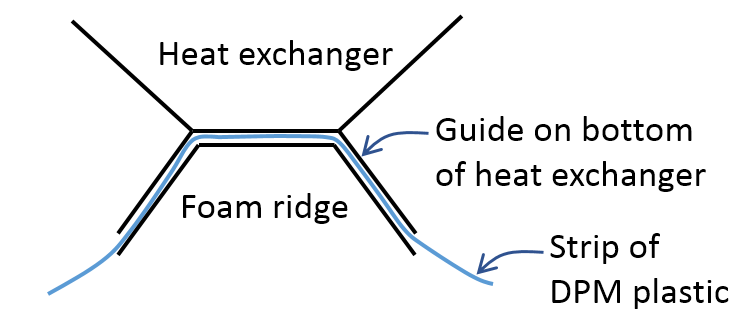
Thinner than that. I think mine was some leftover DPM plastic, so quite flexible. Mine is something like this: The strip extends a bit longer at both ends of the guide, and is bent up so nothing can drip off the end.
-
7-12 relates to the size (basically the range of gaps widths its designed for, I believe). You choose the size to suit the specific gaps that need sealing.
-
I think there's design flaw with these Brink units. Mine has the same issue with standing water in a non-draining area. There's some discussion here: The solution for me was to fit a strip of flexible plastic between the inverted channel on the heat exchanger and the foam ridge that it slides onto. The edge of the plastic extends past the foam, which kicks any condensation out away from the foam itself. That stops it trickling down the foam and tracking to the undrained area. Brink must be aware of this issue, as they send someone out to fix it over three years after installation. Their fix involved aluminium tape, and basically ripped off the first time I removed the heat exchanger! As for your mould issue, once mould gets into this foam, I suspect it's going to be hard to kill off. I think a few rounds of scrupulous cleaning coupled with the application of some anti-mould compound (gel bleach perhaps?) might work?
-
The sun, our Eddi and my SunAmp: keepin' me guessin'
jack replied to ToughButterCup's topic in Energy Storage
The way phase change materials (PCMs) work is that they start as a solid below a transition temperature. Heat gets added and the temperature rises until it reaches the transition temperature (note that there's really a temperature transition range, partly due to material properties and partly due to imperfect heat transfer within the material). At that point, extra heat energy no longer raises the temperature, but instead goes into changing the phase from solid to liquid. In general, this phase change takes a lot of energy. That's why a relatively small volume of PCM can store a lot more accessible energy than can be achieved by heating something like water while it stays within its liquid phase. Once the PCM has all been converted to liquid, adding further energy will start to increase the temperature. At some point, the PCM's maximum operating temperature is reached, and no more energy can be added. One difficulty with PCMs is that you can't determine from temperature alone how much energy it's storing when it's at its transition temperature. With water, if you know the temperature, you can estimate how much hot water you have. With PCMs, once you reach the transition temperature, there's no significant temperature change until the PCM has all liquefied. This means that if the temperature is below or above the transition temperature, you can estimate total energy based on temperature, but you're somewhat in the dark while at the transition zone. Estimating the energy while the PCM is at the transition temperature is what's been discussed above. However, once you go above the transition temperature, you can again determine how "full" the energy store is. So if your Sunamp was completely full, then used a small amount of energy, that would have resulted in a temperature change that the Sunamp controller can interpret as meaning that capacity again exists. So the Sunamp knows when it's full, and in theory knows (or could know) how much capacity it has left as long as its PCM temperature is above the transition temperature. It's when it's at the transition temperature that it's ignorant of how much energy it's actually storing. Of course, the vast majority of the energy stored by the Sunamp is available at the transition temperature, so the ability to determine energy capacity based solely on temperature (beyond "nearly full" or "nearly empty") doesn't exist. I'm completely ignorant of how Sunamp actually program their controllers, but something like the above could be happening in terms of allowing the immersion diverter to operate even if only a small amount of power has been taken from the store from when it was full.
