


Mike
-
Posts
1565 -
Joined
-
Last visited
-
Days Won
9
Everything posted by Mike
-
An introduction... Renovation + 1950s + subsidence = a challenge!
Mike replied to alfaTom's topic in Introduce Yourself
Please do :) It's good to have an update and to see what you've been up to! -
Mvhr funny noises and dripping
Mike replied to Pocster's topic in Mechanical Ventilation with Heat Recovery (MVHR)
I can't help with that system, but: Condensation should only form on the exhaust ("to atmosphere") side. In winter, warm moist air from the house is being chilled by the incoming air, so the air will no longer be able to hold as much water, causing condensation if the temperature drops enough. If a unit isn't built with good enough insulation between the supply and exhaust sides, or if it allows air to leak from one side to the other to any great extent, then theoretically condensation could form on the wrong side. I've not heard of that happening though, and it would be surprising if that happened only after 3 years of use. Unless the heat exchanger has been removed and hasn't been seated correctly afterwards? You definitely don't want two drainage points; that would be a route for air to leak between the intake and the exhaust. -
Unlikely, and whatever happens the price is likely to go up considerably. It's already gone up in France this year due to the number of gas users quitting the network as electrification kicks in - see https://forum.buildhub.org.uk/topic/37232-gas-network-price-rises-heading-to-the-uk-eventually - and that's only going to accelerate. That's without the cost of upgrading the gas grid to take hydrogen - pipe pressures will have to be increased to compensate for the difference in molecular weight, needing new pumps, and appliances and network equipment have to be upgraded to stop the smaller hydrogen molecules escaping. Then you have the cost of generating the hydrogen. Replacing methane with hydrogen in the pipe seems to be either wishful thinking by the gas industry at best or, being more cynical, a deliberate ploy by them to hamper Government decision-making, prolong the use of natural gas and delay electrification.
-
We need a chemist: Portland cement and Lime.
Mike replied to SteamyTea's topic in Research Resources
If you're using lime mortar it's sensible to plaster with lime too, so both layers share similar properties in terms of movement & vapour transmission. One thing not often mentioned is to think about when you schedule the work - it's going to be easier to work with the seasons, at least outside. Stone-laying season for medieval stonemasons was apparently between Lady Day (25 March) & Michaelmas (29 September); the rest of the year was spent cutting stone for the next season. You don't need to go that far, but something to be think about. -
What type of pump do plumbers use to pump out water from a pipe?
Mike replied to Adsibob's topic in General Plumbing
Provided you're pumping water, not sucking air, then a a Gardena Drill Pump is very effective - Available from Amazon & probably elsewhere. -
Swift boxes and other ecological architectural "enhancements"
Mike replied to Lincolnshire Ian's topic in Planning Permission
Schwegler - https://www.schwegler-natur.de/vogelschutz/?lang=en - do a good range too, though I'm not sure if they still have retailers in the UK. -
The Plans, version 2.
Mike commented on TheMitchells's blog entry in Renovation of Ellesmere Bungalow.
Probably too late now, but at some point this year Johnson & Starley were due to produce a new version of the Aquair 'Heat Interface Unit' to allow a heat pump to supply warm air via the ducts used by those central storage heaters. -
We need a chemist: Portland cement and Lime.
Mike replied to SteamyTea's topic in Research Resources
I'm not a chemist either, but it's also a matter of internal structure and physical properties, not just chemistry. For a good summary, see Lime mortars for the conservation of historic buildings, 2002, by Kerstin Elert, Carlos Rodriguez-Navarro, Eduardo Sebastian Pardo, Eric Hansen and Olga Cazalla . It's available to download (in Englsh) from the French Laboratoire de recherche des monuments historiques here . To pick out one section in particular: ...the unfavourable properties of Portland cement mortars [include] brittleness, high strength, and a thermal expansion coefficient which can be twice as large as that of lime mortars and most types of brick and stone. Its low porosity, and especially the large amount of small pores, might hinder water movement in masonry and cause damage due to the accumulation of moisture behind cement layers or to evaporation and deposition of salts in adjacent stones or bricks. Moreover, soluble salts such as calcium sulphates and sodium salts might be present in Portland cement mortar, which can leach out over time. Lime mortar, on the other hand, has a low efflorescence potential due to its relatively high chemical purity. Additionally, it has the advantage of allowing limited movement within the mortar joints and can undergo autogeneous healing due to dissolution and precipitation processes. Carrington and Swallow point out the importance of lime mortar being softer and more porous than masonry, acting as a sacrificial substrate where evaporation of water and associated decay from soluble salt crystallization could take place. Although the paper recommends aged lime putty for conservation use, I'd add that other forms of lime are more suitable in some cases. For example you wouldn't want to use lime putty on a damp background, where regularly exposed to heavy rain, or on hard stone; hydraulic limes would be suitable instead. As a rule of thumb, hydraulic limes (and NHL 3.5 in particular) also seem to be suitable for most buildings built within the last couple of hundred years, as well as being easier to use. Also not mentioned in that paper, the natural antibacterial and antifungal properties of lime can be beneficial in some circumstances - for example as a parge coat beneath natural insulation. It also doesn't mention that cracks in cement can facilitate water penetration (though, as above, it does mention that cracks in lime tend to self-heal). -
They're not that noisy - at least good ones aren't. If installed in a cupboard with a sound-resistant door + decent walls + either fixed onto something very solid or on anti-vibration mounts + with duct attenuators, you're unlikely to hear anything except, perhaps, on boost.
-
With an MVHR system you'd swap to a recirculating hood, so that would free up some more space 'top-right' for MVHR ducts - for example for the MVHR kitchen ceiling extract & the supply to the living room (so the right-hand side of the floor). Drop more ducts through the left-hand space and you're potentially able to connect up the rest of the 1st floor.
-
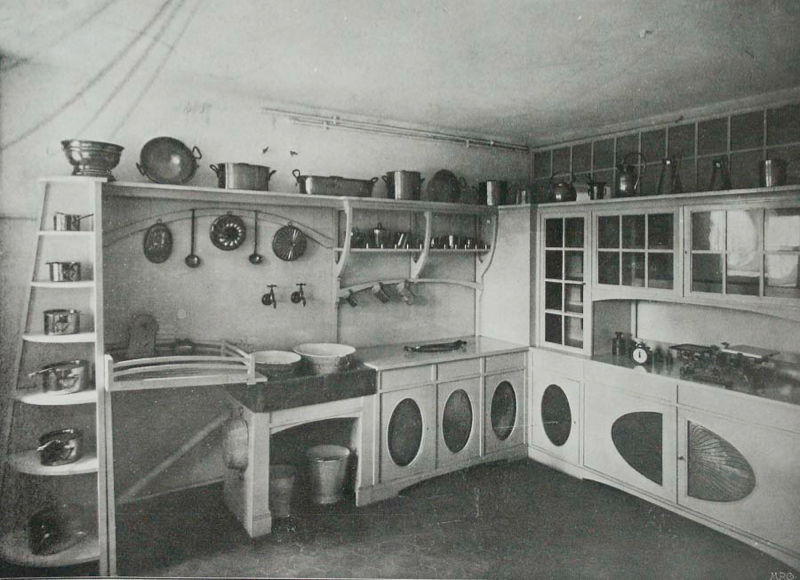
An interesting article and an era-defining kitchen, though most of the features mentioned - continuous countertops, built-in cabinets and drawers optimised for storage, a tiled splashback - are more-or present in Peter Behrens' 1901 Art Nouveau kitchen in Darmstadt:
-
Yes, there are at least a couple of people on here who've done that, to automatically boost the speed if a rise in humidity is detected. I'll be doing the same with my current part-installed system, plus manual boot. Zehnder have a good reputation, with good results in the Passivhaus database, and self install & self-commissioning is certainly possible - there are threads on here about those topics that will help. It's more about having a healthy internal air quality than cost saving, though there should be one. But how do you evaluate what things are worth? Is the cost of your windows / kitchen / bathroom suite worth it? It was worth it to me - I've installed Zehnder. More expensive units tend to use less electricity to operate, have better heat recovery, use better quality components, be better built and offer more features (fan adjustments, control options, more sophisticated summer bypass, etc.) If your budget will stretch far enough, then the above mentioned Passivhaus Database is a good place to look. Units there have been independently tested, are evaluated using a different (more accurate) formula for heat recovery than that used in the UK, and take into account electricity used to come up with an overall efficiency ratio.
-
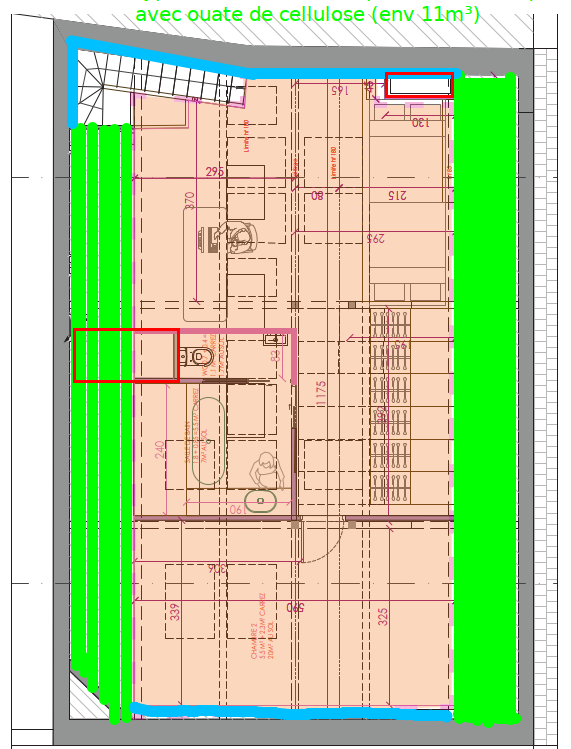
That's a very helpful report. I wouldn't want to quantify the difference, but I'd expect it to be substantial. It looks like you've made a good start! I'd guess the chimneys would be the weakest point afterwards due to their size, though you obviously have a good steer on them. So the chimneys seem to be at the foot of the drawing; not very helpful for the main intake & exhaust ducts if the garage is the MVHR location. I've marked in red a couple of spaces on the top floor plan - if those are (or could become) fairly unobstructed voids they could be useful duct routes - and the one on the left potentially another location for the MVHR unit and / or distribution manifolds.
-
@Garald Nudge me in a week's time and I'll take a look if you like - going to be tied up until then...
-
Yes, ideally in an insulated cupboard. If you can get some insulated duct through them, and if the adjacent flues are dead, then it's a possibility - preferably the intake down one and the exhaust up another, so that the air from the latter doesn't contaminate the former. Though if connecting to a unit in the garage you'd ideally you'd take them through the garage wall / roof.
-
To do it in accordance with the Regs, you'd want MOT (or other suitable crushed stone), sand blinding, DPM, insulation as needed, 100mm concrete on top. Not forgetting the perimeter insulation.
-
At least one - https://www.propassif.fr/. But the database in international - https://database.passivehouse.com/en/components/list/ventilation_small? - and Efficiency Ratio is the key number.
-
If that is the @50Pa score, it is unbelievably good for an old place. The French new-build standard (q4) requires ≤ 0.6 m3/h.m² at 4pa. The area used is also different from the UK test; in the UK the full area of the heated envelope is used, the French version excludes the ground floor - presumably because it's expected to be solid & non-leaking. Ignoring the difference in area and using the LABC cheat-sheet (https://www.labc.co.uk/news/dont-feel-pressurised-air-permeability-testing) that would be in the region of 2.77 to 3.28 @ 50pa. Which is still not bad, considering no particular attention was paid to the topic. That's very useful - sounds like it would be fairly easy to fix many of those. Don't ignore the ones that let air in behind walls and false ceilings, even if minor. They are still ways that moist air might be able to reach cool surfaces where condensation could therefore be caused, especially if the air is being pressured though them by the PIV system. It's not surprising for the nature of the house. I'd certainly have a chat with a reputable MVHR expert & see what they say. If it's feasible, and if budget allows, I'd choose a unit from the Passivhaus database.
-
Interestingly I'm doing it the other way round in France, though there are a couple of key differences (leaving out the variations in the regs & requirements). In particular, everything is wired in single wires (no twin & earth cable) and pulled through 16, 20 or 25mm ⌀ flexible conduit, using airtight back boxes. I've done the design (including a schematic, which is mandatory over here), bought all the kit apart from the wires, planned & installed the conduits, and will be mounting & equipping the (52-way) consumer unit. That leaves the electrician to pull the wires & make the connections. That's quick and easy as draw wires are pre-installed and virtually everything is push fit, apart from the 16mm² cables in the CU. Then it gets tested & certified by the independent electrical inspectorate before they'll turn on the supply. My hunch is that it would be cheaper to do it this way in the UK too, as more of it can be DIYed. Although, unless you're sure of what you're doing, pay the electrician to do the planning (particularly the conduit runs, since they depend on the number and diameters of the wires in each). It's similar to how non-domestic installations are done in the UK, so electricians should understand the idea.
-
What can I do about incomplete first fix electrical works?
Mike replied to tokyotecubate's topic in Electrics - Other
Send them a letter listing the outstanding work as best you can, list your previous communications on the subject, point out their responsibilities under the Consumer Rights Act 2015, and say that you will will take further action under the act and / or for breach of contract if they don't provide a satisfactory plan within X days to complete the work by Y date, or if they fail to achieve it. See https://www.thecpa.co.uk/news/consumer-rights-act-2015/ : As a trader, you must perform the service with relevant care and skill, and within a reasonable time frame. Also, information said or written is binding, ‘where the consumer relies on it’. Always make sure that all your promotional materials are truthful and accurate, and relate to the product in hand. If any of these parts of your service is below standard, the consumer is entitled to ask for you to either redo a part of the service or complete the whole service again for free. If the service cannot be performed within a reasonable amount of time, without causing inconvenience, the consumer is entitled to ask for a price reduction – in some cases up to 100%. -
If you'll be making lots of dust, it may also be worth putting a cyclone separator (eg https://www.amazon.co.uk/VEVOR-Separator-Retrofit-Collectors-Connector/dp/B0DBYZH4V) between the sander and the vacuum to save on filters & vacuum bags.
-
Provided you have a master plan, roll it all into one application. Provide you're with LA Building Control they're unlikely to worry about when you complete - I know one project that must have lasted 20 years - though a private company may not be so accommodating (or may go bust in that timescale). As a bonus, if you get approval under the current Regs then any updates won't apply (they normally only apply to new applications).
-
Yes, it's possible :)
-
I'm probably unusual in that until recently I'd always cut mitres by hand. That's changed for my current project, but rather than a choosing a dedicated mitre saw I've chosen a track saw for additional flexibility (I'll be building various items of fitted furniture, starting with the kitchen). It could be worth looking at as an alternative but, it depends what you need to cut and in what quantity.
-
A firewall is a generic term. A compartment wall is a fire-resistant wall that subdivides a building into separate sections.

