Mike
-
Posts
1565 -
Joined
-
Last visited
-
Days Won
9
Everything posted by Mike
-
Trickle Vents and de-centralised MVHR
Mike replied to mickeych's topic in Mechanical Ventilation with Heat Recovery (MVHR)
Making the building more airtight + adding MVHR is undoubtedly the best option. It doesn't have to involve throwing lots of money at it, but does require a well implemented plan. Post some sketches of the roof junction and you'll probably get some suggestions of how to do that. Though there are probably already be other threads on the topic that will give you ideas too. -
Paint, Black Jack or nothing below DPC?
Mike replied to ChrisInKent's topic in General Structural Issues
The void should be ventilated with proper air vents anyway... It shouldn't matter. Leave it alone. -
Soakers wouldn't normally be used with profiled tiles; the lead is dressed into the tile valleys as expected. The side flashing would normally wrap round the front a little more, but from your internal picture the leak is more generalised than that. The roofing felt should have been turned up behind the flashing but, you can't see if that was done. Also you can't see the depth to which the lead is turned into the brick joints (it should be at least 25mm), or what's going on with the back gutter behind the chimney, or on top. It is certainly possible that the porosity of the bricks and / or mortar joints that haven't been fully filled result in driving rain soaking the brickwork and bypassing the flashing. The builder could have added a horizontal lead damp proof course level with the top of the flashing to to reduce the effect, though it's not often done. As @DannyT says, a vapour-permiable brick sealer would be an option to avoid rebuilding it (again), though a second best option on new work. I'd let the roofers investigate further - it's their work and their responsibility to get it right.
-
Yes, if Rachel Reeves is looking for ideas, try France.
-
That's taxed too (well commercial sites are) at €3,000 per pitch...
-
It would probably be taxable in France - there's a 'garden shed tax' for any covered structure of 5m² or more with a ceiling height of 1.8m or more. This year it's a €1,038 lump sum in the Île-de-France, €916 elsewhere.
-
Not a good idea, for two linked reasons: It should stop the moisture appearing where it is now, but due to capillary action within the wall it's very likely to emerge higher up (or to your neighbour's side, if you tank high enough). The build-up of moisture in a cob wall can cause it to deteriorate, potentially to the point of collapse. Instead, use materials that allow the moisture to escape. This remains your best course of action.
-
+1. Take a look again at the EWI & IWI options. +1 again. If you still have spare cash after all the above, then consider UFCH, with plenty of insulation below the slab.
-
If there was a capacity problem I imagine it wouldn't be closed, but who would pay the owners to keep it mothballed? Apart the costs of maintaining it in working condition, together with a trained workforce, you'd also need stop the redevelopment of the coal docks (or open new docks) at Immingham then mothball them too.
-
And how the rest of the G7 are progressing: https://www.carbonbrief.org/guest-post-tracking-g7-climate-progress-with-data-from-116095-power-plants/

-
It's not how I'd do it, but based on my previously mentioned hotel experience, there were plenty of problems with flexible tap connectors, but none with flexible wastes, so I'd not be too concerned.
-
It's not uncommon for purlins to be designed with struts and, from the colour of the timber, I'd not be too surprised if the strut on the left is original, with the one on the right being added when the purlin was cut. If so, and if the one the right is bearing onto something sensible, you wouldn't have a major problem and, as @joe90 says, it should be easy to fix.
-
I agree. Also make sure that you have adequate ventilation in the room. I suspect that it could be the other way round - that your side may have been replastered at some point with sand-cement and/or gypsum, which can be problematic on traditionally built houses.
-
Cold unventilated loft - condensation risk?
Mike replied to G and J's topic in Roofing, Tiling & Slating
The principle is good - the idea is that it cuts convection within the loft and reduces heat loss (by around 2% to 4%*), although that's only achievable with near-perfect air sealing. In addition to the issues raised above about airtightness at the ceiling level, airtightness below the tiles (and the junction at the eaves and gables) is also vital. The good new is that, also from the study below*, provided you use membranes with very low vapour diffusion resistance then moisture seems very unlikely to be a problem even if there is leakage - you just miss out on the thermal benefits. *Thermal and Moisture Performance of a Sealed Cold-Roof System with a Vapor-Permeable Underlay, by Tuomo T. Ojanen -
I used these on my last bath room which was still fine after 10 years. I've used them many times in the past too. AFAIK they're all still fine. But, having seen the damage that can be caused, I no longer take the risk. Reliable alternatives are readily available. Yes and no. Being a hotel, they'd undoubtedly have specified connectors to BS EN 13618 (or it's predecessor - they'd been installed at least 10 years previously). It's more likely a DIYer would ignore that (or not even think of looking for it). However it seems clear that that standard isn't good enough, so to that extent yes, product quality is an issue. However to pick something of higher quality you'd need to evaluate manufacturers' data on the quality and thickness of the brass / rubber / stainless stainless steel braiding that they use, and the resistance to water hammer / temperature / chemicals - if you can find anyone who publishes that.
-
You can check the regs: https://www.waterregsuk.co.uk/guidance/ :) And, while not a rule, beware of flexible tap connectors:
-
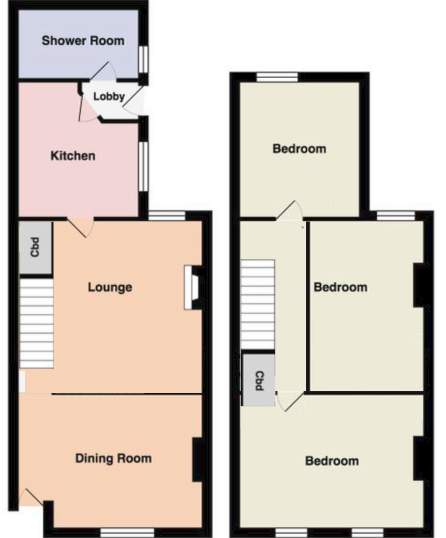
The downside to flipping the stairs 180° is that, although the dimensions of the dining room (or lounge) remain the same, you loose useful space as you'll have created a virtual corridor through the room, though you may prefer that to a real corridor upstairs. But, of course, you have to make compromises somewhere!
-
The perimeter of the heated envelope is the best place, in terms of minimising heat loss. Blocking it at both ends could lead to greater condensation (than otherwise) between the blockages. Buanderie wouldn't necessarily be mentioned - utility rooms (with a water supply) fall under the definition of salle d'eau - https://www.batiment-ventilation.fr/outils/faq/dans-larrete-de-mars-1982-quelle-est-la-difference-entre-une-salle-deau-et-une-salle-de-bains-105 (a room other than the kitchen or WC, equipped with a water supply, but without a bath or shower) I'm not an expert on the text (and don't have time to read it!), however it could be because you only tracked down part 1-1-2, or because my memory is wrong (since I have a VMC double-flux). For a more definitive view, polish off your French and ask at the forumconstruire (which comes up with this, and others: https://www.forumconstruire.com/construire/topic-395665-bouche-extraction-buanderie.php)
-
In France a laundry room does normally have mechanical extract fitted - I think the regs (DTU 68.3) require that - so I'd disable it and probably block the exit from the house in a reversible way, rather than strip everything out and seal it off permanently.
-
I agree that it's not required while you have that type of dryer.
-
Pre-Filter for Log Burner Smells
Mike replied to benben5555's topic in Mechanical Ventilation with Heat Recovery (MVHR)
The Paul/Zehnder ISO-BOX DN160 is much more affordable, as are the filters. Not sure if it's still sold in the UK though - got mine here: https://www.econology.fr/zehnder-comfosystems-caisson-filtrant-isobox-dn-160-filtre-a-pollen.html -
Rotate 90°, not 180:
-
More commonly kitchen or bathroom, but could be utility. You'll need to trace the duct or thread something along it if you want to know. Or test the airflow at the grille - that is, see if a piece of tissue paper 'sticks' to the grille when the fan is on, and falls off if you turn it off. Poor choice of material, in particular. Provided the duct & fan fit together then use either an aluminium foil HVAC tape or, since it won't be running at a high temperature, an airtightness tape such as Pro Clima Tescon Vana.
-
That's fine, and frequently done these days. Traditionally something like a 225 x 32mm length of timber would be sawn diagonally (in cross section) to create two feather-edge boards that would be nailed to the top of the rafters, fat edge to the centre, thin edge picking up the ends of the tile battens, which is the way I've always done it. Since you have plane tiles on the roof, personally I'd choose to use valley tiles, rather than GRP or lead for the valley.
-
Tarmac repair conundrum- edge meets gravel
Mike replied to Great_scot_selfbuild's topic in Driveways
To do it properly, add a kerb stone or brick edging along the full length, on a concrete bed and with haunching.