


Mike
-
Posts
1565 -
Joined
-
Last visited
-
Days Won
9
Everything posted by Mike
-
It's an extractor fan (with a 2-year warranty): http://www.panol.fr/product.php?productid=17793 And that tape is not good.
-
I can't see an easy solution either. You don't want anything that relies on a gravel board to keep the soil away - it will fill up over time - and a 100mm thick retaining wall 500mm high seems inadequate. Theremoblock insn't intended to be used as a wall and the internal ledge would look odd. I'd also not use cement board cladding that close to the boundary due to the difficulty/impossibility of future maintenance (it's not going to be easy to install it in the first place either); since the houses are brick I'd want a brick external leaf, at least on that side. As @G and J suggests, you'll likely need a structural engineer to come up with something that will work with your foundations. Better to take a pause now and get it right, than build something that could cause problems in the future, not least when you eventually want to sell it, even if you can get it past Building Control.
-
I agree with the sentiments above - be very wary. Best case is that the cracks are due to poor quality rendering, with re-rendering the solution. If it's entirely crack-free on the inside (and hasn't been freshly painted, and isn't wallpapered, and all other surfaces are sound, flat and appropriately level/vertical), and an SE spots no other significant issues, that may point towards it being mainly a rendering problem. However it's equally possible that there are cracks in in the bricks / blocks beneath, which could be for various reasons, needing anything from repairs to demolition & rebuilding. It seems that there's a filled crack in the older-looking render above the flood light. If that really is an older part of the building, rendered at a separate time to the extension(s), I'd certainly walk away (unless you know that it's not in an area susceptible to subsidence, and you buy with the intention of demolition & rebuilding, at the appropriate price for that). A rather minor point in the context, but that single air vent is inadequate if it's ventilating the floor void.
-
If pressure washing doesn't work, the next step up would be sandblasting. I'd not paint it.
-
MVHR Design: Feedback & Mythbusting
Mike replied to joshwk's topic in Mechanical Ventilation with Heat Recovery (MVHR)
To add a more rounded picture, MVHR isn't all about cost recovery / return on investment - the same as many kitchens and bathroom suites will never recover their investment. Apart from any cost savings (which can be real), if MVHR is properly specified an installed it can filter the outside air, maintain a healthy internal atmosphere, avoid noise transmission through trickle vents, reduce condensation & mould risk, and avoid blowing warm air out through rattling extractor fans. And probably some other things I've not thought of. As for air-tightness, the Building Regs standards are very unambitious. Passivhaus requires no more than 0.6 air changes per hour under 50pa of pressure, and values as low as 0.2 are possible. However that is only achievable if the architect designs-in adequate airtightness measures, if the various contractors and installers know what they're doing, and if someone is checking the quality of the work and materials used. -
Subsidence is a loaded word more commonly taken to mean the dropping of the ground, taking foundations wall and floor with it. If only a localised part the floor has moved that may be why the surveyor didn't want to use the term, even if it has, in linguistic terms, subsided. It could have been the tree. Or maybe poor compaction of the soil or hardcore beneath the floor slab. Maybe there was an old well / bomb shelter / tree root / something else just there. BTW, as I recall, there isn't much clay in Norfork, is there? It wouldn't hurt, and they're not unduly expensive. A structural engineer's survey of the building may be better though, if you want additional reassurance. That depends how keen you are to buy and how competitive the market is. It wasn't necessarily the tree... It's more a case of whether your surveyor has missed anything. If that's really the only fault, and building's been there since 1969, then I'd not worry that much, but my risk aversion may be different to yours. And, budget permitting, I'd be tempted to take up all the ground floors anyway, then insulate them and install underfloor heating.
-
10mm each way is often used. I prefer 15mm to make sure there's enough space to get a foam gun nozzle in.
-
'Moisture meters' don't measure moisture, they measure electrical resistance, so no comment on the specific figures. However the presence of the previously mentioned hygroscopic salts would no doubt account for the difference between the inside and the outside of the brick, since they would change the electrical conductivity/resistivity (and be mainly present on the inside). Yes, that does happen. I guess lime mortar would have been used, with as little lime as as the builders could get away with.
-
WC Frames back-to-back - possible?
Mike replied to Rick734's topic in Bathrooms, Ensuites & Wetrooms
Geberit make connectors for back-to-back WCs - https://catalog.geberit-global.com/en-NT/systems/CH3_102113/products. I guess others probably do too. -
There is, but below the roof (tiles) - so no scaffolding & no water-tightness to worry about.
-
Most difficult and expensive is removing the part above the roof. After that, it's normally easy if you have an aptitude for that sort of thing, and can live with the mess for a few days. But if skill and cash are limiting factors, then filing it as previously described is next best (preferably after sweeping it).
-
It does, however some condensation can occur in voids in cavity walls. In the case of a flue, its internal faces will be infused hygroscopic salts, which increases the condensation risk. Yes. But if you're going to do that, and already plan to replaster, why not just remove the flue, as I suggested in your other thread?
-
Open plan conversion - load bearing wall?
Mike replied to Jduncan's topic in General Structural Issues
+1. If it is a structural wall, you will also need Building Regulations approval. Another +1. It will also make the staircase feel enclosed, it's not good to have to walk through a kitchen to get to another room and there doesn't look much space for the kitchen island. As a minimum, more the kitchen to the garage side of the new room. +1. If do you open it up then you'll need to install a fire suppression system to comply with Building Regulations. -
A very good thought! I don't see why not, if you're happy with the appearance.
-
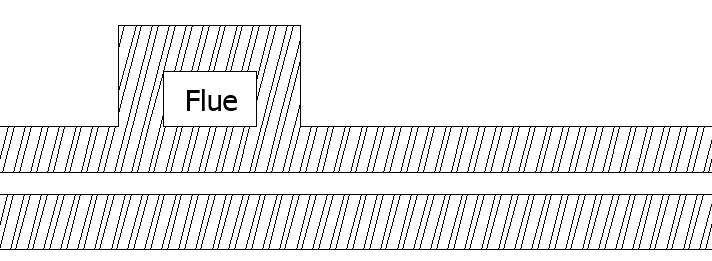
It depends what you've got. Conceptually I'd guess it's something like this, but presumably not so obvious - it could be in the corner of the room, an extension of an old upper floor chimney breast, etc. You'd need to compare measurements of the ground and upper floors and determine exactly where it goes. And drill a small hole & use an endoscope if necessary, as per @Jilly's suggestion. This It's not essential, but preferable if you never intend to use the flue again and can put up with the hassle. It permanently removes the risk of condensation and drafts, eliminates the chance of hygroscopic salts causing problems, and normally gives a little more usable floor space. As others have mentioned, the alternative is to seal the top (level with the upper floor ceiling and made fully airtight), put insulation over it, and seal the bottom. Fill the flue between with something insulating and non-hygroscopic - commonly EPS beads. Foam's not normally recommended, but if you choose to do so, consider the risks first. The top ones I can think of are that it could cause damage as it expands - for example if the structure is weak (minimised by leaving each can to expand before adding the next); it can flow through holes - into the cavity or elsewhere - and cause problems (EPS can do that too, but is more easily removed); and it can later shrink and leave a gap between the foam and the flue sides (so don't rely on it for airtightness - at least not regular foam).
-
All good advice. I'd add that if it looks as though any of the soot is loose / lightly attached, it would be worth sweeping the flues to remove what you can, since soot (and the brickwork) will contain hygroscopic salts that are likely to be contributing to the problem. Alternatively, as this is a cavity wall, presumably the flue projects into the room above? If so then an even better solution would be to remove it, eliminating the condensation risk. Then wire-brush the exposed inner leaf of the cavity (which presumably formed part of the flue), treat with SBR & render & skim it.
-
You could also swap the induction hob for a model that has built-in power management (which shares the power between the rings), if you don't have that already. These use 16 or 20 Amps, rather than the 32A of a regular hob. Of course things won't cook so fast if you have all rings running flat-out. Also consider a load-shedder (such as the Hager 60060), to temporarily cut the supply to a number of selected circuits if the total load approaches the maximum. However you need to be able to shed enough load - the immersion heater and washing machines could be cut without inconvenience, but probably not much else, but that may be enough. You'd need one in each consumer unit that has loads that you wish to shed.
-
The first problem thin joints is that they need a fine sand, rather than regular bricklaying sand. However a fine sand will weaken the mortar, and also take you outside the scope of the British Standards. Traditionally a mix of lime putty & (I think) silver sand would have been used, which would be a better bet than using cement, since it will absorb movement and self-heal, rather than crack. The second problem is a regular mortar bed can cope with deviations in brick size. As the joints become thinner, the bricks need to be more accurate as any deviations will be more apparent. Alternatively, you need to use traditional rubber bricks - which aren't made from rubber, but soft bricks that need to be individually rubbed / ground down to meet the tight tolerances required. I can't see why moisture levels would be a problem. Your best bet would be to ask Wienerberger. I'd guess that they either have a recommended mortar specification, or will sell a special one themselves, and that they will specify a suitable mortar joint thickness that suits the tolerance of their bricks. Through doing it the old way with lime putty would be an option, subject to convincing Building Control.
-
I've not kept track of all the arguments, but my impression is that (most of?) those that are still around are likely to be effective if installed properly. Personally I'd only consider one if there are no other viable options, if it had a BBA certificate, and as a top-up, not alone. In France, the recommendation is normally to use the multifoil on the inside, as a top-up below traditional insulation, to reduce the condensation risk. In contrast, the TLX-Gold information that you linked to has it below the tiles, above other insulation, though it does says that there must be a 'well sealed ceiling' to avoid condensation risk. Since making a ceiling vapour tight (and keeping it that way for the next few decades) is not easy, personally I'd use it beneath. Another argument against using it directly under the tiles is that it may get coated with dust, reducing it's effectiveness. Not done it, but rather than a bonding gutter you'd need to create a secret gutter at the lower level, create an abutment with timber with a flashing over the top, and end your tiles with a regular verge.
-
Can you use stainless steel screws with a Dewalt torque driver ?
Mike replied to Siadwell's topic in Garages & Workshops
Torque driver, or impact driver? I'd be cautious about using the latter, but may be OK if you dial it back - try on some scrap. -
+1. Nothing to worry about.
-
Floor joists: in blockwork, on masonry hangers or on ringbeam?
Mike replied to SBMS's topic in Brick & Block
Never had a problem with them - just make sure you fix the timbers to them with the square-twisted nails intended for the purpose (aka joist hanger nails). If you do reduce joist spacing, make sure you still have enough space for any pipes or the like that you need to fit between them. -
An interesting design making good use of the slope. But: I'd keep the space between hall and kitchen open I'd make the eternal entrance door outward-opening You need a thicker wall between house and garage to boost the insulation levels Where will you run the drain pipes from the pair of upstairs bedrooms? The staircase to those bedrooms, between the en-suite walls, will feel rather confined, compared to the openness of much of the rest of the house The living room isn't overly generous in size if all the 3 bedrooms will be occupied. It would make a better snug than the chair in the corner of the dining room I'd have a full-height wall between living room and the rest, to enhance that snugness, instead of half-height I'd skip the fireplace (not required in a modern house) and put the TV there instead There's not much space around the kitchen island; it will get in the way. Consider a U-shaped kitchen with breakfast bar, which will then also act as your room divider. The dining room - too big for a dinning room, too small to use as a living room. I'd push the right wall out another couple of meters to allow space for a dining room / lounge space, if you can. Pushing out that right wall would provide space on the floor above for a more generous stairwell. You need wardrobe space in the main bedroom - it may mean moving the skylights.
-
Manhole - Is it still in use or can I fill it?
Mike replied to ABillington's topic in General Self Build & DIY Discussion
It's not clear from the photo that this is for water, though I know you state that there's another nearby. In principle it could be some other service... -
And in addition to insulation, spend time tracking down all the air leaks and sealing them - it can make a big difference. But make sure that you have a proper controlled ventilation strategy too.

