Mike
-
Posts
1565 -
Joined
-
Last visited
-
Days Won
9
Everything posted by Mike
-
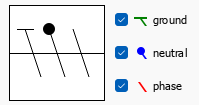
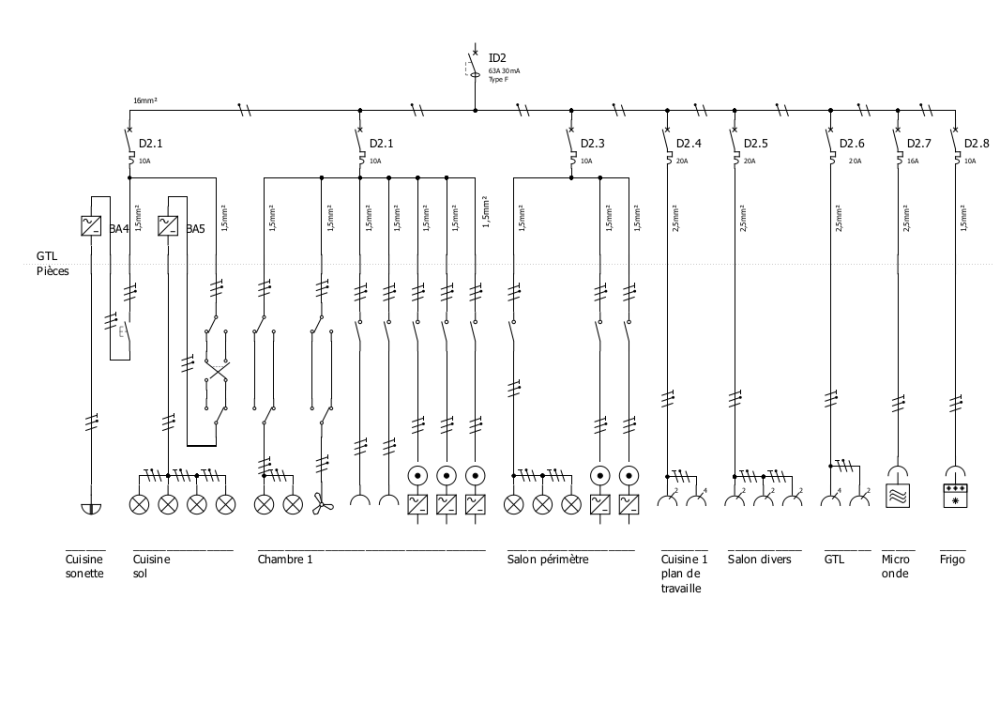
The neutrals & earths are there, but indicated rather than individually drawn: I don't think RCBOs would make it more busy (they would take the place of the breakers, marked D2.1, D2.2, etc.), but there would be some differences. A UK build using rings would normally be have fewer circuits, but with more on each. Radials are required in France and the number of outlets / points / devices per circuit is also limited limited - for example power circuits are limited to 6 / 8 / 12 outlets (where a double outlet counts as 2, not 1), depending on location and whether 1.5 or 2.5mm² wire is used. So, barring late changes, I'll have 28 circuits.
-
Only if open pipe 'gravity hot' and then cold mains the other side Must be the French rules clouding my memory :)
-
My understanding is the same as @JohnMo's - when mixing hot & cold you need single check valve. Regular cisterns have an air gap between the water inlet valve & the water level, which is fine. Double check valves for outside taps. Washing machines & dishwashers are required to have built-in valves, but nothing to stop you adding another.
-
Out of interest, in addition to the architectural electrical drawings mentioned above, in France you also need schematic electrical drawings. They're normally drawn by the electrical contractor as part of their contract. Without it the Electrical Inspectorate won't test the installation and, without their certificate, you don't get a mains connection. It's also used for subsequent maintenance. Example below for 1 row of my consumer unit (still in draft, which is why there's a duplicate D2.1):
-
Relaid patio now above some vents, water pooling... what to do?
Mike replied to TimD's topic in Landscaping, Decking & Patios
It's true that buildings without a DPC rely on moisture evaporating from the wall. However some height difference is needed between external ground level and internal floor level, so that enough moisture has evaporated before it reaches that floor level. If the floor is timber, then you also need ventilation beneath the floor, from one side to the other, to prevent excessive moisture build-up. If there's now a concrete floor with a DPM, that will block the evaporation towards the inside - in which case, unless the wall can evaporate the extra moisture to the outside, it's likely to cause problems on the inside above floor level, making that height difference even more important. In other words, sandstone can only deal it in the right conditions. So definitely a good idea to do some remedial works as suggested above. -
Vaporizing lead & paint with a laser seems like a very bad idea. Apart from protecting the operator, the vapour is going to condense and deposit lead & paint dust wherever air movement takes it - don't underestimate how dangerous that can be. You'd need to confine it using negative pressure & clean every surface afterwards using a vacuum with HEPA filters, for starters. See also: HSE: Control of lead at work If you're finding the stripping too much, there are specialist lead paint removal contractors out there with all the necessary gear. For doors and other items that can be removed, there are (or were) paint stripping services who submerge the object in a stripping tank.
-
I'd dispute pointless, but I would agree that they have limited powers & cash. The French equivalent (Municipal Council) has much more of both; if they did nothing, there would be a riot. They have responsibility for: planning permission & building permits (within National guidelines), land use (sometimes) preschools, elementary schools, after-school clubs (except for paying the teachers) community support (e.g. daycare for children, home care for the elderly, financial & other aid to those in need) local culture & heritage (e.g. libraries, museums, theatres, community centres, festivals, events) sport & recreation (sports grounds, swimming pools, gyms, supporting local clubs & associations) the environment (natural environment, public parks & gardens, maintaining local roads, regulating advertising) safety & public order (by-laws, public behaviour, municipal police, public health) water supply, sewerage, waste, recycling (though those may soon be moved up the chain) organising & running elections any and all other matters of local interest (unless the powers are allocated to another body)
-
A frustrating tale - I hope you get a good outcome. If you can get it sorted correctly for £54, that's a bargain*. Do let us know how it goes. *A 2026 EPC survey here in France found prices of €100-130 for a 30m² studio, to €300-400 for a house >200m², with discounts if combined with other mandatory surveys (and, I guess, extra to trawl through a big file). Prices went up by 15 to 20 % after the certificates became legally enforceable in 2021.
-
For aesthetics, why not put the light switches on the same axis as the sockets?
-
Insulation layer for shorter time constant?
Mike replied to Alan Ambrose's topic in Underfloor Heating
Not Rick, but no. MVHR doesn't shift enough air to make a big difference. Much better to open the window. -
Reminds me of Vestey Brothers - once the UK's biggest private company & the World's biggest meat business, best known in the UK for Dewhurt Butchers & Oxo. Although the brothers themselves were much wealthier than their near-contemporary John Sainsbury (2nd only to the Queen, allegedly), their attempt to get into supermarkets (Downsway) was a huge fail. Dewhurst (Union International) crashed in the 90's and most of what remained was sold off. The rump - now Vestey Holdings - had a turnover last year of £719 million, compared to Sainbury's £33 billion. BP's future, perhaps.
-
Insulation layer for shorter time constant?
Mike replied to Alan Ambrose's topic in Underfloor Heating
In that example, once the air temperature reaches the floor temperature (typically between 23 & 28°C), the floor is unable to release any more heat into the room. Not until the air in the room cools below floor temperature as a result of opening the window, when the draft will likely be enough to carry away the excess. -
+1. Some companies just can't adapt to change. See also: - British Airways sold their low-cost airline (Go) because they couldn't make it pay. Low-cost airlines now have around 50% of the European market - IBM sold their PC arm to Lenovo for the same reason - but PCs definitely haven't gone away
-
Insulation layer for shorter time constant?
Mike replied to Alan Ambrose's topic in Underfloor Heating
Only if you think that more rapid heating and cooling is good. In which case why not use radiators? -
I'd probably fit a horizontal MVHR unit in that space, but block the access from the bedroom, accessing it instead through trap(s) in a new bathroom ceiling. Unless I'd only just renovated the bathroom. dMVHR is certainly worth considering, but there are downsides too: You'd need to do some calculations to check the size - one option here. Good units are fairly quiet if run at less than 2/3 capacity. The list at https://database.passivehouse.com/en/components/list/ventilation_small includes the noise level and shows which are horizontal. These units are independently tested to more accurate standards than normal (a higher efficiency ratio = better economy). Other cheaper options exist.
-
Didn't look hard enough (though, in fairness, this was an 'ad-hoc single purpose subcommittee' of the full council): CC BY-SA 3.0 https://en.wikipedia.org/wiki/The_Burghers_of_Calais

-
SE refuses to spec beam with underplate
Mike replied to flanagaj's topic in RSJs, Lintels & Steelwork
I'd guess that there's a risk of the plate sagging and pulling the internal lintel over with it. The proposed solution seems entirely reasonable - SE's do tend to be very practical people. -
No, uPVC needs additional insulation of some kind to beat timber. Timber just starts off with an advantage, but can be enhanced too - for example with cork inserts or with foam insulation between the timber and an aluminium external shell. For examples of what can be done, see https://database.passivehouse.com/en/components/list/window However uPVC is often chosen as a cheap option and, as usual, you tend to get what you pay for.
-
Building Regs Part L gives a minimum requirement based on a hypothetical window size. However the standard just rules out the worst performers and is easily beaten by windows with a solid timber frame. It's also not very helpful unless your windows happen to be that size; windows with a lot of glass or a lot of frame would have a significantly different values. Which is why, for a proper comparison, it needs to be calculated per window using the manufacturer's data (some may calculate it for you): Uw = (Uf x Af + Ug x Ag + ψg x Lg) / ( Af + Ag ) where: Uf = frame U-value Af = frame area Ug = glass U-Value Ag = glass area ψg = Psi value (thermal bridging) of the glass-edge spacer* Lg = perimeter of the glass *I should have mentioned the importance of this - it's the spacer that keeps the 2 panes of glass apart. Cheap windows use aluminium spacers that are very conductive; good windows use low-conductivity plastics that significantly cut the condensation risk at the edge of the glass. For an illustration of what can go wrong, see this post:
-
Re uPVC windows in particular, I posted here about why I avoid them:
-
A key benefit of triple glazing is that the inside air temperature next to the glass will be a few degrees higher than it would be next to a similar double glazed unit. If you have underfloor heating, then the closer that temperature is to the target room temperature, the slower the convection currents are in the room. Which creates a more uniform temperature gradient from floor to ceiling, so you don't need the thermostat as high (which is where there's a cost saving). It also removes condensation risk even when temperatures drop well below zero. However, if you don't have UFCH then the first of these benefits goes 'out of the window' as you'll have significant convection currents anyway. And if you do have UFCH + well-specified double glazing (argon filled, low-e, good weather seals, well-insulated frame), then the temperature gradient can still be very good. In short, it's preferable to choose double glazing in a well-insulated frame, rather than a triple glazing in a standard / poorly insulated frame. Uw is the best guide for that.
-
Take a look at the numptys who failed to expand the National Grid to deliver the electricity to where's it's used: National Grid PLC. Fortunately their planning powers were stripped from them in 2024 and given to the new National Energy System Operator, owned by the Government. They are showing signs of being more competent in prioritising connections, at least: https://www.energynetworks.org/industry/connecting-to-the-networks/connections-reform
-
I've tried several and now mostly have Ezarc, which seem decent. Though probably made in China too.
-
For carbon-intensive goods, something similar is happening from Jan 1. The EU's version is already in place and could soon be expanded to other goods. Good recent update here: https://www.slrconsulting.com/insights/carbon-and-energy-newsletter-july-2026/
-
As of a couple of years ago, all local authorities in France have the powers to implement variable pricing schemes for water & sewerage if they wish. Unlike the UK, most of the water & sewerage infrastructure is municipally owned (though private companies are often given time-limited concessions to operate the networks). Some areas do nothing, some have progressive rates according to the m³ used, some have a 'free' allowance included with the standing charge then a m³ price above that, some pay subsidies for large families, etc. For electricity the most progressive feature is that the standing charge varies according to the Ampage you subscribe for (so UK-style 100A connections are rare). You also get to choose from over 50 providers, or EDF's regulated tariff (similar to the UK price cap). Not sure about variations in gas pricing (I had mine disconnected). For all fuels, those on modest incomes get sent an annual subsidy cheque to spend with their chosen provider too.