pudding
-
Posts
193 -
Joined
-
Last visited
-
Days Won
2
Everything posted by pudding
-
Heatmiser Neostat v2 temperature sensor problem
pudding replied to Ultima357's topic in Underfloor Heating
Would it be worth pestering and chasing up Heatmiser further for anything? From their initial response to me and others interactions, I'm not sure they'd be too willing to offer much/anything at all? -
Heatmiser Neostat v2 temperature sensor problem
pudding replied to Ultima357's topic in Underfloor Heating
I'll try and take one apart tomorrow when I'm back home from work and see if there's any obvious signs of bulging caps etc and post some pics. In the meantime, cheapest source of new ones would be good? Best ive found so far is £59.99 atm. -
Heatmiser Neostat v2 temperature sensor problem
pudding replied to Ultima357's topic in Underfloor Heating
Just to bump this topic back up as it seems most relevant to my issues. I've had 8 x V1 neostats installed for about 8 years now. About 3 months ago, 2 of them failed. The front part of the stat was fine, it was the rear backplate which had failed, I bought another 2 V2 stats, just used the backplates from them and put the V1 front plates back on in order to keep all of the room details/wifi bits. From reading this thread jut now I'm guessing it was the PSU that had failed. Then, this week yet another stat has failed, same thing! So after discovering this thread I'm guessing this issue with heat build up from the PSU (I calibrated my stats with the offset but never went as far as drilling extra vent holes etc), will eventually lead to failure of all of the stats? Or have I just been really unlucky? I emailed Heatmiser telling them of this 3rd stat failing withing a few months of each other and asked about possible solutions and if I should expect all my V1 stats to now fail, and simply got this reply - 'Hi xxxx, Although we understand your frustration your neostats have been powered up 24 hours a day for almost 8 years. Regards, xxxx' Obviously I'm pretty reluctant to keep buying more neostats if they're just going to fail again in a few years time and pretty pee'd off with the fob off dismissive email reply. Has anyone else had any complete PSU failures like me? Any alternatives, or should the V2's i'd now be buying as replacement be any better? -
Discount Offers of the Week
pudding replied to Ferdinand's topic in General Self Build & DIY Discussion
Anybody have any tips on deals or cheap sources for loft insulation. Looking for about 65m2 of loft rolls, 150/200mm thick I guess as I think there's only 100mm in between joists up there right now. Thanks. -
I had a Pyrex measuring jug explode a couple of months ago on me. It was next to the sink and I was holding and moving a glass cup over it towards the sink to get a drink, and I must've just clipped the top of it and it completely exploded and sounded like a gun shot! There was glass 3-4m across the kitchen. Scared the crap out of me and I stood there for a few secs in shock thinking WTF has just happened?
-
Radiators v Daikin Air Conditioning
pudding replied to Digger1's topic in Central Heating (Radiators)
I fitted 2 Daikin Emura units ( 1 in a dining room/1 in a study/spare bedroom) and 1 Stylish, unit in our extension a couple of years ago. The Emura unit in a spare bedroom is absolutely fine noise wise. The Emura units are the only heat source in those rooms and works great, only a gentle air flow comes through them and most of the time theyre only very slowly ticking over, you need to get close to feel and hear them. -
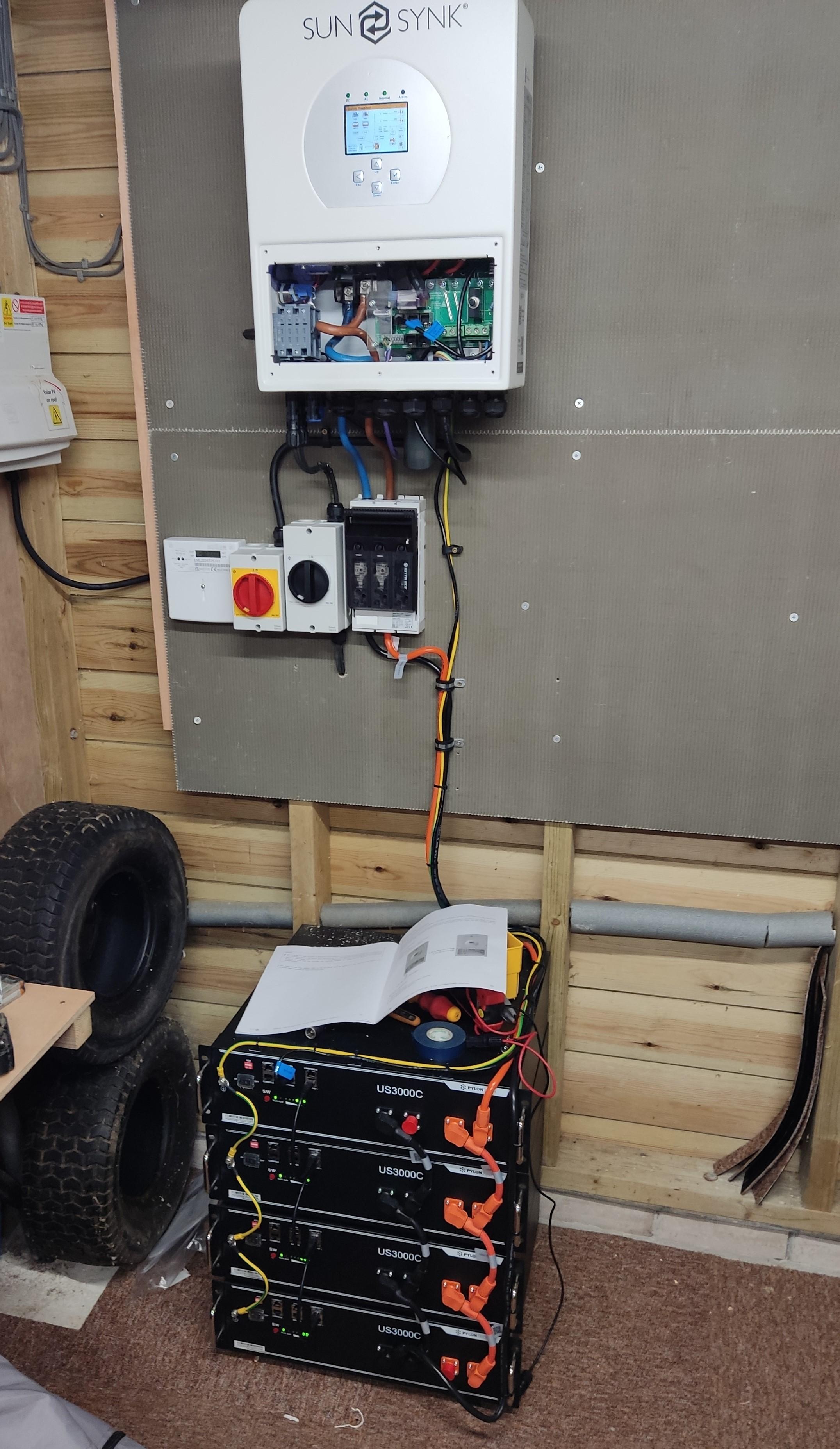
I had a pre-existing 4kWp array from 7years ago, and this year have added another 3.6kW Sunsynk hybrid inverter with 3.5kW more PV panels and 4x Pylontech US3000C batteries giving me 14kWh storage. The inverter uses a single CT clamp around the incoming mains grid supply, so that whenever export is detected, it will redirect and charge the batteries if needed, so it scoops up excess from the pre-existing array too; it doesnt care where the excess comes from.
-
To multisplit or not to multisplit
pudding replied to Radian's topic in Air Source Heat Pumps (ASHP)
As long as the outdoor unit is rated as large enough to satisfy the indoor unit demands, then the only negative of having 1 rather than 2 outdoor units is that you wont be able to have 1 indoor unit heating and 1 cooling, they both need to be operating in the same mode. Apart from that, nothing, should be an easier install only needing one power supply. I've got one outdoor Daikin unit feeding 3 indoor units, 2 x x2.5kw and one 3.5kW. All 2.5kW would have been fine but went with the 3.5kW as that was available in black. We would have been ok with 2kW units, and because of that the outdoor unit is only a 5/6kW (cant remember now) so we cant actually run all units full blast, but thats not a problem for us. There's a table in the Daikin manual that shows the combinations of outdoor and then number of different indoor units and what power you'd actually get from them. -
Any immersion heater on too for the heating in winter?
-
9k? For how big an array, sounds very expensive? Also, what's their heating source, electric or gas? I think without the FiT nowadays you definitely need batteries for self-use, otherwise it's too difficult to use enough of your own generation to really get your money's worth.
-
Thanks for the reply. Any chance you know if you've got the G100 cert for this Solis inverter, which I understand it needs for the G99 fast track? I've had a look online and cant find any? Also, any chance of a few pics? I'm planning on getting all of the same kit and self installing (seems fairly simply from initial reading of the manuals), with an electrician just making the connection from inverter to AC isolator and then to our garage consumer unit.
-
Any chance you can let me know where you bought the system from, as I'm looking at something exactly like this and these products? Did you install yourself of get an electrician or solar company to install? Also did you get G99 fast track approval for it or full on G99 application for the system from your DNO?
-
Aerogel if its gotta be thin and is a small area like just reveals?
-
Hi fi system and forums
pudding replied to SuperJohnG's topic in Networks, AV, Security & Automation
Got a link to the avf page? Also what budget? -
Aircon 1st fix
pudding replied to SuperPav's topic in Mechanical Ventilation with Heat Recovery (MVHR)
Yeah you can 1st fix this now, as its just plain copper tubing. Then the ends are flared to connect to the units. But, you need to know in advance exactly where on the wall the units are going and outside for the condensor unit, and where on the units the copper connects to, so you can either leave enough copper poking out or the wall and get any holes through walls in the right place. Don't need to worry right now about any cooling calcs, any units can be connected to the copper pipes, you just need to choose and manufacturer and unit to determine 15/22mm or whatever size pipes need pulling and bending. -
From that to this.....
pudding replied to ToughButterCup's topic in General Self Build & DIY Discussion
Before:- To this:- -
Yes, add probably at least 180mm+ for the roof joists.
-
Hi, thanks for the tips on this method of edging. I've got myself 4 x 6m lengths of 150x6mm steel now, and have cut a load of rebar I had lying around up ready to go and a brand new cheap MIG welder. Now, what would be the best way around to go ahead, either a) weld stakes to the flat plates before banging them in the ground, or b) bang the stakes in the ground first, then weld the flat plate. Method a is obviously going to be easier for the welding part of it, but we have pretty stony ground here, and I'm concerned it could become a pain in the bum trying to bang the stakes in already attached to the 6m length plate and hitting stones and rocks and not being able to move the stake and keeping them vertical and where I want them. Method b is better in regards to getting the stakes in the ground properly and in position, but then potentially a pain trying to weld next to the ground with less room to manoeuvre (first time welder here, never done it before ? ) So, what would the wise old heads on here do??
-
It's mounted on the wall brackets that are supplied with it. Not sure if I have a pic of it before I put the cladding around it. It's an A2A heat pump unit for the wall mounted air con units, if that makes any difference compared to the normal air source units discussed on here? (dont think it does/should.) It's a Daikin system I installed, and with the app you can see the power consumption for each wall mounted unit. So far (a whole 5 days with cladding/3days with slate roof on), there doesnt appear to be any noticeable change in the power used (obviously it's very weather/temp dependent, plus the units automatically sense if someone is in the room and doesnt top up the heat as often if nobody is there). Apart from increased power consumption, what issues would/could become evident?
-
I literally just finished doing exactly this, disguising my A2A external unit this week (plus radon outlet under there) and put the slates on this morning. Used left over cedar cladding and some old slates. Hopefully it won't kill the airflow too much. You can still feel a nice airflow coming through the vertical slats so dont think the COP is going to be killed from it. There are plenty of places selling stuff like this for a lot of money, so I doubt there's too much effect on performance.
-
I put this in my Rage mitre saw - https://www.screwfix.com/p/erbauer-tct-saw-blade-254-x-30mm-80t/4260v to cut some plaster-in aluminium profile. Worked a treat.
-
Hi all, Little conundrum here regarding our extension, and cold bridging involving a granite post that is under an existing, now internal full height window. The top of the granite is pretty much at the level of where new engineered oak floor boards will go. Options to cover this area I see are:- 1. Drill/grind/cut away at the granite to lower it 50-100mm, then we can put some more PIR sheet and then screed on top before the oak floor. 2. Cut away less, say 20mm of the granite so that the oak floor boards can just fit on top of the granite, maybe with some adhesive foam to fill any small gaps/undulation left from the cutting 3. Leave the granite as it is, put the oak floor boards up to the edge of the granite in line with the rest of the full length of the wall (PIR upstands are wonky and not aligned with the full length of the wall due to the random stone wall), and then use a oak cover board on top to fill the gap between the oak floor and the wall, with adhesive foam (so a small amount of insulating material) as in the attached sketch Last solution will be the easiest, but of course would probably have the biggest cold bridge to the ground, but will it really matter much? This granite is now fully internal, so shouldn't get freezing cold in winter. Any comments, or other possible solutions? Cheers.
-
Raise the rooflight upstand, add more insulation to the same height on top of joists so everything is flush. Then, have a step up from the existing door to the new higher level. You'll have one small area of the step where the insulation isn't up to the rest then?
-
What was the other name for that and where from if possible?
-
I did think about cutting the Iroko rather than the cladding battens. Could be a good reason to buy a table saw. I do have some builders doing the work, but am helping out here and there in between homeschooling and happy and would like to do this bit myself especially if its a good excuse to get another tool. With cutting the Iroko, on that internal corner, in order to get 50mm visible, it would mean getting oversize timber to cut down as the narrower cut down face would be facing outwards. How do you work that one out? Time for a scale drawing methinks, gonna be easier than trig. Last Q, decent table saw for a reasonable price for the job?