
Ed Davies
-
Posts
1674 -
Joined
-
Last visited
-
Days Won
1
Everything posted by Ed Davies
-
Dunno, but I suspect there might be certain mathematical elegance to having an even number. ?
-

Second hand solar panels
Ed Davies replied to Russell griffiths's topic in General Self Build & DIY Discussion
Short-circuit current would be more indicative. Meter on the 10 amp range. -
Planning permission or permitted development?
Ed Davies replied to Tom's topic in Planning Permission
OTOH, the uplift clause was presumably reflected in the original selling price. If not it's difficult to understand why the OP agreed to it. Other approaches might have been something like negotiating an option or just buying outright without the clause but they'd have likely resulted in a higher overall price. -
Second hand solar panels
Ed Davies replied to Russell griffiths's topic in General Self Build & DIY Discussion
There seem to be a lot of panels sold from solar farms which are upgrading. Bimble Solar have been around for quite a few years selling them on like this. Not quite as cheap but usually in better condition. -
Friend did an oak-frame extension (basically a one-bed house less the kitchen) on insulated beam and block (Hanson Jetfloor). Put the concrete, UFH and screed down before the oak frame was constructed, let alone the internal studs. His builder was very sceptical but after seeing it work did his own extension the same way. The only problem they had was a change of design to the stairs needed for compliance with some fire rules which resulted in the newel post moving to somewhere they weren't absolutely sure there wasn't a pipe. IIRC they were 90% sure of the positions but checked by turning the heating on and using an IR thermometer as it started to heat up. I think they just left the pipes a bit long where they came out of the screed and temporarily fixed the manifold to some bits of timber while the screed went down. Easy as the manifolds were in what was to become the glazed link to the old part of the house; would have been a bit more awkward if it was in the middle of the building.
-
So this all works financially, if a) the hardware keeps going for 7 years and doesn't need any expensive replacements and b) the RHI keeps going at this ridiculous rate for 7 years as well? That could happen, I suppose.
-
Obviously not from the point of view of complying with a particular set of rules for some reason (wanting a gold star or not to be subject to the threat of state-sponsored violence or whatever). But it's worth at least thinking about if there's ever to be anything better than Passivhaus, for example. I've seen that said a number of times but I'm sceptical. 50 pascals corresponds to the extra stagnation pressure from a wind of 8.84 m/s (19.77 mph). If that wind is blowing on to the upwind side of the house the downwind side will be at roughly -50 Pa so, very crudely, there'll be in an inflow on the upwind side equal to test conditions and an outflow on the downwind side of the same. Combine that with the ”Bernoulli suction” of the roof (acting like a wing with lower pressure over the top) and the practical infiltration rate is likely to be a lot more than 1/20th of the test number. For comparison, the wind so far this month at Wick airport (which I use as an proxy for the wind on my site) has averaged at 6.92 m/s (15.5 mph). Bearing in mind that the average of the squares is larger than the square of the averages it won't be far short of test conditions. Maybe that 1/20th is a reasonable average for the whole year but that's not very interesting; the average for the heating season would be more relevant.
-
In another thread: @JSHarris wrote: On reflection I'm beginning to think relating airtightness to floor area would make sense, which is probably why nobody does it. Ideally, it'd be done per person (m³/h/peep, or better l/s/peep) but you can't really determine the number of people who will occupy the house. Passivhaus does some other measures using finished-floor area as a proxy for the number of people, e.g., heat load, total heating and primary energy use. Apart from this tending to encourage larger houses with wasted space, I don't think it'd be completely mad to treat air leakage in the same way. Using air permeability (m³/m²·h, as per building regs in the UK) fails to penalise awkward shaped houses (e.g., long and thin) which leak more air for the same permeability and internal area just because they have a larger envelope area. Using AC/h fails to penalise unnecessarily large houses. Say you have a 10 m x 10 m bungalow with a room height of 2.4 metres, then the envelope area is 296 m². If the leakage is 1 m³/m²·h then that's 296 m³/h and the air change rate is 296/240 = 1.233 AC/h. If you increase the ceilings to 3 metres the envelope increases to 320 m² and so the air change rate becomes 320/300 = 1.0667 AC/h. I.e., better even though the house is actually leaking more air. I doubt this makes a huge difference in practice (other than it being very difficult to build tiny houses to Passivhaus standards) and there isn't really a single right answer I do think it's worth being aware of the tradeoffs between the different methods of measurement.
-
I'm pretty sure it's total external area, not just floor area, including walls and roof so it's a direct measurement of the quality of fabric. From: https://www.stromatech.com/building-performance-testing/air-tightness-testing/air-tightness-compliance/ It's a pain to have two systems in use. The rest of the world (including Passivhaus) uses air changes/hour (often written ACH or AC/h). The m³/m²/h and AC/h numbers are often similar which makes things even more confusing but there's not a direct conversion between them as the ratio depends on the size and shape of the house. For a given fabric leakage rate (m³/m²/h) and a given shape a larger house will have a lower AC/h rate than a smaller one. Obviously, houses aren't scaled up without changing their shape but this is one of a number of reasons why Passivhaus tends to be easier with large houses so encourages building bigger. It's one of the reasons I'm not 100% sold on Passivhaus in detail as opposed to in principle.
-
Ta. So how quickly after the switch triggers does hot water start coming out of the heat exchanger? It must take a non-zero amount of time for the primary circuit to get heat into the exchanger and then for the exchanger itself to warm up. Reason for asking is I'm thinking of a similar arrangement for preheat of water into a Sunamp. Maybe I'd prefer not to just use a coil in the buffer tank as there might be other heat sources (direct from solar thermal) which could be used. Not sure, rather depends on this sort of consideration. (And it sounds like the sort of thing the OP would like to consider, too.)
-
Does that pump run continuously or is it switched somehow? If switched, how? Flow switch on the DHW pipe? If switched then an additional advantage of a DHW coil in the TS is quick heat meaning less wait and water waste running cold through until hot appears at the tap.
-
Indeed, if it's just heating a 90 litre buffer tank (and that's not losing heat anywhere) then the return temperature ought to be ramping up quite quickly, in less than an hour. My return temperature question was on the assumption that it was heating the slab.
-
What's the return temperature and flow rate? The heat pump won't raise the temperature of the water that much in each cycle round. Picking one arbitrary (but reasonable sounding number) out of thin air, one circulation pump says it does 0.33 m³/h. That's 330 litres/hour = 5.5 litres (or 5.5 kg)/minute = 0.092 kg/s. The specific heat capacity of water is just under 4200 J/kg·K so it's capable of carrying away 386.4 J/s (= watts) for each kelvin (°C) of temperature rise. If your heat pump is putting in 5 kW then the temperature rise will be 5000/386.4 = 13 °C. If your flow rate is higher (might well be as that 0.33 m³/h is against the maximum allowed head, I think) then the temperature rise will be smaller.
-
I understand the conventional expression is “well hard”. Particularly applicable to boreholes in chalk.
-
Indeed, that's the solution if @Onoff does have that problem. I assume @Nickfromwales is trying determine, first, if he does have the problem or not.
-
Isn't another way to tell if it could do overrun to look at the wiring for the pump? If it comes off the boiler control board then it could be an overrun one so you have to do the experiment @Nickfromwales suggests. If the boiler controller doesn't have a pump output, so the pump's wired straight off the wiring centre, then I think it can't be an overrun one? The pump for the non-system (vented) oil boiler here is wired direct from the wiring centre (i.e., in series with the switched outputs of the zone valves and in parallel with the boiler itself) even though it's actually inside the boiler case.
-
This. People are so used to products which are only small incremental changes relative to existing technology and are sold to huge markets that they're largely shielded from how much of engineering is “suck-it-and-see” learning. It's difficult for small firms making products in relatively small quantities to sell into a consumer market to get the right balance between presenting it as for early-adopters and a mass-market product. Just to ramp up to decent production levels which have any hope of making money they're pressured to move to mass-market quickly but it's easy for that to backfire if there's any glitch along the way. I think there's a need to be a bit more nuanced about the continuum from science-fair project to high-street product both on the part of the sellers and in the minds of the buyers.
-
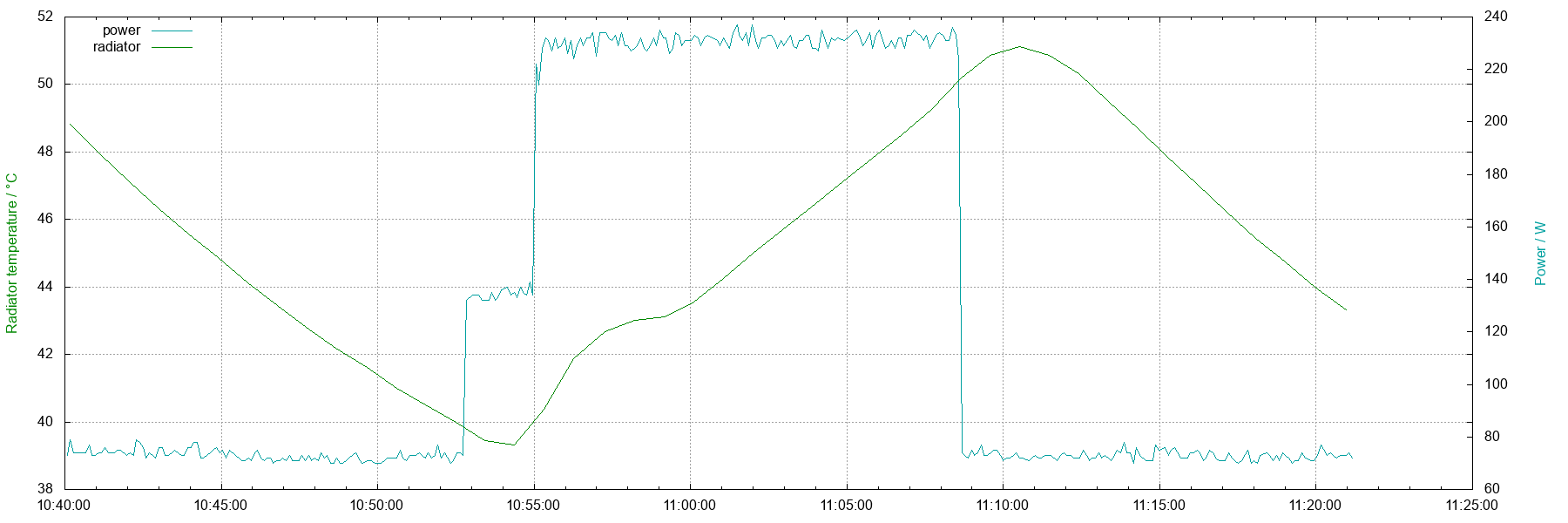
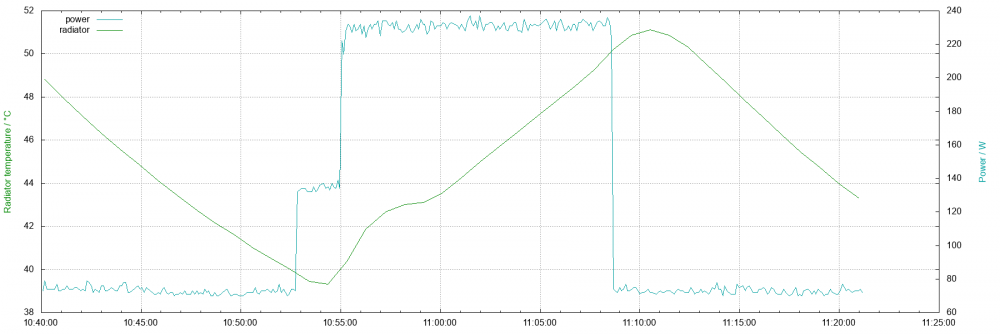
Pump keeps running for a few minutes after the boiler stops to make use of the heat remaining in the boiler. Otherwise it just goes to waste (e.g., for an outdoor boiler) or waits and gets used when the boiler next runs. E.g., for the oil boiler in the house I'm renting when the thermostat calls for heat the S-plan wiring sends power to the pump and boiler but the boiler is already hot enough from the last run so doesn't fire up for a minute or two. The thermostat called for heat at just before 10:53. The power consumption increased as the pump started. and about 1.5 minutes later the water got to the radiator in my study and its temperature started to increase and the temperature sensor there began to notice. At 10:55 enough hot water in the boiler had been replaced by cold that the boiler started up further increasing the power consumption. It'd be more efficient for this extra pump run to happen at the end of the cycle but that'd be a bit more complicated with simple S-plan wiring where just the valve-motor current goes through the thermostat. Problem is, if the boiler controller is controlling the pump and does the overrun but only gets a signal that the call for heat has ceased because the zone valves have closed it results in the pump pushing against closed valves.
-
Insulation between suspended timber floor renovation.
Ed Davies replied to Oz07's topic in Heat Insulation
Yes, but there are some which are marketed as completely waterproof (e.g., Protect A1) which it would be a bad move to use and it was worth clarifying as the OP didn't specify which sort of felt they had in mind. The polythene over the top is mostly for airtightness though as a VCL it'll be a small help rather than a hindrance. Remember that the bottom surface may not be that well ventilated. -
Insulation between suspended timber floor renovation.
Ed Davies replied to Oz07's topic in Heat Insulation
Quite a few people have done it using roofing felt as you suggest. Just to be clear, though, it needs to be a vapour permeable membrane type rather than fully watertight stuff used on some roofs. Obviously you need to make sure that you don't block any ventilation. The usual thing is to put a taped polythene sheet over the top of the joists to make the whole thing airtight and further reduce the water vapour migrating downwards before putting the floor deck back. -
My opinionated opinion: airtightness testing should be done before the insulation, let alone the plasterboard, is installed.
-
Seems sensible. Have just had a dig through my box of network cables and they seem to all be 568Bs, somewhat to my surprise as there was a mixture as I remembered it. (Well, apart from the coax network cable at the bottom ? ).
-
The snag is they don't go into the connector in pairs, the green and green/white pair have to be split either side of the blue and blue/white pair, which is what creates much of the problem in trying to hold the eight wires flat and in the right orientation to slide into the connector, IMHO. I was responding to: It would matter if you had, for example, orange/white on 1 and brown/white on 2, or anything else other than <colour>/white - <colour> (or <colour> - <colour>/white>) on each of 1-2, 3-6, 4-5 and 7-8. So if one end is mixing two pairs up then that's definitely the one to fix. For best performance you should consistently use either the 568A or 568B pairs along the length of any run (e.g, to a patch panel, through a patch lead, then to the other device) because the different colour pairs have different twist pitches to reduce cross-talk and so have slightly different transmission characteristics and changing along the way might increase reflections. I think that's only going to matter at very high speed along longish runs, though.
-
You really need to keep the pairs paired, at least. Personally, I've never bothered with crimping plugs on the end of cables. Rather, in the few places where I've wanted fixed cables I've always put a socket on the end then plugged in a short pre-made lead as required. A lot less stressful, I think.
-
Does Antifreeze make your heating quieter?
Ed Davies replied to ProDave's topic in Underfloor Heating
Could the noise have been the result of cavitation? Ethylene glycol has a much lower vapour pressure (at least at 20 °C) than water so would presumably be less susceptible to that. Or maybe it's a matter of the viscosity; perhaps making the pump turn slower. Dunno.