
Ed Davies
-
Posts
1674 -
Joined
-
Last visited
-
Days Won
1
Everything posted by Ed Davies
-
Makita ones would, though:
-
Are you sure? Anhydrous sodium acetate boils at about that temperature but the trihydrate form boils at 122 °C. It's the trihydrate which has a melting point of 58 °C whereas that of the anhydrous is 324 °C so I assume the base material is more like the trihydrate form. https://en.wikipedia.org/wiki/Sodium_acetate
-
No, I don't think it gets explody (I'd assume they have a PRV of some sort) but it does kill the goop (PCM) which would be a disappointment. This is part of why, for the DIY control system I have in mind, I'd only load it through the low-power hot-water exchanger. It's easy to use a TMV and/or a NC pipe stat to provide a backup overheat protection to make sure the hot water input never goes over the safe temperature. PRV - pressure relief valve. PCM - phase change material. TMV - thermostatic mixing valve. NC - normally closed.
-
What does “on demand” mean? Connection where BT hasn't already laid fibres in the road?
-
Did you ask Andrews and Arnold? They were very helpful with getting me connected in the house I'm currently renting when BT had put a stop, for a couple of months, on all new broadband requests while the exchange was being upgraded.
-
Thanks. Obviously “protected” has a wider meaning than I thought (which was that a tool was needed for access, like with the bonding rules). Do lofts count? I was assuming I'd have to trunk all the wiring for my RE stuff in the loft. Wouldn't mind too much with plastic trunking but doing it in metal would be a pain. Would metal cable trays there be suitable?
-
Under what circumstances do cables like those have to be trunked? I was under the impression that all cables except within specific wiring cupboards, etc, needed to be. Had the oil boiler here replaced a few months ago and the electrician used trunking in the kitchen boiler and the bedroom hot water tank cupboards (new thermostat on the HW tank as it was going from gravity fed to pumped) for all the wiring except the short flexes to the boiler and the pump and an earth wire which runs off somewhere which I think is exempt anyway. Doubt he'd have bothered if he didn't need to.
-
I've got one of those Grandstream 802s. Works fine on Sipgate but I haven't managed to get it to connect the other port to Ekiga yet, but then I can't get Ekiga's own software to connect to Ekiga either. Linphone connects to Ekiga OK, though. Weird. Do you get IPv6 connectivity? A static block of IPv6 addresses? Don't know what your use case is but maybe Pagekite is suitable. Basically, you run a program on one of your machines which sets up a TCP tunnel to their servers and they then relay incoming http://alphonsox.pagekit.com/, https, ssh, etc, connections back through the tunnel to your network.
-
I'd have nothing more to do with him. Allowing somebody to fix their mistakes is entirely reasonable. When they still get it wrong (and, maybe, lie about it - what's up with the supposed notification of building control?) it's time to just get somebody competent to inspect, document and, where required, fix. If you can reclaim the cost of that from the builder then great, otherwise at least the builder will know this guy is a liability, particularly if you can show him the documentation of the faults.
-
But he's already shown himself unable or unwilling to comply with the legal requirements. Those posting on here can only see what you provide photos of; from just those they can hardly reassure you that the final result is kosher so you'll need to get somebody else in to inspect it. So why bother with him? I think you're past the point to just cut your losses and go elsewhere.
-
Ah, useful to understand that you don't use the forecast in the control loop yet. Still, it's nice to have the option.
-
From what he said previously I think @TerryE's system looks at the forecast in working out how much heat to put in overnight. I think that, in general, projecting ahead like this is key to managing household energy efficiently. Most of the systems I see react only to the current conditions (e.g., the battery's nearly charged, start diverting to hot water) rather than looking ahead and making more balanced decisions (it's forecast to be sunny tomorrow and the battery's already half full which gives us plenty of energy for this evening and night so we can start heating hot water immediately). Obviously this sort of thing matters more if you have multiple variable sources and sinks for energy but even with quite simple systems it can make a difference. Sometimes the forecast will be wrong and you'll wind up using more energy than you could have (e.g., @TerryE's system doing a bit more heating in the afternoon or leaving the slab a bit warmer than it needed to be) but generally they're pretty good for at least 24 hours these days.
-
Surely there's some paper trail for the G3 certification?
-

The Great Thermal Mass Myth................
Ed Davies replied to Jeremy Harris's topic in Boffin's Corner
For the conventional definition of time constants used in mathematics, physics, electronics, etc, it comes out as simply the temperature difference between inside and outside divided by the rate of change of inside temperature. E.g., if the inside of the house is at 20 °C and the outside is at 10 °C and the inside temperature drops initially (when, say, the heating is turned off) at 0.2 °C/hour then the time constant is (20 - 10)/0.2 = 50 hours. That's the length of time the temperature would take to drop to the outside temperature if it continued downwards at the same rate as it started. Actually, of course, as the temperature difference decreases the rate of cooling will also decrease so it will curve out (following an exponential curve) getting closer and closer to the outside temperature but never (in a theoretical steady-state) quite reaching it. When the temperature has dropped to 15 °C the rate of cooling should have halved so the time constant is now (15 - 10)/0.1 = 50 hours. Yipee, the time constant is constant. After the time constant it should reach 1/e ~= 0.368 times the original difference. So, after 50 hours our example house should be at 13.68 °C.- 122 replies
-
- 3
-

-
- thermal mass
- heat capacity
- (and 4 more)
-
mvhr and minimal other heating
Ed Davies replied to scottishjohn's topic in Mechanical Ventilation with Heat Recovery (MVHR)
Ah, OK, you meant insulation outside the tank. I thought you meant the tank being outside the house. I meant the tank being inside the house (so all the heat leakage will contribute to the household heating). What? The specific (per unit mass) heat capacity of water is more than four times that of concrete. The volumetric heat capacity of water (per unit volume) is double that of concrete. OK, you can heat the concrete to many hundreds of °C whereas water goes elsewhere if you heat it above 100 °C at normal pressures but I don't think that's what you mean. -
Maybe it's carb icing ?
-
mvhr and minimal other heating
Ed Davies replied to scottishjohn's topic in Mechanical Ventilation with Heat Recovery (MVHR)
My nutty professor idea is a 10'000 litre tank reasonably well insulated on the inside. My primary heating will be leakage from the tank - I can even see myself removing insulation in, say, February to get a bit more heat out of it. More likely, run a few small radiators off it. To be determined in the light of practical experience. Primarily heated from solar thermal with maybe some spare energy from the PV going in there, particularly in bright weather in the autumn. -
mvhr and minimal other heating
Ed Davies replied to scottishjohn's topic in Mechanical Ventilation with Heat Recovery (MVHR)
AFAICS, Passivhaus and UFH are two quite separate issues: a Passivhaus should need very little heating to the point where UFH is not needed, after all the idea is that you can heat it just by heating the supply air from the MVHR so a couple of electric convector heaters or towel rails should do. In a way fitting UFH is an admission of lack of confidence. However, there are two reasons you might choose to use UFH. One is that it's a pleasant way to heat the house and likely reasonably efficient as its radiant heat probably allows a slightly lower indoor air temperature which will reduce the (already small) ventilation heat losses a bit. The other is that it's a good way of using the output of an ASHP as it allows the heat pump to operate at a much lower temperature than it would with, for example, radiators so it'll operate more efficiently. Whether it's worth having an ASHP purely for space heating in a Passivhaus is debatable (there are a few on here who choose to only heat with direct electrical resistance heating) but as you also need DHW it's much more likely worthwhile. Still not absolutely clear cut, though. AFAICS - as far as I can see. UFH - underfloor heating. MVHR - mechanical ventilation with heat recovery. ASHP - air source heat pump. DHW - domestic hot water. -
Is an outward-opening door always required or just when an inward-opening door would overlap the clear space required round the WC?
-
Electric Monitors (Sunamp related content!)
Ed Davies replied to Barney12's topic in Electrics - Other
Graph of my household power consumption during my shower last night. There was other consumption during the time, of course, but pretty negligible. It's a 7 kW electric, heating directly from the mains cold water. Integrating from 23:37 to 23:44 gives a total of 2556052 watt·seconds (joules) which converts to 0.71 kWh.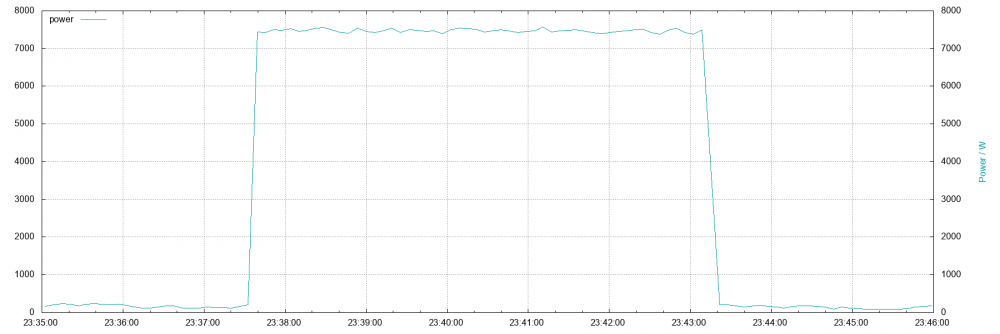
-
Electric Monitors (Sunamp related content!)
Ed Davies replied to Barney12's topic in Electrics - Other
That fits well with the usual assumption of 3 kWh/person/day for DHW. -
Yep, that's the sort of thing I was trying to visualize. Pressure from AB would help hold it in place perhaps whereas from A or B it would push it towards the central position. Can't see why it makes a difference whether it's on the flow or return side for that - either way the pump's pushing into a dead end, just one with a smaller volume if the stuck valve is on the flow side. That's assuming that the pump is just before the exchanger in the heat pump.
-
Sorry if this derails the thread a bit but I'm intrigued as to why (so emphatically) these valves mustn't be put in the return pipework. Is it just that the pressure in the wrong direction (from A or B to AB) would overcome the motor/spring?
-
It's Marley Eternit. It's dark red. Well, it was, it's now faded quite a bit. I can't help feeling that the shiny membranes are probably better for long exposure [¹]. On the gables I've used Protect TF200 Thermo which I've seen left exposed for quite a while on kit houses around here without apparent problems. Unfortunately, that's not approved for roofs for some reason (not least because I'll have most of a roll left over by the time I've finished the gables ? ). The first builders I approached to do the sarking, membrane and counter-battens recommended a particular membrane whose name I've now, unfortunately, forgotten (Redland something?) but it was heavier weight than the Eternit and shiny. When the first lot were too busy to quote I got the another lot in and they suggested this as the Marley equivalent but I'm not entirely convinced now. E.g., the other stuff said cover within 3-months whereas this says ASAP on the BBA cert. [¹] Not to mention helping a bit with insulation when the shiny side is facing a cavity.
-
My roof membrane has been exposed for most of a year. Even with the amount of UV here in the NE of the island it's not surprising that it's not very waterproof now. It's currently laid over sarking boards with 12x38 counter- battens running up and down the roof. Once the Velux windows are in I'll get 38x50 battens then a profile steel roof added. I'm considering various options like rip it off and start with a new membrane and new counter-battens but that would be tedious and also tend to damage the roof underneath (particularly if the current ring nails are pulled out). Therefore, another option I'm thinking of is just putting another layer of membrane over the existing membrane and counter-battens but under the battens. Probably with “stub” counter-battens between the battens to hold the new membrane down. The new membrane would need stapling down to keep it flat to the roof between the counter-battens. Since the old membrane is letting in so much water it's obvious it's not very liquid, let alone vapour, impermeable so there doesn't seem to be any risk of producing too much vapour resistance. Any thoughts on why this might be a silly idea?