Jeremy Harris
-
Posts
26430 -
Joined
-
Last visited
-
Days Won
360
Everything posted by Jeremy Harris
-
Our battens are just nailed through the membrane, it seals up around punctures very well, as it's pretty tough and tends to shrink tight around punctured holes, it seems.
-
There's been a great deal of extended life testing on this stuff, just as there is with all plastic membranes, like DPCs, airtightness membrane, external breather membrane etc. The stuff lasts many decades, and has been shown to, so is not a problem. I'd be far more concerned about the durability of other materials in the house, like the PVC insulation around the wiring, than I would about the airtightness tape, as the latter seems to have been the focus of a great deal of accelerated life testing. Ordinary polythene and PVC membranes are also likely to have a shorter life if they are exposed to movement, as both will become less flexible and more brittle with age. There are a lot of tapes that last for decades, with no failure of their adhesive at all. Years ago one of the places I worked at had a very large aluminium sheet ground plane, outdoors, for measuring antenna characteristics. It had been built at the end of WWII and all the joints between the sheets were sealed with heavy duty self-adhesive aluminium tape. 50 years of exposure to sun, rain, snow and frost hadn't caused any of that adhesive tape to fail, and we still had spare rolls from when it was built that were just as sticky as when they were new. If we had the technology to make very long-lasting adhesive tapes more than 60 years ago, then I can't see that we've managed to lose it somehow.
-
The other brightside is something my late father in law (a good friend) said to me around 20 years ago, not long after he retired from BA. He'd been surprised by how much his outgoings dropped when he retired. I didn't really believe it, but have found it's spot on. My gross "pay" dropped by around 48% when I took early retirement (at 58). However, my net income only dropped by around 33%, and that was pretty much balanced by reduced outgoings associated with work, so I ended up no worse off. Had I not been haemorrhaging money on the new build we'd have been in pretty much the same position as when I was working.
-
Great tip! I have a job to do replacing the battery in an iPad, and was not looking forward to prising the case apart, even though I have a set of tools to do it. I reckon a couple of bits Siga tape stuck either side should be a great help in separating the two halves of the case.
-
We've only once let a house, and both tenants were a total nightmare. I really don't know how people put up with the hassle of letting houses out, given the increased responsibilities on landlords and the risk that the tenants will trash the place, not pay their rent, etc etc. Our final tenant not only failed to pay the rent, but when we finally had him evicted he went around and smashed both toilets and the washbasins, and left the place with all the taps running. We had a local estate agent around when we were about to start the new build, as one option was to let our current house, rather than sell, mainly because houses weren't selling at all at the time. She seemed very optimistic that we'd get good tenants for around £600 to £700 a month, but frankly I just couldn't face going through the hassles we had years ago when we let a place.
-
Our pipes are on 200mm centres, cable tied to the steel fabric in the slab. Seems to be absolutely fine, as the water flow temperature is never very high and so the slab tends to be at an even temperature all over, with no cool or hot spots that we can notice.
-
Pretty much like any small single tank softener. It'll work OK, but you either have no water, or hard water, whilst it's regenerating, plus as Peter says it needs power, I think. The advantage of the Harvey and Kinetico designs (and they are similar and related - Harvey used to sell the Kinetico then designed his own) is that they have twin tanks, so can deliver softened water and regenerate at the same time. The single tank units cannot do this, so they are often set to regenerate overnight, when shutting the water off for a short time may not be a problem, or they just go to bypass when regenerating and feed hard water to the house. The supposed plus point of the Harvey design over the Kinetico is just the water meter. The Kinetico has a simpler, but less sensitive, water flow meter than the Harvey, and so is supposedly less able to detect low flow rates. Whether this is a significant issue or not I'm not sure, but Harvey make a fair bit of it in their advertising. Even if you're not interested in a Harvey (or one of the others that use the Harvey internals with their own case, like the TwinTec) it's worth looking at the Harvey YouTube videos, as they are generally pretty informative about softeners in general (just ignore the hard sell from Harvey!). I actually have two Harveys, one TwinTec and one Harvey (they are absolutely identical internally, just slightly different cases). I bought one as a brand new demo unit from a Harvey sales chap, and also bought a supposedly faulty brand new unit (a return) for £150. In fact both work perfectly, so I have a complete set of spares for the one that I have installed. I installed the Harvey in the TwinTec case, because as Peter says, the clear lid over the salt box is useful, so my spare unit looks exactly like a Harvey in every way, but in reality has a set of TwinTec tanks inside. I've stripped the spare unit down to check everything, and there really is very little in them that can't be easily repaired. Early units had a less than perfectly reliable fill valve, but that can be swapped out for the newer float valve that is much better, and the only other bits likely to ever need work might be the meter shaft O seals (I've heard these can start to leak after a few years, but it's a ten minute job to replace them, they are a standard size) and the ion exchange resin. The latter should last for years, unless you accidentally get too much chlorine in the water (not really a problem for mains water, except the water companies will sometimes disinfect pipes after work which can cause this to happen). Changing the resin is possible, but messy. It's not expensive, it's just a bit of a faff to remove the plugs and get the old resin out. Pouring new resin in should be easy enough with a funnel.
-
There are essentially three types of product aimed at scale reduction. The first is an ion exchange water softener that will prevent it completely by removing all calcium and magnesium ions in the water and replacing them with a lower level of sodium ions. All these softeners use the same principle, and the ones mentioned above are ion exchange softeners. The second type is the magnetic or electric coil (or sometimes some form of metal "catalyst") type that are claimed to change the charge of the magnesium and calcium ions and so reduce scale by preventing them from sticking to pipes, the kettle etc. I built one of these about 15 years ago, cost around £4 IIRC, and it works in so far as it does stop scale sticking to things. The big downside is that the scale just collects as powder in the kettle (and presumably unseen in the bottom of any hot water tank) and so you needs to flush the kettle out and never use the bottom inch or so of water in it, because it will be gritty with particles of precipitate. The third type is the phosphate dosing system, where phosphate is added to the water and helps to both precipitate out the calcium and magnesium and stops it sticking to surfaces, but the phosphate also makes the water "feel" a bit less hard. These units need regular (and fairly expensive) phosphate replacement. I believe that the Monarch Scaleout is either the second or third type. The "ceramic beads" may well be phosphate coated, or there may be some other magnesium and calcium ion charge change taking place. It's clear that, like the system we have in our current house, it does produce precipitate, as they warn of it in their brochure. As things stand, there is only one way of softening water, i.e. removing the magnesium and calcium ions that cause the problems, and that's an ion exchange softener. All of the other products on the market are not water softeners, do not remove the calcium and magnesium ions and vary from being outright snake oil to products that offer a limited benefit to pipework only, IMHO. Our softener (which is identical to the TwinTec - Harvey have licensed their twin tank system to two or three companies) was around £700, and based on current performance I think it will use around £50 to £70 a year in salt. The general view is that those with hard water can use around 50 to 100% more soaps and detergents per year than those with soft water, so the probability is that the thing will save more than its running cost per year.
-
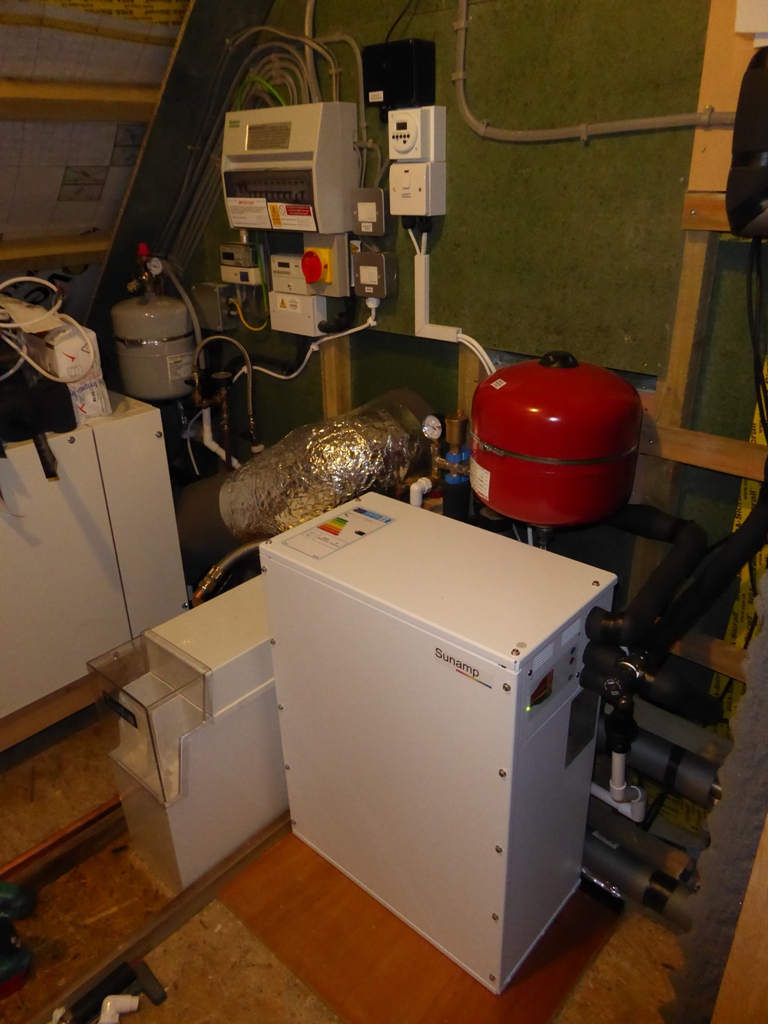
I looked around at loads of options and settled on a Harvey twin tank model. It's great, very clean and easy to use, takes block salt which is easy to handle, doesn't need an electrical supply and only uses 18 litres of water to regenerate, for 750 litres of softened water. It also doesn't stop delivering soft water during regeneration, as it has twin tanks that alternate, so the ten minute or so regeneration doesn't interfere with soft water delivery as the unit just uses the other tank. It's also small, and will fit into a kitchen cabinet if need be. The only thing to watch is the size of hoses fitted to it. Ours came with some long, large bore hoses, but they weren't going to fit where we wanted to install it, so I had to hunt around for some large bore (19mm bore) short flexible hoses to plumb it in. You do need to plumb it in with three full bore ball valves, so you can bypass it, and that may well make it a tight fit in a kitchen unit. Ours is installed in the service area, next to the Sunamp PV, and you can see it in this photo: It's the thing on the floor with the clear panel where the salt blocks go. I've found that buying salt blocks in bulk reduces the price a lot. I bought about a 2 year supply on a pallet delivery and they were around half the price some places charge.
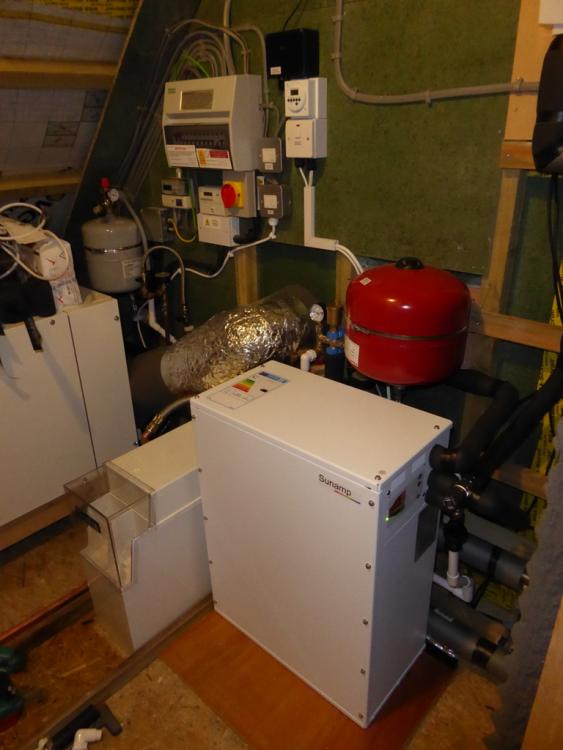
-
The problem with the news is that wherever you are in the UK whatever is newsworthy seems to be centred around London and the South East, with the possible exception of NI (we could only get NI TV when we lived in Portpatrick, and the news there rarely seemed to mention London, from what I saw of it). I think we discussed this particular problem of larger houses in Scotland on ebuild, and I'm damned sure that part of the problem is that many of the potential buyers for places that would make good B&Bs are from England, and following the Scottish Referendum uncertainty (which doesn't seem to have gone away - the Nats seem determined to have another go before long) a fair few of those potential buyers will be staying away until the dust has settled. Friends of ours who had B&Bs in D&G sold up before the referendum as they were concerned about the impact on house prices. That's an area where house price inflation has always been very low in the main, even when there have been big booms down South, but the flip side has been that there haven't been big crashes in house prices there either, so the referendum uncertainty seems to have created a big new risk that is holding buyers back, I'm sure.
-
That's good to know. In our case the trimming would be dead easy, as the Munster Ecoclad Plus glazing has a push-fit rubber trim fitted between the glass and the timber trim on the inside. If that is pulled out the film could be trimmed at the edge and then the trimmed edge hidden under the trim when it's re-fitted.
-
The point above about any house selling at the right price for a buyer is spot on, I think, painful as it is. We reconciled ourselves to selling our current house at a lower than average price before we started looking at self-build seriously, as the market was depressed and we knew we didn't want to stay here. In some ways we're fortunate, in that the market price of our current house is double what we paid for it in 2000, so even selling at below the estate agent market price won't be a loss. Also, I deliberately under-valued this house in terms of doing our sums on what we could afford to build, as when we started the market was still depressed and I felt we'd be lucky to get a quick sale. I've decided that I'm going to market the house using an online-only agent, to reduce costs, and I've been thinking of ways to incentivise the sale. The house is in the right sort of area to sell to either a second tier buyer on the way up or to older buyers looking to downsize and who want a bungalow. The village is OK and there are good public transport links here, with a bus stop only 50 yards away, a shop, post office, primary school and doctors surgery less than 300 yards away. The main problem is that I've virtually done no maintenance work at all on the house in the last 6 years, and over the past three years during our build it has been getting increasingly tatty. I debated whether it was worth re-decorating it but decided just to have the porch flat roof recovered and get the essentials done to sell, like the boiler servicing and safety check and a full EPC (it's not bad, came out at the bottom of band C). What I think we'll do is offer a "cash back and free access" deal after exchange of contracts, but before completion, where if the buyers make an acceptable offer we'll give them some cash under a separate arrangement (not part of the house purchase) to redecorate as they like, and give them day time access to do the work, with a nearby retired friend acting as daily key holder for us. My hope is that this might be enough to give the sale an edge over other properties on the market that need a bit of work doing. I'm sure we'll end up selling for £10k or so less than an agent would think reasonable, but we're just going to take the hit to sell the place and be able to concentrate wholly on the finishing touches to the new place (mainly landscaping and garden related stuff). We'll still end up with around £120k or so of savings returned, even selling at a low price, and frankly I'm not at all sure we really need much in the way of a savings buffer. It seems daft, but even with my fairly high monthly outgoings (small mortgage repayment, commuting 32 miles a day, spending a few hundred a month on stuff for the new house) I'm still saving around £400 a month from my pension, and once we've moved that level of monthly savings will increase a fair bit, as the running costs of the new house will be trivial compared to the one we're in now. It'll cause a bit of pain selling at a low price, but my view is that it will be around a couple of years worth of savings lost, and that seems to me to be worth it just to not have the hassle of a protracted sale process.
-
To answer some basics, the Sunamp is fine with pre-heated water. It delivers water at around 75 deg C when charged, and the amount of hot water you get out depends on the temperature that the Sunamp has to raise the water by. If you feed it with water at 30 deg C, say, and you set the Sunamp TMV to 45 deg C (the delivered DHW temperature) then it only has to raise the water from 30 deg C to 45 deg C, in effect, so will deliver twice as much hot water on a charge than if it was fed with water at 15 deg C. Our cold water comes in at around 8 deg C, all year around, but mains can vary from around 4 deg C to 8 deg C with the season, I believe, The thermal store thing is only a problem in this application because thermal stores are intended to operate at high temperatures, much higher than an ASHP could deliver. The design temperature for most is around 75 deg C, so with hot water coming out of the thermal store TMV at 45 deg C, and a 5 deg C temperature loss across the coil in the thermal store (perhaps a bit on the high side) then the thermal store can deliver hot water at a constant temperature to the DHW system until it cools down to below about 50 deg C, and then the temperature will start to drop. For pre-heat, then the thermal store temperature will start to drop immediately, as it's already below the DHW temperature, which is why a UVC would be a better bet. If I get time later I'll do some example calculations and perhaps a graph that illustrates how a low temperature UVC compares to a low temperature thermal store when used as a pre-heat system. Right now I keep popping in here as a break from sorting out hundreds of receipts and filling in our VAT reclaim...............................
-
I'm seriously considering this for our front gable, which provides a bit too much solar gain. I've been looking at the heat reflective film, the light grey one that still lets through a fair bit of light. I'm not sure how good this would be at preventing sun damage to furnishings, though, as I believe that's mainly caused by UV. Modern glazing seems pretty good at keeping out UV, from what I can see, but older stuff may not be. I'm still at the thinking about it stage, but have read the instructions on DIY installation and it doesn't look that difficult to do. I just hope that it's easier and neater than the DIY car window tint film. I remember using that very many years ago and it was a complete pain to apply neatly and even harder to remove after I'd decided it looked really naff.........
-
Using a low temp thermal store is sort of OK if you have the room for a large one, but because of the drop in delivery temperature from the instant you start drawing water through a thermal store, when compared with a UVC that will deliver a near-constant delivery temperature until nearly exhausted, I'd opt for a UVC with an immersion and use that immersion as a second solar dump and with a timer set to run once every couple of weeks as an anti-legionella system. You would only need around half the capacity if using a UVC, so lower losses, less capital cost and less space taken up. The problem is that all the water in a thermal store starts to reduce in temperature from the moment you start to draw water through it. A UVC doesn't behave like this, it allows you to draw off maybe two thirds to three quarters of the hot/warm water off at a near constant temperature before the temperature starts to reduce. This really makes a thermal store pretty useless if it is running at a temperature that is below the desired DHW temperature, as a pre-heat device. If I was designing our system from scratch (ours very much evolved during the build) then I'd have had a 200 litre indirect UVC pre-heated to 35 to 40 deg C by the ASHP and have that feed warm water to the Sunamp PV, or if that wasn't charged enough, to the 9.6kW inline water heater.
-
That tallies with my experience. I first bought a 16W rectangular light for the hall and that was great, very nice light output and no radio interference at all. I then bought some 3W and 6W round units from the same supplier and the radio interference from them was dreadful.
-
That's strange, as it was MCS approved when installed in our roof. Makes me wonder if they've changed the design; I seem to remember someone saying they no longer used the type of black anodised alloy panel clamps we have and had changed the way the upstands are arranged where the panel fastenings fit. Easyroof is near-identical, in fact we ordered Easyroof but it was out of stock when our guys came to install it, so there was a last-minute change to the GSE system.
-

PV Panels: Black with Silver Solder Lines OR All Black
Jeremy Harris replied to Barney12's topic in Photovoltaics (PV)
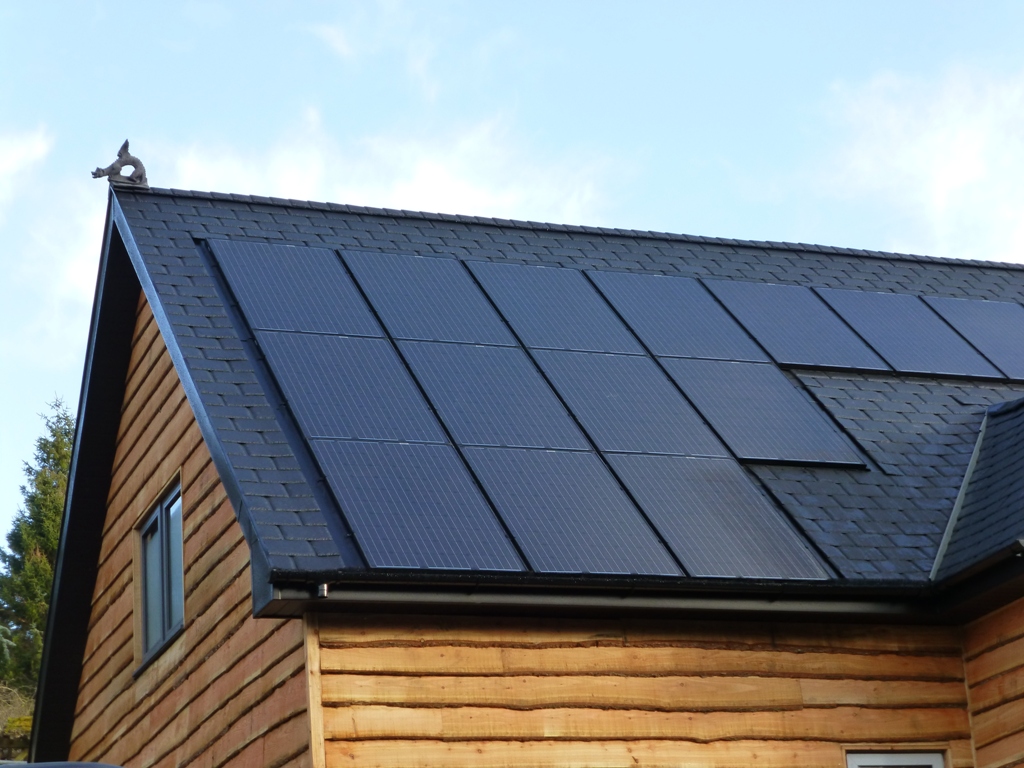
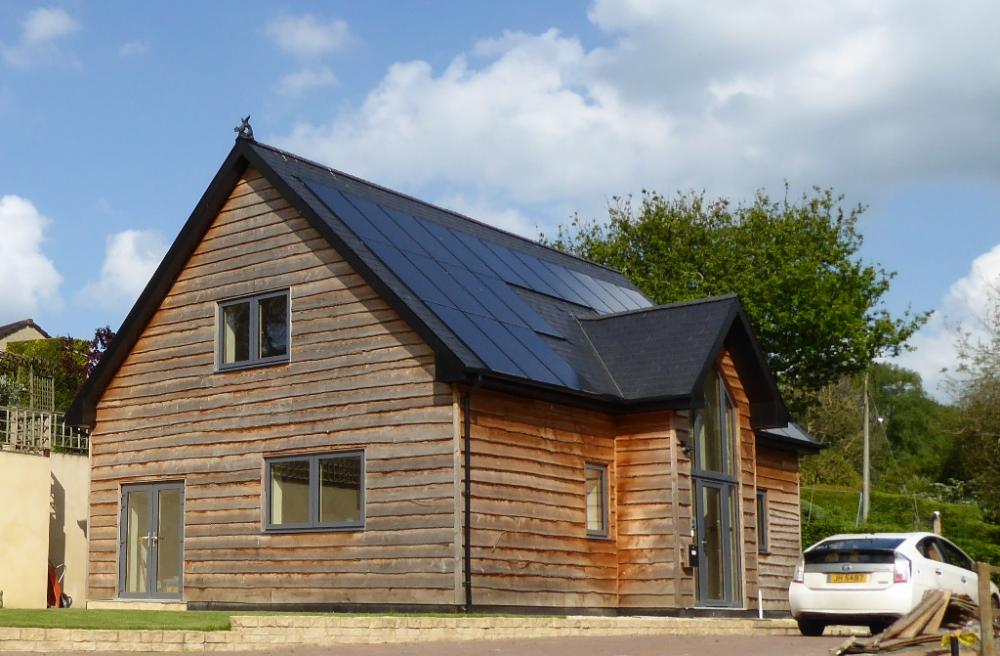
FWIW, you can't see the thin silver lines from ground level anyway. They are just visible in this zoomed in photo of our roof: but they aren't visible from ground level: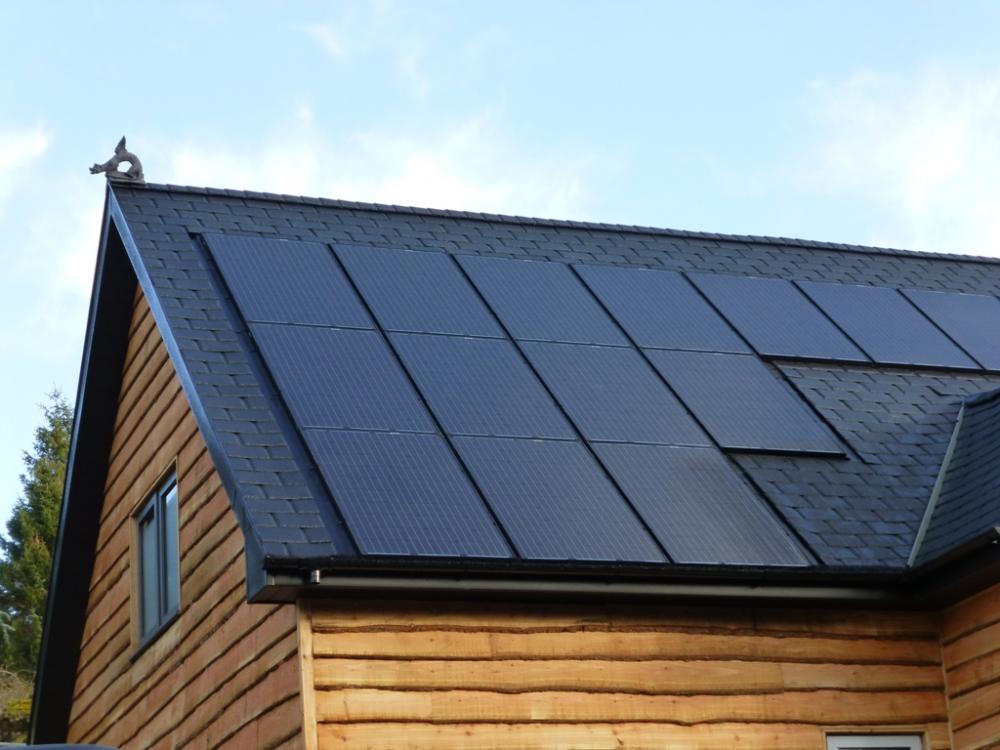
-
We looked closely at using thin film on to a raised seam metal roof, in fact that's what our original planning approval was for. We were forced to change to all-black in roof panels with slate because the thin film stuff was no longer available. I checked again recently, as I was thinking of using it along a covered walkway we're going to add to the side of the house, but it seems that it's still unavailable. I think that the main problem is that ordinary panels are so cheap that thin film systems, with their lower efficiency, can't compete and so aren't being promoted.
-
A Timber framed house with external wall insulation
Jeremy Harris replied to ProDave's topic in Timber Frame
There was a Grand Designs house a few years ago in Herefordshire had steico wood fibre fitted to SIPs and then rendered. This was the rather bizarre house built by Border Oak with a massive internal oak frame that didn't do anything but look nice! -
My experience has been that the thermo type with the remote sensor that is fitted inside a pocket in the flow manifold seems to allow very good control down to about 24 deg C flow temp, and just about work at 23 deg C flow. In practice I run it at around 24 to 25 deg C flow temp, as that seems to be a reasonable compromise. At that flow temp, with a 70 litre buffer tank at 35 deg C, fed from the ASHP, the UFH seems to be reasonably good at providing the small amount of heat needed in cold weather, but it's worth bearing in mind that even in the very coldest weather we've had over the past year or so I've never seen the UFH come on for more than about an hour or so in the morning, every two to three days. I think it very much depends on your set up and heating requirement as to which thermostatic valve will work best. When I was researching them the three port type were unable to control reliably below about 28 deg C, whereas the 2 port remote head ones seem to work very well at a much lower flow temperature. 28 deg C would have been too high for our system, I'm sure, as ideally I wanted to be able to deliver just a very small amount of heat to the floor, as the house is extremely sensitive to sudden heat inputs, and once it gets a bit too warm it takes a long time to cool down again.
-
The powerful LED strips need a lot of current and are very bright. Three across a 4m width seems more than adequate for me. I've found the best way to fix them is to paint or prime the surface, then stick on a length of 50mm wide aluminium tape (the stuff used to join insulation sheets), rub the aluminium tape down well and then stick the LED strip down the centre of the line of tape. This makes the LED strip adhere better and also seems to make the strip run a bit cooler, which in turn helps the self-adhesive backing stay fixed. For power supplies, I've used ventilated aluminium cased 12V supplies, wall mounted. The bright 5630 strip needs about 3A per 5m length at 12V, and I opted to use three 5A supplies, like these: http://www.ebay.co.uk/itm/12V-24V-IP67-Waterproof-LED-Transformer-Driver-Power-Supply-CCTV-240V-DC-2A-5A-/291663843407?var=&hash=item43e885104f:m:mp4HSAn6fw0MWK4ZUIErztg I ran lengths of 1.5mm² T&E cable above the ceiling to feed the far end of each strip (I've used the full 5m on each roll) joined to either end of the strip and then with single 1.5mm² T&E feeds running to the power supplies, inside a length of conduit where they come down the wall.
-
That's a good point for others to note. All attachments on ebuild are locked and inaccessible, so blogs or posts there that are read-only are hampered by not having photos and attachments accessible. It makes for a fair bit of extra work in finding the original files and copying them somewhere secure and accessible (either hosted on here, or on a secure file server and linked here)
-
I've had full structural surveys (not the pretty useless "housebuyers survey") done on three houses we've bought, but only because my employer was paying. Each time I went around with the surveyor and every report was comprehensive, pointing out a number of things I'd never have spotted, some minor, on one occasion some really major structural failings that were not at all obvious to me until they were pointed out (it was an old chapel conversion where the steel tie bars holding the side walls together had been removed, causing the walls to start to spread). That last survey also showed obvious things I'd already spotted, like all the blocked underfloor vents, the elevated ground level on one side which was around 2ft above the timber floor level inside and some roof failings (which turned out to be because of the walls spreading when the ties had been removed during the conversion). The chapel was the only one of the three we walked away from, only because the owners refused to negotiate on price in the light of the serious failings found. Knowing what I've learned from doing up two very old houses and having followed these surveyors around, I'd not hesitate to do a survey myself now. 25 years ago there's no way I'd have purchased a 200 year old house without a full structural survey.
-
Welcome, you're spot on about all the red tape, my experience has been that getting over the hurdles imposed by 1001 different rules, regulations and policies, particularly understanding whether or not they apply in the first place, was one of the hardest bits of the whole project. I'm inclined to think that the system has been deliberately designed to be a job creation scheme for all manner of consultants, assessors etc, none of whom add any value whatsoever to your home, in any shape or form.